
API Management Market Outlook: Size, Share, Trends, Growth Analysis, Competitive Landscape & Forecast, 2026-2033

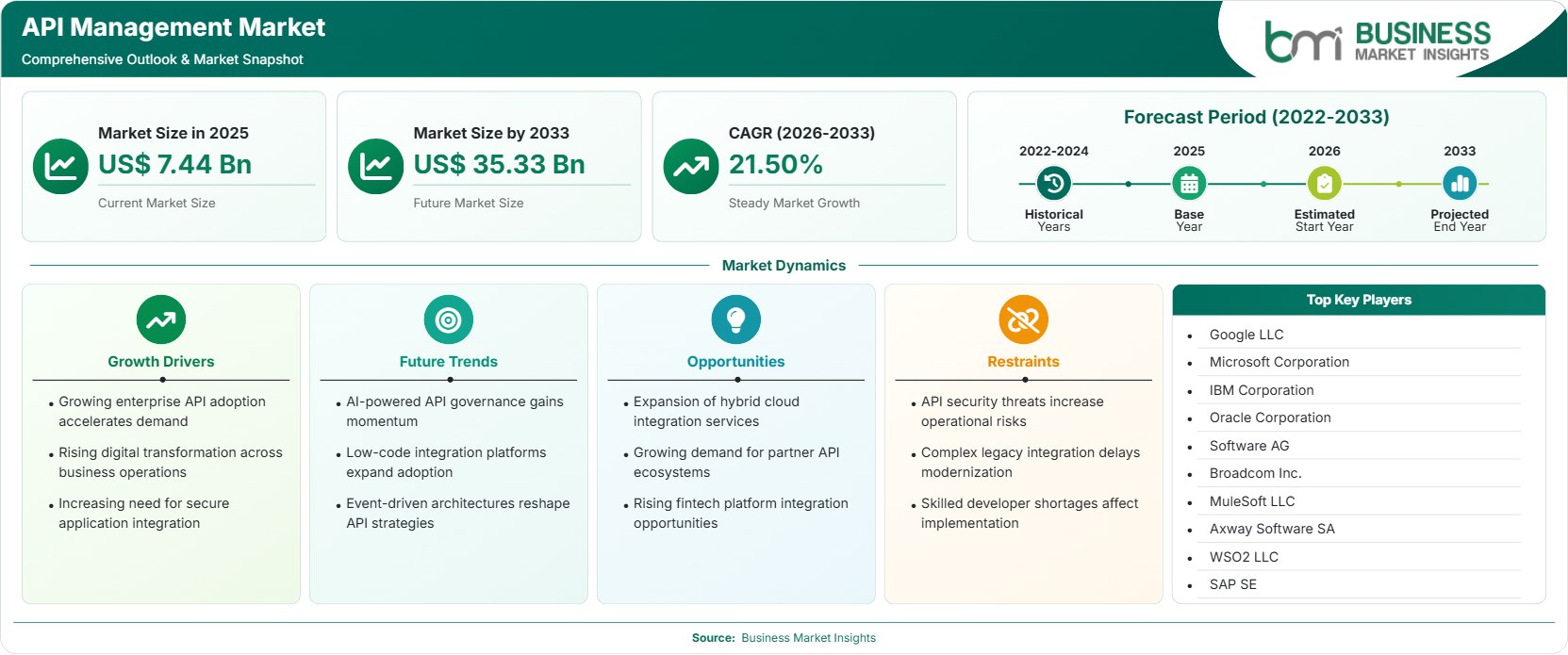
The API Management Market size was valued at US$ 7.44 billion in 2025 and is projected to reach US$ 35.33 billion by 2033, growing at a CAGR of 21.50% during 2026–2033. Growing enterprise API adoption, accelerating digital transformation initiatives, and increasing demand for secure application integration continue driving sustained expansion across global industries.

Report Coverage
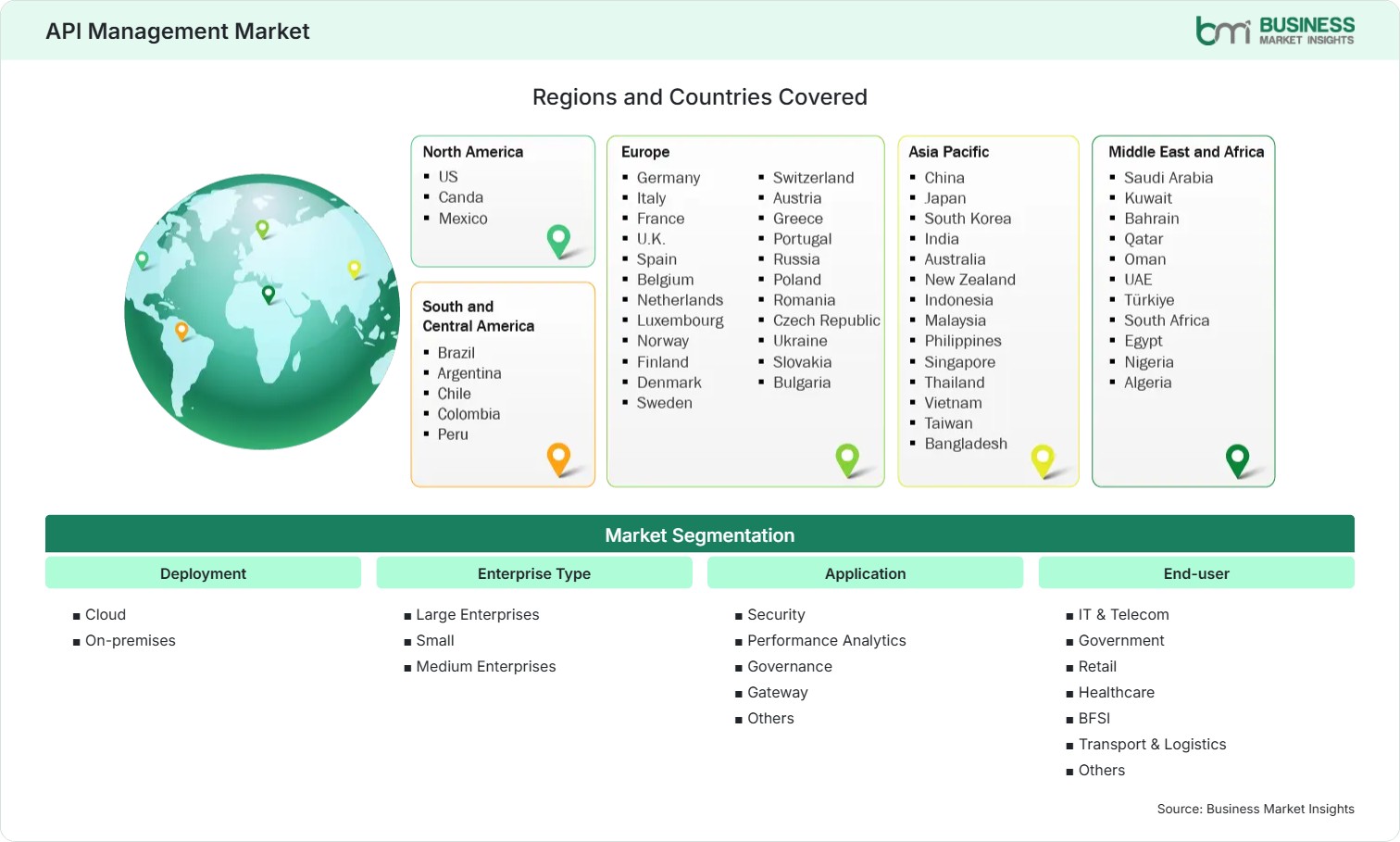
  • Deployment: Cloud, On-premises
  • Enterprise Type: Large Enterprises, Small, Medium Enterprises
  • Application: Security, Performance Analytics, Governance, Gateway, Others
  • End-user: IT & Telecom, Government, Retail, Healthcare, BFSI, Transport & Logistics, Others
US$ 7.44 Bn Market size in 2025
US$ 35.33 Bn Market Size by 2033
21.50% CAGR, 2026 - 2033
2026-2033 Forecast Period

AI Overview

API Management Market Summary

  • North America Region: North America accounts for 37%–40% market share in 2025 and is projected to expand at a CAGR of 20.8%–21.4% during 2026–2033. Strong cloud adoption, enterprise software modernization, and expanding digital ecosystems continue supporting regional leadership. The U.S. remains the dominant market with a CAGR of 21.0%–21.6%, driven by increasing investments in API security, cloud-native applications, and enterprise integration platforms.
  • Fastest Growing Region: Asia Pacific represents 25%–28% market share in 2025 and is expected to register a CAGR of 23.4%–24.1%, supported by rapid enterprise digitalization, expanding fintech ecosystems, growing cloud infrastructure, and increasing government investments in digital services.
  • Leading Segment: Cloud deployment accounts for 65%–68% market share in 2025 and is anticipated to grow at a CAGR of 22.1%–22.8%, driven by scalability, flexible deployment models, and increasing adoption of SaaS applications.
  • High Growth Segment: BFSI captures 24%–27% market share in 2025 and is projected to record a CAGR of 23.5%–24.2%, supported by open banking initiatives, digital payment expansion, and increasing demand for secure API connectivity.
  • Key Market Opportunity: Expanding hybrid cloud architectures, partner API ecosystems, and digital financial services continue creating strong opportunities for scalable API management platforms and integration technologies.
  • Major Market Players: Google LLC, Microsoft Corporation, IBM Corporation, Oracle Corporation, Software AG, Broadcom Inc., MuleSoft LLC, Axway Software SA, WSO2 LLC, and SAP SE.
Strategic Insights

API Management Market: Strategic Insights

API Management Market Strategic Framework
FREE PDF
Request your free sample
Request free sample
Stakeholder View

Key Takeaways

  • API management platforms have become critical components of enterprise digital ecosystems by enabling secure communication between cloud applications, internal systems, partners, and customers.
  • Financial institutions, healthcare providers, and government organizations continue representing high-value customers due to increasing requirements for secure data sharing and regulatory compliance.
  • Cloud-native deployment models remain the preferred approach because they simplify scalability, improve operational flexibility, and accelerate software delivery across distributed environments.
  • Asia Pacific presents the strongest long-term investment opportunity as enterprises accelerate digital transformation, fintech innovation, and cloud infrastructure deployment across emerging economies.
  • Strategic partnerships between cloud providers, software vendors, and integration platform developers continue strengthening enterprise API ecosystems worldwide.
  • Artificial intelligence, predictive analytics, and automated API monitoring are becoming key competitive differentiators for platform providers serving enterprise customers.
Geographic Outlook

API Management Market Regional Highlights

North America API Management Market

North America accounts for 37%–40% API Management Market share in 2025 and is expected to register a CAGR of 20.8%–21.4% during 2026–2033. The region benefits from mature cloud infrastructure, high enterprise software adoption, and increasing investments in cybersecurity and digital transformation. Organizations continue modernizing legacy systems while expanding API-driven integration strategies to improve operational efficiency and digital service delivery.

  • Strong enterprise cloud adoption continues accelerating API platform implementation across multiple industry verticals.
  • Financial institutions increasingly invest in secure API gateways supporting open banking and digital financial services.
  • Growing adoption of artificial intelligence strengthens demand for scalable API lifecycle management solutions.
  • Continuous software modernization initiatives encourage greater integration across hybrid cloud environments.

US API Management Market

The United States contributes 84%–87% of North American revenue and is projected to expand at a CAGR of 21.0%–21.6% through 2026–2033. Enterprise digitalization, cloud-native application development, and increasing API security investments continue driving strong platform adoption across public and private sectors.

  • Large enterprises continue expanding API-first software development strategies.
  • Cloud service providers strengthen enterprise integration capabilities through advanced API platforms.
  • Financial technology innovation supports increasing API usage across payment ecosystems.
  • Growing cybersecurity investments improve enterprise API governance and compliance capabilities.

Europe API Management Market

Europe represents 24%–27% market share in 2025 and is expected to register a CAGR of 20.2%–20.9% during the forecast period. Demand is supported by expanding cloud adoption, strict data protection regulations, and increasing digital transformation across public and private organizations. Germany remains the leading regional market, while the Netherlands records the fastest growth through increasing cloud platform investments.

  • GDPR compliance continues encouraging organizations to strengthen API governance and security frameworks.
  • Digital public services increase demand for standardized application integration platforms.
  • Manufacturing companies accelerate API deployment to support Industry 4.0 initiatives.
  • Enterprises continue investing in hybrid cloud infrastructure to improve operational flexibility.

Asia Pacific API Management Market

Asia Pacific holds 25%–28% market share in 2025 and is projected to record the fastest 23.4%–24.1% CAGR through 2026–2033. Rapid digitalization, expanding fintech ecosystems, growing cloud infrastructure, and increasing enterprise technology investments continue strengthening regional demand. China leads overall market revenue, while India records the fastest expansion driven by digital public infrastructure and cloud adoption.

  • Expanding digital payment ecosystems accelerate enterprise API deployment across financial services.
  • Government digital transformation initiatives strengthen enterprise cloud adoption.
  • Technology startups increasingly rely on API-first architectures to accelerate application development.
  • Rising cloud investments improve accessibility to enterprise integration platforms.

Rest of World API Management Market

The Rest of World region accounts for 8%–11% market share in 2025 and is projected to register a CAGR of 20.9%–21.5% during 2026–2033. Digital banking expansion, cloud migration, and public sector modernization continue creating new opportunities across Latin America, the Middle East, and Africa.

  • Brazil remains the leading Latin American market supported by fintech expansion and enterprise cloud adoption.
  • GCC countries continue investing in digital government platforms and smart city infrastructure.
  • Healthcare digitalization strengthens demand for secure API integration solutions.
  • Enterprises increasingly adopt hybrid cloud environments to modernize legacy business applications.
Global Market Geography
FREE PDF
Request your free sample
Request free sample
Segment Analysis

API Management Market Segmentation

Deployment

The deployment segment dominates the market as organizations prioritize scalable platforms capable of managing APIs across cloud-native and hybrid IT environments. It accounted for 65%–68% market share in 2025 and is expected to register a CAGR of 22.1%–22.8% during 2026–2033. Growing enterprise cloud migration, API lifecycle automation, and multi-cloud strategies continue expanding the API Management Market scope, enabling organizations to securely connect applications, services, and business partners.

  • Cloud: Leads the segment due to flexible deployment, lower infrastructure costs, simplified scalability, continuous software updates, and strong compatibility with microservices, DevOps practices, and cloud-native enterprise applications.
  • On-premises: Remains relevant among organizations requiring complete infrastructure control, strict regulatory compliance, enhanced data sovereignty, and secure deployment within highly regulated industries such as government and financial services.

Enterprise Type

Enterprise adoption continues expanding as organizations integrate APIs into digital business strategies and application modernization initiatives. This segment represented 69%–72% market share in 2025 and is projected to grow at a CAGR of 21.2%–21.8% during 2026–2033. Increasing API traffic, digital ecosystem expansion, and enterprise integration projects continue supporting investments across organizations of all sizes.

  • Large Enterprises: Account for the majority of platform deployments because they manage extensive application ecosystems, high API volumes, global operations, and complex digital transformation programs requiring centralized API governance.
  • Small & Medium Enterprises: Continue increasing adoption as cloud-based API management platforms become more affordable, enabling smaller organizations to improve application connectivity, customer engagement, and digital service delivery.

Application

Application diversity continues expanding as enterprises require comprehensive platforms supporting API security, governance, monitoring, and performance optimization. The segment accounted for 31%–34% market share in 2025 and is expected to register a CAGR of 22.4%–23.0% during 2026–2033. Current API Management Market trends indicate growing investments in intelligent API monitoring, automated governance, and real-time analytics to improve operational efficiency.

  • Security: Represents the leading application as organizations strengthen authentication, authorization, encryption, threat detection, and API access control to protect enterprise applications and sensitive business data.
  • Performance Analytics: Enables organizations to monitor API usage, response times, traffic patterns, and service availability, supporting continuous optimization of digital services and application performance.
  • Governance: Supports API lifecycle management, version control, policy enforcement, documentation, and regulatory compliance across enterprise application ecosystems.
  • Gateway: Functions as the primary interface for routing, authentication, rate limiting, traffic management, and secure communication between applications, users, and backend services.

End-user

Enterprise demand continues expanding across industries adopting API-driven business models to improve operational agility and digital customer experiences. The end-user segment accounted for 24%–27% market share in 2025 and is projected to register a CAGR of 23.5%–24.2% during 2026–2033. Increasing digital service delivery, cloud adoption, and application modernization continue strengthening API platform investments across diverse industry sectors.

  • IT & Telecom: Generates strong demand by supporting cloud services, network management, application integration, and digital platform development requiring secure and scalable API infrastructure.
  • Government: Public agencies increasingly deploy API management platforms to improve digital citizen services, interdepartmental data exchange, regulatory compliance, and secure public sector modernization.
  • Retail: Retailers utilize APIs to integrate e-commerce platforms, payment gateways, inventory systems, customer engagement applications, and omnichannel digital experiences.
  • Healthcare: Healthcare organizations adopt API platforms to securely exchange electronic health records, connect clinical applications, improve interoperability, and strengthen regulatory compliance.
  • BFSI: Records the fastest growth through open banking initiatives, digital payment ecosystems, embedded finance, fraud prevention, and secure financial application integration.
  • Transport & Logistics: Logistics companies leverage APIs to integrate fleet management, shipment tracking, warehouse systems, route optimization, and supply chain visibility platforms.
Market Forces

API Management Market Dynamics

Key Market Drivers

Growing enterprise API adoption accelerates demand

Organizations across sectors are adopting an API-first strategy to facilitate application integration, automation, and digital service delivery. APIs are critical in connecting cloud-based platforms, enterprise software, mobile applications, and third-party services into digital ecosystems. According to industry predictions, organizations are managing hundreds of thousands of APIs and the demand for managing them has increased. Vendors have continued to provide API management platforms with improved features such as automation and monitoring. These developments continue supporting API Management Market growth as enterprises expand digital business models and application ecosystems.

Rising digital transformation across business operations

Digital transformation initiatives remain a major catalyst for API management adoption as organizations modernize legacy infrastructure and accelerate cloud migration. Businesses are using APIs to facilitate real-time exchange of data among different business application, customer-facing systems, enterprise resource planning systems, and even the cloud environment. The rise in popularity of microservices architecture, DevOps approach, and containerization is increasing the complexity of integration within enterprises, which has led to the importance of API management platforms. In addition, businesses require more agility and fast deployments, and therefore continuously invest in advanced lifecycle API management systems.

Increasing need for secure application integration

The rapid expansion of connected applications has significantly increased enterprise focus on API security and governance. Companies need strong authentication, authorization, encryption, and traffic management systems to safeguard their business data against data breaches and cyberattacks. With regulations regarding data privacy becoming increasingly stringent, companies are bolstering API governance to communicate securely, whether they operate in the cloud or in-house. Modern API management solutions incorporate security features directly into the development process. These advancements continue shaping API Management Market trends, enabling organizations to securely scale digital services across increasingly complex technology ecosystems.

Key Market Opportunities

Expansion of hybrid cloud integration services

Hybrid cloud models are gaining popularity due to businesses adopting a combination of public and private clouds with on-premises infrastructure that enhances flexibility. The shift is creating greater demand for an API management system that ensures the safe integration of apps across different computing systems while adhering to the same set of governance rules. Vendors are coming up with integrated management solutions that allow multi-cloud orchestration and automation. API Management Market Forecasts indicate that continued enterprise investment in hybrid cloud infrastructure will create significant opportunities for providers offering scalable, interoperable, and security-focused API integration capabilities.

Growing demand for partner API ecosystems

Businesses increasingly collaborate with suppliers, distributors, developers, and technology partners through secure API ecosystems that enable seamless information exchange and digital service integration. The Partner API model facilitates innovation by enabling outside firms to gain access to selected capabilities of the organization while retaining central control over governance and access. Banks, retail firms, health care organizations, and technology companies are growing their digital ecosystems to enhance customer interactions and explore revenue possibilities. The API management firms whose offerings will make it easier to do business will be well positioned to succeed in this environment.

Rising fintech platform integration opportunities

Rapid expansion of digital payments, embedded finance, open banking, and financial technology platforms is creating substantial opportunities for API management providers. Financial organizations need secure and highly scalable APIs that can handle tasks such as real-time payment transactions, customer identification and authentication, fraud detection, and compliance. An API platform helps to facilitate connectivity between banks, payment processors, fintechs, and third-party application developers. Innovations within the financial services industry and cross-border payment networks will drive future growth in API management solutions.

Market Restraints and Challenges

API security threats increase operational risks

The growing number of publicly exposed APIs has expanded the cybersecurity attack surface for enterprises operating digital services. Factor: Weaknesses in authentication measures, incorrect configuration of APIs, granting of excessive permissions, and advancing cyber threats result in higher chances of unauthorized access, data leaks, and disruption of services. Impact: Companies are required to allocate considerable resources in terms of costs and complexity for API security testing, monitoring, encryption, and detection. Despite the constant improvement of in-built security features by vendors, this problem is still faced within the industry.

Complex legacy integration delays modernization

Many organizations continue operating legacy enterprise systems that were not originally designed for modern API-based connectivity. Factor: Integrating older applications with cloud-native platforms often requires extensive customization, middleware deployment, and application redesign before APIs can be implemented effectively. Impact: Longer implementation timelines, higher project costs, and increased technical complexity delay digital transformation initiatives while reducing operational agility. Enterprises are increasingly adopting phased modernization strategies and integration platforms to minimize disruption, although legacy infrastructure continues to remain a significant barrier to widespread API adoption.

Company Analysis

Competitive Landscape

Competition in the market is driven by cloud-native innovation, API security, lifecycle management capabilities, and integration with hybrid cloud environments. API Management Market analysis indicates that leading vendors are strengthening their platforms through artificial intelligence, automation, developer portals, analytics, and low-code integration capabilities. Strategic investments in API governance, zero-trust security, and multi-cloud deployment continue differentiating major providers across enterprise digital transformation initiatives.

Company Name

Overview

Products and Services Relevant to this Market

Google LLC

Global cloud technology provider offering enterprise API management solutions through its Google Cloud platform.

Apigee API Management, API gateway, developer portal, API analytics, API security, and cloud integration services.

Microsoft Corporation

Leading enterprise software company delivering cloud-based integration and API lifecycle management capabilities.

Azure API Management, Azure Integration Services, API gateway, developer tools, security, and monitoring solutions.

IBM Corporation

Enterprise technology provider specializing in hybrid cloud, integration, automation, and API lifecycle management.

IBM API Connect, API security, gateway services, developer portal, analytics, and hybrid cloud integration solutions.

Oracle Corporation

Global enterprise software company offering cloud infrastructure and enterprise integration technologies.

Oracle API Platform Cloud Service, API gateway, integration cloud, API governance, and developer management solutions.

Software AG

Enterprise software provider focused on digital integration, business transformation, and API management technologies.

webMethods API Management, API governance, integration platform, analytics, and hybrid integration services.

Broadcom Inc.

Technology company delivering enterprise infrastructure software and API security solutions.

Layer7 API Management, API gateway, identity management, API security, analytics, and policy enforcement solutions.

MuleSoft LLC

Salesforce subsidiary providing enterprise integration and API-led connectivity platforms for digital transformation.

Anypoint Platform, API Manager, API design tools, integration services, developer portal, and API monitoring.

Axway Software SA

Enterprise integration specialist delivering secure API management and business-to-business integration technologies.

Amplify API Management, API gateway, API marketplace, governance tools, analytics, and integration services.

WSO2 LLC

Open-source enterprise software provider specializing in API management, integration, and identity management platforms.

WSO2 API Manager, API gateway, identity management, integration platform, analytics, and developer portal solutions.

SAP SE

Global enterprise software provider integrating API management into its business technology ecosystem.

SAP Integration Suite, API Management, application integration, cloud connectivity, governance, and lifecycle management services.

Trust & Transparency

Research Methodology

The market analysis combines proprietary research with secondary data from government agencies, company disclosures, regulatory filings, industry databases and expert interviews. Market estimates are validated through data triangulation, cross-market benchmarking and analyst review.

View Full Research Methodology

Questions Answered

Frequently Asked Questions

What does the API Management Market Report include?

The Market Report provides comprehensive insights into market dynamics, regional performance, competitive landscape, technology trends, segmentation analysis, investment opportunities, and strategic developments influencing long-term industry growth.

Which end-user industry is expected to grow the fastest?

The BFSI sector is projected to record the fastest growth due to expanding open banking initiatives, digital payment platforms, embedded finance solutions, and increasing investments in secure financial application integration.

Why is API security becoming increasingly important?

Organizations exchange large volumes of sensitive business and customer data through APIs. Strong authentication, encryption, access control, and continuous monitoring help reduce cyber risks while ensuring regulatory compliance and secure application connectivity.

Which deployment model dominates the market?

Cloud deployment holds the largest market share because it offers scalability, lower infrastructure costs, simplified management, rapid implementation, and seamless integration with modern cloud-native applications and enterprise services.

What factors are driving the API Management Market?

The market is driven by increasing enterprise API adoption, expanding cloud migration, rapid digital transformation, growing microservices implementation, and rising demand for secure integration between enterprise applications, partners, and digital platforms.

Access the Full API Management Market Report

Get segment-level forecasts, regional estimates, competitive benchmarking, company profiles and downloadable Excel datasets.

Access the full API Management Market Report
350 pages PDF & Excel | 2026-08-25
Similar Research

Related Market Reports