
Asset Performance Management Market Outlook: Size, Share, Trends, Growth Analysis, Competitive Landscape & Forecast, 2022-2033

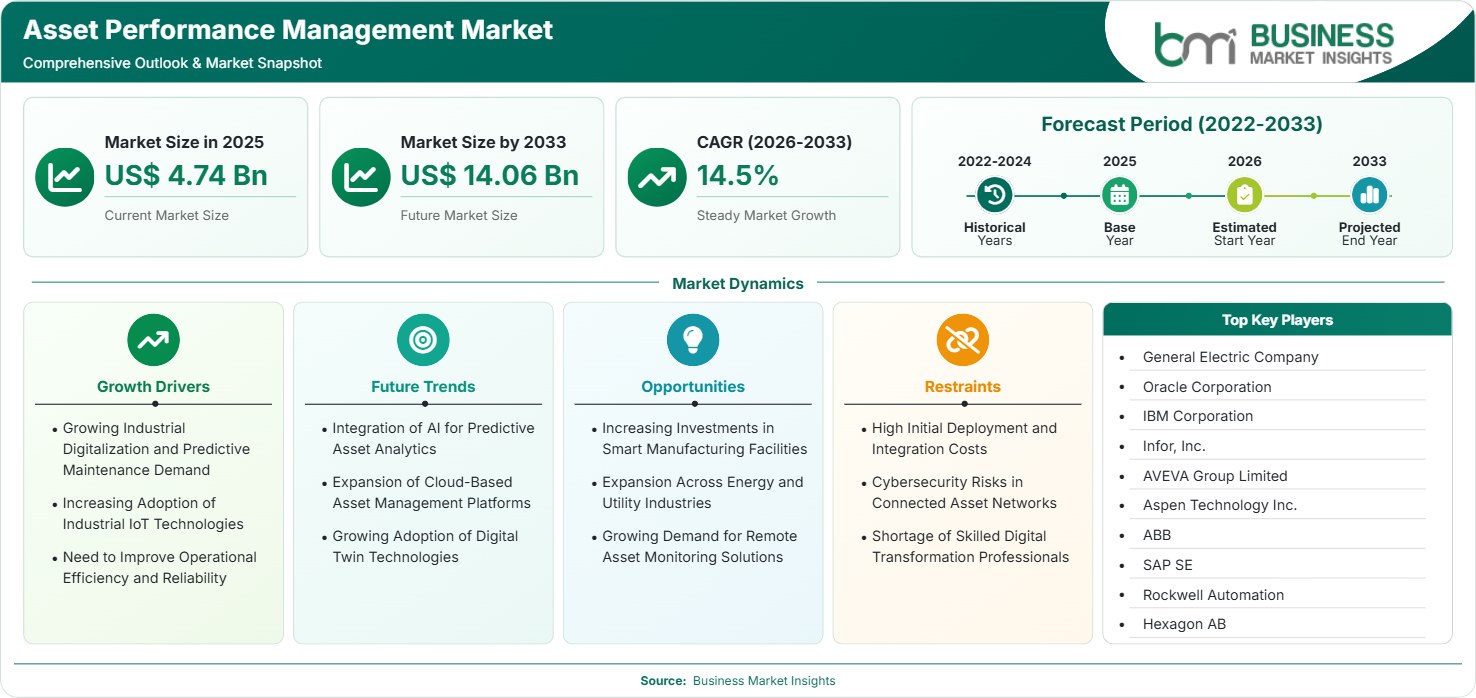
The Asset Performance Management Market size was valued at US$ 4.74 Billion in 2025 and is projected to reach US$ 14.06 Billion by 2033, growing at a CAGR of US$ 14.56% during 2026–2033, driven by predictive maintenance adoption, industrial automation expansion, digital transformation initiatives, and opportunities from connected asset ecosystems.

Report Coverage
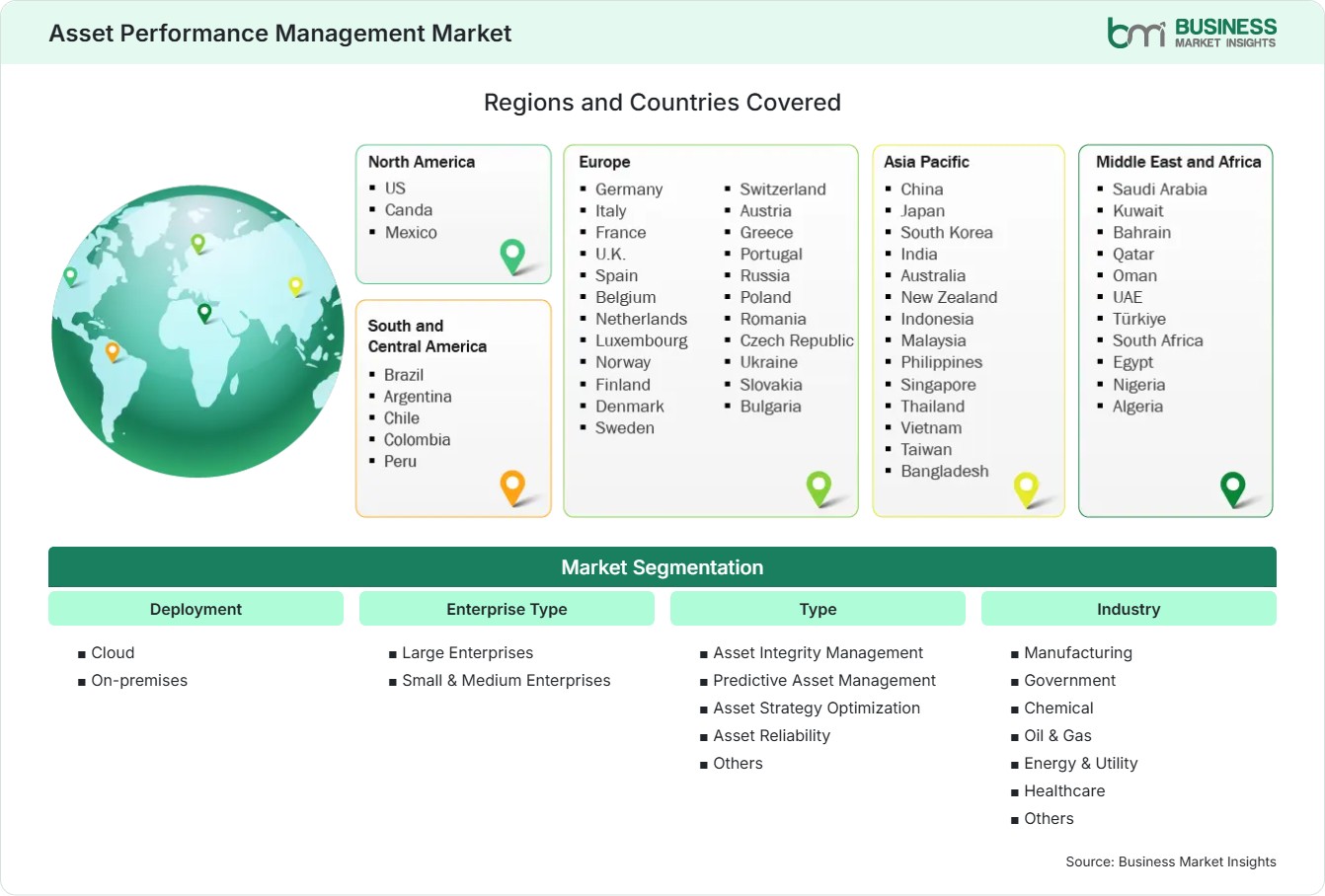
  • Deployment: Cloud, On-premises
  • Enterprise Type: Large Enterprises, Small & Medium Enterprises
  • Type: Asset Integrity Management, Predictive Asset Management, Asset Strategy Optimization, Asset Reliability, Others
  • Industry: Manufacturing, Government, Chemical, Oil & Gas, Energy & Utility, Healthcare, Others
US$ 4.74 Bn Market size in 2025
US$ 14.06 Bn Market Size by 2033
14.5% CAGR, 2026 - 2033
2026-2033 Forecast Period

01 AI Overview

Asset Performance Management Market Summary

  • North America Region: North America holds a 35%–38% share in 2025, growing with a CAGR of 13.8%–14.8% influenced by industrial digitalization, cloud adoption, and asset reliability investments. The US market maintains strong adoption across manufacturing and energy sectors, expanding at a CAGR of 14.0%–15.0% through 2033 due to advanced analytics deployment.
  • Fastest Growing Region: Asia Pacific holds a 28%–31% share in 2025, growing with a CAGR of 15.2%–16.2% supported by smart manufacturing expansion, infrastructure modernization, and industrial IoT investments across emerging economies.
  • Leading Segment: Cloud deployment holds a 55%–58% share in 2025, growing with a CAGR of 15.0%–16.0% driven by scalable infrastructure, remote monitoring capabilities, and lower maintenance complexity for industrial operators.
  • High Growth Segment: Predictive Asset Management holds a 30%–33% share in 2025, growing with a CAGR of 16.0%–17.0% supported by AI-based forecasting, machine learning applications, and demand for proactive equipment maintenance strategies.
  • Key Market Opportunity: Digital transformation programs, connected industrial assets, and AI-enabled analytics create opportunities for vendors to deliver integrated solutions that improve uptime, reduce failures, and optimize lifecycle performance across industries.
  • Major Market Players: General Electric Company, Oracle Corporation, IBM Corporation, Infor, Inc., AVEVA Group Limited, Aspen Technology, Inc., ABB Ltd., SAP SE, Rockwell Automation, Inc., Hexagon AB.
02 Strategic Insights

Asset Performance Management Market: Strategic Insights

asset-performance-management-market-market-strategic-framework
FREE PDF
Request your free sample
Request free sample
03 Stakeholder View

Key Takeaways

  • The market ecosystem is evolving from standalone maintenance software to integrated platforms that combine asset monitoring, analytics, enterprise resource planning connectivity, and operational intelligence, creating opportunities for technology vendors, industrial operators, and service providers.
  • High-value opportunities are emerging in predictive asset management applications, where organizations use machine learning models and sensor-based insights to anticipate equipment failures, optimize maintenance intervals, and improve asset utilization across manufacturing and energy environments.
  • Innovation priorities are shifting toward AI-powered diagnostics, digital twins, edge analytics, and automated decision support capabilities that enable industrial teams to analyze complex asset conditions and implement reliability improvements faster.
  • Asia Pacific presents an attractive investment landscape due to manufacturing expansion, infrastructure upgrades, and increasing adoption of industrial automation technologies in countries including China, India, Japan, and South Korea.
  • Market consolidation is being shaped by acquisitions, strategic alliances, and technology partnerships as established industrial software providers strengthen capabilities in analytics, cloud platforms, cybersecurity, and asset lifecycle management.
04 Geographic Outlook

Asset Performance Management Market Regional Highlights

North America Asset Performance Management Market

North America accounted for a 35%–38% share in 2025 and is projected to expand at a CAGR of 13.8%–14.8% from 2026–2033. The region benefits from mature industrial infrastructure, strong software adoption, and high investments in operational efficiency. The Asset Performance Management Market share remains concentrated in the US and Canada, where manufacturers and utilities prioritize predictive maintenance programs.

  • Industrial companies are adopting cloud-based monitoring platforms to improve equipment visibility, reduce downtime, and integrate operational data with enterprise applications.
  • The US remains the largest contributor, supported by manufacturing modernization, energy infrastructure upgrades, and increased deployment of artificial intelligence-based maintenance solutions.
  • Canada is witnessing adoption across mining, utilities, and energy sectors requiring improved asset reliability and remote monitoring capabilities.
  • Regulatory focus on safety, environmental compliance, and operational resilience continues encouraging investments in advanced asset management technologies.

US Asset Performance Management Market

The US market held a share of 29%–32% in 2025 and is projected to grow at a CAGR of 14.0%–15.0% from 2026 to 2033. The region is leading in implementation owing to the presence of highly automated industries, a software ecosystem, and digital transformation programs. Asset-intensive industries have been focusing on analytics-enabled maintenance strategies to improve productivity and operational resilience.

  • Manufacturing companies are integrating predictive analytics with production systems to minimize unexpected equipment failures and improve operational planning.
  • Energy operators are investing in digital monitoring solutions for power generation, transmission infrastructure, and renewable energy assets.
  • Aerospace, healthcare, and process industries are expanding adoption through reliability-centered maintenance programs and connected equipment strategies.
  • Enterprise technology investments continue supporting deployment of scalable cloud platforms and industrial data analytics capabilities.

Europe Asset Performance Management Market

Europe Asset Performance Management Market held a 24%–27% share in 2025 and is forecast to register a CAGR of 13.5%–14.5% between 2026–2033. Germany, the UK, and France represent leading markets due to industrial automation maturity, sustainability initiatives, and advanced manufacturing ecosystems. The region focuses on improving efficiency, reducing emissions, and extending asset lifecycles.

  • Germany demonstrates strong adoption through Industry 4.0 initiatives, automated factories, and manufacturing reliability programs.
  • The UK market benefits from energy modernization projects and increasing investments in infrastructure monitoring solutions.
  • France is expanding adoption across aerospace, utilities, and industrial sectors requiring advanced asset intelligence.
  • European sustainability regulations are encouraging organizations to optimize resource utilization and improve equipment efficiency.

Asia Pacific Asset Performance Management Market

Asia Pacific represented a 28%–31% share in 2025 and is expected to achieve a CAGR of 15.2%–16.2% through 2033, making it the fastest-growing region. China, India, Japan, and South Korea are key contributors due to industrial expansion, automation investments, and digital manufacturing initiatives. The Asset Performance Management Market growth is supported by the modernization of large asset bases.

  • China is expanding adoption through smart factory programs, industrial automation investments, and large-scale manufacturing digitization.
  • India is experiencing rising demand from energy, manufacturing, and infrastructure sectors implementing connected asset strategies.
  • Japan and South Korea are leveraging robotics, advanced analytics, and automation technologies to enhance industrial reliability.
  • Regional enterprises are increasingly adopting cloud solutions due to scalability, faster deployment, and reduced infrastructure requirements.

Rest of World Asset Performance Management Market

Rest of World Asset Performance Management Market accounted for a 9%–12% share in 2025 and is projected to grow at a CAGR of 12.5%–13.5% during 2026–2033. South and Central America are adopting solutions across mining, oil and gas, and utilities, while the Middle East and Africa are investing in industrial modernization. Brazil, Saudi Arabia, and the UAE represent important growth markets.

  • Brazil is increasing adoption through mining, energy, and manufacturing industries seeking improved equipment reliability and operational efficiency.
  • Middle Eastern countries are deploying digital asset solutions within energy projects and industrial diversification programs.
  • Saudi Arabia and UAE investments in infrastructure and energy transformation support advanced monitoring adoption.
  • African markets are gradually adopting solutions through utilities expansion, industrial development, and infrastructure improvement initiatives.
global-market-geography
FREE PDF
Request your free sample
Request free sample
05 Segment Analysis

Asset Performance Management Market Segmentation

Deployment

Deployment segmentation reflects the transition toward flexible digital infrastructure, with cloud solutions accounting for a 55%–58% share in 2025 and expanding at a CAGR of 15.0%–16.0% between 2026–2034. Organizations prefer scalable platforms, remote accessibility, and reduced infrastructure complexity. On-premises systems continue serving industries requiring strict data control, customized configurations, and established operational environments.

  • Cloud: Cloud deployment enables organizations to access scalable asset monitoring platforms, analytics capabilities, and remote collaboration tools. Adoption is increasing among enterprises seeking faster implementation, lower maintenance requirements, and improved operational flexibility.
  • On-premises: On-premises deployment remains relevant for industries requiring dedicated infrastructure, enhanced control over operational data, and customized integration with legacy industrial systems and enterprise applications.

Enterprise Type

Enterprise-type segmentation highlights distinct adoption patterns based on organizational scale, technology maturity, and investment capacity. Large enterprises accounted for a 65%–68% share in 2025 and are growing at a CAGR of 13.5%–14.5% between 2026–2034 due to complex asset networks. Small and medium enterprises are adopting affordable cloud-based solutions.

  • Large Enterprises: Large organizations deploy advanced platforms across multiple facilities to manage complex asset portfolios, improve reliability, and integrate operational intelligence with enterprise-level decision-making systems.
  • Small & Medium Enterprises: Small and medium enterprises increasingly adopt modular solutions that provide predictive capabilities, operational insights, and maintenance optimization without requiring extensive technology infrastructure investments.

Type

Type segmentation demonstrates increasing demand for specialized solutions addressing different asset lifecycle requirements. Predictive Asset Management represented a 30%–33% share in 2025 and is projected to grow at a CAGR of 16.0%–17.0% between 2026–2034. Organizations are prioritizing predictive analytics, equipment health monitoring, and reliability improvement strategies across industrial operations.

  • Asset Integrity Management: Asset integrity solutions support industries by monitoring equipment conditions, managing risks, and maintaining operational safety across critical infrastructure, including energy facilities and industrial plants.
  • Predictive Asset Management: Predictive asset solutions use artificial intelligence, machine learning, and sensor data to forecast failures, optimize maintenance schedules, and improve equipment availability across asset-intensive environments.
  • Asset Strategy Optimization: Asset strategy optimization helps organizations develop effective maintenance plans, prioritize investments, and balance operational performance with lifecycle cost considerations.
  • Asset Reliability: Asset reliability solutions focus on improving equipment performance, reducing failures, and increasing production continuity through structured maintenance practices and reliability engineering methodologies.

Industry

Industry segmentation reflects diverse adoption across asset-intensive sectors requiring improved efficiency, reliability, and operational visibility. Asset Performance Management Market manufacturing represented a leading application area with a 27%–30% share in 2025 and a CAGR of 14.0%–15.0% between 2026–2034. Industrial organizations are implementing digital maintenance strategies to optimize production assets and improve performance outcomes.

  • Manufacturing: Manufacturing companies adopt asset management platforms to improve production efficiency, minimize downtime, and support smart factory initiatives through connected equipment monitoring.
  • Government: Government organizations utilize solutions for infrastructure management, public utilities, and operational planning across critical assets requiring long-term performance optimization.
  • Chemical: Chemical industries deploy monitoring technologies to enhance safety, maintain process reliability, and optimize complex production equipment operating under demanding conditions.
  • Oil & Gas: Oil and gas companies use advanced asset management systems to monitor exploration, production, and processing assets while improving maintenance efficiency.
  • Energy & Utility: Energy and utility providers implement digital solutions to manage generation, transmission, and distribution assets while improving reliability and regulatory compliance.
  • Healthcare: Healthcare organizations apply asset management technologies to monitor medical equipment performance, improve availability, and support efficient facility operations.
06 Market Forces

Asset Performance Management Market Dynamics

Key Market Drivers

Growing Industrial Digitalization and Predictive Maintenance Demand

The growing use of digital industrial platforms is driving the Asset Performance Management Market trend, as organizations seek to gain benefits from improved reliability and maintenance efficiency. Manufacturing organizations and energy producers use sensors and analytics, as well as automated monitoring solutions, to adopt more efficient maintenance models. According to the International Energy Agency, digital solutions are becoming increasingly valuable for enhancing efficiency in energy systems. The market trend is driven by the need to understand asset condition and improve lifecycle management and productivity.

Increasing Adoption of Industrial IoT Technologies

The deployment of IoT applications in industrial settings is leading to higher demand for asset management solutions by ensuring the collection of real-time data through the connectivity of machinery, equipment, and infrastructural elements. Companies are implementing technologies such as smart sensors, edge computing, and cloud computing to enhance operational visibility. The growing number of connected devices facilitates the analysis of asset condition and service planning. The integration of IoT systems and software solutions leads to higher demand for solutions that combine monitoring, analytics, and workflow management.

Need to Improve Operational Efficiency and Reliability

Asset-intensive industries have increasingly focused on implementing reliability improvement programs due to rising operational costs, deteriorating facilities, and increased production needs. Corporations have begun using cutting-edge solutions to monitor equipment performance and eliminate surprises. The Asset Performance Management Market growth stems from growing interest in achieving greater output without proportional increases in operational costs. Asset-intensive industries such as manufacturing, utilities, and oil and gas have been employing reliability-related approaches to extend their assets' lifecycles and improve safety outcomes.

Key Market Opportunities

Increasing Investments in Smart Manufacturing Facilities

Opportunities for solution vendors arise as smart manufacturing adoption grows with the use of interconnected systems, automation, and intelligent maintenance operations within factories. Investments in digitized production environments are increasing the need for platforms that connect machine data to production decisions. The need for solutions that increase production rates, minimize downtimes, and optimize resource usage is high. Deployment opportunities will be especially high in facilities that modernize their old machines to become connected. The Asset Performance Management Market forecast suggests there are plenty of opportunities ahead for industrial companies.

Expansion Across Energy and Utility Industries

The transition to new energy sources and infrastructure upgrade projects are bringing new opportunities for advanced asset management tools across power generation, transmission, and distribution networks. Utility companies need better insight into the state of their aging infrastructure and the integration of renewable energy infrastructure with their current systems. The digital platform allows operators to track equipment condition and maintenance activities to improve reliability. New growth areas are available in renewable energy plants, grid infrastructure upgrades, and distributed energy infrastructure, where efficiency remains an important strategic objective.

Growing Demand for Remote Asset Monitoring Solutions

Remote monitoring is an asset that becomes increasingly beneficial due to the geographical spread of the company's resources and complex working conditions. With cloud-based solutions, service teams have access to data on asset performance, can conduct analysis, and can organize work without being physically present on site. This solution is gaining popularity in industries such as oil and gas, utilities, and transportation, as it helps reduce inspection costs and improve response time. With emerging technologies like AI analytics and digital twins, the decision-making process becomes better remotely.

Market Restraints and Challenges

High Initial Deployment and Integration Costs

Factor: High implementation costs for software deployment, sensor installation, system integration, and workforce training can limit adoption among cost-sensitive organizations. Impact: Small businesses and industries with limited budgets may be forced to delay investments or settle for partial systems rather than complete ones. Inability to integrate with existing technologies could complicate the process. It is important for an organization to look at the cost-benefits of an investment when making decisions. The solution to this problem has been provided by vendors.

Cybersecurity Risks in Connected Asset Networks

Factor: Increasing connectivity between industrial assets, cloud platforms, and enterprise systems creates additional cybersecurity vulnerabilities. Impact: Cybersecurity risks can limit implementation for companies that need to ensure security and regulatory compliance in their operations. Cybersecurity measures include implementing proper authentication mechanisms, network monitoring, and securing the connected environment. With the growing number of IoT devices, it becomes increasingly important for asset management software to include cybersecurity measures. Providers are building their products using features that will increase confidence and adoption rates.

07 Company Analysis

Competitive Landscape

The Asset Performance Management Market analysis highlights a competitive environment shaped by industrial technology leaders, enterprise software providers, and specialized asset reliability solution companies. Major players are differentiating through cloud-native platforms, artificial intelligence capabilities, industrial IoT integration, digital twins, and industry-specific solutions. Companies are strengthening market positions through partnerships, platform enhancements, and ecosystem expansion across manufacturing, energy, utilities, and process industries.

Company Name

Overview

Products and Services relevant to this market

General Electric Company

Global industrial technology provider offering digital solutions for asset-intensive industries and infrastructure operators.

Asset performance solutions, industrial analytics, predictive maintenance platforms, and digital twin technologies.

Oracle Corporation

Enterprise technology company providing cloud-based applications and industrial data management capabilities.

Oracle IoT applications, cloud infrastructure, analytics, and enterprise asset management solutions.

IBM Corporation

Technology and consulting organization delivering AI-driven industrial transformation solutions.

Maximo Application Suite, asset monitoring, predictive maintenance, and AI analytics services.

Infor, Inc.

Enterprise software provider focused on industry-specific operational management platforms.

Enterprise asset management software, maintenance optimization, and industrial workflow solutions.

AVEVA Group Limited

Industrial software company specializing in engineering and operational intelligence solutions.

Asset performance monitoring, industrial analytics, digital twin platforms, and lifecycle management tools.

Aspen Technology, Inc.

Industrial software provider serving process industries with optimization technologies.

Asset performance management software, predictive analytics, and process optimization solutions.

ABB Ltd.

Automation and electrification technology company supporting industrial digitalization.

Asset health monitoring, industrial automation systems, reliability solutions, and digital services.

SAP SE

Enterprise software provider offering integrated business and asset management applications.

SAP Asset Management, predictive maintenance applications, analytics, and cloud enterprise solutions.

Rockwell Automation, Inc.

Industrial automation company providing connected manufacturing and operational technologies.

FactoryTalk analytics, asset management platforms, industrial IoT solutions, and maintenance technologies.

Hexagon AB

Digital reality and industrial technology company delivering data-driven operational solutions.

Asset lifecycle intelligence, industrial analytics, digital twins, and operational optimization platforms.


10 Trust & Transparency

Research Methodology

The market analysis combines proprietary research with secondary data from government agencies, company disclosures, regulatory filings, industry databases and expert interviews. Market estimates are validated through data triangulation, cross-market benchmarking and analyst review.

View Full Research Methodology

11 Questions Answered

Frequently Asked Questions

How are companies addressing challenges related to implementation?

Organizations are adopting modular platforms, cloud deployment models, and phased implementation strategies to manage costs and integration complexity. Technology providers are also improving interoperability and cybersecurity capabilities to support broader adoption.

What role does artificial intelligence play in this Asset Performance Management Market Report?

Artificial intelligence improves failure prediction, anomaly detection, and maintenance planning by analyzing large volumes of operational data. AI capabilities help organizations transition from scheduled maintenance toward condition-based and predictive approaches.

Which industries benefit most from Asset Performance Management technologies?

Manufacturing, energy and utilities, oil and gas, chemical processing, and healthcare sectors benefit significantly because they operate complex assets where reliability, safety, and lifecycle optimization directly influence operational performance.

How do cloud platforms influence Asset Performance Management Market implementation?

Cloud platforms enable faster deployment, scalable infrastructure, remote accessibility, and easier integration with enterprise systems. They allow organizations to analyze asset information across locations while reducing dependence on complex internal IT infrastructure.

What factors are accelerating adoption of Asset Performance Management solutions?

Adoption is increasing due to industrial automation, connected asset deployment, predictive maintenance requirements, and demand for improved operational reliability. Organizations are investing in technologies that provide real-time insights, reduce downtime, and optimize maintenance decisions.

Access the Full Asset Performance Management Market Report

Get segment-level forecasts, regional estimates, competitive benchmarking, company profiles and downloadable Excel datasets.

Access the full Asset Performance Management Market Report
350 pages PDF & Excel | 2026-08-03