
Asset Finance Software Market Outlook: Size, Share, Trends, Growth Analysis, Competitive Landscape & Forecast, 2026-2033

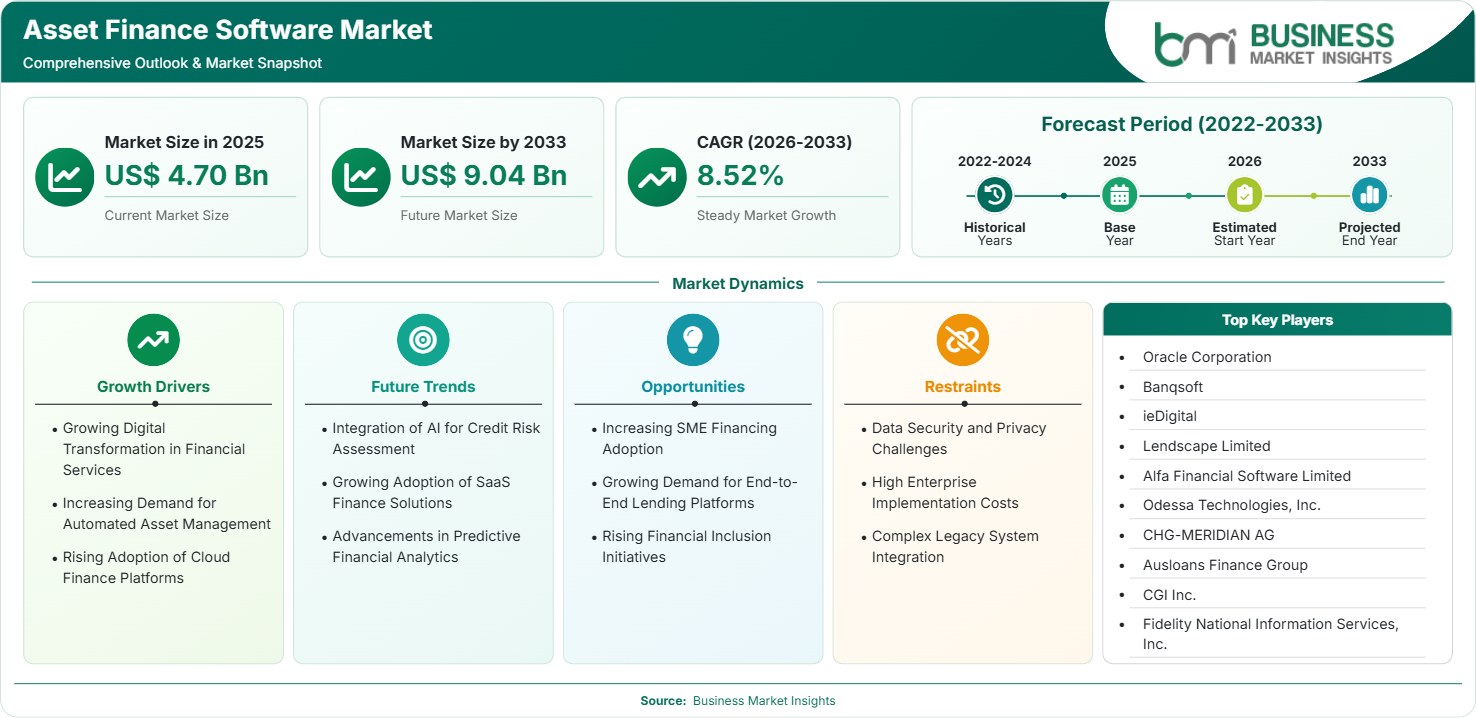
The Asset Finance Software Market size was valued at US$ 4.70 Billion in 2025 and is projected to reach US$ 9.04 Billion by 2033, growing at a CAGR of US$ 8.52% during 2026–2033, driven by digital lending transformation, cloud adoption, automated asset lifecycle management, and expanding financing needs among enterprises.

Report Coverage
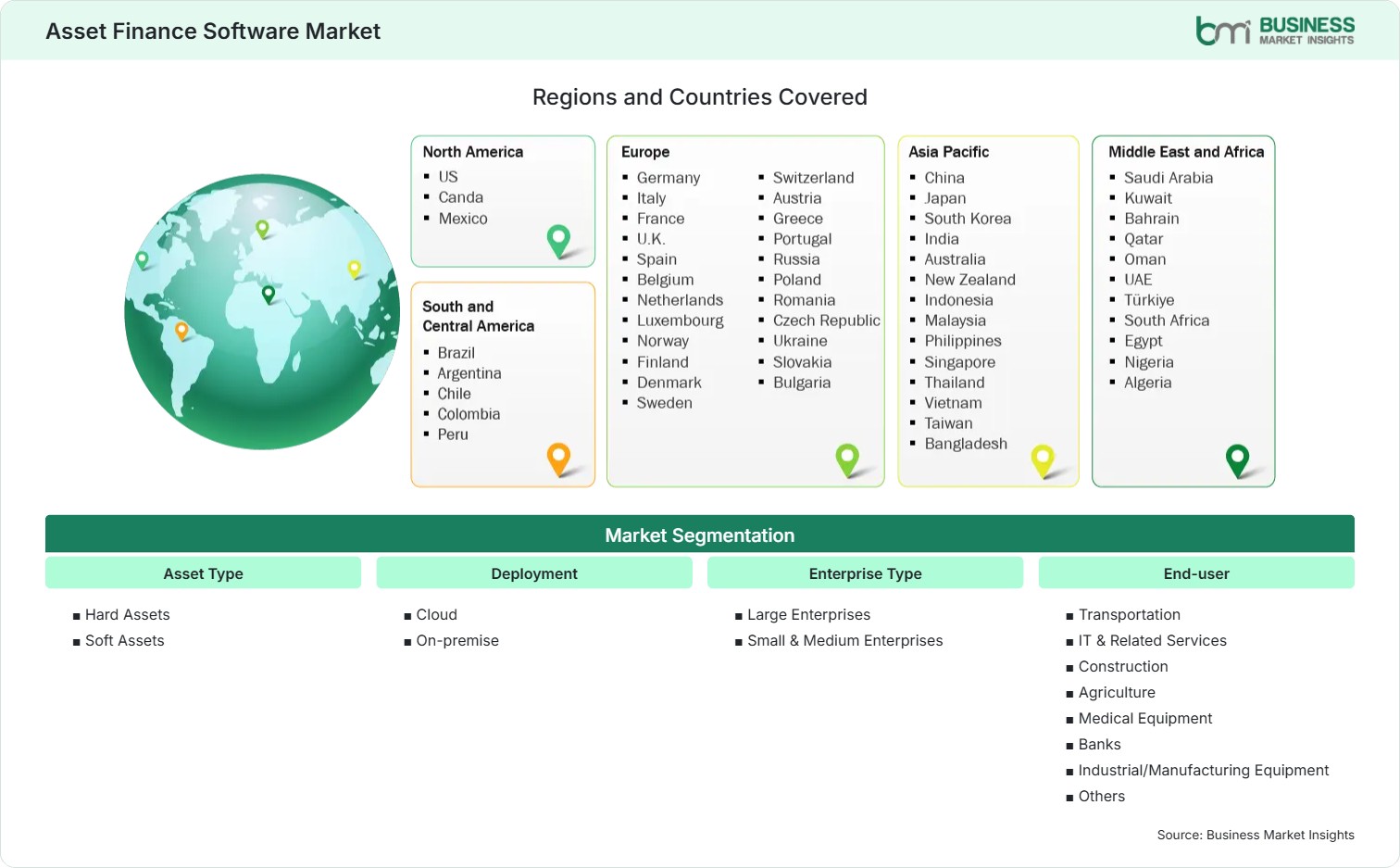
  • Asset Type: Hard Assets, Soft Assets
  • Deployment: Cloud, On-premise
  • Enterprise Type: Large Enterprises, Small & Medium Enterprises
  • End-user: Transportation, IT & Related Services, Construction, Agriculture, Medical Equipment, Banks, Industrial/Manufacturing Equipment, Others
US$ 4.70 Bn Market size in 2025
US$ 9.04 Bn Market Size by 2033
8.52% CAGR, 2026 - 2033
2026-2033 Forecast Period

01 AI Overview

Asset Finance Software Market Summary

  • North America Region: North America holds a 35%–38% share in 2025, growing with a CAGR of 7.8%–8.4% influenced by advanced financial infrastructure, leasing modernization, cloud migration, and automated lending platforms. The US market analysis indicates strong adoption with a CAGR of 8.0%–8.5% between 2026–2033 due to commercial financing digitization.
  • Fastest Growing Region: Asia Pacific holds a 25%–28% share in 2025, growing with a CAGR of 9.0%–9.6% supported by expanding SME financing, digital banking initiatives, fintech investments, and increasing adoption of cloud-based asset management solutions across emerging economies.
  • Leading Segment: Cloud deployment holds a 55%–58% share in 2025, growing with a CAGR of 9.2%–9.8% due to scalable infrastructure, reduced maintenance requirements, faster implementation cycles, and increasing demand for integrated financing ecosystems.
  • High Growth Segment: Small & Medium Enterprises hold a 42%–45% share in 2025, growing with a CAGR of 9.5%–10.1% supported by simplified financing access, digital onboarding, flexible leasing models, and technology-driven credit evaluation solutions.
  • Key Market Opportunity: The market opportunity is concentrated in cloud-native lending platforms, SME financing expansion, embedded finance solutions, and automated workflows enabling faster asset acquisition decisions across industries.
  • Major Market Players: Oracle Corporation, Banqsoft, ieDigital, Lendscape Limited, Alfa Financial Software Limited, Odessa Technologies, Inc., CHG-MERIDIAN AG, Ausloans Finance Group, CGI Inc., and Fidelity National Information Services, Inc.
02 Strategic Insights

Asset Finance Software Market: Strategic Insights

asset-finance-software-market-market-strategic-framework
FREE PDF
Request your free sample
Request free sample
03 Stakeholder View

Key Takeaways

  • Asset finance ecosystems are shifting from traditional leasing administration toward integrated digital platforms connecting lenders, asset providers, customers, and regulatory systems. Software vendors are strengthening interoperability through APIs, automation frameworks, and embedded finance capabilities.
  • Growth opportunities are emerging through SME-focused financing models, where simplified onboarding, automated credit assessment, and flexible repayment structures can improve access to equipment financing across transportation, construction, healthcare, and manufacturing sectors.
  • Innovation priorities are moving toward artificial intelligence-based underwriting, predictive portfolio analytics, robotic process automation, and cloud-native architectures that enable faster decision-making and improved lifecycle management for financed assets.
  • Asia Pacific presents a compelling regional opportunity due to expanding digital banking infrastructure, increasing equipment financing requirements, and government initiatives supporting financial inclusion across India, China, Southeast Asia, and other developing economies.
  • Investment activity is increasingly focused on software consolidation, strategic partnerships, and platform expansion as financial technology providers seek broader capabilities in leasing, lending automation, customer engagement, and enterprise integration.
04 Geographic Outlook

Asset Finance Software Market Regional Highlights

North America Asset Finance Software Market

North America accounted for a 35%–38% share in 2025 and is projected to expand at a CAGR of 7.8%–8.4% during 2026–2033. The region benefits from mature leasing markets, strong financial technology adoption, and enterprise demand for automated financing platforms. Asset Finance Software Market share remains supported by established banks, equipment financiers, and technology-driven lenders.

  • Financial institutions are adopting automated platforms to streamline leasing operations, improve underwriting accuracy, and enhance customer experiences across commercial financing activities.
  • The United States and Canada are accelerating cloud-based deployments through digital transformation programs supporting faster asset financing workflows and improved operational efficiency.
  • Demand from transportation and industrial equipment sectors is increasing as companies seek flexible financing models for fleet modernization and capital-intensive investments.
  • Regulatory emphasis on transparency, reporting accuracy, and risk management is encouraging lenders to upgrade legacy finance management systems.

US Asset Finance Software Market

The US market represented a 28%–31% share in 2025 and is estimated to grow at a CAGR of 8.0%–8.5% from 2026–2033. Strong fintech adoption, advanced banking infrastructure, and high enterprise investment in automation continue to strengthen market positioning. The Asset Finance Software Market share is influenced by large leasing providers, commercial banks, and equipment finance specialists.

  • US lenders are investing in digital platforms that integrate credit assessment, contract management, and customer relationship capabilities.
  • Equipment financing demand from construction, transportation, and technology sectors supports continued adoption of specialized software solutions.
  • Cloud deployment growth is enabling smaller financial institutions to access advanced capabilities without extensive infrastructure investments.
  • Partnerships between software providers and financial institutions are expanding automated lending ecosystems.

Europe Asset Finance Software Market

Europe held a 24%–27% share in 2025 and is expected to register a CAGR of 7.0%–7.8% through 2033. Germany, the United Kingdom, and France represent major adoption markets, while emerging European economies demonstrate increasing demand for digital lending infrastructure. Asset Finance Software Market growth is supported by regulatory modernization and sustainability-focused financing initiatives.

  • Germany is strengthening adoption through industrial equipment financing requirements and advanced manufacturing investments requiring efficient asset management systems.
  • The United Kingdom is expanding digital lending solutions through fintech innovation and financial services modernization programs.
  • France is witnessing increased demand for automated leasing platforms supporting corporate equipment acquisition and mobility financing.
  • European providers are integrating compliance automation features to address evolving financial regulations and reporting standards.

Asia Pacific Asset Finance Software Market

Asia Pacific captured a 25%–28% share in 2025 and is projected to achieve a CAGR of 9.0%–9.6% between 2026–2033. China, India, Japan, and Southeast Asian economies are driving regional expansion through fintech adoption, SME financing growth, and increasing digital infrastructure investments. Asset Finance Software trends indicate rising preference for scalable cloud solutions.

  • China is expanding digital financing ecosystems through technology adoption among banks, leasing companies, and equipment financing providers.
  • India is experiencing increased demand from SMEs requiring accessible financing solutions for machinery, vehicles, and business assets.
  • Southeast Asian markets are adopting cloud platforms to improve financial service availability and operational efficiency.
  • Japan is integrating advanced automation technologies into mature leasing and equipment financing processes.

Rest of World Asset Finance Software Market

Rest of World accounted for a 10%–13% share in 2025 and is anticipated to grow at a CAGR of 6.8%–7.5% during 2026–2033. South America, the Middle East, and Africa are gradually adopting digital financing platforms as businesses seek improved access to equipment and infrastructure funding. Brazil, UAE, and South Africa represent key growth markets.

  • Brazil is witnessing increased demand for financing platforms supporting commercial vehicles, agricultural equipment, and industrial investments.
  • Middle Eastern economies are adopting digital lending technologies alongside infrastructure development and business diversification initiatives.
  • South Africa is improving financial technology adoption through expanding digital banking and enterprise financing solutions.
  • Regional providers are focusing on localized platforms addressing regulatory requirements and diverse customer financing needs.
global-market-geography
FREE PDF
Request your free sample
Request free sample
05 Segment Analysis

Asset Finance Software Market Segmentation

Asset Type

The Asset Type segment represents diverse financing requirements across physical and intangible assets, with hard assets maintaining a 62%–65% share in 2025 and expanding at a CAGR of 7.8%–8.4% during 2026–2034. Asset Finance Software Market scope continues to expand as lenders require specialized workflows for asset valuation, lifecycle tracking, and financing management.

  • Hard Assets: Physical assets such as vehicles, machinery, and industrial equipment drive demand through structured leasing models, asset tracking requirements, and financing solutions supporting capital-intensive business operations.
  • Soft Assets: Intangible assets including software licenses, technology services, and intellectual property financing are gaining adoption through digital business models and flexible financing arrangements.

Deployment

The Deployment segment is undergoing rapid transformation as organizations prioritize scalable technology infrastructure, with cloud solutions accounting for a 55%–58% share in 2025 and growing at a CAGR of 9.2%–9.8% during 2026–2034. Asset Finance Software trends highlight increasing preference for flexible, secure, and easily integrated platforms.

  • Cloud: Cloud deployment enables financial institutions and leasing companies to reduce infrastructure costs, accelerate implementation, and access continuous software upgrades through subscription-based models.
  • On-premise: On-premise solutions remain relevant among enterprises requiring direct infrastructure control, customized security frameworks, and integration with existing internal financial systems.

Enterprise Type

The Enterprise Type segment reflects varying digital maturity among organizations, with large enterprises holding a 55%–58% share in 2025 and expanding at a CAGR of 7.2%–7.8% through 2034. Large institutions continue investing in advanced platforms, while smaller businesses increasingly adopt accessible financing technologies.

  • Large Enterprises: Large organizations demand comprehensive platforms supporting complex asset portfolios, multi-location operations, compliance management, and integration with enterprise resource planning systems.
  • Small & Medium Enterprises: SMEs are adopting simplified financing platforms that improve access to equipment funding, automate applications, and support faster approval processes through digital workflows.

End-user

The End-user segment covers multiple industries requiring efficient asset acquisition and lifecycle management solutions. Transportation remains a significant application area with a 22%–25% share in 2025 and a CAGR of 8.0%–8.6% during 2026–2034. Asset financing software adoption is increasing as industries modernize equipment investment strategies.

  • Transportation: Fleet operators use financing platforms to manage vehicle acquisition, leasing schedules, maintenance tracking, and asset utilization analytics across commercial transportation networks.
  • IT & Related Services: Technology companies adopt solutions for financing hardware, software infrastructure, and digital equipment required for expanding service delivery capabilities.
  • Construction: Construction firms utilize financing software to manage heavy machinery acquisition, equipment leasing, and project-based asset investment requirements.
  • Agriculture: Agricultural businesses implement financing platforms to support machinery purchases, seasonal funding models, and improved access to modern farming equipment.
  • Medical Equipment: Healthcare providers use specialized financing solutions to acquire advanced diagnostic systems, medical devices, and technology-enabled healthcare infrastructure.
  • Banks: Financial institutions deploy platforms to automate lending operations, manage leasing portfolios, and improve customer engagement through digital financing services.
  • Industrial/Manufacturing Equipment: Manufacturers adopt asset finance solutions to support machinery upgrades, production expansion, and capital expenditure optimization.
06 Market Forces

Asset Finance Software Market Dynamics

Key Market Drivers

Growing Digital Transformation in Financial Services

Financial service providers are implementing initiatives to digitally transform themselves in order to automate financing process which was initially carried out manually. The Asset Finance Software trend is associated with the growing need for real-time analytics, digital onboarding of customers, and an ecosystem approach to lending. As per industry trends of modernization, it can be seen that the focus of financial service providers is on adopting API-enabled systems and cloud technology to increase their agility. Asset Finance Software Market trends show that automation, artificial intelligence, and workflow improvement are being considered as key investment areas.

Increasing Demand for Automated Asset Management

The users of the assets and the financiers are embracing automated systems of asset management to enhance visibility within their asset portfolio, payment plans, and performance within the lifecycle. The use of advanced analytics helps companies to track the use of the asset, assess risks and make appropriate financing choices. Automated systems are most useful for industries such as transportation, manufacturing, and other industries that use a lot of equipment, with complexities in their assets continually growing.

Rising Adoption of Cloud Finance Platforms

The cloud-based platforms are gaining popularity among businesses due to their scalability and ease of implementation. The cloud makes it possible for the software vendor to update the product continuously while improving its security features and increasing access to it for remote users. More financial institutions opt for subscription platforms, which make it possible to adapt to new requirements without spending on the purchase of the software. In the Asset Finance Software Market, this trend is driving the demand for more flexible finance management solutions.

Key Market Opportunities

Increasing SME Financing Adoption

Small and medium-sized companies are one of the main growth areas as companies look to obtain equipment, transportation, and other operational facilities easily. The use of digital channels will help companies in making their application for finances easier, documenting the process, and evaluating the credit of small firms. The reports from Asset Finance Software Market Forecasts show growth in the area by providing solutions that utilize alternative data analysis, automation of approval process, and flexible payments.

Growing Demand for End-to-End Lending Platforms

Financial institutions are increasingly seeking comprehensive platforms that integrate customer acquisition, credit evaluation, contract management, servicing, and reporting capabilities within a unified environment. This demand presents chances to suppliers providing modular products that are capable of interfacing with banking applications and enterprise systems. The end-to-end solution will bring efficiency in operation through less fragmented processes and better visibility of the portfolio. With increasing complexities in the financing model, vendors that have comprehensive lifecycle management abilities stand to benefit from increased enterprise demand.

Rising Financial Inclusion Initiatives

Financing through technology is becoming more widespread in government schemes and institutions due to the growth of the digital landscape in emerging economies. Lending platforms driven by technology offer new avenues of accessing financing for companies and individuals who have been unable to do so in the past due to constraints in traditional financing options. Systems that facilitate automated verification and evaluation are expected to be successful in financial inclusion schemes.

Market Restraints and Challenges

Data Security and Privacy Challenges

Factor: Increasing volumes of sensitive financial, customer, and asset-related data managed through digital platforms create cybersecurity concerns for lenders and software providers. Impact: Security concerns, compliance needs, and data breach possibilities can lead to greater risks of operations and slow down technology adoption by the regulated financial companies. Providers of the Asset Finance Software need to allocate funds to support encryption, identity management, access control, and compliance systems in order to build trust with the customers. Interconnection of financing platforms with bank systems and other applications increases the necessity of having high security standards.

High Enterprise Implementation Costs

Factor: Complex integration requirements, customization needs, and migration from legacy financing systems increase initial implementation expenses for organizations. Impact: High initial investment may delay adoption from small financial companies and firms due to a low budget for technological innovation. The implementation of Asset Finance Software is associated with the redesigning of processes and training of staff, in addition to integration into existing enterprise solutions, thus creating more resource needs. In response to this challenge, vendors are using modular software platforms and cloud-based licensing to overcome financial constraints.

07 Company Analysis

Competitive Landscape

The Asset Finance Software Market analysis indicates a competitive environment shaped by global technology providers, specialized leasing software companies, and financial technology firms offering solutions for asset lifecycle management, lending automation, and digital financing operations.

Company Name

Overview

Products and Services relevant to this market

Oracle Corporation

Global enterprise technology provider offering financial management and cloud solutions for organizations worldwide.

Cloud finance platforms, asset lifecycle management, enterprise applications, and automated financial workflows.

Banqsoft

Nordic financial technology company specializing in lending and asset finance solutions.

Leasing platforms, loan management systems, digital finance solutions, and portfolio administration tools.

ieDigital

Financial technology provider delivering digital banking and lending transformation solutions.

Digital lending platforms, customer engagement tools, and automated finance management solutions.

Lendscape Limited

Specialist lending technology provider supporting commercial finance businesses globally.

Asset finance platforms, lending automation, workflow management, and portfolio servicing solutions.

Alfa Financial Software Limited

Enterprise software provider focused on asset finance and automotive finance sectors.

Alfa Systems platform, leasing management, contract administration, and finance lifecycle solutions.

Odessa Technologies, Inc.

Software company specializing in asset finance technology platforms and automation.

Lease accounting, asset finance software, workflow automation, and configurable financing applications.

CHG-MERIDIAN AG

Global technology management and financing company serving enterprise customers.

Technology leasing solutions, asset management services, and financing lifecycle platforms.

Ausloans Finance Group

Australian finance provider offering lending and asset financing services.

Equipment finance solutions, digital application processes, and customer financing services.

CGI Inc.

Global IT and consulting company delivering financial technology solutions.

Banking platforms, leasing solutions, digital transformation services, and finance automation.

Fidelity National Information Services, Inc.

Financial technology company providing solutions for banking and financial institutions.

Lending platforms, financial processing systems, digital banking technologies, and analytics solutions.

10 Trust & Transparency

Research Methodology

The market analysis combines proprietary research with secondary data from government agencies, company disclosures, regulatory filings, industry databases and expert interviews. Market estimates are validated through data triangulation, cross-market benchmarking and analyst review.

View Full Research Methodology

11 Questions Answered

Frequently Asked Questions

What challenges affect implementation decisions?

Implementation decisions are influenced by cybersecurity requirements, integration complexity, customization needs, migration challenges, and investment considerations among organizations transitioning from traditional financing systems.

What does the Asset Finance Software Market Report highlight about future adoption?

The Report highlights increasing adoption of AI-driven lending tools, automated compliance systems, embedded finance solutions, and cloud-native platforms supporting digital transformation across global financing ecosystems.

Which industries are major users of these platforms?

Major users include transportation companies, banks, manufacturing firms, healthcare organizations, construction businesses, and agricultural enterprises requiring efficient asset acquisition and lifecycle management solutions.

How does cloud deployment influence the market?

Cloud deployment enables faster implementation, lower infrastructure requirements, continuous updates, and improved accessibility, allowing financial institutions and enterprises to adopt advanced financing capabilities without significant technology investments.

What factors are driving Asset Finance Software adoption?

Asset Finance Software adoption is increasing due to digital lending transformation, cloud migration, automated workflows, and growing demand for efficient management of financed assets across transportation, industrial, healthcare, and technology sectors.

Access the Full Asset Finance Software Market Report

Get segment-level forecasts, regional estimates, competitive benchmarking, company profiles and downloadable Excel datasets.

Access the full Asset Finance Software Market Report
350 pages PDF & Excel | 2026-08-05