
Enterprise Application Integration Market Outlook: Size, Share, Trends, Growth Analysis, Competitive Landscape & Forecast, 2026–2033

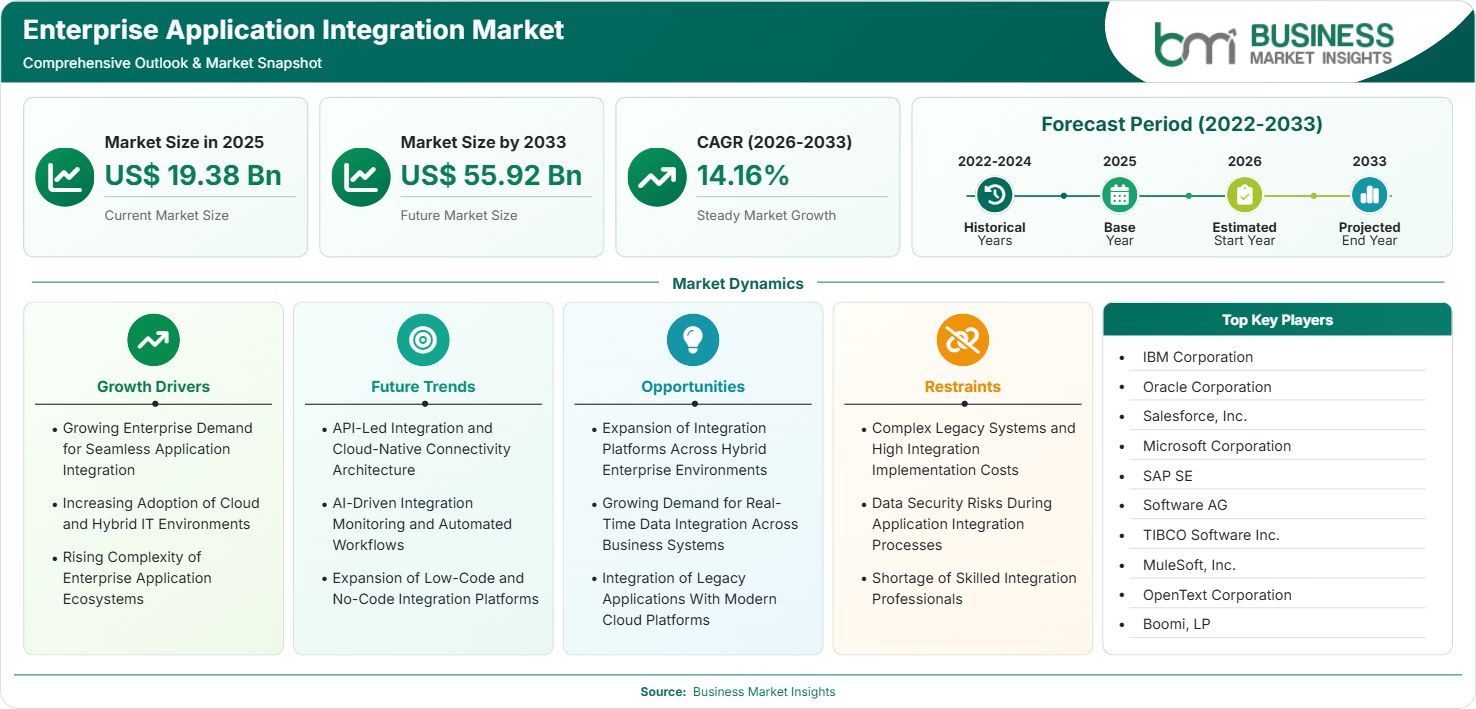
The Enterprise Application Integration Market size was valued at US$ 19.38 Billion in 2025 and is projected to reach US$ 55.92 Billion by 2033, growing at a CAGR of 14.16% during 2026–2033 driven by cloud migration, hybrid IT expansion, application modernization, and growing AI workloads are accelerating integration investments across large enterprises and SMEs.

Report Coverage
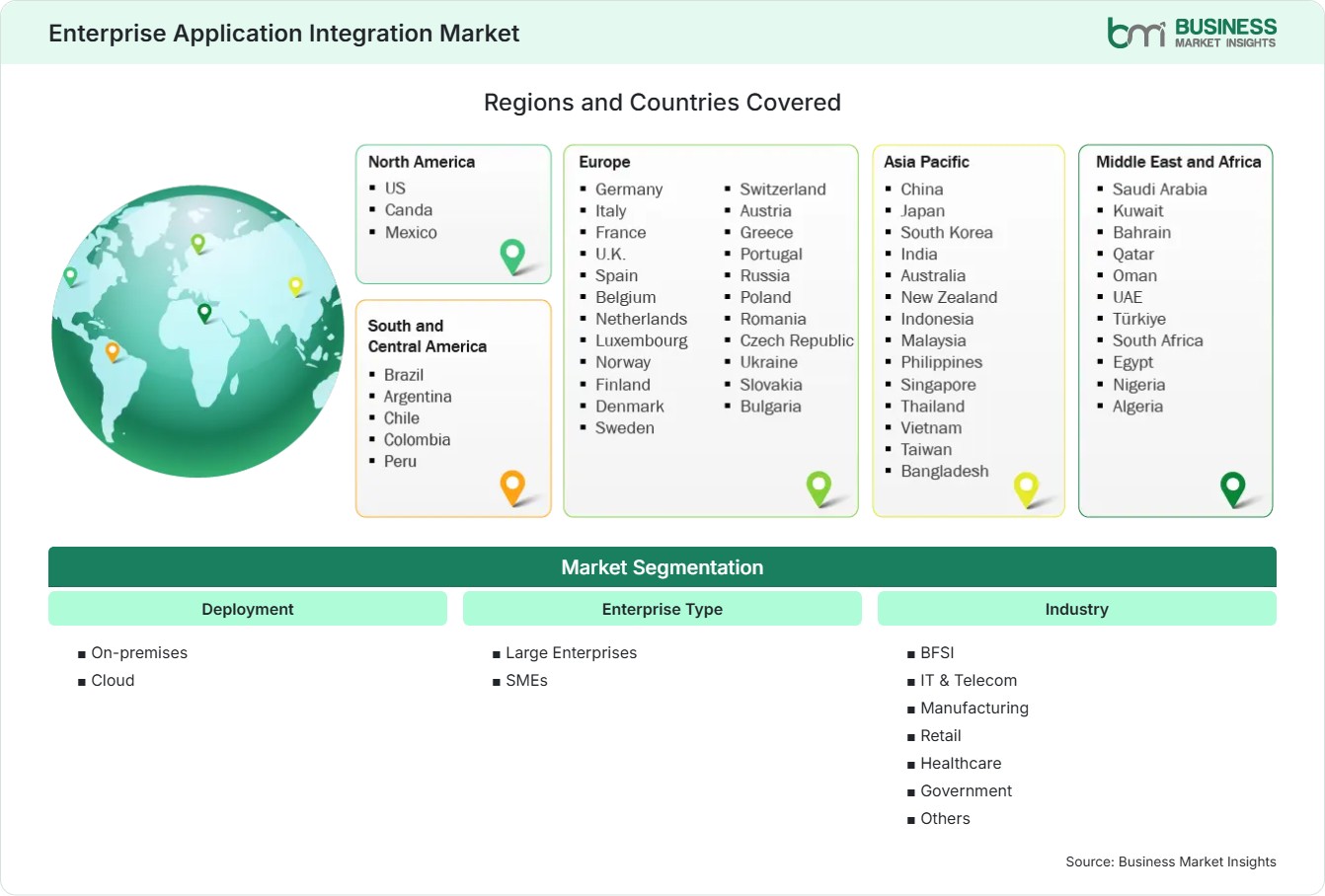
  • Deployment: On-premises, Cloud
  • Enterprise Type: Large Enterprises, SMEs
  • Industry: BFSI, IT & Telecom, Manufacturing, Retail, Healthcare, Government, Others
US$ 19.38 Bn Market size in 2025
US$ 55.92 Bn Market Size by 2033
14.16% CAGR, 2026 - 2033
2026-2033 Forecast Period

01 AI Overview

Enterprise Application Integration Market Summary

  • North America: North America held a 34%–38% enterprise application integration market share in 2025, with a 13.4%–14.3% CAGR during 2026–2033, supported by cloud migration, API modernization, enterprise automation, and increasing demand for interoperable business applications. The US market remains the regional technology center, with approximately 13.8%–14.7% CAGR as enterprises modernize application estates and expand cloud-based integration.
  • Fastest Growing Region: Asia Pacific accounted for a 23%–27% share in 2025 and is projected to expand at a 15.0%–16.2% CAGR during 2026–2033, supported by digital transformation, cloud adoption, expanding enterprise software deployments, application modernization, data localization requirements, and rising investment in integration infrastructure.
  • Leading Segment: Cloud Deployment represented a 61%–65% share in 2025, expanding at a 15.0%–15.9% CAGR during 2026–2033, supported by scalable integration architectures, subscription-based software consumption, hybrid connectivity, API management, faster deployment cycles, and reduced infrastructure management requirements.
  • High Growth Segment: SMEs represented a 27%–31% share in 2025, with a 15.2%–16.4% CAGR during 2026–2033, driven by accessible cloud integration platforms, low-code development, managed services, SaaS adoption, automation, and reduced dependency on internally maintained middleware infrastructure.
  • Key Market Opportunity: Integration platforms are becoming strategic control layers for applications, APIs, data, automation, and AI agents, creating opportunities for vendors offering governed connectivity, observability, security, and reusable integration assets.
  • Major Market Players: IBM Corporation, Oracle Corporation, Salesforce, Inc., Microsoft Corporation, SAP SE, Software AG, TIBCO Software Inc., MuleSoft, Inc., OpenText Corporation, Boomi, LP.
02 Strategic Insights

Enterprise Application Integration Market: Strategic Insights

Enterprise Application Integration Market Strategic Framework
FREE PDF
Request your free sample
Request free sample
03 Stakeholder View

Key Takeaways

  • The value chain is moving from standalone middleware toward integrated platforms combining API management, application connectivity, data synchronization, event processing, automation, monitoring, governance, and security.
  • Cloud deployment provides the strongest commercial upside because enterprises increasingly require elastic integration infrastructure capable of supporting SaaS applications, distributed data, APIs, and hybrid workloads without extensive infrastructure ownership.
  • AI-assisted integration development, automated mapping, intelligent workflow generation, agent connectivity, API discovery, and integration observability are becoming important product-development priorities across leading platforms.
  • Pacific offers the strongest expansion potential because enterprise digitization, cloud migration, application modernization, and data-governance requirements are developing simultaneously across multiple economies.
  • Competitive investment is increasingly focused on platform consolidation, AI-enabled integration, API governance, hybrid connectivity, and integration intelligence rather than traditional point-to-point middleware alone.
  • Vendors that support both modern cloud-native applications and legacy systems can capture broader enterprise budgets because modernization rarely eliminates the existing application estate immediately.
04 Geographic Outlook

Enterprise Application Integration Market Regional Highlights

North America Enterprise Application Integration Market

North America represented a 34%–38% share in 2025, and North America Enterprise Application Integration Market forecast to grow at 13.4%–14.3% CAGR during 2026–2033. The region benefits from mature enterprise software adoption, extensive cloud infrastructure, API modernization, and strong demand for automation. Integration spending is increasingly linked to application rationalization and AI readiness.

  • Cloud-native application adoption is increasing demand for API management, event-driven architectures, secure connectivity, and integration platforms capable of operating across multiple deployment environments.
  • Enterprises are consolidating fragmented middleware environments to improve governance, reduce duplicated interfaces, strengthen observability, and establish consistent policies across application and data flows.
  • AI adoption is increasing integration requirements because enterprise AI systems need governed access to applications, business data, APIs, identity systems, and transactional workflows.

US Enterprise Application Integration Market

The US accounted for approximately 72%–77% of North American demand in 2025, expanding at a 13.8%–14.7% CAGR during 2026–2033. Strong enterprise cloud adoption, software modernization, API development, and AI investment support integration spending. US enterprises increasingly require connectivity between legacy applications and cloud services while maintaining security and operational visibility.

  • Large US enterprises are modernizing application estates while retaining critical legacy systems, increasing demand for integration layers that bridge older architectures with cloud-native applications.
  • AI initiatives are strengthening demand for secure application and data connectivity because intelligent workflows require controlled access to enterprise systems and reusable APIs.
  • Integration platforms are increasingly evaluated as strategic infrastructure, making scalability, observability, resilience, governance, and security important purchasing criteria.

Europe Enterprise Application Integration Market

Europe held a 25%–29% share in 2025, growing at a 12.7%–13.7% CAGR during 2026–2033. Germany, the United Kingdom, and France remain major demand centers because of established enterprise software environments and ongoing modernization. Germany is projected at approximately 12.9%–13.9% CAGR, while the UK is positioned around 13.3%–14.3% CAGR.

  • European enterprises are expanding hybrid architectures, requiring integration platforms that can connect regulated workloads, private infrastructure, public clouds, SaaS applications, and partner ecosystems.
  • Data protection and operational resilience requirements are increasing demand for governed APIs, secure identity propagation, audit trails, encryption, and centralized integration monitoring.
  • Germany's manufacturing-intensive economy creates demand for application interoperability connecting enterprise resource planning, supply-chain, production, customer, and operational systems.
  • The United Kingdom's mature cloud ecosystem and financial-services sector support demand for secure, observable, and policy-driven application integration.

Asia Pacific Enterprise Application Integration Market

Asia Pacific represented a 23%–27% share in 2025 and is projected to record the fastest regional growth at 15.0%–16.2% CAGR during 2026–2033. China, Japan, India, South Korea, Singapore, and Australia contribute substantial enterprise technology demand. India is positioned around 16.0%–17.0% CAGR, while China is estimated at 15.2%–16.2% CAGR.

  • India is developing strong demand for cloud integration, API management, automation, and data connectivity as enterprises modernize applications and expand digitally enabled business operations.
  • China is increasing enterprise application modernization and cloud deployment, creating demand for localized integration capabilities, API governance, automation, and secure application connectivity.
  • Japan and South Korea retain substantial installed enterprise application estates, creating opportunities for integration modernization that connects established systems with newer cloud platforms.
  • Singapore and Australia benefit from mature digital infrastructure and cloud adoption, supporting sophisticated integration requirements across financial services, government, telecommunications, and enterprise technology environments.

Rest of World Enterprise Application Integration Market

Rest of World represented an 11%–15% share in 2025, expanding at a 12.0%–13.2% CAGR during 2026–2033. South and Central America are developing integration demand through cloud migration, enterprise software modernization, and digital banking. Brazil is positioned around 12.2%–13.2% CAGR, supported by large enterprise technology investments and expanding cloud infrastructure. The Middle East and Africa are developing integration demand through government digitalization, financial-services modernization, telecommunications investment, and enterprise cloud adoption.

  • Brazil's expanding cloud and digital enterprise ecosystem supports demand for API management, workflow integration, application modernization, and secure data connectivity.
  • Gulf economies are investing in digital government and enterprise platforms, creating demand for scalable integration architectures supporting multiple applications and data environments.
  • African financial institutions and telecommunications companies are modernizing technology estates, increasing demand for integration platforms capable of connecting digital services with established enterprise systems.
  • Regional enterprises increasingly prioritize data sovereignty, cybersecurity, identity management, and governance when selecting cloud-based integration infrastructure.
Global Market Geography
FREE PDF
Request your free sample
Request free sample
05 Segment Analysis

Enterprise Application Integration Market Segmentation

Deployment

Cloud Deployment accounted for a 61%–65% share in 2025 and is projected to expand at a 15.0%–15.9% CAGR between 2026–2033, supported by scalable infrastructure, SaaS adoption, hybrid connectivity, faster provisioning, and reduced infrastructure management. On-premises deployment remains relevant for regulated, latency-sensitive, and legacy-intensive environments.

  • On-premises: Remains relevant where enterprises require infrastructure control, internal data processing, predictable connectivity, or compatibility with established applications and security architectures.
  • Cloud: Benefits from elastic capacity, managed infrastructure, rapid deployment, subscription economics, API accessibility, and easier integration across distributed SaaS and cloud-native applications.

Enterprise Type

Large Enterprises represented a 69%–73% share in 2025, supported by extensive application estates, complex data environments, and substantial modernization budgets. SMEs are expanding faster at approximately 15.2%–16.4% CAGR, supported by cloud platforms, low-code tools, managed integration, and reduced infrastructure requirements. Enterprise Application Integration Market trends increasingly favor accessible platforms that allow organizations of different sizes to implement governed connectivity without maintaining extensive middleware infrastructure.

  • Large Enterprises: Require sophisticated integration governance, API management, monitoring, security, workflow orchestration, and hybrid connectivity across extensive application portfolios and organizational structures.
  • SMEs: Benefit from cloud-based integration, prebuilt connectors, low-code development, managed services, and subscription models that reduce infrastructure and specialized development requirements.

Industry

BFSI remains a major integration adopter because financial operations depend on high-volume, secure, interoperable applications. IT & Telecom require integration across distributed digital platforms, while manufacturing connects enterprise applications with operational environments. Retail depends on synchronized commerce and business systems, and healthcare requires secure interoperability. Government modernization supports integration demand through digital services, while other industries expand adoption as application portfolios become increasingly distributed.

  • BFSI: Requires secure, reliable integration across banking applications, payment platforms, customer systems, risk systems, data environments, and regulatory workflows.
  • IT & Telecom: Demand scalable API management, application connectivity, event processing, automation, and hybrid integration across complex digital service environments.
  • Manufacturing: Requires interoperability across enterprise resource planning, supply-chain, production, asset, quality, and operational applications to support coordinated information flows.
  • Retail: Uses integration to synchronize business applications, digital commerce systems, customer platforms, inventory processes, and transaction data across distributed environments.
  • Healthcare: Requires secure interoperability between clinical, administrative, financial, and data systems while maintaining privacy, governance, identity, and regulatory controls.
  • Government: Digital public services require governed integration between citizen-facing platforms, administrative applications, identity systems, databases, and internal workflows.
06 Market Forces

Enterprise Application Integration Market Dynamics

Key Market Drivers

Growing Enterprise Demand for Seamless Application Integration

Organizations are now running their applications portfolio which involves SaaS applications, cloud-based applications, databases, traditional applications, APIs, and internal applications. According to IBM, “application integration is an approach that integrates heterogeneous systems using APIs and middleware with minimal data silos and improved process flow.” The structural gap provides a driving force for Enterprise Application Integration Market growth in terms of the need for reuseable interfaces, API management, event-driven connectivity, workflow automation, and integration observability.

Increasing Adoption of Cloud and Hybrid IT Environments

Cloud migration expands the number of environments that enterprise applications must communicate across. Large enterprises recorded substantially higher adoption than SMEs, reinforcing the need for integration infrastructure that supports distributed architectures. Microsoft positions Azure Integration Services around connecting legacy applications with newer technologies while supporting API management, business-process automation, messaging, events, and monitoring. Hybrid integration therefore requires consistent security, identity, observability, and policy controls across on-premises and cloud environments. This architecture shift is strengthening demand for flexible integration platforms.

Rising Complexity of Enterprise Application Ecosystems

Application portfolios are becoming more heterogeneous as enterprises combine packaged software, custom applications, SaaS platforms, data services, APIs, and AI workloads. Complexity increases when applications use different interfaces, data models, authentication mechanisms, deployment environments, and release schedules. The Enterprise Application Integration Market trends are consequently moving toward platforms that reduce development effort while increasing visibility across business-critical data flows. AI is also creating a new connectivity layer because enterprise agents require controlled access to applications and APIs.

Key Market Opportunities

Expansion of Integration Platforms Across Hybrid Enterprise Environments

Hybrid environments provide a substantial opportunity because enterprises rarely migrate every application simultaneously. Integration platforms can become the interoperability layer between legacy systems, private infrastructure, public cloud services, SaaS applications, APIs, and partner systems. Demand is strengthened by the need for centralized governance and consistent security across different runtimes. Vendors can expand revenue by offering hybrid deployment, reusable connectors, integration monitoring, API lifecycle management, identity controls, and managed services through unified platforms.

Growing Demand for Real-Time Data Integration Across Business Systems

Real-time integration is becoming increasingly important as enterprises seek faster operational decisions and more responsive digital processes. Batch-oriented interfaces can create delays between business applications, while event-driven integration allows data changes to trigger downstream workflows with lower latency. This creates opportunities for platforms combining APIs, event brokers, streaming connectivity, workflow orchestration, monitoring, and automated error handling. Integration vendors can differentiate by providing visibility into transaction flows and actionable operational telemetry.

Integration of Legacy Applications with Modern Cloud Platforms

Legacy modernization creates sustained demand because established applications frequently remain operational after surrounding systems migrate to cloud environments. Integration platforms can preserve access to existing business processes while enabling newer applications to consume legacy data and functions through APIs, connectors, and controlled workflows. This reduces the need for immediate replacement and supports phased modernization strategies. Vendors can capture long-duration modernization budgets by supporting application discovery, interface conversion, API exposure, security, observability, and staged migration.

Market Restraints and Challenges

Complex Legacy Systems and High Integration Implementation Costs

Factor: Legacy applications often have proprietary interfaces, undocumented dependencies, inconsistent data models, and specific infrastructures that make integration difficult. Impact: Implementation cost may cause delay in integration initiatives, need for more consulting services, and limited usage by organizations with small technology budgets. Integration is even more difficult when enterprises own several middleware systems that they have built at various stages of their modernization initiatives.

Data Security Risks During Application Integration Processes

Factor: Integration platforms transmit sensitive business information between applications, APIs, databases, cloud services, and external endpoints, creating additional points where authentication, authorization, encryption, and monitoring must be enforced. Impact: Security weaknesses can expose confidential information, disrupt business workflows, and increase regulatory risk, making security architecture a critical purchasing criterion. Modern integration platforms increasingly incorporate identity propagation, secrets management, API security, private connectivity, encryption, and centralized policy controls.

07 Company Analysis

Competitive Landscape

Enterprise Application Integration Market analysis indicates intense competition among diversified enterprise software providers, cloud platform companies, specialized integration vendors, and automation-focused technology firms. Competitive differentiation increasingly depends on connector breadth, API management, hybrid deployment, developer productivity, AI-assisted integration, observability, security, and integration governance.

Company Name

Overview

Products and Services relevant to this market

IBM Corporation

Global enterprise technology provider with extensive hybrid-cloud integration and application modernization capabilities.

IBM App Connect, API management, messaging, event integration, application connectivity, hybrid integration and integration governance.

Oracle Corporation

Enterprise software and cloud infrastructure provider with broad application and integration capabilities.

Oracle Integration, application adapters, API connectivity, workflow automation, integration monitoring and cloud integration services.

Salesforce, Inc.

Enterprise CRM and cloud software company with MuleSoft positioned as its integration and automation platform.

MuleSoft Anypoint Platform, API management, application integration, automation, agent connectivity and integration intelligence.

Microsoft Corporation

Global software and cloud provider offering integrated application, API, messaging and workflow connectivity.

Azure Integration Services, API Management, Logic Apps, Service Bus, Event Grid and hybrid application integration.

SAP SE

Enterprise software provider with integration capabilities spanning SAP and heterogeneous business application environments.

SAP Integration Suite, API management, Cloud Integration, event-driven integration and business-process connectivity.

Software AG

Enterprise integration technology provider associated with webMethods and hybrid application connectivity.

webMethods integration, API management, application connectivity, hybrid integration and integration governance.

TIBCO Software Inc.

Integration and analytics technology provider focused on enterprise connectivity and data movement.

Integration platforms, API management, event processing, messaging, data connectivity and orchestration capabilities.

MuleSoft, Inc.

Integration technology company operating within Salesforce with a strong API-led connectivity heritage.

Anypoint Platform, API management, application integration, connectors, automation and integration development capabilities.

OpenText Corporation

Enterprise information management and business integration provider serving complex application environments.

Trading Grid, Business Network, application integration, managed file transfer, API connectivity and enterprise information integration.

Boomi, LP

Integration and automation platform provider focused on cloud-native connectivity and application interoperability.

Boomi Integration and Automation Platform, API management, connectors, workflow automation, data integration and governance.

10 Trust & Transparency

Research Methodology

The market analysis combines proprietary research with secondary data from government agencies, company disclosures, regulatory filings, industry databases and expert interviews. Market estimates are validated through data triangulation, cross-market benchmarking and analyst review.

View Full Research Methodology

11 Questions Answered

Frequently Asked Questions

What factors influence integration platform selection?

Enterprises increasingly evaluate connector availability, API management, hybrid deployment, security, observability, implementation effort, and compatibility with existing application environments.

Which industries have strong integration requirements in Enterprise Application Integration Market?

BFSI, IT and telecom, manufacturing, retail, healthcare, and government maintain strong integration requirements because their operations depend on interconnected applications, secure data flows, automation, and interoperable digital services.

How is AI changing enterprise application integration?

AI is increasing demand for governed access to enterprise applications, APIs, data, and workflows while driving AI-assisted integration development, and automated integration management.

Why is cloud deployment gaining market leadership?

Cloud deployment provides scalable infrastructure, faster provisioning, managed operations, subscription economics, and connectivity across distributed SaaS and enterprise applications, making it increasingly suitable for hybrid technology architectures.

What is Enterprise Application Integration Market Report?

The Market Report evaluates deployment models, enterprise categories, industries, market dynamics, and technology developments through 2033.

Access the Full Enterprise Application Integration Market Report

Get segment-level forecasts, regional estimates, competitive benchmarking, company profiles and downloadable Excel datasets.

Access the full Enterprise Application Integration Market Report
350 pages PDF & Excel | 2026-08-20