
System Integration Market Outlook: Size, Share, Trends, Growth Analysis, Competitive Landscape & Forecast, 2026-2033

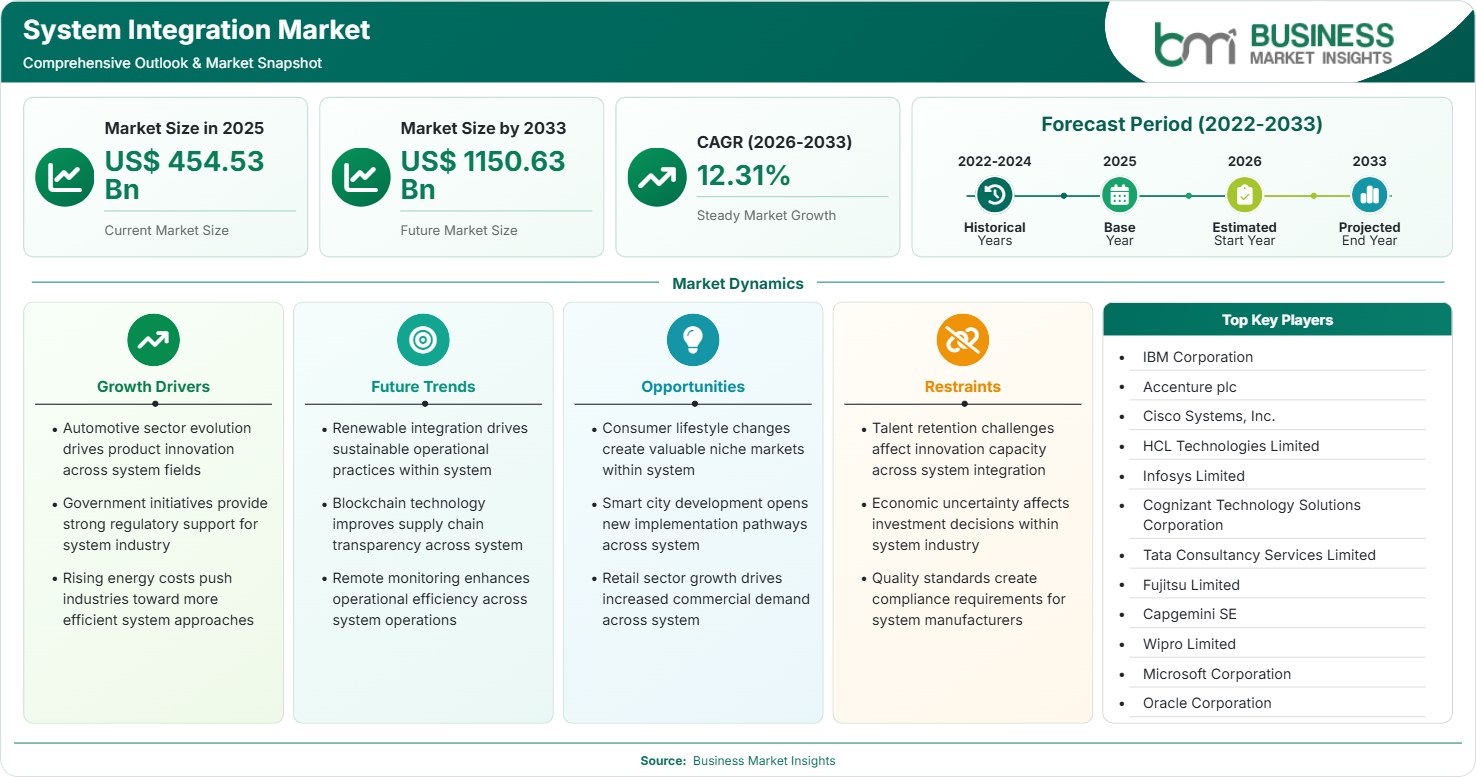
The System Integration Market size was valued at US$ 454.53 Billion in 2025 and is projected to reach US$ 1150.63 Billion by 2033, growing at a CAGR of 12.31% during 2026–2033. Rising enterprise cloud adoption, AI-enabled automation, cybersecurity modernization, and industrial digital transformation are accelerating demand, while expanding smart infrastructure programs and edge computing deployments create new integration opportunities.

Report Coverage
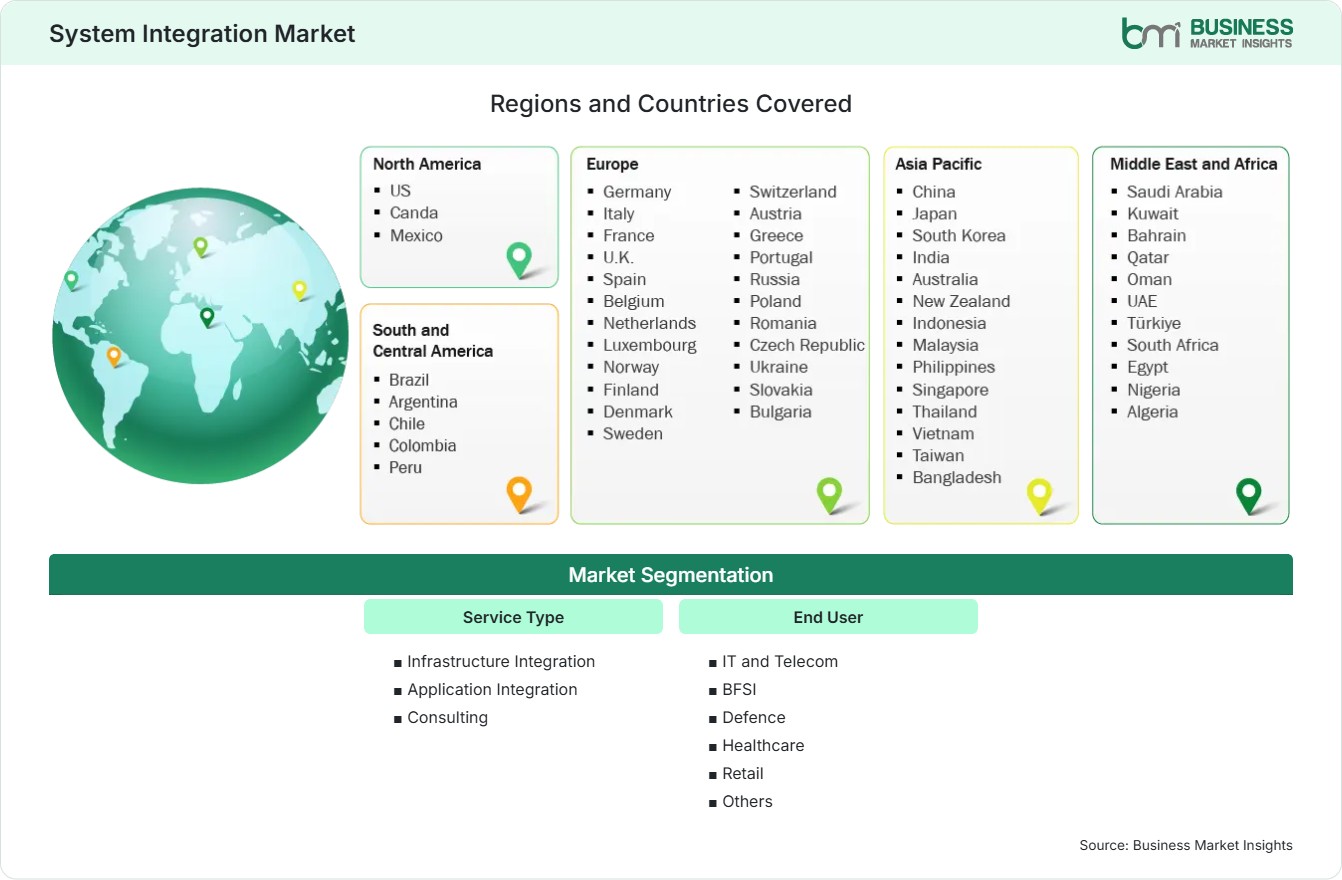
  • Service Type: Infrastructure Integration, Application Integration, Consulting
  • End User: IT and Telecom, BFSI, Defence, Healthcare, Retail, Others
US$ 454.53 Bn Market size in 2025
US$ 1150.63 Bn Market Size by 2033
12.31% CAGR, 2026 - 2033
2026-2033 Forecast Period

AI Overview

System Integration Market Summary

  • North America Region: North America holds a market share of 36%–39% in 2025, growing at a CAGR of 11.2%–12.0% during 2026–2033. Enterprise cloud migration, AI deployment, cybersecurity upgrades, and legacy modernization programs drive spending. Opportunities emerge from multi-cloud orchestration, industrial automation integration, government digitalization initiatives, and mission-critical infrastructure transformation projects. The U.S. market benefits from large enterprise technology spending and is projected to expand at a CAGR of 11.5%–12.3% through 2033.
  • Fastest Growing Region: Asia Pacific holds a market share of 27%–30% in 2025, growing at a CAGR of 13.8%–14.8% during 2026–2033. Accelerating industrial digitalization, smart manufacturing investments, hyperscale data centers, and government technology programs stimulate adoption. Opportunities arise through 5G deployment, cloud-native infrastructure integration, digital public services, and enterprise modernization across developing economies.
  • Leading Segment: Infrastructure Integration holds a market share of 44%–47% in 2025, growing at a CAGR of 11.8%–12.6% during 2026–2033. Organizations require seamless connectivity across cloud environments, networks, security frameworks, and operational systems. Opportunities emerge from hybrid architectures, edge deployments, automation platforms, and large-scale modernization initiatives across industries.
  • High Growth Segment: Application Integration holds a market share of 31%–34% in 2025, growing at a CAGR of 13.4%–14.2% during 2026–2033. Increasing software complexity, API ecosystems, SaaS adoption, and real-time analytics requirements accelerate demand. Opportunities develop through AI-enabled workflows, digital platforms, customer experience transformation, and connected enterprise architectures.
  • Key Market Opportunity: Growing adoption of AI-enabled enterprise ecosystems requires integration across cloud, data, security, and operational platforms, creating sustained demand for specialized services capable of delivering scalable, interoperable, and automated digital environments.
  • Major Market Players: IBM Corporation, Accenture plc, Cisco Systems, Inc., HCL Technologies Limited, Infosys Limited, Cognizant Technology Solutions Corporation, Tata Consultancy Services Limited, Fujitsu Limited, Capgemini SE, Wipro Limited, Microsoft Corporation, Oracle Corporation, Deloitte Touche Tohmatsu Limited, NEC Corporation, Atos SE, Tech Mahindra Limited, AVI-SPL LLC, and Kinly Group.
Strategic Insights

System Integration Market: Strategic Insights

System Integration Market Strategic Framework
FREE PDF
Request your free sample
Request free sample
Stakeholder View

Key Takeaways

  • The ecosystem increasingly depends on partnerships among cloud providers, software vendors, cybersecurity specialists, network providers, and consulting firms capable of delivering end-to-end transformation outcomes.
  • Application-centric modernization projects present the strongest expansion potential as enterprises seek seamless connectivity between cloud-native platforms, analytics systems, and customer-facing applications.
  • AI-driven orchestration, automation platforms, observability tools, and low-code integration technologies are reshaping solution design and reducing deployment complexity.
  • India, Indonesia, Vietnam, Saudi Arabia, and the UAE present compelling investment opportunities due to rapid digital infrastructure development and enterprise technology spending growth.
  • Strategic acquisitions remain central to competitive positioning as major consulting and technology firms expand cloud, cybersecurity, AI, and industry-specific integration capabilities.
  • Demand for cybersecurity integration services is accelerating as organizations consolidate security operations across hybrid and multi-cloud environments.
Geographic Outlook

System Integration Market Regional Highlights

North America System Integration Market

North America accounted for approximately 36%–39% of global revenue in 2025 and is expected to expand at a CAGR of 11.2%–12.0% through 2033. The region benefits from mature enterprise IT ecosystems, substantial cloud investments, and rapid AI implementation. Large-scale modernization initiatives across government agencies, healthcare institutions, financial services organizations, and telecom operators continue supporting demand. The System Integration Market share remains highest in this region because enterprises prioritize interoperability, cybersecurity resilience, and operational automation across increasingly complex technology environments.

  • Enterprises are accelerating hybrid cloud integration strategies to improve scalability, application performance, and governance while reducing operational complexity across distributed digital environments.
  • AI deployment initiatives require integration between data platforms, analytics engines, cybersecurity systems, and enterprise applications, expanding project scope and service requirements.
  • Federal modernization programs continue driving investment in secure infrastructure integration, digital services delivery, and mission-critical technology transformation initiatives.
  • Industrial automation and smart manufacturing projects increasingly rely on integrated operational technology and information technology architectures for efficiency gains.

US System Integration Market

The United States represents approximately 78%–82% of North American System Integration Market revenue and is projected to grow at a CAGR of 11.5%–12.3% through 2033. Strong enterprise technology spending, widespread cloud adoption, and AI investments support sustained demand. Major sectors including BFSI, healthcare, defense, and telecommunications continue expanding digital transformation programs. The market benefits from advanced vendor ecosystems, high cybersecurity expenditures, and increasing adoption of integrated automation frameworks supporting operational agility and business resilience.

  • Fortune 1000 organizations continue replacing legacy systems with cloud-native architectures requiring sophisticated migration and interoperability expertise.
  • Defense agencies increasingly invest in secure network integration, real-time intelligence platforms, and advanced command-and-control systems.
  • Healthcare providers prioritize interoperability among electronic health records, analytics platforms, and connected medical technologies.
  • Data center modernization projects create recurring opportunities for infrastructure integration and managed transformation services.

Europe System Integration Market

Europe captured approximately 25%–28% of global System Integration Market revenue in 2025 and is forecast to expand at a CAGR of 11.5%–12.5% during the forecast period. Demand is supported by Industry 4.0 adoption, cybersecurity regulations, and sustainability-focused digital investments. Germany remains the leading national market, while Poland and other Central European economies represent higher-growth opportunities with CAGR potential exceeding regional averages. Organizations increasingly pursue integrated digital ecosystems to support operational efficiency, compliance requirements, and customer experience transformation initiatives.

  • Manufacturing modernization projects across Germany continue driving demand for integrated automation, analytics, and industrial connectivity solutions.
  • Financial institutions are investing in cloud transformation and cybersecurity integration to meet evolving regulatory requirements.
  • Smart energy and utility modernization programs require interoperability across distributed assets, operational systems, and digital control platforms.
  • Public-sector digitalization strategies are generating long-term opportunities for enterprise-wide integration and modernization projects.

Asia Pacific System Integration Market

Asia Pacific represented approximately 27%–30% of global System Integration Market revenue in 2025 and is expected to achieve the fastest CAGR of 13.8%–14.8% through 2033. China remains the largest regional market, while India demonstrates the strongest growth trajectory. Investments in smart manufacturing, telecommunications infrastructure, cloud computing, and digital government initiatives are accelerating adoption. Expanding enterprise technology budgets and large-scale infrastructure projects continue strengthening demand for integration expertise across public and private sector organizations.

  • Rapid 5G deployment requires integration of network infrastructure, edge computing resources, and digital service platforms.
  • Government-led digital transformation initiatives across India and Southeast Asia create significant project pipelines for service providers.
  • Manufacturing enterprises increasingly integrate IoT platforms, analytics systems, and automation technologies to improve productivity.
  • Growth in hyperscale data centers strengthens opportunities across cloud infrastructure integration and managed services.
  • Financial institutions continue modernizing technology environments to support digital banking and customer engagement strategies.

Rest of World System Integration Market

The Rest of World region accounted for approximately 8%–10% of global revenue in 2025 and is projected to expand at a CAGR of 12.4%–13.2% through 2033.

South and Central America benefit from digital banking expansion, cloud migration initiatives, and telecom modernization projects. Brazil remains the leading regional market while Mexico demonstrates accelerating adoption.

The Middle East and Africa are supported by smart city investments, government digitalization programs, and infrastructure modernization. Saudi Arabia and the UAE lead adoption, while South Africa represents a growing technology services market.

  • Vision-driven economic diversification programs support advanced digital infrastructure and enterprise transformation investments.
  • Telecommunications modernization projects require integrated network, cloud, and customer engagement platforms.
  • Energy sector digitalization initiatives create opportunities for operational technology integration and advanced analytics deployment.
  • Financial inclusion programs across emerging economies support adoption of integrated digital banking ecosystems.
Global Market Geography
FREE PDF
Request your free sample
Request free sample
Segment Analysis

System Integration Market Segmentation

Service Type

Infrastructure Integration accounted for 44%–47% share in 2025 and is expected to grow at 11.8%–12.6% CAGR through the forecast period. The System Integration Market scope continues expanding as organizations modernize data centers, deploy hybrid cloud architectures, strengthen cybersecurity frameworks, and integrate operational technologies with enterprise platforms.

  • Infrastructure Integration: Supports interoperability across networks, cloud platforms, security systems, and data centers while enabling modernization, scalability, resilience, and operational efficiency across enterprise environments.
  • Application Integration: Connects business applications, SaaS platforms, analytics environments, and customer-facing systems, enabling seamless workflows, data visibility, and real-time decision-making capabilities.
  • Consulting: Assists organizations in architecture planning, transformation strategy, governance design, technology selection, and execution roadmaps supporting complex modernization initiatives.

End User

IT and Telecom represented the largest end-user category with approximately 24%–27% share in 2025 and is expected to grow at 12.8%–13.6% CAGR. System Integration Market trends indicate increasing demand from telecom operators, financial institutions, healthcare providers, retailers, and defense organizations pursuing digital transformation and automation initiatives.

  • IT and Telecom: Requires integrated cloud, network, cybersecurity, and customer experience platforms to support digital services, connectivity expansion, and operational efficiency objectives.
  • BFSI: Focuses on modernizing core systems, enhancing cybersecurity capabilities, enabling digital banking, and improving customer engagement through integrated technology environments.
  • Defence: Demands secure interoperability among command systems, intelligence platforms, communications networks, and mission-critical operational technologies.
  • Healthcare: Prioritizes connectivity across clinical systems, analytics platforms, electronic health records, and connected medical technologies.
  • Retail: Supports omnichannel commerce, inventory optimization, customer analytics, and integrated digital engagement strategies across physical and online channels.
Market Forces

System Integration Market Dynamics

Key Market Drivers

Enterprise Cloud and Hybrid Infrastructure Expansion

Global enterprise cloud adoption continues accelerating, creating demand for integration expertise capable of connecting cloud-native and legacy environments. From cloud adoption surveys in the industry, the large enterprises are found to have operations in various cloud service providers along with their on-premises operations. This needs interoperability and security integrations for smooth operation. The System Integration Market can grow because of the need for unified view of the system, optimization of workload, and resilient architecture of the organization. The demand for such services is especially high in industries that are regulated where data security and continuity of operations are important.

AI and Automation Deployment Across Industries

AI adoption is reshaping enterprise technology requirements. Organizations increasingly deploy machine learning, generative AI, intelligent automation, and advanced analytics across operations. Effective implementation requires seamless integration between data environments, enterprise applications, cloud platforms, and governance systems. System Integration Market trends indicate an increasing demand for AI-ready architectures that will be able to handle scalable implementations. There are heavy investments being made by healthcare organizations, manufacturing organizations, financial institutions, and telecommunication organizations to create AI ecosystem integrations. As organizations scale from pilot implementation to production implementation, integration knowledge is crucial for business value.

Industrial Digital Transformation and Connected Ecosystems

Manufacturing, energy, logistics, and utilities sectors continue adopting connected technologies including IoT platforms, digital twins, predictive analytics, and automation systems. These initiatives of such efforts depends on the interoperability between operational technology and enterprise information technology systems. The growth of Industry 4.0 initiatives around the world is expected to drive a continuous need for integration services. Real-time visibility, predictive maintenance, and optimization have become more important priorities for many organizations. Integration experts will be critical for linking together sensors, networking, applications, and analytics.

Key Market Opportunities

AI-Native Enterprise Architecture Modernization

Organizations increasingly redesign technology environments around AI-enabled processes rather than simply adding AI tools to existing systems. This transition creates substantial opportunities for service providers capable of integrating data pipelines, AI platforms, automation frameworks, and governance mechanisms. System Integration Market Forecasts indicate growing enterprise spending on AI-ready infrastructure and interoperable digital ecosystems. Vendors that provide scalable architecture modernization services can benefit from long-term transformation engagements. Demand is expected to remain strong among financial institutions, healthcare organizations, and industrial enterprises seeking measurable productivity improvements through integrated AI adoption.

Smart City and Digital Infrastructure Programs

Governments worldwide continue investing in digital public infrastructure, connected transportation systems, intelligent utilities, and smart governance initiatives. These projects require extensive integration of networks, sensors, cloud platforms, cybersecurity controls, and citizen service applications. Long implementation timelines and significant capital commitments create recurring revenue opportunities. Countries across the Middle East, Asia Pacific, and Europe are expanding digital infrastructure investments. Service providers with expertise in large-scale interoperability, public-sector transformation, and operational resilience are well positioned to capitalize on these opportunities.

Cybersecurity Integration and Zero-Trust Adoption

Cybersecurity strategies increasingly emphasize integrated security operations across distributed environments. Identity management, endpoint security, network security, threat intelligence, and compliance solutions are being converged into single ecosystem platforms by organizations. Such a scenario creates potential for vendors who can offer secure-by-design architecture. Increasing regulations and increasing cybersecurity threats drive the demand. As organizations move towards zero trust architectures and hybrid working models, the importance of integration services is becoming critical.

Market Restraints and Challenges

Complex Legacy Environments Increase Project Risks

Factor: Many organizations continue operating highly customized legacy systems developed over decades. Impact: Integration initiatives may encounter interoperability issues, extended rollout periods, high implementation costs, and elevated operational risks. There may be a lack of standard interfaces in legacy infrastructures, which adds difficulty to the process of modernization. The need to reconcile innovation objectives with business continuity needs leads to elongated project time frames and additional resource requirements. Skill deficiencies in connection with legacy systems add additional complexity.

Talent Shortages and Rising Delivery Costs

Factor: Demand for cloud architects, cybersecurity specialists, AI engineers, and integration consultants continues exceeding available supply. Impact: Wage inflation, delayed projects, and difficulties in allocating resources are results of labor shortages. Specialized skills that are needed to deliver complicated digital transformation programs have become the subject of competition for various organizations. High investment in developing such skills, training employees, and recruiting is necessary for service providers. High delivery costs may influence both the profitability of the projects and the budgets of customers, especially those of medium-sized companies.

Company Analysis

Competitive Landscape

System Integration Market analysis indicates a competitive environment characterized by global consulting firms, technology vendors, infrastructure specialists, and digital transformation providers.

Company Name

Overview

Products and Services relevant to this market

IBM Corporation

Global technology leader focused on hybrid cloud, AI, and enterprise modernization initiatives.

Hybrid cloud integration, automation platforms, AI services, infrastructure modernization, consulting.

Accenture plc

Leading consulting and technology services company serving enterprises globally.

Digital transformation, cloud migration, application integration, cybersecurity, managed services.

Cisco Systems, Inc.

Networking and infrastructure specialist with strong enterprise technology presence.

Network integration, security platforms, collaboration systems, infrastructure services.

HCL Technologies Limited

Global IT services provider with strong engineering and modernization capabilities.

Cloud transformation, infrastructure integration, application modernization, managed services.

Infosys Limited

Technology consulting company focused on digital transformation and AI initiatives.

Enterprise integration, cloud services, automation, application modernization, consulting.

Cognizant Technology Solutions Corporation

Provider of consulting and technology transformation solutions across industries.

Systems integration, digital engineering, cloud migration, cybersecurity services.

Tata Consultancy Services Limited

Large-scale global IT services and consulting organization.

Enterprise integration, infrastructure services, cloud transformation, managed operations.

Fujitsu Limited

Technology company specializing in digital transformation and infrastructure solutions.

Infrastructure integration, data center modernization, cloud services, enterprise platforms.

Capgemini SE

Consulting and technology services company with global delivery capabilities.

Digital transformation, application integration, cloud services, cybersecurity integration.

Wipro Limited

IT services provider supporting enterprise modernization programs globally.

Systems integration, cloud migration, analytics integration, managed services.

Microsoft Corporation

Technology leader offering cloud and enterprise software ecosystems.

Azure integration, productivity platforms, AI services, enterprise connectivity.

Oracle Corporation

Enterprise software and cloud technology provider.

Application integration, database connectivity, cloud infrastructure, analytics solutions.

Deloitte Touche Tohmatsu Limited

Professional services network with strong transformation consulting capabilities.

Technology consulting, enterprise integration, cybersecurity, digital transformation services.

NEC Corporation

Japanese technology provider supporting infrastructure and digital modernization.

Network integration, public sector systems, digital platforms, managed services.

Atos SE

European digital transformation and infrastructure services provider.

Cloud integration, cybersecurity, infrastructure modernization, consulting services.

Tech Mahindra Limited

IT services company with telecommunications and enterprise expertise.

Network integration, cloud transformation, application modernization, digital services.

AVI-SPL LLC

Specialist in collaboration and workplace technology integration.

Unified communications, audiovisual integration, workplace technology services.

Kinly Group

Provider of workplace collaboration and communication integration solutions.

Digital workplace integration, collaboration systems, managed technology services.

Trust & Transparency

Research Methodology

The market analysis combines proprietary research with secondary data from government agencies, company disclosures, regulatory filings, industry databases and expert interviews. Market estimates are validated through data triangulation, cross-market benchmarking and analyst review.

View Full Research Methodology

Questions Answered

Frequently Asked Questions

Why is Asia Pacific considered a high-opportunity region?

The System Integration Market Report highlights rapid industrial digitalization, smart city investments, government technology initiatives, expanding cloud infrastructure, and growing enterprise IT budgets, supporting strong long-term demand.

What distinguishes infrastructure integration from application integration?

Infrastructure integration focuses on networks, cloud environments, security systems, and hardware ecosystems, while application integration connects software platforms, workflows, data environments, and business processes.

How does AI influence integration requirements?

AI implementation requires seamless connectivity among data platforms, enterprise applications, cloud infrastructure, governance frameworks, and cybersecurity systems to deliver scalable business outcomes.

What industries generate the highest spending on integration projects?

IT and telecom, BFSI, healthcare, defense, manufacturing, and retail sectors account for substantial spending because they manage complex digital ecosystems and mission-critical operations.

What factors are accelerating demand for system integration services?

Enterprise cloud adoption, AI deployment, cybersecurity modernization, digital transformation initiatives, and increasing technology complexity are creating sustained demand for integration expertise across industries.

Access the Full System Integration Market Report

Get segment-level forecasts, regional estimates, competitive benchmarking, company profiles and downloadable Excel datasets.

Access the full System Integration Market Report
350 pages PDF & Excel | 2026-08-28