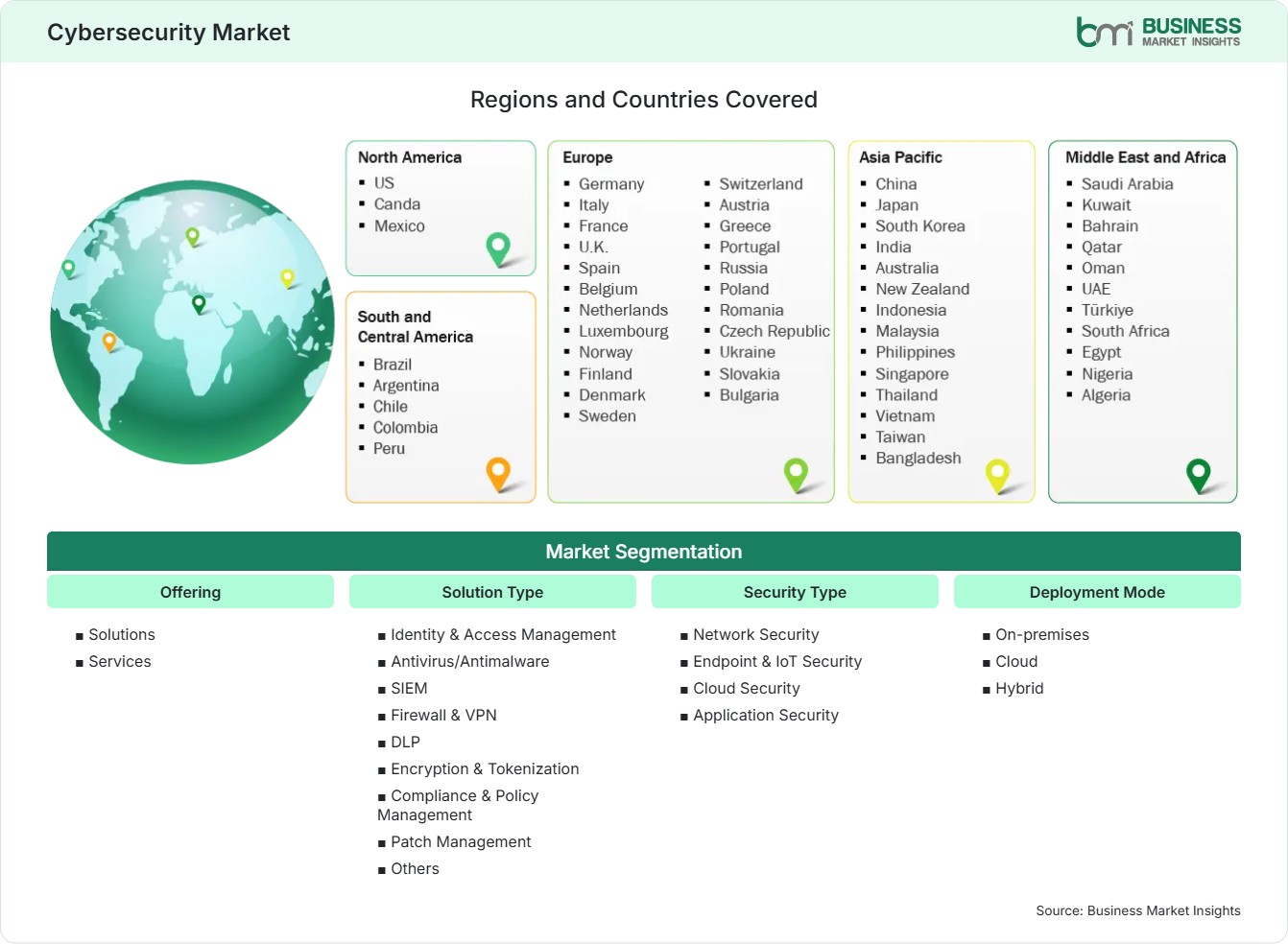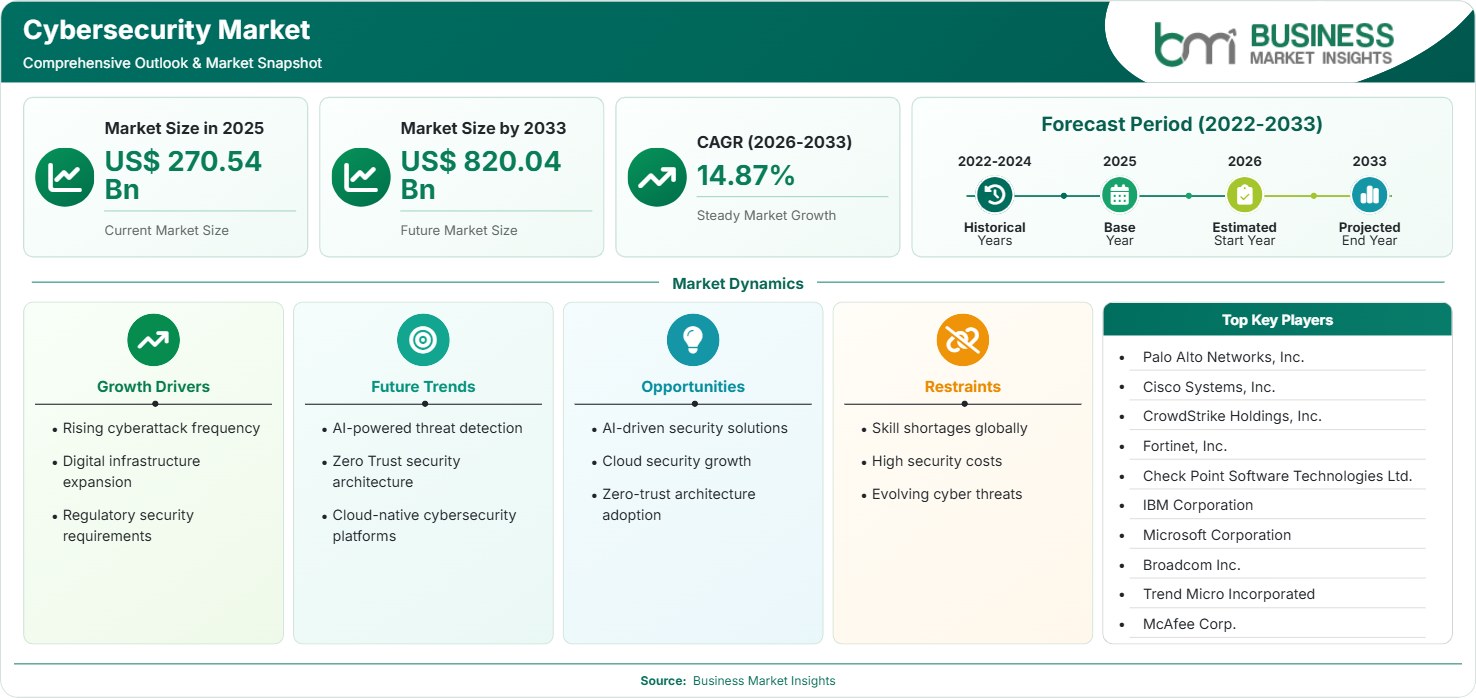
Cybersecurity Market Regional Highlights
North America Cybersecurity Market
North America captures 37%-40% of the total Cybersecurity Market Share in 2025 and is anticipated to have a CAGR of 13.5%-14.5% between 2026 and 2033. High cybersecurity expenditure by enterprises, high cloud computing penetration rate, strict regulatory framework, and use of AI-based threat detection solutions keep North America dominant in the field.
- Large corporations keep shifting away from a piecemeal approach to security towards unified cybersecurity platforms that incorporate endpoint, cloud, identity, and network security.
- Government cybersecurity efforts, critical infrastructure transformation projects, and more spending on financial services, healthcare, and defense are fueling the adoption of advanced threat intelligence.
- Rapid cloud migrations and hybrid work trends are driving demand for cloud-native application security, identity governance, access service edge, and XDR technologies across several industries.
- Managed security service providers are augmenting their security operations capabilities with artificial intelligence, helping companies cope with rising cyber threats amid a shortage of cybersecurity professionals.
US Cybersecurity Market
The US is the leading contributor in the North American region, accounting for 30%-33% of the global market by 2025, growing at a CAGR of 13.8%-14.6% through 2033. The ongoing initiatives in federal cybersecurity programs, development of cloud infrastructure, adoption of artificial intelligence, and rising demand for cyber resilience requirements support sustained Cybersecurity Market growth across the public and private sectors.
- Government agencies continue implementing Zero Trust Architecture mandates while expanding investments in identity security, continuous monitoring, and cyber resilience across defense, healthcare, and critical infrastructure.
- Financial institutions prioritize AI-enabled fraud detection, cloud security, and advanced authentication technologies to address increasingly sophisticated cyberattacks while meeting evolving regulatory compliance requirements.
- Technology providers accelerate innovation across generative AI security, automated threat hunting, and extended detection and response solutions to improve enterprise cyber defense capabilities.
- Large-scale cloud service adoption and expanding digital ecosystems continue driving investments in application security, API protection, and cloud workload security platforms across enterprises of all sizes.
Europe Cybersecurity Market
Europe holds 25%–28% of global revenue in 2025 and is expected to register a CAGR of 14.2%–15.2% between 2026 and 2033. Regional demand is supported by stringent data protection regulations, increasing digital sovereignty initiatives, and rising investments in critical infrastructure cybersecurity. Germany remains the leading Cybersecurity market, while Eastern European economies demonstrate faster adoption supported by accelerated digital transformation.
- Germany is leading adoption in its region by modernizing industrial cybersecurity, automating manufacturing operations, and adopting operational technology security.
- The United Kingdom is continuously growing its investments in cloud security, identity management, and managed detection services among financial and public sector organizations.
- France is investing more in cybersecurity through digital resilience programs, national cybersecurity strategies, and AI threat intelligence technologies.
- Poland and other Central and Eastern European countries have stronger growth rates due to digital infrastructure, cloud adoption, and cybersecurity.
- The adoption of GDPR, NIS2, and sector-specific compliance regulations is driving investments in governance, risk management, security monitoring, and incident response platforms.
Asia Pacific Cybersecurity Market
Asia Pacific captures 24%–27% of the global Cybersecurity market in 2025 and is projected to achieve the fastest CAGR of 16.5%–17.5% through 2033. Rapid enterprise digitalization, government-led cybersecurity initiatives, cloud adoption, and increasing cybercrime incidents continue driving investment across developed and emerging economies. China leads regional revenue generation, while India records the strongest long-term expansion.
- China continues investing heavily in cybersecurity technologies supporting digital infrastructure, industrial modernization, smart manufacturing, and national cyber resilience initiatives.
- India demonstrates the fastest regional expansion through accelerating cloud migration, fintech growth, expanding digital public infrastructure, and increasing enterprise cybersecurity investments.
- Japan strengthens cybersecurity spending to protect manufacturing, telecommunications, healthcare, and critical infrastructure.
- Australia and Singapore continue advancing cybersecurity maturity and enterprise adoption of zero-trust architectures.
- Growing SME digitalization across Southeast Asia creates substantial opportunities for cloud-delivered security, managed detection services, and subscription-based cybersecurity platforms.
Rest of World Cybersecurity Market
The Rest of World segment contributes 10%-12% of worldwide revenue in 2025 and is expected to grow at a CAGR of 15.0%-16.0% from 2026 to 2033. Digital transformation, infrastructure modernization, and growing cyberattacks are among the factors constantly driving investments in cybersecurity in South & Central America and the Middle East & Africa.
South & Central America observes an increase in cybersecurity spending across the financial services, telecom, and government verticals; the Middle East & Africa capitalize on smart cities initiatives, energy infrastructure security, and digital economy programs that accelerate enterprise security modernization.
- Brazil leads South & Central America through increasing investments in banking cybersecurity, cloud security platforms, and national cyber resilience programs.
- Saudi Arabia remains the leading Middle Eastern market, driven by Vision 2030 digital transformation initiatives.
- Increasing ransomware attacks against industries such as energy, utilities, healthcare, and finance continue to drive the need for companies to adopt zero-trust architecture, extended detection and response solutions, and managed security services.
- International compliance, investments in hyperscale data centers, and growth in digital transformation initiatives continue to present opportunities for cybersecurity platforms in developing countries.
- Growing partnerships between governments, telecommunications providers, cloud service companies, and cybersecurity vendors strengthen regional cyber resilience.