Market Summary
Executive Summary and Global Market Analysis
AI cybersecurity and electronic warfare help strengthen digital security systems, threat detection capabilities, and electronic defense operations across civilian and military environments. These technologies are used to identify cyber threats, automate incident response, analyze network vulnerabilities, detect electronic interference, and improve battlefield communication security. Increasing digital transformation, growing cyberattack frequency, and rising dependence on connected systems are supporting the adoption of AI-powered cybersecurity and electronic warfare solutions across industries.
Several operational and technological constraints continue to influence the AI Cybersecurity & Electronic Warfare market. The increasing complexity of cyber threats and evolving electronic attack techniques require continuous system upgrades and advanced algorithm training. Organizations often face challenges related to integration with legacy infrastructure, high deployment costs, and shortages of skilled cybersecurity professionals. Strict regulatory requirements associated with data privacy, national security, and digital infrastructure protection can also increase implementation complexity. In addition, concerns regarding false threat detection, AI model transparency, and operational reliability in high-risk defense environments continue to create adoption barriers for certain organizations and government agencies.
Despite these challenges, the market continues to expand due to increasing investments in intelligent defense systems and automated cybersecurity operations. Cloud-based deployment models are witnessing growing adoption because of their scalability, centralized monitoring capabilities, and remote threat management features. The defense and government sectors remain major adopters due to rising geopolitical tensions and increasing cyber warfare preparedness initiatives. BFSI and healthcare organizations are also investing in AI-driven cybersecurity solutions to protect sensitive data and critical infrastructure. Competitive activity within the market is focused on real-time threat analytics, automated response systems, predictive intelligence capabilities, and secure electronic communication technologies.
Segment Analysis
AI Cybersecurity & Electronic Warfare Market Segmentation
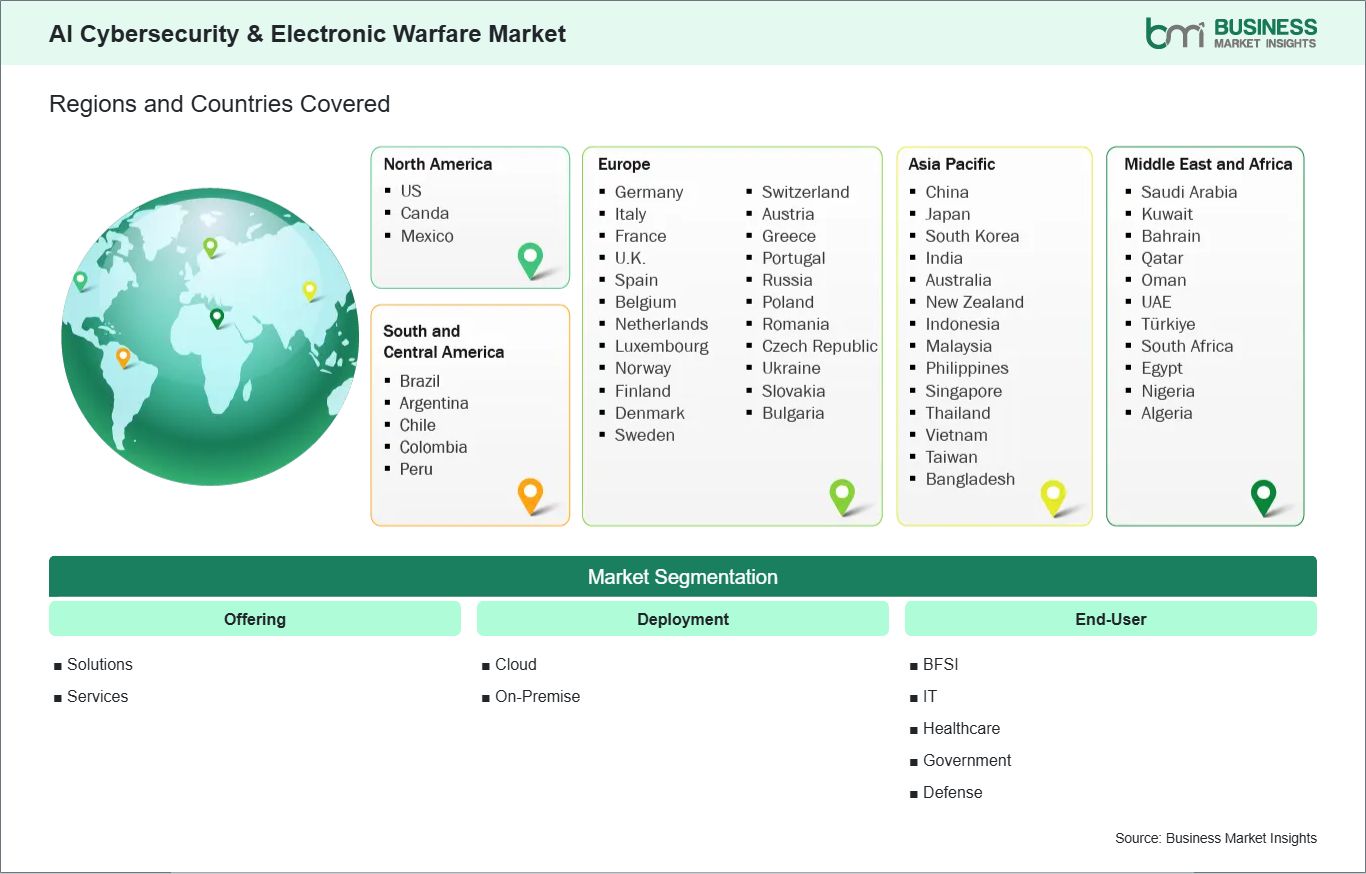
The AI Cybersecurity & Electronic Warfare market is segmented by offering, deployment, and end-user industries. Increasing digital security requirements and rising cyber threat activities are supporting demand across multiple industry verticals.
By Offering
- Solutions: Includes AI-powered threat detection, intrusion prevention, malware analysis, and electronic defense systems.
- Services: Covers consulting, managed security services, system integration, and maintenance support.
By Deployment
- Cloud: Increasingly adopted due to scalability, centralized monitoring, and remote accessibility advantages.
- On-Premise: Preferred by organizations requiring higher control over sensitive operational and defense data.
By End-User
- BFSI: Uses AI cybersecurity systems for fraud detection, transaction monitoring, and data protection.
- IT: Adopts advanced threat intelligence and network security solutions to protect digital infrastructure.
- Healthcare: Focuses on protecting patient data, connected medical devices, and healthcare networks.
- Government: Invests in cyber defense systems for national infrastructure protection and intelligence operations.
- Defense: Uses AI-driven electronic warfare systems for communication security, signal intelligence, and battlefield threat analysis.
Market Forces
AI Cybersecurity & Electronic Warfare Market Drivers and Opportunities
Increasing Cyber Threat Complexity and Digital Defense Investments
The rapid growth of connected digital infrastructure and cloud-based operations has significantly increased the risk of cyberattacks across industries. Organizations are facing sophisticated threats such as ransomware, phishing campaigns, data breaches, and electronic interference attacks, creating strong demand for AI-powered cybersecurity and electronic warfare solutions. Artificial intelligence technologies help organizations detect abnormal network activity, automate threat response, and improve predictive threat intelligence capabilities. Governments and defense agencies are also increasing investments in intelligent cyber defense systems to strengthen national security and protect critical communication infrastructure.
The growing adoption of remote work environments, connected industrial systems, and digital financial platforms is further increasing the need for advanced cybersecurity technologies. AI-driven systems enable real-time monitoring and automated analysis of large volumes of network data, improving operational efficiency and reducing response times. Regulatory frameworks related to data privacy and cyber resilience are also encouraging organizations to modernize their security infrastructure. As cyber threats continue to evolve in complexity and scale, AI-based defense technologies are expected to become increasingly important across commercial and military environments.
Expansion of AI-Driven Threat Intelligence and Autonomous Defense Systems
Advancements in machine learning, behavioral analytics, and predictive intelligence technologies are creating significant opportunities for the AI Cybersecurity & Electronic Warfare market. Organizations are increasingly investing in autonomous threat detection systems capable of identifying cyber risks and electronic attacks without continuous manual intervention. AI-powered cybersecurity platforms are improving operational efficiency by automating repetitive security tasks, reducing false alarms, and strengthening incident response capabilities.
The growing development of smart defense systems and connected military platforms is also creating opportunities for advanced electronic warfare technologies. Defense organizations are focusing on AI-enabled communication protection, signal intelligence, and electronic countermeasure systems to improve battlefield readiness and mission security. Increasing adoption of cloud-native security platforms and zero-trust security architectures is further expanding the market potential for intelligent cybersecurity technologies.
Emerging innovations in quantum-resistant encryption, AI-based network analytics, and automated vulnerability assessment systems are expected to support long-term market growth. As industries continue to prioritize digital resilience and operational security, demand for integrated AI cybersecurity and electronic warfare solutions is expected to increase across both civilian and defense sectors.
Size and Share Analysis
AI Cybersecurity & Electronic Warfare Market Size and Share Analysis
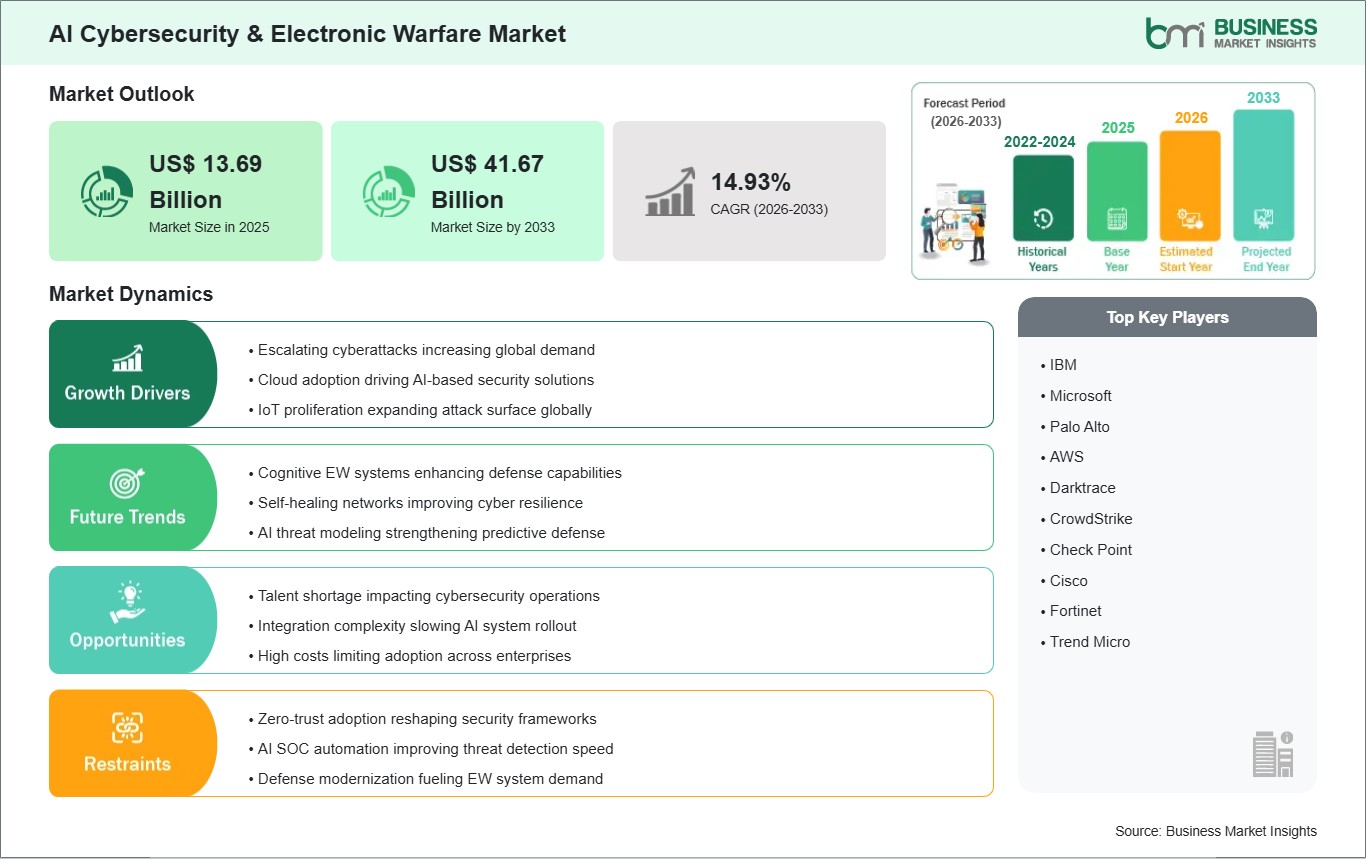
The AI Cybersecurity & Electronic Warfare Market is projected to grow from US$ 13.69 Billion in 2025 to US$ 41.67 Billion by 2033 , registering a CAGR of 14.93% from 2026 to 2033.
By offering, solutions hold a significant share due to increasing demand for AI-powered threat intelligence, malware detection, and automated response systems. Services are also witnessing rising demand as organizations seek managed security support, consulting, and integration services for complex cybersecurity environments. By deployment, cloud-based solutions account for a considerable share of the market because of their scalability, centralized monitoring capabilities, and flexibility in remote security management. On-premise deployment continues to maintain importance among government and defense organizations requiring higher control over sensitive operational data.
By end-user, government and defense sectors remain major adopters of AI Cybersecurity & Electronic Warfare solutions due to increasing cyber warfare preparedness initiatives and national security requirements. BFSI and healthcare industries are also expanding investments in intelligent cybersecurity systems to protect critical infrastructure and sensitive customer information. Continuous advancements in AI-driven analytics, autonomous defense technologies, and secure digital communication platforms are expected to support long-term market growth.
Report Coverage
AI Cybersecurity & Electronic Warfare Market Report Coverage and Deliverables
The "AI Cybersecurity & Electronic Warfare Size and Forecast (2022-2033)" report provides a detailed analysis of the market covering below areas:
- Market size and forecast at global, regional, and country levels for all the key market segments covered under the scope
- Market trends, as well as market dynamics such as drivers, restraints, and key opportunities
- Market analysis covering key market trends, global and regional framework, major players, regulations, and recent market developments
- Industry landscape and competition analysis covering market concentration, heat map analysis, prominent players, and recent developments for the market
- Detailed company profiles, including SWOT analysis
Geographic Insights
AI Cybersecurity & Electronic Warfare Market Geographic Insights
The AI Cybersecurity & Electronic Warfare Market shows diverse regional adoption patterns influenced by digital transformation initiatives, defense modernization programs, cyber threat levels, and investments in intelligent security infrastructure.
North America represents a mature market for AI Cybersecurity & Electronic Warfare solutions due to strong digital infrastructure, advanced defense capabilities, and increasing investments in cybersecurity modernization. The United States continues to lead adoption with significant focus on national cyber defense programs, cloud security infrastructure, and AI-powered intelligence systems. Government agencies and defense organizations are actively investing in electronic warfare technologies and automated threat detection platforms to strengthen operational readiness. Canada is also witnessing increasing adoption across financial institutions, healthcare systems, and public infrastructure protection initiatives. The presence of advanced technology providers and strong regulatory focus on cybersecurity resilience continue to support regional market maturity.
Asia Pacific is witnessing strong growth due to increasing digitalization, expanding internet infrastructure, and rising cybersecurity concerns across developing and developed economies. Countries such as China, India, Japan, and South Korea are strengthening investments in AI-driven cybersecurity systems and electronic defense technologies to protect critical infrastructure and communication networks. Financial institutions and IT companies across the region are adopting intelligent threat monitoring systems to improve operational security and reduce cyber risks. Defense modernization initiatives and increasing geopolitical tensions are also supporting demand for advanced electronic warfare capabilities. Growing cloud adoption, smart city development, and digital government programs continue to create opportunities for intelligent cybersecurity technologies across the region.
Industry Activity
Recent Developments
The AI Cybersecurity & Electronic Warfare Market is analyzed using a mix of primary and secondary research sources, including corporate publications, industry associations, and verified databases. This approach ensures accurate tracking of innovation trends and strategic developments influencing the market.
- In February 2024, Palo Alto Networks announced expanded AI-driven cybersecurity capabilities through enhancements in its threat detection and automated security operations platform. The development focused on improving real-time threat intelligence, incident response efficiency, and cloud security operations for enterprise customers. The initiative highlighted the growing importance of AI-powered cybersecurity technologies in modern digital infrastructure protection.
- In October 2023, Lockheed Martin announced advancements in electronic warfare and AI-enabled defense systems to strengthen military communication security and threat detection capabilities. The development supported modernization efforts in defense intelligence and electronic protection technologies. The initiative reflected increasing investments in AI-driven electronic warfare solutions across defense operations.
Trust & Transparency
Research Methodology
The market analysis combines proprietary research with secondary data from government agencies, company disclosures, regulatory filings, industry databases and expert interviews. Market estimates are validated through data triangulation, cross-market benchmarking and analyst
review.
View Full Research Methodology
Key Sources Referred:
World Bank - Global Trade Indicators World Trade Organization (WTO) International Monetary Fund (IMF) International Trade Administration (ITA) Company Websites Company Annual Reports Company Investor Presentations