
Industrial Cybersecurity Market Outlook: Size, Share, Trends, Growth Analysis, Competitive Landscape & Forecast, 2026-2033

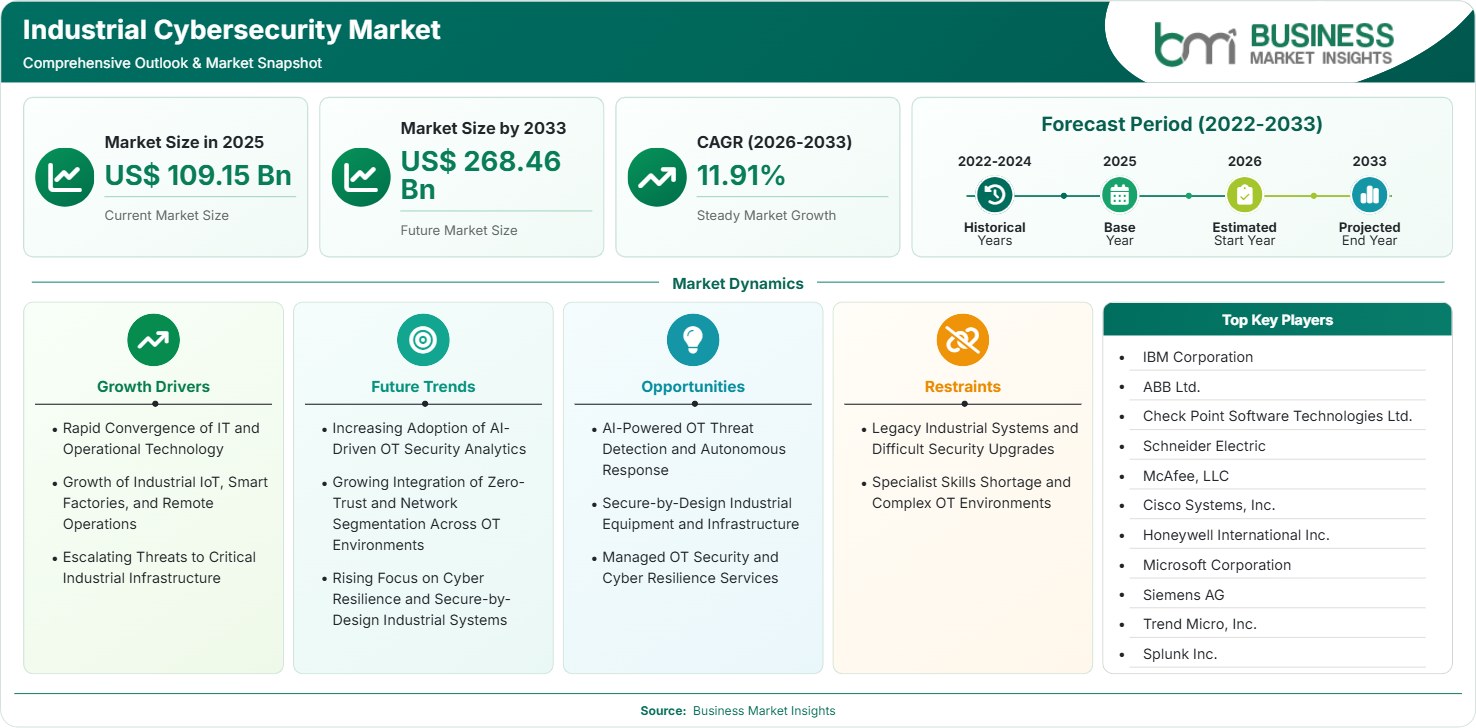
The Industrial Cybersecurity Market size was valued at US$ 109.15 Billion in 2025 and is projected to reach US$ 268.46 Billion by 2033, growing at a CAGR of 11.91% during 2026–2033, driven by OT connectivity, ransomware, Industry 4.0, cloud migration, critical infrastructure protection, AI adoption, and regulatory requirements.

Report Coverage
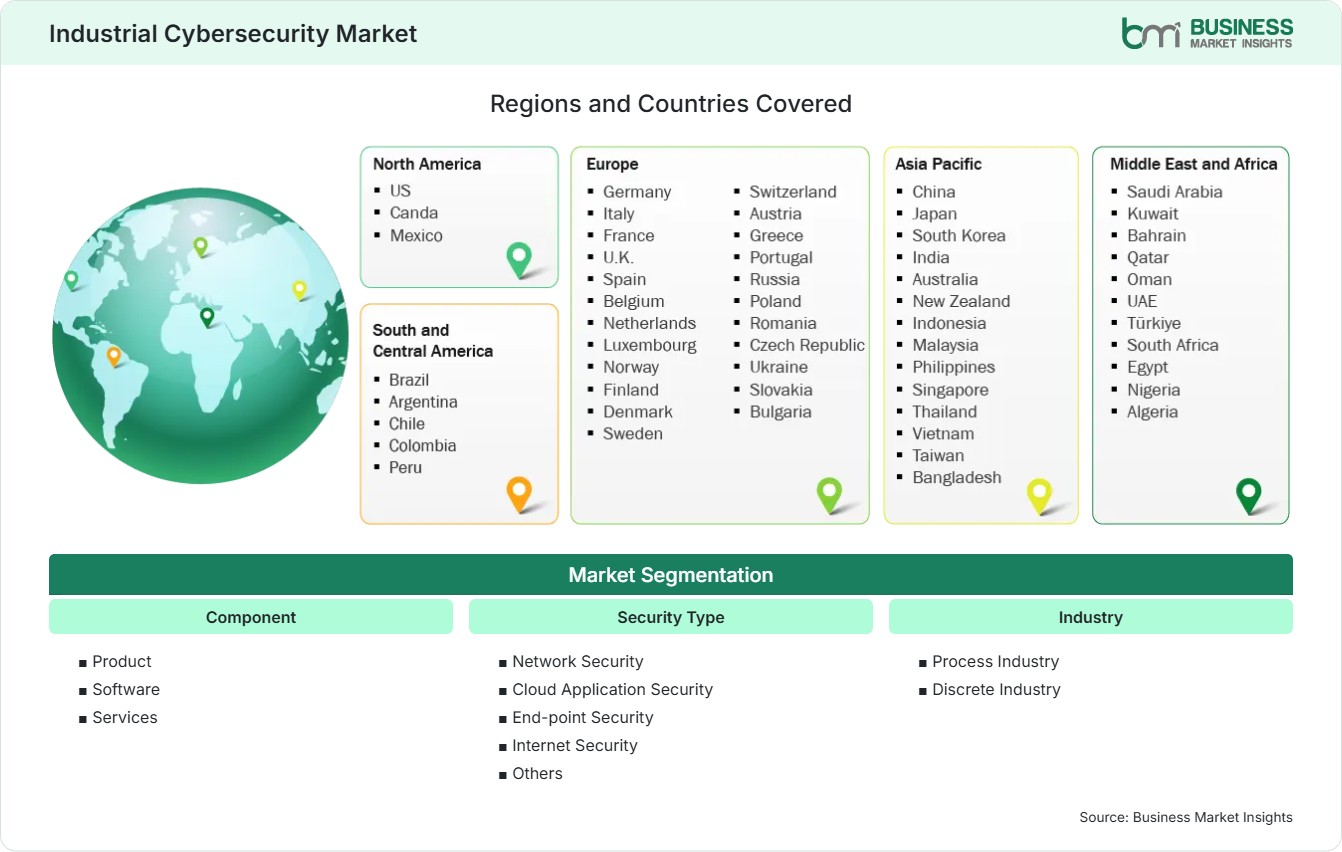
  • Component: Product, Software, Services
  • Security Type: Network Security, Cloud Application Security, End-point Security, Internet Security, Others
  • Industry: Process Industry, Discrete Industry
US$ 109.15 Bn Market size in 2025
US$ 268.46 Bn Market Size by 2033
11.91% CAGR, 2026 - 2033
2026-2033 Forecast Period

AI Overview

Industrial Cybersecurity Market Summary

  • North America Region: North America holds a 34%–38% share in 2025 and records a 10.9%–11.7% CAGR during 2026–2033. Critical-infrastructure protection, manufacturing modernization, cloud adoption, advanced security operations, zero-trust programs, and OT visibility investments support regional leadership.
    The U.S. dominates regional demand, recording a 11.0%–11.8% CAGR through 2033, driven by manufacturing, energy, utilities, defense, and critical-infrastructure cybersecurity requirements.
  • Fastest Growing Region: Asia Pacific holds a 25%–29% share in 2025 and records a 13.6%–14.8% CAGR during 2026–2033. Smart-factory expansion, industrial IoT, manufacturing digitization, infrastructure investment, connected operational technology, rising cyber threats, and national cybersecurity initiatives accelerate adoption.
  • Leading Segment: Product holds a 51%–55% share in 2025 and records an 11.2%–11.8% CAGR during 2026–2033. Network protection, endpoint security, secure gateways, intrusion detection, vulnerability management, and industrial firewalls remain essential as operational environments become increasingly connected.
  • High Growth Segment: Services holds a 17%–21% share in 2025 and records a 13.8%–14.7% CAGR during 2026–2033. Managed security, threat monitoring, incident response, vulnerability assessment, OT consulting, compliance services, and continuous security operations support complex industrial environments.
  • Key Market Opportunity: OT-aware AI security, asset discovery, secure remote access, zero-trust architectures, industrial threat intelligence, managed detection, cyber resilience, and convergence of IT and OT security offer significant opportunities.
  • Major Market Players: IBM Corporation, ABB Ltd., Check Point Software Technologies Ltd., Schneider Electric, McAfee, LLC, Cisco Systems, Inc., Honeywell International Inc., Microsoft Corporation, Siemens AG, Trend Micro, Inc., Splunk Inc., Rockwell Automation, Inc., Bayshore Networks, Inc., Broadcom Inc., Kaspersky Lab, Dell Inc., Proofpoint, Inc., FireEye, Inc., Symantec Corporation, and Palo Alto Networks, Inc.
Strategic Insights

Industrial Cybersecurity Market: Strategic Insights

Industrial Cybersecurity Market Strategic Framework
FREE PDF
Request your free sample
Request free sample
Stakeholder View

Key Takeaways

  • The value chain is shifting from standalone security products toward integrated platforms combining OT asset discovery, network monitoring, endpoint protection, secure remote access, vulnerability management, managed services, and incident response.
  • Services offer strong growth potential as industrial operators increasingly require continuous monitoring, threat hunting, vulnerability assessment, incident response, and specialized OT expertise that internal IT teams may lack.
  • Technology innovation increasingly focuses on AI-assisted anomaly detection, behavioral analytics, secure-by-design equipment, identity-based access, micro segmentation, automated remediation, and IT-OT-cloud integration.
  • Asia Pacific offers strong expansion potential as advanced manufacturing, automation, critical infrastructure, and smart-factory investments accelerate across major industrial economies.
  • Competition is shifting toward integrated platforms and ecosystem partnerships, with automation and cybersecurity providers increasingly collaborating to deliver connected industrial protection.
Geographic Outlook

Industrial Cybersecurity Market Regional Highlights

North America Industrial Cybersecurity Market

North America holds a 34%–38% Industrial Cybersecurity Market share in 2025 and records a 10.9%–11.7% CAGR during 2026–2033. Growth is supported by mature industrial automation, critical infrastructure, cybersecurity investment, and advanced security operations. The US remains the leading market, while Canada contributes through energy, utilities, mining, and manufacturing.

  • Manufacturers are prioritizing OT network visibility as legacy systems often lack modern security telemetry.
  • Energy and utilities are strengthening segmentation, identity controls, remote access, and vulnerability management.
  • Defense and aerospace require specialized protection for sensitive engineering and production environments.
  • Managed security services are gaining adoption because many industrial organizations lack specialized OT expertise.

US Industrial Cybersecurity Market

The US represents 82%–86% of North American demand in 2025 and records an 11.0%–11.8% CAGR during 2026–2033. Advanced manufacturing, critical infrastructure, cloud adoption, mature cybersecurity providers, and government focus on resilience support demand across energy, utilities, transportation, defense, chemicals, and manufacturing.

  • Manufacturers are adopting network segmentation and identity-based controls to limit movement between IT and OT environments.
  • Federal initiatives are strengthening OT resilience, vulnerability coordination, incident recovery, and secure technology procurement.
  • Ransomware risks are increasing demand for backups, recovery planning, incident response, and continuous monitoring.

Europe Industrial Cybersecurity Market

Europe holds a 27%–30% Industrial Cybersecurity Market share in 2025 and records a 10.4%–11.2% CAGR during 2026–2033. Germany, the UK, France, Italy, the Netherlands, Sweden, and Switzerland are major markets, supported by advanced manufacturing and stringent cybersecurity requirements.

  • Germany offers strong opportunities across manufacturing, automotive, machinery, automation, and industrial software.
  • The UK is strengthening cyber resilience across energy, transportation, manufacturing, and critical infrastructure.
  • France and Italy benefit from aerospace, automotive, energy, utilities, and industrial modernization.
  • Nordic markets emphasize secure automation, connected infrastructure, and cybersecurity-by-design.

Asia Pacific Industrial Cybersecurity Market

Asia Pacific holds a 25%–29% Industrial Cybersecurity Market share in 2025 and records a 13.6%–14.8% CAGR during 2026–2033, making it the fastest-growing region. China, Japan, India, South Korea, Singapore, and Southeast Asia are key markets. Smart factories, IIoT, automation, cloud adoption, and government cybersecurity initiatives are supporting demand.

  • China benefits from smart manufacturing, robotics, IIoT, connected factories, and critical infrastructure development.
  • India is expanding cybersecurity across manufacturing, energy, transportation, pharmaceuticals, automotive, and smart-city projects.
  • Japan and South Korea offer strong demand across electronics, automotive, robotics, semiconductors, and utilities.
  • Southeast Asia is increasing investment in automation, logistics, energy, and electronics manufacturing.

Rest of World Industrial Cybersecurity Market

Rest of World holds a 14%–17% share in 2025 and records a 9.0%–10.1% CAGR during 2026–2033. Latin America is expanding through mining, oil and gas, manufacturing, utilities, and infrastructure modernization. Middle Eastern markets are investing in energy, petrochemicals, and industrial diversification, while Africa offers emerging opportunities across mining, utilities, and manufacturing.

  • Brazil offers opportunities across energy, mining, manufacturing, chemicals, utilities, and infrastructure.
  • Mexico benefits from manufacturing expansion across automotive, electronics, aerospace, and industrial logistics.
  • Gulf economies are investing in energy, petrochemicals, smart infrastructure, and managed security services.
  • African markets offer long-term potential in mining, utilities, telecommunications, and manufacturing, despite uneven cybersecurity maturity.
Global Market Geography
FREE PDF
Request your free sample
Request free sample
Segment Analysis

Industrial Cybersecurity Market Segmentation

Component

Product holds a 51%–55% share in 2025 and records an 11.2%–11.8% CAGR during 2026–2033. Software and services are expanding as industrial organizations require continuous visibility, advanced analytics, managed monitoring, and specialized incident response. Product demand remains foundational because industrial networks require dedicated firewalls, intrusion detection, secure gateways, endpoint controls, and vulnerability technologies designed around OT constraints. Industrial Cybersecurity Market scope is increasingly expanding from plant-level protection to enterprise-wide industrial resilience.

  • Product: Hardware and embedded security technologies protect industrial networks, devices, endpoints, and communication paths while supporting availability and deterministic operational requirements.
  • Software: Security software provides asset discovery, vulnerability management, monitoring, analytics, incident detection, policy enforcement, and centralized management across geographically distributed industrial environments.
  • Services: Consulting, managed security, assessment, integration, incident response, threat hunting, compliance, and lifecycle support address the specialist capabilities many industrial organizations lack internally.

Security Type

Network Security holds a 31%–35% share in 2025 and records an 11.5%–12.1% CAGR during 2026–2033 because industrial communication architectures remain highly dependent on network segmentation and controlled connectivity. Cloud Application Security is the fastest-growing security category as plants adopt cloud applications, remote operations, and industrial platforms. Endpoint security remains important for engineering workstations, HMIs, industrial PCs, and connected devices. Internet security and related technologies strengthen broader perimeter and access protection.

  • Network Security: Industrial firewalls, segmentation, intrusion detection, secure gateways, and traffic monitoring reduce lateral movement and help protect critical OT communication paths.
  • Cloud Application Security: Security controls protect cloud-connected industrial applications, data, APIs, remote services, and hybrid architectures linking production systems with enterprise platforms.
  • End-point Security: Endpoint protection secures engineering workstations, industrial PCs, HMIs, servers, and connected devices against malware, unauthorized access, and suspicious behavior.
  • Internet Security: Internet-facing assets require secure browsing, remote access, email protection, threat intelligence, and policy controls as industrial organizations interact with external networks.
  • Others: Additional capabilities include identity security, data protection, industrial deception, security information and event management, vulnerability intelligence, and specialized resilience technologies.

Industry

Process Industry holds a 57%–61% share in 2025 and records a 11.7%–12.3% CAGR during 2026–2033 because oil and gas, chemicals, pharmaceuticals, utilities, mining, and food processing rely heavily on continuous operations. Discrete Industry records faster modernization as automotive, aerospace, electronics, machinery, and robotics adopt connected production systems. Industrial Cybersecurity Market trends increasingly reflect risk-based segmentation because process facilities prioritize safety and availability, while discrete manufacturers emphasize production continuity, intellectual property, and flexible automation.

  • Process Industry: Oil and gas, chemicals, utilities, pharmaceuticals, mining, and food facilities require highly resilient security because disruption can affect continuous processes, safety systems, production quality, and physical assets.
  • Discrete Industry: Automotive, aerospace, electronics, machinery, and consumer-product manufacturing increasingly connect robots, PLCs, sensors, production software, and supply-chain systems, expanding the attack surface.
Market Forces

Industrial Cybersecurity Market Dynamics

Key Market Drivers

Rapid Convergence of IT and Operational Technology

Industrial facilities increasingly connect control systems with enterprise applications, cloud platforms, remote-service tools, IIoT devices, analytics environments, and centralized management systems. This connectivity improves operational efficiency but creates additional pathways into production systems. OT security must protect availability, reliability, safety, recovery, industrial protocols, and control-system dependencies. As a result, businesses are adopting network segmentation, identity-based access, secure remote connectivity, asset management, and specialized monitoring. With digital engineering becoming more integrated with production, cybersecurity is now an essential part of operational resilience. This structural shift is supporting Industrial Cybersecurity Market growth as organizations strengthen protection across connected industrial environments.

Growth of Industrial IoT, Smart Factories, and Remote Operations

Smart manufacturing is expanding the use of connected machines, sensors, robotics, digital twins, edge computing, private 5G, and cloud platforms across industrial environments. These technologies improve visibility and productivity but increase the number of connected assets and potential vulnerabilities. Remote management and distributed operations further increase the need for authentication, access control, monitoring, and session management. Industrial operators increasingly require scalable security solutions across multiple facilities, production lines, vendors, and connected devices without disrupting operations. Consequently, demand is rising for asset discovery, vulnerability management, network analytics, managed detection, and security orchestration. These developments are shaping Industrial Cybersecurity Market trends as security becomes embedded within smart-factory modernization.

Escalating Threats to Critical Industrial Infrastructure

Industrial control systems face growing cyber risks that can disrupt physical operations, create safety concerns, cause financial losses, and extend recovery periods. Energy grids, production plants, water systems, transport infrastructure, and chemical plants are appealing targets because disruptions can interfere with essential services and physical operations. Industrial equipment that is exposed and remote access systems can provide additional chances for attacks, whereas automated attack methods can hasten the process of reconnaissance and exploitation. Therefore, there is a need for security technologies that will be able to detect abnormal commands, unauthorized configuration changes, anomalous network behavior, and suspicious accesses.

Key Market Opportunities

AI-Powered OT Threat Detection and Autonomous Response

Artificial intelligence provides an opportunity to strengthen industrial threat detection by identifying unusual patterns across machines, network traffic, user activity, control commands, and process states. AI models can establish behavioral baselines, prioritize alerts, reduce false positives, and accelerate incident response. Security platforms can increasingly incorporate behavioral analytics, automated triage, attack-path analysis, and response guidance to help teams manage complex OT environments. The strongest opportunity lies in applying AI to OT telemetry without interfering with legitimate production activities. This expansion is expected to broaden the Industrial Cybersecurity Market Forecasts as organizations seek faster detection, improved threat prioritization, and more efficient security operations.

Secure-by-Design Industrial Equipment and Infrastructure

Cybersecurity is increasingly being incorporated into the design and procurement of industrial equipment, creating opportunities for manufacturers and security providers. Consumers are demanding PLCs, drives, control systems, gateways, sensors, industrial PCs, and networking equipment that have security baked in, with enhanced authentication capabilities, secure update capabilities, certificate management, and lifecycle management. Secure by design approaches make it less reliant on supplementary controls once the equipment is in place, enhancing security within the connected production environments. OEMs can gain advantage by providing security certification, vulnerability management program, software bill of material, secure development process, and security maintenance beyond the product’s standard lifecycle.

Managed OT Security and Cyber Resilience Services

Many industrial organizations lack sufficient OT cybersecurity expertise to provide continuous monitoring across diverse facilities, legacy systems, specialized protocols, and distributed operations. These capabilities can be filled by managed security services that include remote monitoring, threat hunting, vulnerability assessments, incident response services, compliance assistance, and virtual security operations. Customer demand is especially significant in the case of manufacturing companies, utilities, industrial suppliers, and companies that go through digital transformation without large security departments. With growing complexity of cyber threats, customers are focusing on fast detection, lower exposure, and resiliency instead of just security products.

Market Restraints

Legacy Industrial Systems and Difficult Security Upgrades

Factor: Many industrial facilities rely on legacy PLCs, SCADA systems, engineering workstations, embedded devices, and proprietary control technologies that lack modern cybersecurity capabilities.

Impact: Operators may avoid frequent patching because changes can disrupt production, affect certifications, or create instability. Older systems may lack authentication, encryption, logging, and secure update mechanisms. Security upgrades can require network redesign, compensating controls, or equipment replacement, increasing costs and complexity. Long equipment lifecycles further delay modernization. Vendors must therefore provide passive monitoring, segmentation, secure gateways, and virtual patching that strengthen protection without disrupting critical operations.

Specialist Skills Shortage and Complex OT Environments

Factor: Industrial cybersecurity requires expertise in security operations, industrial networking, control systems, engineering processes, safety, and operational technology.

Impact: Organizations may struggle to recruit professionals capable of identifying OT risks, analyzing industrial protocols, investigating anomalies, and managing incidents without affecting production. Conventional IT tools may generate irrelevant alerts or misinterpret industrial activity. Skills shortages can delay vulnerability assessments, segmentation, monitoring, and compliance initiatives. Managed security services, remote support, training, and standardized architectures can address these gaps, although reliance on external expertise may increase operating costs for facilities requiring continuous protection.

Company Analysis

Competitive Landscape

The Industrial Cybersecurity Market analysis reflects a broad competitive ecosystem spanning enterprise cybersecurity providers, industrial automation companies, networking specialists, cloud platforms, endpoint vendors, security analytics companies, and OT-focused specialists. Competitive differentiation increasingly depends on OT protocol awareness, asset visibility, AI capabilities, industrial partnerships, managed services, secure-by-design engineering, threat intelligence, and integration with existing plant systems.

Company Name

Overview

Products and Services Relevant to this Market

IBM Corporation

Technology company offering cybersecurity, AI, cloud, consulting, and enterprise security solutions.

IBM Security, X-Force, threat intelligence, AI-assisted security, managed services, incident response, and OT cybersecurity consulting.

ABB Ltd.

Industrial automation and electrification company integrating cybersecurity into automation and digital industrial systems.

ABB Ability cybersecurity, System 800xA security, industrial network protection, vulnerability management, secure automation, and cybersecurity services.

Check Point Software Technologies Ltd.

Cybersecurity provider offering network, cloud, endpoint, and threat-prevention solutions applicable to industrial environments.

Firewalls, network security, cloud security, endpoint protection, secure access, threat prevention, and industrial network defense.

Schneider Electric

Energy-management and industrial-automation company integrating cybersecurity across OT and industrial digital platforms.

EcoStruxure security, industrial control protection, network security, secure automation, vulnerability management, monitoring, and cybersecurity consulting.

McAfee, LLC

Cybersecurity company focused on endpoint protection, threat prevention, and security technologies for connected environments.

Endpoint security, threat prevention, vulnerability protection, security analytics, and cyber protection services.

Cisco Systems, Inc.

Networking and cybersecurity company providing visibility, segmentation, identity, and threat protection for connected industrial environments.

Industrial Ethernet, firewalls, network segmentation, identity security, intrusion prevention, and OT visibility.

Honeywell International Inc.

Industrial technology company with process-control expertise and cybersecurity solutions for operational technology environments.

Honeywell Forge Cybersecurity, OT monitoring, industrial control protection, secure remote access, vulnerability management, and managed security.

Microsoft Corporation

Technology and cloud provider extending cybersecurity across industrial IoT, edge, identity, and enterprise environments.

Microsoft Defender, Sentinel, Entra, Azure security, IoT security, OT monitoring, threat intelligence, and cloud protection.

Siemens AG

Industrial technology company embedding cybersecurity across automation, industrial networks, edge platforms, and connected infrastructure.

Industrial cybersecurity, SINEC security, Industrial Edge security, OT network protection, private 5G security, and secure automation.

Trend Micro, Inc.

Cybersecurity provider offering endpoint, network, cloud, and specialized industrial security capabilities.

Trend Micro cybersecurity platform, industrial security, endpoint protection, network defense, cloud security, threat intelligence, and managed security.

Splunk Inc.

Security and observability technology provider integrated into Cisco, supporting data-driven threat detection and security monitoring.

Security analytics, SIEM, threat detection, machine-data analysis, incident investigation, observability, and OT-relevant security monitoring.

Trust & Transparency

Research Methodology

The market analysis combines proprietary research with secondary data from government agencies, company disclosures, regulatory filings, industry databases and expert interviews. Market estimates are validated through data triangulation, cross-market benchmarking and analyst review.

View Full Research Methodology

Questions Answered

Frequently Asked Questions

How should investors use an Industrial Cybersecurity Market Report?

Investors should assess OT exposure, industrial digitization, security architecture, product-service mix, sector demand, regional manufacturing intensity, regulations, managed-security adoption, recurring service revenue, vendor partnerships, and AI-enabled security capabilities.

How important is IT and OT network convergence?

IT and OT convergence enable data exchange between business applications, cloud services, connected machines, and control systems but expands attack surfaces. Segmentation, identity management, monitoring, and secure remote access are therefore increasingly important.

Why are industrial cybersecurity services growing rapidly?

Many industrial companies lack specialized OT security personnel and continuous monitoring capabilities. Managed services provide access to threat analysts, incident-response specialists, vulnerability experts, and industrial-security expertise while allowing internal teams to focus on production.

How is OT cybersecurity different from traditional IT security?

OT security prioritizes availability, safety, deterministic operations, process integrity, and equipment reliability. Unlike conventional IT controls, OT solutions must address industrial protocols, legacy systems, long equipment lifecycles, and physical-process risks.

What is driving demand for industrial cybersecurity?

Industrial digitalization, connected machinery, IIoT, cloud integration, remote access, ransomware, critical-infrastructure attacks, and regulatory requirements are driving demand. Operators increasingly require security solutions that protect operational continuity, safety, and process integrity.

Access the Full Industrial Cybersecurity Market Report

Get segment-level forecasts, regional estimates, competitive benchmarking, company profiles and downloadable Excel datasets.

Access the full Industrial Cybersecurity Market Report
350 pages PDF & Excel | 2026-09-02
Similar Research

Related Market Reports