
Oil & Gas Cybersecurity Market Outlook: Size, Share, Trends, Growth Analysis, Competitive Landscape & Forecast, 2026-2033

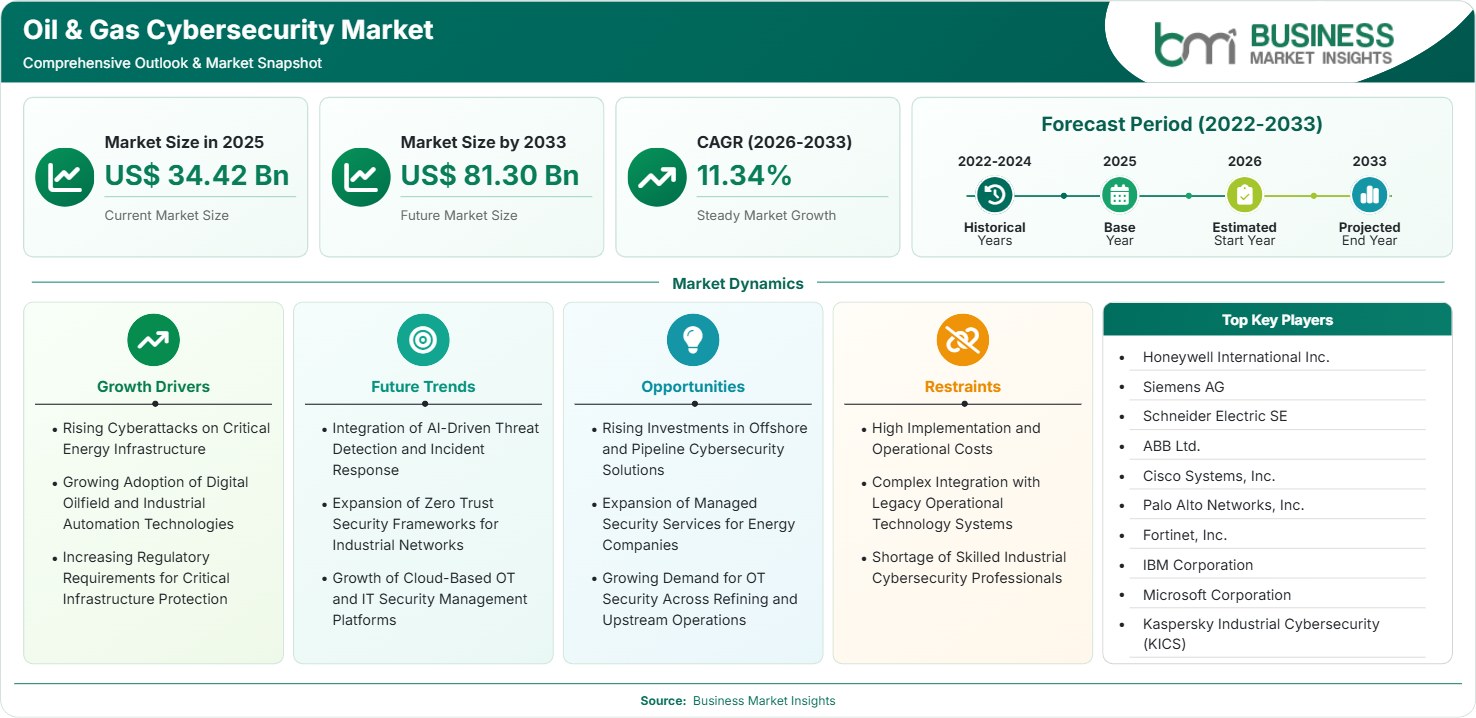
The Oil & Gas Cybersecurity Market size was valued at US$ 34.42 Billion in 2025 and is projected to reach US$ 81.30 Billion by 2033, growing at a CAGR of 11.34% during 2026–2033. Increasing cyber threats targeting critical energy infrastructure, growing digitalization of oil and gas operations, rising adoption of industrial automation technologies, and expanding regulatory requirements for cybersecurity compliance are supporting market growth globally.

Report Coverage
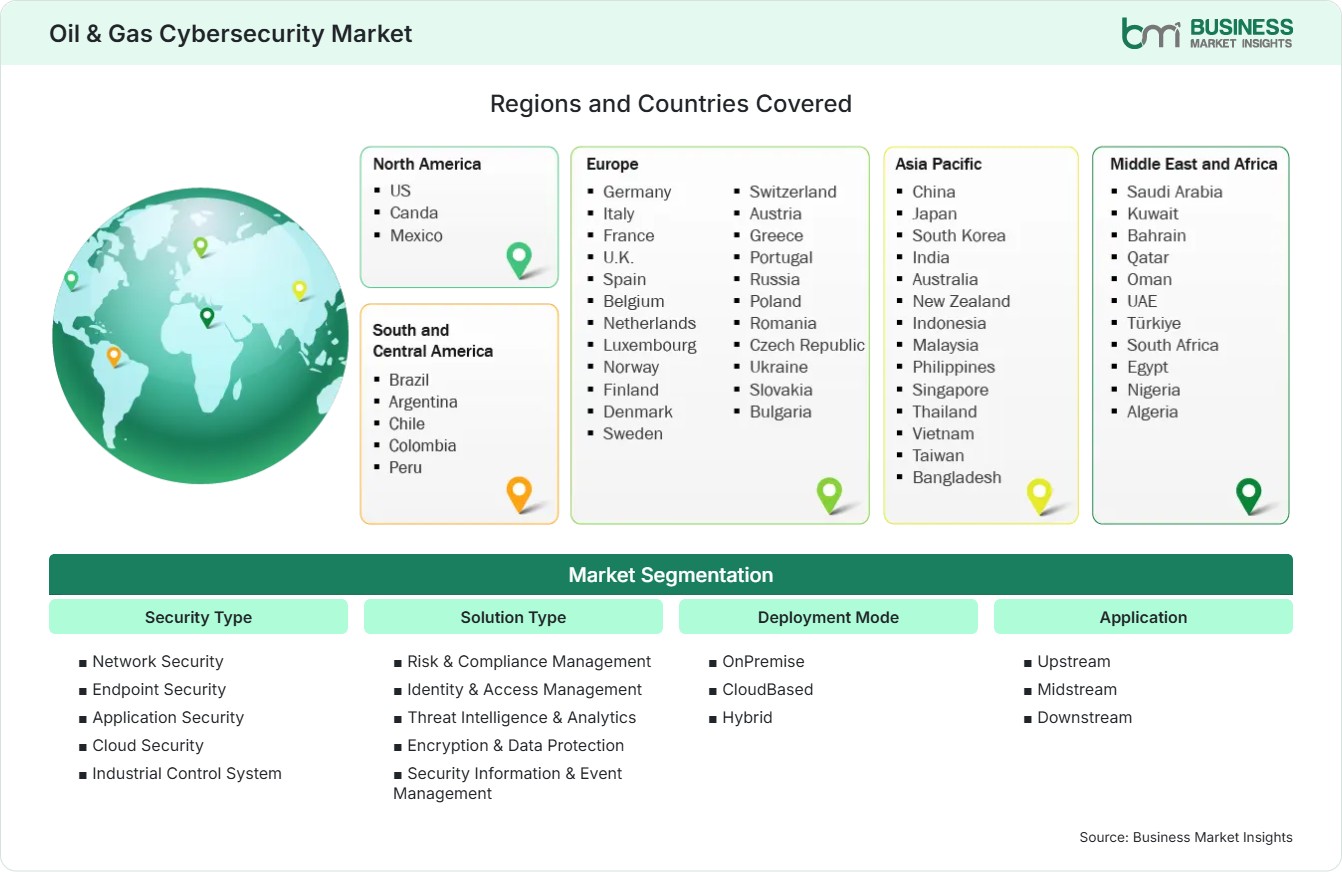
  • Security Type: Network Security, Endpoint Security, Application Security, Cloud Security, Industrial Control System
  • Solution Type: Risk & Compliance Management, Identity & Access Management , Threat Intelligence & Analytics, Encryption & Data Protection, Security Information & Event Management
  • Deployment Mode: OnPremise, CloudBased, Hybrid
  • Application: Upstream , Midstream , Downstream
US$ 34.42 Bn Market size in 2025
US$ 81.30 Bn Market Size by 2033
11.34% CAGR, 2026 - 2033
2026-2033 Forecast Period

AI Overview

Oil & Gas Cybersecurity Market Summary

  • North America Region: North America holds a market share of 38%–41% in 2025, growing with a CAGR of 10.9%–11.6% during 2026–2033. Strong cybersecurity investments, widespread deployment of industrial control systems, and increasing energy infrastructure protection initiatives continue supporting regional leadership. The U.S. oil & gas cybersecurity market is expected to register a CAGR of 11.1%–11.8%.
  • Fastest Growing Region: Asia Pacific accounts for 27%–30% share in 2025 and is projected to grow at a CAGR of 12.1%–12.8% through 2033. Expanding energy infrastructure, rising cyber risk awareness, and increasing industrial digitization continue driving regional growth.
  • Leading Segment: Network Security represents 29%–32% share in 2025 and is expected to grow at a CAGR of 11.5%–12.2% through 2033. Growing protection requirements for interconnected operational and information technology environments continue supporting segment dominance.
  • High Growth Segment: Downstream accounts for 36%–39% share in 2025 and is forecast to grow at a CAGR of 11.9%–12.6% during 2026–2033. Increasing digital connectivity across refining, storage, and distribution operations continues accelerating segment growth.
  • Key Market Opportunity: Expansion of industrial cybersecurity platforms, cloud-based threat intelligence solutions, zero-trust architectures, and operational technology (OT) security services is creating substantial growth opportunities.
  • Major Market Players: Honeywell International Inc., Siemens AG, Schneider Electric SE, ABB Ltd., Cisco Systems, Inc., Palo Alto Networks, Inc., Fortinet, Inc., IBM Corporation, Microsoft Corporation, and Kaspersky Industrial Cybersecurity (KICS).
Strategic Insights

Oil & Gas Cybersecurity Market: Strategic Insights

Oil & Gas Cybersecurity Market Strategic Framework
FREE PDF
Request your free sample
Request free sample
Stakeholder View

Key Takeaways

  • Cybersecurity has become a critical operational requirement across upstream, midstream, and downstream oil and gas activities.
  • Network security remains the leading security category due to increasing OT and IT convergence.
  • Downstream operations continue representing the largest application segment.
  • Industrial control system protection is becoming increasingly important as digitization accelerates.
  • Cloud-based security solutions are gaining adoption across energy enterprises.
  • North America remains the leading oil & gas cybersecurity market due to strong cybersecurity spending and infrastructure protection initiatives.
  • Asia Pacific is projected to witness the fastest growth owing to energy infrastructure expansion and digital transformation.
  • Advanced threat intelligence and zero-trust security models are expected to create significant future opportunities.
Geographic Outlook

Oil & Gas Cybersecurity Market Regional Highlights

North America Oil & Gas Cybersecurity Market

North America accounts for 38%–41% Oil & Gas Cybersecurity Market share in 2025 and is projected to grow at a CAGR of 10.9%–11.6% through 2033. The region benefits from extensive oil and gas infrastructure, advanced digitalization initiatives, strong regulatory oversight, and increasing cybersecurity investments. Energy companies continue prioritizing operational technology protection and critical infrastructure resilience against evolving cyber threats.

  • Operators are investing heavily in industrial cybersecurity technologies to safeguard production and distribution networks.
  • Increasing cyber threats targeting critical infrastructure continue supporting demand.
  • OT and IT integration initiatives are creating new cybersecurity requirements.
  • Regulatory compliance mandates continue driving cybersecurity spending.
  • Cloud security adoption is expanding across energy operations.
  • Advanced monitoring and threat detection capabilities remain key investment priorities.

US Oil & Gas Cybersecurity Market

The United States contributes approximately 89%–93% of North American revenue and is expected to register a CAGR of 11.1%–11.8% through 2033. The country remains the largest market due to extensive energy infrastructure, high cybersecurity awareness, and strong investment in industrial cybersecurity solutions.

  • Energy companies continue modernizing security architectures across operational facilities.
  • Industrial control system security remains a key area of focus.
  • Cyber resilience initiatives are expanding across upstream and downstream environments.
  • Threat intelligence adoption continues increasing among major operators.
  • Government infrastructure protection strategies continue supporting oil & gas cybersecurity market growth.

Europe Oil & Gas Cybersecurity Market

Europe represents 22%–25% of global revenue in 2025 and is anticipated to expand at a CAGR of 11.2%–11.9% through 2033. Growing cybersecurity regulations, increasing digital transformation programs, and rising industrial security concerns continue supporting regional growth. Germany remains the leading market while Poland demonstrates stronger growth momentum.

  • Germany continues leading regional demand through strong industrial cybersecurity adoption and digital infrastructure investments.
  • Poland is among the fastest-growing markets and is estimated to register a CAGR of 12.1%–12.8% during the forecast period, supported by industrial modernization and security upgrades.
  • Energy operators are increasing investments in cyber risk management solutions.
  • Operational technology security continues gaining importance across facilities.
  • Compliance requirements are accelerating cybersecurity deployment.
  • Cloud-based security services continue witnessing rising demand.

Asia Pacific Oil & Gas Cybersecurity Market

Asia Pacific accounts for 27%–30% of global revenue in 2025 and is expected to achieve the fastest CAGR of 12.1%–12.8% through 2033. Expanding energy infrastructure, rapid industrial digitalization, and increasing awareness regarding cyber resilience continue supporting strong regional growth.

  • China remains the largest regional oil & gas cybersecurity market due to extensive energy sector investments and growing cybersecurity adoption.
  • India is projected to achieve approximately 13.0%–13.7% CAGR, supported by infrastructure modernization, digital transformation initiatives, and increasing industrial cybersecurity investments.
  • Energy companies are deploying advanced monitoring and threat detection solutions.
  • Regulatory emphasis on critical infrastructure protection is increasing.
  • Industrial control system security remains a major investment area.
  • Expansion of smart energy projects continues creating growth opportunities.

Rest of World Oil & Gas Cybersecurity Market

Rest of World accounts for 8%–11% of global revenue in 2025 and is projected to expand at a CAGR of 10.2%–10.9% through 2033. Increasing energy infrastructure investments, rising cybersecurity awareness, and growing industrial automation adoption are supporting market growth across Latin America, the Middle East, and Africa.

  • Brazil continues generating demand through energy sector modernization initiatives.
  • The UAE is witnessing increasing deployment of advanced cybersecurity technologies across energy facilities.
  • Saudi Arabia is expected to achieve approximately 11.1%–11.8% CAGR through 2033, supported by digital transformation programs and critical infrastructure protection initiatives.
  • Energy operators are prioritizing cyber risk management strategies.
  • Industrial IoT deployments continue creating demand for enhanced security solutions.
  • Infrastructure modernization programs remain supportive of long-term market expansion.
Global Market Geography
FREE PDF
Request your free sample
Request free sample
Segment Analysis

Oil & Gas Cybersecurity Market Segmentation

Security Type

The security type segment represents the primary cybersecurity solutions deployed to protect oil and gas infrastructure, operational technology environments, industrial control systems, and enterprise networks from increasingly sophisticated cyber threats. This segment accounts for approximately 29%–32% share in 2025 and is projected to grow at a CAGR of 11.5%–12.2% through 2033. The expanding Oil & Gas Cybersecurity Market Scope is supported by rising cyberattacks targeting critical infrastructure, increasing industrial connectivity, and growing investments in operational resilience.

  • Network Security: Network security dominates the market due to extensive demand for perimeter protection, traffic monitoring, intrusion prevention, and secure data transmission across energy operations.
  • Endpoint Security: Endpoint security solutions protect industrial devices, servers, workstations, field assets, and connected equipment against malware and unauthorized access.
  • Application Security: Application security solutions help protect software platforms, operational applications, and enterprise systems from cyber vulnerabilities.
  • Cloud Security: Cloud security is gaining traction as oil and gas operators increasingly adopt cloud-based analytics, monitoring, and operational platforms.
  • Industrial Control System (ICS): ICS security remains critical for protecting SCADA systems, controllers, and operational technology assets from cyber disruptions.

Solution Type

The solution type segment highlights the major cybersecurity offerings utilized to identify threats, manage risks, and strengthen resilience across oil and gas operations. This segment accounts for approximately 25%–28% share in 2025 and is expected to register a CAGR of 11.8%–12.5% through 2033. Current Oil & Gas Cybersecurity Market Trends indicate increasing adoption of threat intelligence platforms, advanced analytics, zero-trust architectures, and real-time monitoring solutions.

  • Risk & Compliance Management: These solutions help organizations manage cybersecurity frameworks, regulatory compliance, and operational risk exposure.
  • Identity & Access Management (IAM): IAM solutions enable secure user authentication, role-based access control, and privileged account management.
  • Threat Intelligence & Analytics: Organizations increasingly deploy analytics platforms to identify, monitor, and respond to evolving cyber threats.
  • Encryption & Data Protection: Data protection technologies safeguard sensitive operational and business information against breaches and unauthorized access.
  • Security Information & Event Management (SIEM): SIEM solutions support centralized monitoring, detection, and incident response across enterprise environments.

Deployment Mode

The deployment mode segment reflects the primary approaches through which cybersecurity solutions are implemented across oil and gas enterprises. This segment accounts for approximately 52%–55% share in 2025 and is forecast to grow at a CAGR of 11.3%–12.0% through 2033.

  • On-Premise: On-premise deployments remain widely utilized for critical operational environments requiring direct control and enhanced security.
  • Cloud-Based: Cloud deployments continue gaining popularity due to scalability, remote accessibility, and advanced analytics capabilities.
  • Hybrid: Hybrid models are increasingly adopted to balance security requirements with operational flexibility and digital transformation goals.

Application

The application segment represents the major operational stages across the oil and gas value chain utilizing cybersecurity technologies. This segment accounts for approximately 36%–39% share in 2025 and is projected to grow at a CAGR of 11.9%–12.6% through 2033.

  • Upstream: Upstream operations require cybersecurity protection for exploration, drilling, production facilities, and remote asset management systems.
  • Midstream: Midstream operators utilize cybersecurity solutions to secure transportation networks, storage facilities, and pipeline infrastructure.
  • Downstream: Downstream dominates the market due to increasing digitalization of refining, processing, distribution, and fuel retail operations.
Market Forces

Oil & Gas Cybersecurity Market Dynamics

Key Market Drivers

Rising Cyberattacks on Critical Energy Infrastructure

The growing frequency and sophistication of cyberattacks targeting energy infrastructure are significantly driving demand for cybersecurity solutions across the oil and gas sector. Critical assets including pipelines, refineries, storage facilities, and production operations have become attractive targets for cybercriminals, nation-state actors, and ransomware groups. Successful attacks can disrupt operations, compromise sensitive information, and create substantial financial and reputational damage. As threat actors continue developing advanced attack methods, energy companies are increasingly investing in comprehensive cybersecurity frameworks capable of protecting critical infrastructure, ensuring operational continuity, and maintaining resilience against evolving cyber risks.

Growing Adoption of Digital Oilfield and Industrial Automation Technologies

Digital transformation initiatives across the oil and gas industry are expanding the use of smart sensors, industrial IoT devices, cloud platforms, automation technologies, and advanced analytics systems. While these technologies improve operational efficiency and productivity, they also create larger attack surfaces and new cybersecurity challenges. Organizations are increasingly connecting operational technology networks with enterprise systems, requiring stronger protection measures. As digital oilfield projects continue expanding globally, demand for cybersecurity solutions designed to safeguard interconnected environments is expected to rise significantly, supporting sustained market growth over the coming years.

Increasing Regulatory Requirements for Critical Infrastructure Protection

Governments and regulatory agencies worldwide are strengthening cybersecurity requirements to protect critical infrastructure against emerging threats. Oil and gas companies are increasingly required to implement risk management frameworks, incident response plans, compliance programs, and advanced security controls to meet regulatory expectations. These mandates are encouraging organizations to invest in modern cybersecurity platforms and continuous monitoring capabilities. Regulatory pressure is also driving greater executive awareness regarding cyber resilience and operational security. As compliance standards continue evolving, cybersecurity spending across the energy sector is expected to remain a strategic priority for industry participants.

Key Market Opportunities

Rising Investments in Offshore and Pipeline Cybersecurity Solutions

Offshore platforms, pipeline networks, and remote production facilities are becoming increasingly connected and automated, creating substantial opportunities for specialized cybersecurity providers. These critical assets often operate across geographically dispersed environments and require advanced protection against cyber intrusions, operational disruptions, and infrastructure sabotage. Energy organizations are investing in security technologies capable of monitoring remote assets while ensuring uninterrupted operations. As pipeline modernization and offshore energy development projects continue expanding worldwide, cybersecurity vendors have significant opportunities to provide tailored solutions designed specifically for challenging operational environments.

Expansion of Managed Security Services for Energy Companies

Many oil and gas organizations face shortages of skilled cybersecurity personnel and increasingly rely on external expertise to manage complex security environments. Managed security service providers are helping companies improve threat detection, incident response, vulnerability management, and compliance monitoring while reducing operational burdens. These services enable energy operators to access advanced cybersecurity capabilities without maintaining large in-house teams. As cyber threats become more sophisticated and security operations grow more complex, demand for managed security services is expected to increase substantially across both large enterprises and mid-sized energy companies.

Growing Demand for OT Security Across Refining and Upstream Operations

Operational technology environments have become a major focus area for cybersecurity investments due to their direct impact on safety, productivity, and infrastructure reliability. Refineries, production facilities, drilling operations, and industrial control systems require specialized protection strategies that differ significantly from traditional IT security approaches. Organizations are increasingly deploying OT-focused monitoring, segmentation, analytics, and incident response solutions to address emerging operational risks. In addition, increased convergence between IT and OT systems is accelerating cybersecurity modernization efforts. Long-term Oil & Gas Cybersecurity Market Forecast projections remain highly favorable as OT security becomes a core component of energy sector digital transformation strategies.

Market Restraints and Challenges

High Implementation and Operational Costs

Factor: Advanced cybersecurity programs often require substantial investments in security software, monitoring platforms, infrastructure upgrades, consulting services, workforce training, and continuous threat management capabilities. Large-scale energy environments frequently require highly customized and specialized protection solutions.

Impact: Elevated implementation and maintenance costs can create budgetary pressures, particularly for smaller operators and organizations with limited cybersecurity resources. High investment requirements may delay adoption timelines or limit deployment scope across certain operational facilities.

Complex Integration with Legacy Operational Technology Systems

Factor: Many oil and gas facilities operate legacy industrial control systems and operational technologies that were not originally designed with modern cybersecurity requirements in mind. Integrating advanced security solutions into these environments can be technically challenging and operationally sensitive.

Impact: Integration complexity may increase deployment costs, extend project timelines, and create concerns regarding system reliability and operational continuity. Organizations often need specialized expertise to modernize security architectures while minimizing disruption to critical energy operations.

Company Analysis

Competitive Landscape

The Oil & Gas Cybersecurity Market Analysis is characterized by intense competition among industrial automation providers, operational technology security specialists, cloud security vendors, and enterprise cybersecurity companies. Market participants are focusing on industrial control system protection, threat intelligence platforms, identity management solutions, zero-trust architectures, and advanced security monitoring technologies to strengthen their market positions. Rising cyber threats targeting critical energy infrastructure, increasing digital transformation initiatives, and growing regulatory compliance requirements continue driving innovation across the market. Companies are investing in OT security platforms, managed security services, AI-powered threat detection solutions, and cloud security capabilities to protect increasingly connected oil and gas environments.

Company Name

Overview

Products and Services relevant to this market

Honeywell International Inc.

Industrial technology and automation company serving energy and critical infrastructure sectors.

Industrial cybersecurity solutions, OT security platforms, threat management systems, and critical infrastructure protection technologies.

Siemens AG

Industrial automation and digitalization company serving global energy operations.

Industrial cybersecurity services, network protection solutions, ICS security technologies, and operational risk management platforms.

Schneider Electric SE

Energy management and industrial automation solutions provider.

OT cybersecurity solutions, industrial security platforms, network monitoring tools, and critical infrastructure security systems.

ABB Ltd.

Electrification and industrial automation company serving energy industries.

Industrial cybersecurity technologies, control system security, network protection solutions, and infrastructure security services.

Cisco Systems, Inc.

Networking and cybersecurity technology provider.

Network security solutions, threat intelligence platforms, secure access technologies, and industrial networking security products.

Palo Alto Networks, Inc.

Cybersecurity company specializing in advanced threat prevention.

Firewall technologies, cloud security solutions, threat intelligence platforms, and operational technology security services.

Fortinet, Inc.

Cybersecurity provider serving enterprise and industrial markets.

Industrial firewalls, network security platforms, threat detection systems, and operational technology security solutions.

IBM Corporation

Technology and cybersecurity services company.

Security information and event management solutions, threat analytics, managed security services, and cybersecurity consulting.

Microsoft Corporation

Technology company providing cloud and cybersecurity solutions.

Cloud security platforms, identity and access management, threat protection tools, and cybersecurity analytics solutions.

Kaspersky Industrial Cybersecurity (KICS)

Industrial cybersecurity specialist focused on critical infrastructure protection.

Industrial control system security, threat intelligence solutions, endpoint protection technologies, and OT cybersecurity services.

Trust & Transparency

Research Methodology

The market analysis combines proprietary research with secondary data from government agencies, company disclosures, regulatory filings, industry databases and expert interviews. Market estimates are validated through data triangulation, cross-market benchmarking and analyst review.

View Full Research Methodology

Questions Answered

Frequently Asked Questions

How is operational technology (OT) security influencing the market?

OT security is becoming increasingly critical as energy companies seek to protect industrial control systems, SCADA networks, production assets, and connected operational environments from cyber threats that could disrupt operations or compromise safety.

What does this Oil & Gas Cybersecurity Market Report cover?

The market report covers security type analysis, solution type assessment, deployment mode evaluation, application analysis, regional trends, competitive landscape analysis, market drivers, opportunities, restraints, challenges, and future growth prospects through 2033.

Why is Downstream the leading application segment?

Downstream leads the market because refineries, distribution facilities, storage terminals, and fuel retail operations are becoming increasingly digitized and connected, creating greater cybersecurity requirements and larger attack surfaces.

Which security type segment dominates the market?

Network Security dominates the market due to increasing demand for protecting interconnected enterprise and operational technology environments, preventing unauthorized access, and ensuring secure communications across energy infrastructure.

What is driving growth in the Oil & Gas Cybersecurity market?

Rising cyberattacks on critical energy infrastructure, growing adoption of digital oilfield and industrial automation technologies, increasing regulatory requirements for critical infrastructure protection, and expanding OT-IT integration are major factors driving market growth.

Access the Full Oil & Gas Cybersecurity Market Report

Get segment-level forecasts, regional estimates, competitive benchmarking, company profiles and downloadable Excel datasets.

Access the full Oil & Gas Cybersecurity Market Report
350 pages PDF & Excel | 2026-08-21
Similar Research

Related Market Reports