
Enterprise Conversational GenAI Market Outlook: Size, Share, Trends, Growth Analysis, Competitive Landscape & Forecast, 2026-2033

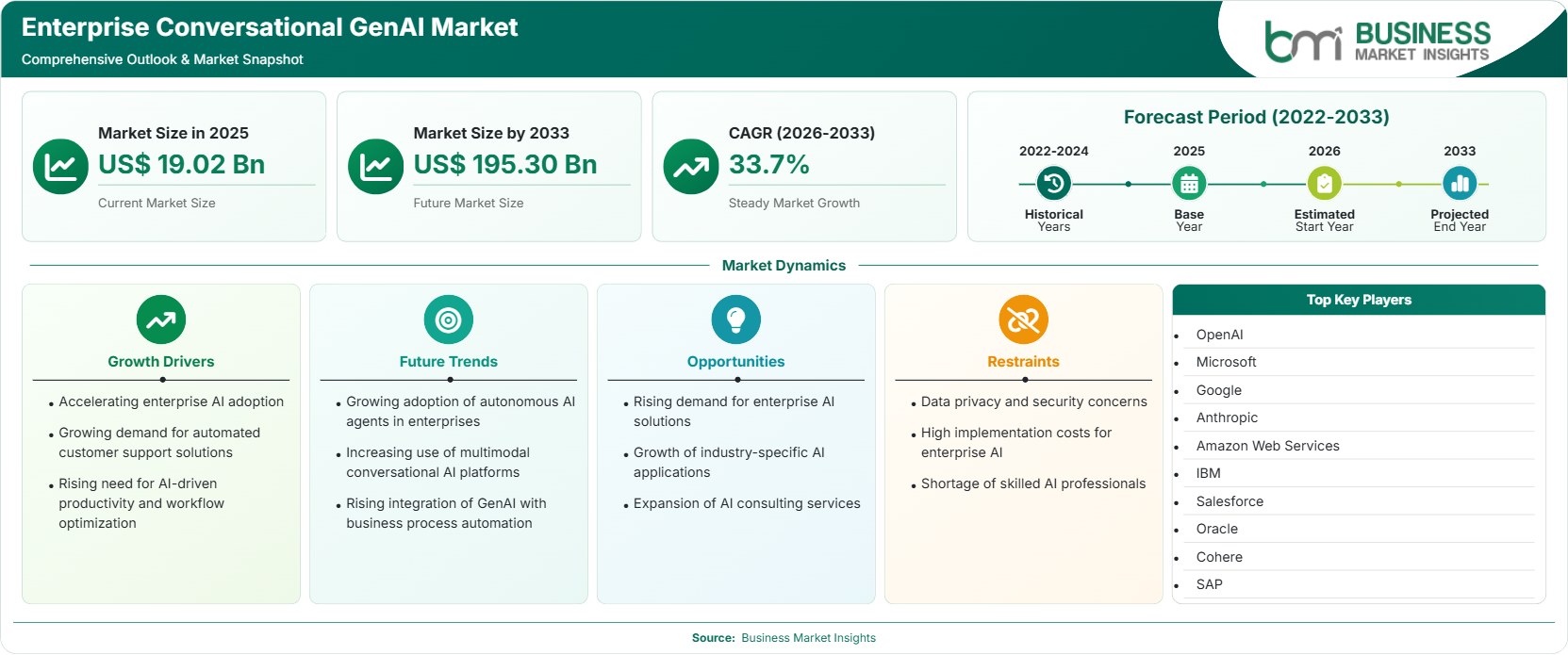
The Enterprise Conversational GenAI Market size was valued at US$ 19.02 Billion in 2025 and is projected to reach US$ 195.30 Billion by 2033, growing at a CAGR of 33.7% from 2026 to 2033, driven by enterprise AI adoption, automated customer engagement, workflow optimization, generative AI innovation, and increasing demand for intelligent business automation solutions.

Report Coverage
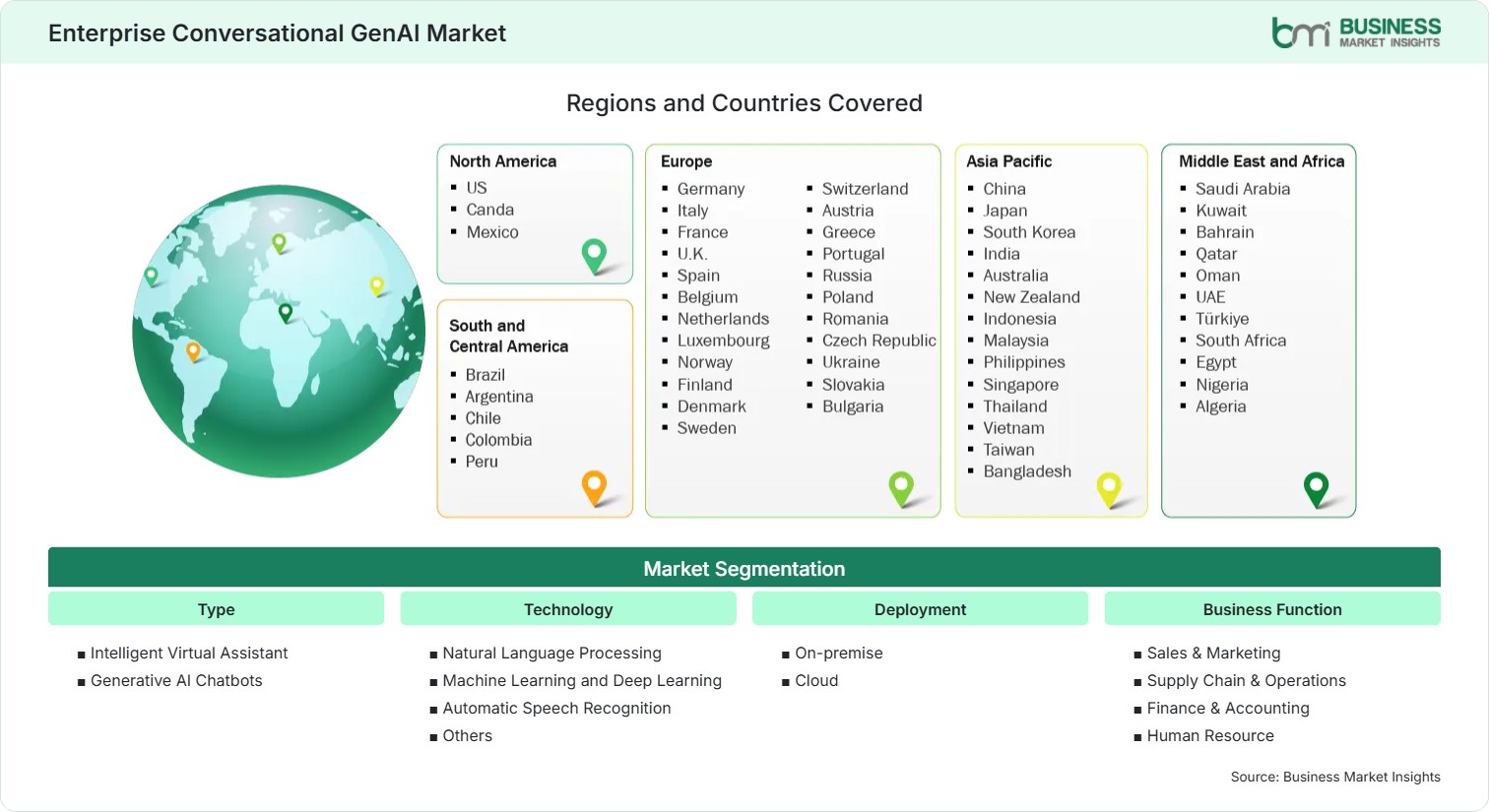
  • Type: Intelligent Virtual Assistant, Generative AI Chatbots
  • Technology: Natural Language Processing, Machine Learning and Deep Learning, Automatic Speech Recognition, Others
  • Deployment: On-premise, Cloud
  • Business Function: Sales & Marketing, Supply Chain & Operations, Finance & Accounting, Human Resource
  • Industry: BFSI, IT & Telecom, Retail & e-Commerce, Healthcare, Government & Public Sector, Media & Entertainment, Education, Others
US$ 19.02 Bn Market size in 2025
US$ 195.30 Bn Market Size by 2033
33.7% CAGR, 2026 - 2033
2026-2033 Forecast Period

01 AI Overview

Enterprise Conversational GenAI Market Summary

  • North America Region: North America holds market share of 40%–44% in 2025, growing with a CAGR of 31%–34% influenced by advanced enterprise AI adoption, cloud infrastructure maturity, technology investments, and strong demand for automation. The US market demonstrates rapid expansion, with a CAGR of 32%–35% from 2026–2033 supported by AI infrastructure development, enterprise software integration, and generative AI deployment.
  • Fastest Growing Region: Asia Pacific accounts for a share range of 24%–28% in 2025, expanding with a CAGR of 36%–39% due to digital transformation initiatives, growing enterprise automation demand, cloud adoption, and increasing investments in AI-based customer experience platforms.
  • Leading Segment: Generative AI Chatbots represent the leading type segment with a 55%–59% share in 2025 and a CAGR of 35%–38% driven by conversational automation, advanced language models, enterprise knowledge management, and scalable customer interaction solutions.
  • High Growth Segment: Cloud deployment represents the high growth segment with a 62%–66% share in 2025 and a CAGR of 36%–39% supported by flexible infrastructure, faster AI implementation, reduced maintenance requirements, and increasing adoption among enterprises.
  • Key Market Opportunity: Expansion of industry-specific AI applications, enterprise automation platforms, and AI consulting services creates opportunities for providers developing secure, scalable, and customized conversational AI solutions across business functions.
  • Major Market Players: OpenAI, Microsoft, Google, Anthropic, Amazon Web Services, IBM, Salesforce, Oracle, Cohere, SAP.
02 Strategic Insights

Enterprise Conversational GenAI Market: Strategic Insights

Enterprise Conversational GenAI Market Strategic Framework
FREE PDF
Request your free sample
Request free sample
03 Stakeholder View

Key Takeaways

  • The market ecosystem is evolving from standalone chatbot providers toward integrated AI platforms involving cloud providers, software companies, model developers, consulting firms, and enterprise technology partners. Competitive advantage increasingly depends on ecosystem connectivity and enterprise deployment capabilities.
  • Growth opportunities are concentrated in industry-specific conversational AI applications, including banking assistants, healthcare support systems, retail personalization platforms, and employee productivity tools. Organizations are seeking customized AI solutions aligned with specific operational requirements.
  • Innovation priorities are shifting toward multimodal AI capabilities, improved reasoning models, enterprise data integration, and autonomous workflow execution. Companies investing in advanced language models and secure AI architectures are positioned to capture long-term enterprise demand.
  • Asia Pacific represents a strong regional opportunity due to expanding digital economies, increasing cloud adoption, government AI initiatives, and growing enterprise investment in automation technologies across emerging markets.
  • Strategic partnerships, acquisitions, and AI infrastructure investments are shaping competitive dynamics. Technology companies are collaborating to combine foundation models, cloud platforms, enterprise applications, and consulting expertise.
  • Long-term adoption will depend on organizations achieving measurable productivity improvements while addressing implementation challenges related to data governance, workforce adaptation, and AI operational management.
04 Geographic Outlook

Enterprise Conversational GenAI Market Regional Highlights

North America Enterprise Conversational GenAI Market

North America accounted for a 40%–44% share of the Enterprise Conversational GenAI Market in 2025 and is projected to grow at a CAGR of 31%–34% during 2026–2033. The region maintains leadership due to strong technology infrastructure, early enterprise AI adoption, significant research investment, and the presence of major AI companies. The United States represents the largest contributor, supported by extensive cloud adoption and enterprise software modernization.

  • The United States drives regional growth through investments in large language models, enterprise AI platforms, and cloud-based automation solutions.
  • Technology companies are integrating conversational AI capabilities into productivity suites, customer relationship management systems, and business applications.
  • Enterprises across BFSI, healthcare, retail, and technology sectors are adopting AI assistants to improve operational efficiency.
  • Strong venture capital activity supports innovation across AI startups developing specialized enterprise applications.

US Enterprise Conversational GenAI Market

The US accounted for a 35%–39% share of the Enterprise Conversational GenAI Market in 2025 and is estimated to expand at a CAGR of 32%–35% from 2026–2033. The country remains the global center for AI innovation due to leading technology companies, advanced cloud infrastructure, and extensive enterprise software adoption. Businesses are increasingly deploying generative AI tools for productivity enhancement and customer engagement.

  • Enterprises are rapidly integrating AI assistants into business workflows to improve employee productivity and automate repetitive processes.
  • Large technology providers are expanding enterprise AI offerings through partnerships, platform integrations, and specialized solutions.
  • Financial services and healthcare organizations are investing in secure AI systems with enhanced compliance capabilities.

Europe Enterprise Conversational GenAI Market

Europe represented a 20%–24% share of the Enterprise Conversational GenAI Market in 2025 and is expected to register a CAGR of 30%–33% during 2026–2033. The region is supported by increasing enterprise automation initiatives, regulatory focus on responsible AI, and growing adoption of cloud technologies. Germany, the United Kingdom, and France are leading markets due to strong industrial bases and digital transformation programs.

  • The United Kingdom demonstrates strong adoption through financial technology innovation and enterprise AI investments.
  • Germany is integrating conversational AI into industrial operations, manufacturing processes, and business automation systems.
  • France is supporting AI development through national digital transformation initiatives and technology investments.
  • European enterprises are emphasizing secure and compliant AI deployment frameworks.

Asia Pacific Enterprise Conversational GenAI Market

Asia Pacific held a 24%–28% share of the Enterprise Conversational GenAI Market in 2025 and is projected to grow at a CAGR of 36%–39% between 2026–2033. The region represents the fastest-growing market due to increasing digitalization, expanding cloud infrastructure, and rising enterprise demand for automation. China, India, Japan, South Korea, and Southeast Asian economies are major contributors.

  • China is investing heavily in AI development, enterprise automation, and domestic language model ecosystems.
  • India is experiencing strong demand due to expanding technology services, startup innovation, and enterprise digital transformation.
  • Japan is adopting AI solutions for productivity improvement, customer service automation, and business optimization.
  • Southeast Asian markets are increasing AI adoption through cloud-based enterprise applications.

Rest of World Enterprise Conversational GenAI Market

South America, the Middle East, and Africa accounted for a 10%–14% share of the Enterprise Conversational GenAI Market in 2025 and are expected to grow at a CAGR of 32%–35% during 2026–2033. Regional adoption is supported by cloud expansion, digital transformation programs, and increasing interest in AI-powered business solutions. Brazil, the UAE, and Saudi Arabia are emerging contributors.

  • Brazil is expanding AI adoption through enterprise digital transformation and technology modernization initiatives.
  • The UAE is investing in artificial intelligence strategies and smart government applications.
  • Saudi Arabia is developing AI capabilities through technology investments and economic diversification programs.
  • African enterprises are gradually adopting cloud-based AI solutions to improve operational efficiency.
Global Market Geography
FREE PDF
Request your free sample
Request free sample
05 Segment Analysis

Enterprise Conversational GenAI Market Segmentation

Type

The type segment represents the core application categories shaping the Enterprise Conversational GenAI Market, with Generative AI Chatbots maintaining a leading position with a 55%–59% share in 2025 and a CAGR of 35%–38% during 2026–2034. Enterprises are increasingly replacing traditional conversational systems with generative models capable of understanding complex business queries, producing contextual responses, and supporting multiple operational functions. The Enterprise Conversational GenAI scope is expanding as organizations deploy AI assistants across customer service, employee support, and workflow automation environments.

  • Intelligent Virtual Assistant (IVA): Intelligent Virtual Assistants support automated interactions through natural language understanding, enabling enterprises to improve customer engagement, employee assistance, and service efficiency.
  • Generative AI Chatbots: Generative AI Chatbots leverage large language models to provide contextual conversations, content generation, knowledge retrieval, and personalized enterprise interactions across multiple business applications.

Technology

The technology segment defines the foundational capabilities enabling enterprise conversational AI platforms. Natural Language Processing maintains a critical role due to its ability to interpret human language, while machine learning and deep learning technologies enhance model accuracy and adaptability. The segment is projected to grow at a CAGR of 33%–36% during the Enterprise Conversational GenAI Market forecast as enterprises invest in advanced AI architectures, automation platforms, and intelligent workflow solutions. Enterprise Conversational GenAI trends indicate increasing integration of multiple AI technologies to improve conversational accuracy and operational outcomes.

  • Natural Language Processing: Natural Language Processing enables AI systems to understand, analyze, and generate human language for enterprise communication and automation applications.
  • Machine Learning and Deep Learning: Machine Learning and Deep Learning improve conversational accuracy through continuous learning, pattern recognition, predictive capabilities, and adaptive enterprise AI performance.
  • Automatic Speech Recognition: Automatic Speech Recognition enables voice-based interactions by converting spoken language into machine-readable information for customer support and enterprise communication applications.

Deployment

The deployment segment highlights enterprise preferences for flexible AI implementation models, with Cloud deployment representing the leading category with a 62%–66% of the Enterprise Conversational GenAI Market share in 2025 and a CAGR of 36%–39% during 2026–2034. Cloud platforms enable faster deployment, scalable computing capacity, and access to advanced AI infrastructure. Enterprises are increasingly selecting cloud-based conversational AI solutions to reduce implementation complexity and accelerate digital transformation initiatives.

  • On-premise: On-premise deployment provides organizations with greater control over infrastructure, data management, customization, and security requirements for sensitive enterprise applications.
  • Cloud: Cloud deployment enables scalable AI adoption through flexible infrastructure, managed services, faster implementation, and reduced requirements for internal technology resources.

Business Function

The business function segment demonstrates broad adoption across enterprise operations as organizations integrate conversational AI into revenue generation, process management, and employee productivity activities. Sales & Marketing represents a significant application area due to demand for automated customer engagement and personalized communication. The segment is expected to grow at a CAGR of 34%–37% during 2026–2034 as businesses expand AI-driven workflow optimization.

  • Sales & Marketing: Sales and marketing teams use conversational AI for lead qualification, customer engagement, campaign assistance, personalized recommendations, and automated communication management.
  • Supply Chain & Operations: Supply chain and operations functions utilize AI assistants for process monitoring, information retrieval, workflow coordination, and operational decision support.
  • Finance & Accounting: Finance and accounting departments adopt AI solutions for reporting assistance, financial queries, document processing, and automated administrative activities.
  • Human Resource: Human resource departments implement conversational AI for employee support, recruitment assistance, onboarding processes, and workplace information management.

Industry

The industry segment demonstrates strong adoption across sectors seeking automation, improved customer experience, and operational efficiency. BFSI and IT & Telecom represent major application areas due to large volumes of customer interactions and digital service requirements. The segment is expected to expand at a CAGR of 33%–36% during 2026–2034 as enterprises across industries adopt specialized AI applications. Enterprise Conversational GenAI market trends indicate increasing demand for customized solutions tailored to industry workflows.

  • BFSI: Financial institutions deploy conversational AI for customer assistance, digital banking support, financial information services, and operational automation.
  • IT & Telecom: Technology companies utilize AI assistants for customer service, technical support, service management, and internal productivity enhancement.
  • Retail & e-Commerce: Retail businesses adopt conversational AI for personalized shopping experiences, customer support, recommendations, and digital commerce optimization.
  • Healthcare: Healthcare organizations implement AI solutions for patient communication, administrative assistance, appointment management, and information accessibility.
  • Government & Public Sector: Government agencies utilize conversational AI for citizen services, information delivery, administrative support, and digital public service improvement.
  • Media & Entertainment: Media companies apply AI assistants for content discovery, audience engagement, customer support, and personalized experiences.
  • Education: Educational institutions use conversational AI for student assistance, learning support, administrative communication, and digital education services.
06 Market Forces

Enterprise Conversational GenAI Market Dynamics

Key Market Drivers

Accelerating Enterprise AI Adoption

Accelerating enterprise AI adoption is a major driver of the Enterprise Conversational GenAI Market growth as organizations increasingly integrate artificial intelligence into business operations. Enterprises are using conversational AI platforms to automate repetitive activities, improve decision-making, and enhance customer interactions. The rapid development of large language models has reduced barriers to AI implementation by enabling more flexible and scalable applications. Enterprise Conversational GenAI trends indicate growing adoption across industries as businesses seek measurable improvements in productivity, operational efficiency, and service quality.

Growing Demand for Automated Customer Support Solutions

Growing demand for automated customer support solutions is increasing investment in conversational AI platforms capable of handling complex interactions. Enterprises are seeking technologies that can provide faster responses, personalized assistance, and continuous availability while reducing operational costs. AI-powered customer service systems are becoming important tools for managing high-volume interactions across banking, retail, telecommunications, and healthcare sectors. Improvements in language understanding and response generation are enabling organizations to deliver more human-like digital experiences.

Rising Need for AI-Driven Productivity and Workflow Optimization

The rising need for AI-driven productivity and workflow optimization is encouraging enterprises to integrate conversational AI into internal processes. Organizations are deploying AI assistants to support employees with information retrieval, document generation, administrative tasks, and workflow coordination. These applications help reduce manual effort and allow employees to focus on higher-value activities. As enterprises prioritize operational efficiency, conversational AI platforms are becoming strategic tools for improving workforce productivity and business performance.

Key Market Opportunities

Rising Demand for Enterprise AI Solutions

Rising demand for enterprise AI solutions creates significant opportunities for technology providers developing secure and scalable conversational platforms. Businesses across industries are seeking AI systems that can integrate with existing software environments, enterprise databases, and operational workflows. Vendors offering customizable solutions with strong security frameworks and industry-specific capabilities are positioned to capture increasing demand. The Enterprise Conversational GenAI Forecasts indicate continued expansion as organizations accelerate digital transformation initiatives.

Growth of Industry-Specific AI Applications

Growth of industry-specific AI applications represents a major opportunity as enterprises require solutions tailored to specialized workflows and regulatory requirements. Healthcare, finance, retail, and government organizations are seeking conversational AI platforms designed around sector-specific data, compliance standards, and customer needs. Specialized AI applications can deliver higher accuracy and business value compared with general-purpose systems. This trend is encouraging technology providers to develop vertical-focused conversational solutions.

Expansion of AI Consulting Services

Expansion of AI consulting services is creating opportunities for organizations requiring implementation support, strategy development, and AI integration expertise. Many enterprises face challenges related to selecting models, preparing data, managing security, and optimizing AI workflows. Consulting providers can support successful adoption by offering implementation frameworks, governance strategies, and workforce training. Increasing AI complexity is expected to strengthen demand for specialized advisory services.

Market Restraints and Challenges

Data Privacy and Security Concerns

Factor: Enterprise conversational AI systems process large volumes of business information, customer interactions, and proprietary organizational data, creating concerns regarding privacy, cybersecurity, and regulatory compliance.

Impact: Security risks can slow adoption among organizations handling sensitive information, particularly in banking, healthcare, government, and other highly regulated sectors. Enterprises require strong data governance frameworks, encryption mechanisms, access controls, and responsible AI practices before deploying conversational AI solutions at scale. Compliance requirements related to data protection regulations are influencing vendor strategies, with providers increasingly developing secure architectures and enterprise-grade controls to improve trust and adoption.

High Implementation Costs for Enterprise AI

Factor: Enterprise AI deployment requires significant investment in infrastructure, model customization, data preparation, integration activities, and specialized technical expertise.

Impact: High implementation costs can limit adoption among small and medium-sized enterprises and extend deployment timelines for larger organizations. Businesses must evaluate AI investments against measurable productivity gains, operational improvements, and long-term cost benefits. The requirement for skilled AI professionals, continuous model optimization, and ongoing maintenance also contributes to total ownership expenses. Technology providers are responding by offering managed AI services, cloud-based platforms, and flexible pricing models to reduce entry barriers.

07 Company Analysis

Competitive Landscape

The Enterprise Conversational GenAI Market analysis highlights a rapidly evolving competitive environment influenced by foundation model developers, cloud infrastructure providers, enterprise software companies, and specialized AI technology firms. Companies are competing through improvements in large language models, enterprise security capabilities, application integration, customization options, and industry-specific solutions. The competitive landscape is shifting from simple chatbot functionality toward comprehensive AI platforms that support knowledge management, workflow automation, customer engagement, and employee productivity. Strategic partnerships between model developers, cloud providers, and enterprise software companies are becoming increasingly important for expanding market reach and accelerating adoption.

Company Name

Overview

Products and Services relevant to this market

OpenAI

Artificial intelligence research and deployment company developing advanced generative AI technologies.

Large language models, enterprise AI assistants, conversational AI platforms, API-based AI solutions.

Microsoft

Global technology company providing cloud computing, software, and enterprise productivity solutions.

Azure AI services, Copilot solutions, enterprise conversational assistants, AI infrastructure.

Google

Technology company developing AI models, cloud platforms, and enterprise digital solutions.

Generative AI models, conversational AI tools, Google Cloud AI services, enterprise applications.

Anthropic

AI company focused on developing reliable and safe artificial intelligence systems.

Claude AI models, enterprise conversational solutions, secure AI applications.

Amazon Web Services

Cloud computing provider offering enterprise infrastructure and artificial intelligence services.

Amazon Bedrock, AI development platforms, machine learning services, enterprise AI infrastructure.

IBM

Enterprise technology company providing AI, cloud, and business transformation solutions.

watsonx AI platform, conversational assistants, enterprise automation solutions.

Salesforce

Customer relationship management technology provider integrating AI into business applications.

Einstein AI, customer service assistants, sales automation, CRM-based conversational tools.

Oracle

Enterprise software company offering cloud applications and database technologies.

Oracle AI services, enterprise automation platforms, business application AI capabilities.

Cohere

Artificial intelligence company specializing in language models for enterprise applications.

Large language models, enterprise AI APIs, retrieval-based conversational solutions.

SAP

Enterprise software provider supporting business applications and digital transformation.

SAP Business AI, enterprise assistants, workflow automation, business process AI solutions.

08 Industry Activity

Recent Developments

October 2025

Salesforce and OpenAI expanded their strategic partnership to integrate OpenAI’s frontier models, including GPT-5, with Salesforce’s Agentforce 360 Platform. The collaboration enables enterprises to use conversational AI experiences inside ChatGPT, access CRM data through natural-language interactions, and build AI agents for enterprise workflows.

October 2025

Google launched Gemini Enterprise, an enterprise AI platform designed to allow employees to interact with company data, applications, and workflows through conversational AI interfaces. The platform enables organizations to create and deploy AI agents across business functions, expanding Google’s enterprise GenAI capabilities.

May 2025

Salesforce signed a definitive agreement to acquire Informatica for approximately US$ 8 billion, aiming to strengthen its data foundation for enterprise AI agents by combining Informatica’s data governance, integration, and metadata management capabilities with Salesforce’s AI platform. The acquisition supports more reliable conversational GenAI deployments across enterprises.

February 2025

Salesforce and Google expanded their strategic partnership by integrating Google Gemini models with Salesforce Agentforce, enabling enterprises to build AI agents with multimodal conversational capabilities, including text, image, and audio processing, while connecting Salesforce customer data with Google Cloud AI infrastructure.

10 Trust & Transparency

Research Methodology

The market analysis combines proprietary research with secondary data from government agencies, company disclosures, regulatory filings, industry databases and expert interviews. Market estimates are validated through data triangulation, cross-market benchmarking and analyst review.

View Full Research Methodology

11 Questions Answered

Frequently Asked Questions

What are the major challenges affecting conversational GenAI adoption?

Major challenges include data privacy concerns, security requirements, implementation costs, AI governance issues, integration complexity, and the need for skilled professionals to manage enterprise deployments.

What does the Enterprise Conversational GenAI Market Report indicate about future adoption?

The Enterprise Conversational GenAI Report indicates continued adoption driven by specialized AI applications, enterprise workflow automation, improved AI models, and expansion of consulting and implementation services.

Which industries are adopting conversational GenAI solutions rapidly?

BFSI, IT & Telecom, retail, healthcare, and government sectors are adopting conversational GenAI due to high customer interaction volumes, automation needs, and demand for improved service experiences.

Which deployment model is preferred by enterprises for conversational GenAI solutions?

Cloud deployment is gaining preference because it enables faster implementation, scalable computing resources, reduced infrastructure requirements, and easier access to advanced AI models and enterprise automation capabilities.

What is the Enterprise Conversational GenAI Market growth rate?

The market is projected to expand at a CAGR of 33.7% from 2026 to 2033, supported by enterprise AI adoption, automation requirements, cloud deployment growth, and increasing demand for intelligent digital assistants.

Access the Full Enterprise Conversational GenAI Market Report

Get segment-level forecasts, regional estimates, competitive benchmarking, company profiles and downloadable Excel datasets.

Access the full Enterprise Conversational GenAI Market Report
350 pages PDF & Excel | 2026-07-28