
Conversational AI Market Outlook: Size, Share, Trends, Growth Analysis, Competitive Landscape & Forecast, 2026-2033

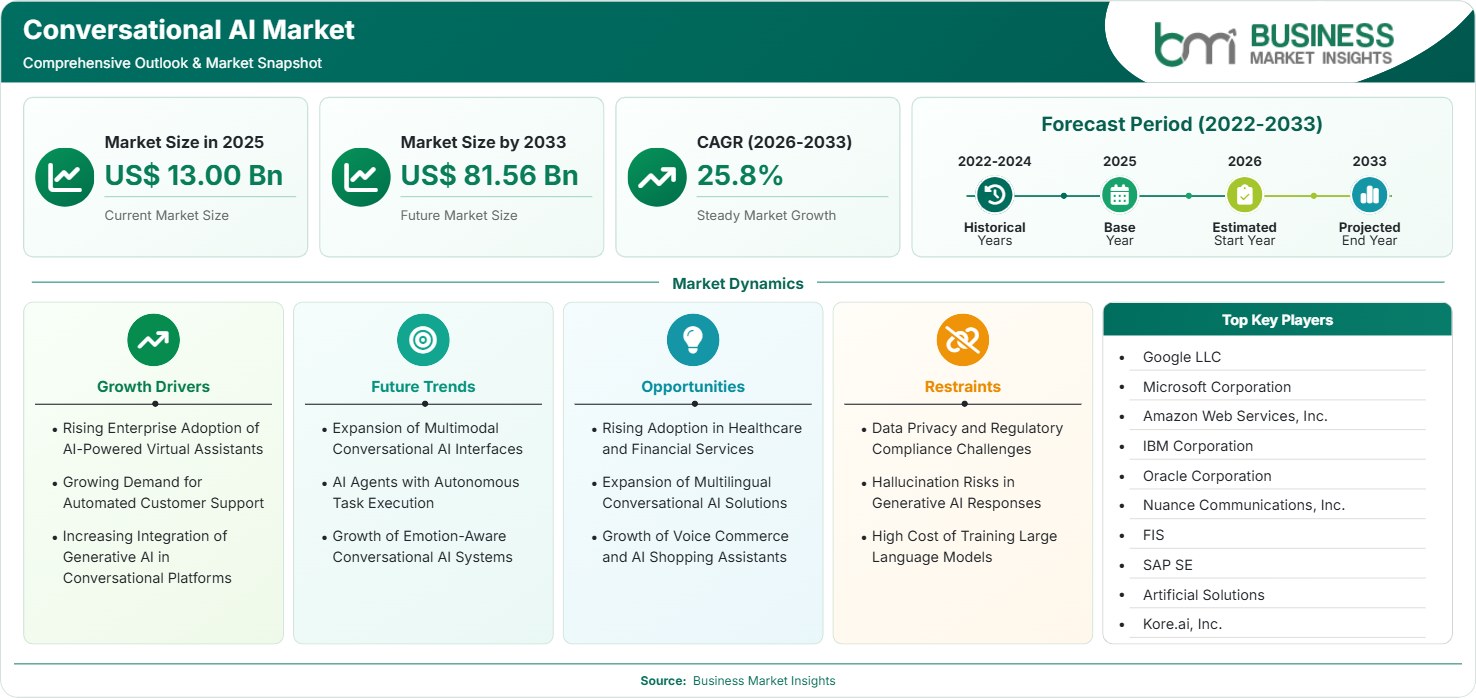
The Conversational AI Market size was valued at US$ 13.00 Billion in 2025 and is projected to reach US$ 81.56 Billion by 2033, growing at a CAGR of 25.8% during 2026–2033. Growth is driven by increasing enterprise adoption of AI-powered customer engagement solutions, rising demand for automated customer support, expanding deployment of virtual assistants across industries, advancements in natural language processing technologies, and growing investments in digital transformation initiatives globally.

Report Coverage
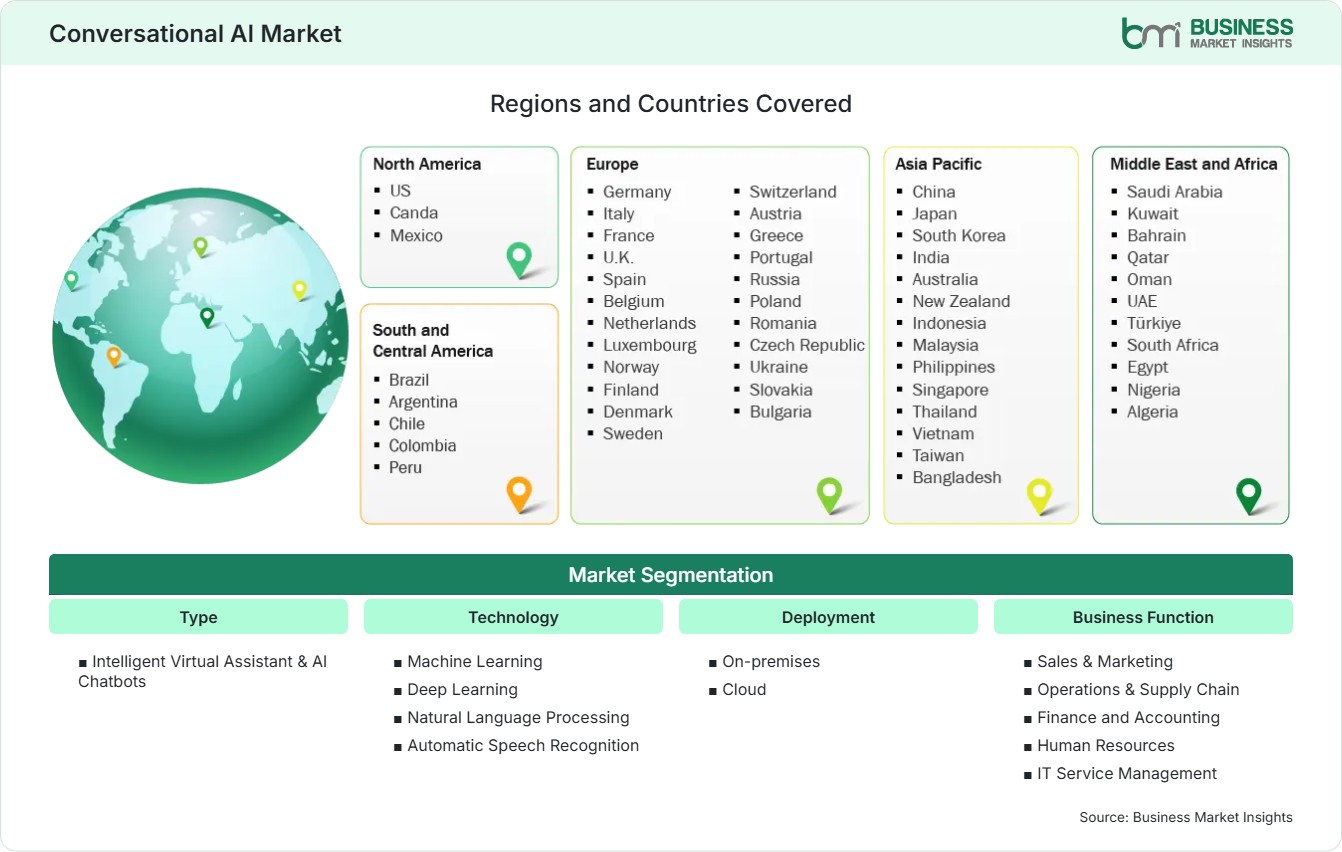
  • Type: Intelligent Virtual Assistant & AI Chatbots
  • Technology: Machine Learning, Deep Learning, Natural Language Processing, Automatic Speech Recognition
  • Deployment: On-premises, Cloud
  • Business Function: Sales & Marketing, Operations & Supply Chain, Finance and Accounting, Human Resources, IT Service Management
  • Industry: BFSI, IT and Telecom, Retail and e-Commerce, Education, Healthcare
US$ 13.00 Bn Market size in 2025
US$ 81.56 Bn Market Size by 2033
25.8% CAGR, 2026 - 2033
2026-2033 Forecast Period

01 AI Overview

Conversational AI Market Summary

  • North America Region: North America holds a market share of 37%–40% in 2025, growing at a CAGR of 24.5%–25.2% during 2026–2033. Demand is supported by strong technology adoption, large-scale cloud infrastructure availability, and growing deployment of AI-powered customer service platforms. The U.S. remains the dominant market, advancing at a CAGR of 24.8%–25.5%.
  • Fastest Growing Region: Asia Pacific accounts for 25%–28% of revenue in 2025 and is projected to register a CAGR of 27.5%–28.4% through 2033. Expanding digitalization, rising AI investments, and growing adoption of enterprise automation solutions continue supporting market development.
  • Leading Segment: AI Chatbots hold a market share of 55%–59% in 2025 and are expected to grow at a CAGR of 26.0%–26.8%. Demand is driven by increasing use of automated customer support, omnichannel engagement strategies, and cost optimization initiatives.
  • High Growth Segment: Natural Language Processing (NLP) accounts for 30%–34% of market revenue in 2025 and is projected to register a CAGR of 27.8%–28.6% during the forecast period. Continuous improvements in language understanding, multilingual processing, and contextual awareness continue supporting expansion.
  • Key Market Opportunity: Growing demand for AI-powered customer experiences, industry-specific conversational platforms, and generative AI-enabled enterprise assistants is creating significant opportunities for technology vendors and service providers.
  • Major Market Players: Google LLC, Microsoft Corporation, Amazon Web Services, Inc., IBM Corporation, Oracle Corporation, Nuance Communications, Inc., FIS, SAP SE, Artificial Solutions, and Kore.ai, Inc.
02 Strategic Insights

Conversational AI Market: Strategic Insights

Conversational AI Market Strategic Framework
FREE PDF
Request your free sample
Request free sample
03 Stakeholder View

Key Takeaways

  • The market ecosystem includes conversational AI platform providers, cloud service providers, enterprises, systems integrators, AI software developers, customer experience vendors, and consulting organizations.
  • AI chatbots remain among the most attractive opportunities due to broad enterprise adoption, lower operational costs, and increasing customer demand for instant support services.
  • Product innovation increasingly focuses on generative AI integration, multilingual capabilities, contextual intelligence, sentiment analysis, and personalized customer engagement.
  • Asia Pacific provides the strongest growth potential supported by rapid digital transformation, expanding cloud adoption, and increasing enterprise investment in AI technologies.
  • Conversational AI market forecasts suggest that cloud-based deployment models continue transforming market dynamics by improving scalability, deployment speed, and accessibility for organizations of all sizes.
  • BFSI, healthcare, retail, telecommunications, and enterprise IT sectors remain primary adopters due to growing demand for automated interactions and improved operational efficiency.
  • Integration of conversational AI with CRM, ERP, customer support, and workforce management systems continues expanding functionality and enterprise value creation.
  • Advancements in NLP and speech recognition technologies are significantly improving user experiences and expanding conversational AI adoption across voice and text-based interactions.
04 Geographic Outlook

Conversational AI Market Regional Highlights

North America Conversational AI Market

North America accounted for 37%–40% of global revenue in 2025 and is projected to expand at a CAGR of 24.5%–25.2% through 2033. Growth is supported by widespread enterprise adoption of artificial intelligence, advanced cloud infrastructure, high digital maturity, and substantial investments in customer experience technologies. The Conversational AI Market share in the region continues benefiting from growing deployment of intelligent virtual assistants and AI chatbots across banking, retail, healthcare, and telecommunications sectors.

  • Enterprises are increasingly implementing conversational AI solutions to automate customer service operations and improve response times.
  • Strong cloud adoption is enabling faster deployment and scalability of AI-powered communication platforms.
  • Financial institutions are leveraging conversational AI for customer onboarding, fraud detection support, and personalized banking experiences.
  • Healthcare providers continue expanding virtual assistant usage for appointment scheduling, patient engagement, and care coordination.
  • Generative AI integration is accelerating innovation in customer experience and enterprise productivity applications.

US Conversational AI Market

The United States represented 32%–35% of global revenue in 2025 and is anticipated to register a CAGR of 24.8%–25.5% during the forecast period. Demand is driven by large-scale digital transformation initiatives, increasing investments in AI technologies, and rising demand for automation across customer-facing and internal business functions. Continued innovation by technology leaders and cloud providers supports Conversational AI Market growth.

  • Customer service automation remains one of the largest use cases across enterprises.
  • Organizations increasingly deploy AI assistants to enhance employee productivity and workflow automation.
  • Retail and e-commerce companies utilize conversational AI to deliver personalized customer experiences.
  • Growing adoption of generative AI solutions continues driving enterprise investments.

Europe Conversational AI Market

Europe held 26%–29% of global revenue in 2025 and is projected to grow at a CAGR of 25.0%–25.8% through 2033. Rising investments in enterprise AI, increasing digital customer engagement initiatives, and growing automation requirements continue supporting market expansion. Germany remains the leading market with a CAGR of 25.1%–25.9%, while Poland is the fastest-growing country, expanding at a CAGR of 26.0%–26.8%.

  • Businesses are increasingly utilizing conversational AI to improve service quality and operational efficiency.
  • Demand for multilingual AI assistants is growing across international organizations.
  • Germany maintains leadership through strong enterprise technology adoption and industrial digitalization initiatives.
  • Poland is witnessing accelerated AI implementation among both SMEs and large enterprises.
  • Regulatory focus on responsible AI is encouraging development of transparent and secure conversational platforms.

Asia Pacific Conversational AI Market

Asia Pacific accounted for 25%–28% of global revenue in 2025 and is expected to remain the fastest-growing region, registering a CAGR of 27.5%–28.4% through 2033. Rapid digitalization, growing smartphone penetration, expanding cloud investments, and increasing enterprise AI adoption continue driving market growth. China remains the largest regional market with a CAGR of 27.2%–28.0%, while India records the highest growth at 28.0%–28.9%.

  • Rising digital customer engagement initiatives continue increasing adoption of AI chatbots and virtual assistants.
  • China benefits from large-scale investments in AI innovation and digital ecosystem development.
  • India is witnessing strong demand for conversational AI across BFSI, e-commerce, telecommunications, and healthcare sectors.
  • Organizations increasingly deploy multilingual conversational platforms to serve diverse customer bases.
  • Expansion of cloud infrastructure and AI development programs continues creating significant growth opportunities.

Rest of World Conversational AI Market

The Rest of World region accounted for 6%–9% of global revenue in 2025 and is expected to register a CAGR of 24.0%–24.8% through 2033. Market growth is supported by increasing adoption of digital customer service technologies, rising cloud investments, and growing awareness of AI-powered business automation. Demand remains particularly strong among financial institutions, telecommunications providers, and public service organizations.

Brazil is the leading market in South & Central America and is forecast to grow at a CAGR of 24.2%–25.0%. In the Middle East & Africa, the United Arab Emirates is expected to be the fastest-growing country with a CAGR of 24.8%–25.6%.

  • Brazil continues benefiting from digital transformation initiatives and expanding enterprise automation investments.
  • The United Arab Emirates is witnessing increasing deployment of AI-driven customer engagement platforms.
  • Government digitalization strategies are encouraging broader AI adoption across industries.
  • Organizations are leveraging conversational AI to improve service accessibility and operational efficiency.
  • Growing cloud adoption is strengthening the regional market outlook.
Global Market Geography
FREE PDF
Request your free sample
Request free sample
05 Segment Analysis

Conversational AI Market Segmentation

Type

Type-based segmentation continues evolving as organizations increasingly seek intelligent communication solutions capable of automating customer interactions and internal workflows. AI Chatbots lead the segment with a 55%–59% share in 2025 and are projected to grow at a CAGR of 26.0%–26.8% through 2033. The Conversational AI Market scope continues expanding as enterprises utilize chatbot technologies to improve customer engagement, reduce operational costs, and provide round-the-clock support across multiple channels.

  • Intelligent Virtual Assistants: Widely utilized for personalized customer engagement, employee assistance, knowledge management, and workflow automation activities.
  • AI Chatbots: Dominate market demand owing to broad adoption across customer service, sales support, lead qualification, e-commerce assistance, and automated communication functions.

Technology

Technology advancements continue serving as the foundation of conversational AI innovation. Natural Language Processing (NLP) accounts for 30%–34% market share in 2025 and is projected to register the fastest growth at a CAGR of 27.8%–28.6% through 2033. Conversational AI Market trends indicate growing emphasis on improving context awareness, sentiment analysis, language understanding, and personalized interactions.

  • Machine Learning: Enables conversational systems to continuously learn from user interactions and improve response quality over time.
  • Deep Learning: Supports advanced language modeling, contextual understanding, and sophisticated conversational capabilities.
  • Natural Language Processing: Drives language comprehension, multilingual communication, intent recognition, and natural conversation experiences.
  • Automatic Speech Recognition: Supports voice-enabled applications by converting spoken language into actionable digital information.

Deployment

Deployment models continue influencing implementation flexibility, scalability, and cost efficiency across organizations. Cloud deployment remains the preferred option due to lower infrastructure requirements and faster implementation. Conversational AI Market share gains are increasingly supported by cloud-based AI services that simplify deployment and accelerate enterprise adoption.

  • On-premises: Preferred by organizations requiring strict data control, regulatory compliance, and customized deployment environments.
  • Cloud: Dominates adoption due to scalability, ease of integration, lower upfront costs, and continuous feature updates.

Business Function

Business function integration continues expanding as enterprises recognize the value of conversational AI across operational areas. Demand is growing beyond customer support to include internal productivity enhancement and workflow automation initiatives.

  • Sales & Marketing: Supports lead generation, customer engagement, product recommendations, and campaign optimization activities.
  • Operations & Supply Chain: Improves information access, workflow coordination, and process automation capabilities.
  • Finance and Accounting: Assists with customer queries, transaction support, compliance communication, and financial process automation.
  • Human Resources: Supports employee onboarding, policy assistance, recruitment engagement, and workforce communication.
  • IT Service Management: Enhances helpdesk operations, ticket management, troubleshooting, and technical support efficiency.

Industry

Industry adoption continues to broaden as conversational AI platforms deliver measurable benefits in customer engagement, productivity, and automation. BFSI remains among the largest adopters due to growing demand for personalized and secure customer interactions.

  • BFSI: Utilizes conversational AI for customer service, account support, financial guidance, fraud monitoring assistance, and claims processing.
  • IT and Telecom: Deploys AI-powered assistants for technical support, customer engagement, and service management functions.
  • Retail and e-Commerce: Benefits from personalized shopping assistance, order tracking, product recommendations, and customer support automation.
  • Education: Supports student engagement, admissions assistance, learning support, and administrative automation.
  • Healthcare: Utilizes conversational platforms for patient engagement, appointment scheduling, symptom guidance, and administrative support.
06 Market Forces

Conversational AI Market Dynamics

Key Market Drivers

Rising Enterprise Adoption of AI-Powered Virtual Assistants

Organizations across industries are increasingly deploying AI-powered virtual assistants to improve customer engagement, automate repetitive tasks, and enhance workforce productivity. Virtual assistants are capable of providing immediate responses, addressing complex information requests, and supporting business workflows without significant human intervention. Enterprises view these technologies as strategic tools that improve operational efficiency while ensuring consistent service quality. Growing digital transformation initiatives and increasing demand for scalable communication channels continue driving investment in virtual assistant platforms. As AI capabilities improve, virtual assistants are becoming integral components of modern enterprise operations.

Growing Demand for Automated Customer Support

Customer expectations for instant, accurate, and personalized service continue increasing across industries. Businesses are adopting conversational AI platforms to deliver 24/7 support while reducing operational costs associated with traditional call centers and support teams. Automated customer support systems can handle high inquiry volumes, reduce response times, and improve customer satisfaction levels. Organizations also benefit from better resource allocation as support personnel can focus on complex issues requiring human expertise. The growing demand for efficient and scalable service delivery remains a major factor supporting conversational AI market expansion.

Increasing Integration of Generative AI in Conversational Platforms

Generative AI is significantly enhancing conversational platforms by enabling more human-like interactions, contextual understanding, and dynamic response generation. Organizations are integrating generative AI capabilities to improve user experiences, increase engagement quality, and support more complex communication scenarios. These technologies allow conversational systems to provide personalized recommendations, summarize information, and generate detailed responses across diverse use cases. As enterprises continue investing in generative AI solutions, conversational platforms are becoming increasingly sophisticated and valuable across customer-facing and internal applications.

Key Market Opportunities

Rising Adoption in Healthcare and Financial Services

Healthcare and financial services organizations are increasingly deploying conversational AI solutions to improve customer interactions, operational efficiency, and service accessibility. In healthcare, conversational platforms support patient engagement, appointment scheduling, and information delivery. Financial institutions utilize AI assistants for account inquiries, customer support, onboarding, and transaction-related services. These industries benefit significantly from automation capabilities that improve service quality while reducing operational complexity. Growing digital transformation initiatives within regulated industries continue creating substantial growth opportunities for conversational AI providers.

Expansion of Multilingual Conversational AI Solutions

Global organizations increasingly require conversational platforms capable of supporting diverse customer populations across multiple languages and regions. Multilingual AI solutions help enterprises deliver consistent customer experiences while improving accessibility and market reach. Advances in natural language processing, machine translation, and language modeling technologies are enabling more accurate and context-aware communication. As businesses continue expanding internationally, demand for multilingual conversational platforms is expected to increase significantly, creating attractive opportunities for technology vendors and service providers.

Growth of Voice Commerce and AI Shopping Assistants

Voice-enabled commerce is emerging as a major opportunity within the conversational AI ecosystem. Consumers increasingly utilize voice assistants to search for products, compare options, place orders, and access customer support services. Retailers and e-commerce platforms are investing in AI-powered shopping assistants that provide personalized recommendations and frictionless purchasing experiences. Improvements in speech recognition and conversational capabilities continue enhancing voice commerce adoption. As consumers become more comfortable with voice-based interactions, the market is expected to benefit from expanding commercial applications.

Market Restraints and Challenges

Data Privacy and Regulatory Compliance Challenges

Factor: Conversational AI systems frequently process sensitive customer information, including personal, financial, healthcare, and behavioral data that are subject to strict regulatory requirements.

Impact: Compliance with privacy regulations and data governance frameworks increases implementation complexity and operational costs. Organizations must invest in security controls, data management processes, and regulatory compliance measures to ensure responsible AI deployment. Failure to address privacy concerns can reduce user trust and create legal and reputational risks, potentially slowing adoption across regulated industries.

Hallucination Risks in Generative AI Responses

Factor: Generative AI models can occasionally produce inaccurate, misleading, or fabricated responses despite appearing highly confident and contextually relevant.

Impact: Hallucination risks can affect customer trust, business decision-making, and overall system reliability. Organizations deploying conversational AI platforms must implement validation mechanisms, monitoring tools, and governance frameworks to reduce inaccuracies. These requirements may increase deployment complexity and operational oversight needs while influencing enterprise adoption decisions, particularly in highly regulated sectors such as healthcare, finance, and government services.

07 Company Analysis

Competitive Landscape

The market remains highly competitive with the presence of global technology providers, cloud service vendors, enterprise software companies, AI platform developers, and customer experience solution providers. Companies are focusing on generative AI integration, advanced natural language processing capabilities, multilingual conversational platforms, industry-specific solutions, and voice-enabled AI assistants. Growing enterprise investments in automation and customer engagement continue shaping Conversational AI Market analysis and competitive strategies across the global artificial intelligence ecosystem.

Company Name

Overview

Products and Services Relevant to this Market

Google LLC

Global technology company with extensive artificial intelligence and cloud computing capabilities.

AI chatbots, virtual assistants, natural language processing platforms, cloud AI services.

Microsoft Corporation

Technology leader providing AI-powered enterprise solutions and cloud infrastructure services.

Conversational AI platforms, Azure AI services, virtual assistants, enterprise automation solutions.

Amazon Web Services, Inc.

Cloud computing provider offering artificial intelligence and machine learning solutions.

AI chatbots, voice assistants, conversational AI development platforms, cloud-based AI services.

IBM Corporation

Enterprise technology company focused on AI, automation, and business transformation solutions.

Conversational AI platforms, virtual assistants, NLP solutions, AI-powered customer engagement systems.

Oracle Corporation

Enterprise software provider serving organizations across multiple industries.

AI-enabled customer service platforms, conversational applications, cloud AI services.

Nuance Communications, Inc.

AI company specializing in speech recognition and conversational technologies.

Voice AI solutions, conversational platforms, healthcare AI assistants, speech recognition technologies.

FIS

Financial technology provider offering digital banking and customer engagement solutions.

Conversational banking solutions, AI-powered customer service platforms, financial assistance tools.

SAP SE

Enterprise software company providing intelligent business process automation solutions.

Conversational AI applications, enterprise assistants, customer experience platforms.

Artificial Solutions

Conversational AI specialist focused on enterprise virtual assistant technologies.

AI chatbots, multilingual conversational platforms, virtual assistant solutions.

Kore.ai, Inc.

Conversational AI platform provider serving enterprise customers globally.

Intelligent virtual assistants, AI chatbots, workflow automation solutions, conversational platforms.

08 Industry Activity

Recent Developments

June 2026

IBM Apptio launched Conversational Insights and new AI-powered capabilities to help enterprises analyze technology spending, optimize hybrid IT investments, and improve financial governance through natural language queries.

May 2026

Microsoft Corporation expanded enterprise generative AI capabilities through enhancements to conversational AI solutions designed to improve workplace productivity and customer engagement.

February 2026

Google LLC strengthened conversational AI offerings with advancements in natural language understanding, multilingual support, and enterprise AI assistant functionality.

October 2025

Amazon Web Services, Inc. enhanced cloud-based conversational AI services to support intelligent customer service, workflow automation, and enterprise application integration.

10 Trust & Transparency

Research Methodology

The market analysis combines proprietary research with secondary data from government agencies, company disclosures, regulatory filings, industry databases and expert interviews. Market estimates are validated through data triangulation, cross-market benchmarking and analyst review.

View Full Research Methodology

11 Questions Answered

Frequently Asked Questions

What challenge has the greatest long-term impact on the industry?

Data privacy and regulatory compliance remain significant challenges because conversational AI platforms frequently process sensitive information that must comply with evolving governance and security requirements.

How is generative AI influencing conversational AI adoption?

Generative AI enables more natural, contextual, and personalized interactions by improving language understanding, response generation, and customer engagement capabilities across multiple use cases.

Why is Asia Pacific the fastest-growing region?

The region benefits from rapid digitalization, increasing cloud investments, growing enterprise adoption of AI technologies, expanding e-commerce ecosystems, and strong government support for AI innovation.

Which type segment leads the market?

AI Chatbots lead the market due to widespread deployment across customer service, sales support, customer engagement, lead generation, and workflow automation applications.

What is driving growth in the conversational AI market report?

Rising enterprise adoption of AI-powered virtual assistants, growing demand for automated customer support, increasing integration of generative AI technologies, and expanding digital transformation initiatives are the primary growth drivers.

Access the Full Conversational AI Market Report

Get segment-level forecasts, regional estimates, competitive benchmarking, company profiles and downloadable Excel datasets.

Access the full Conversational AI Market Report
350 pages PDF & Excel | 2026-07-31