
Enterprise Collaboration Market Outlook: Size, Share, Trends, Growth Analysis, Competitive Landscape & Forecast, 2026-2033

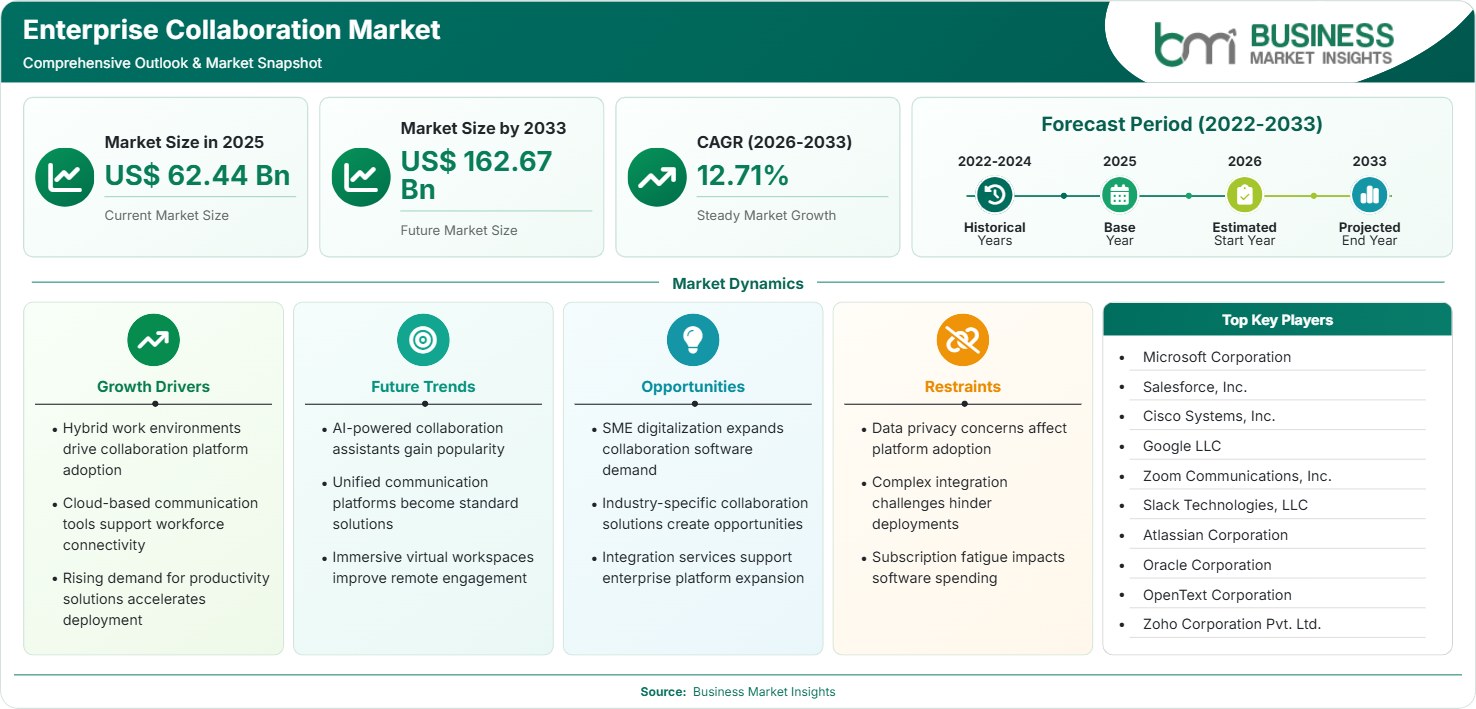
The Enterprise Collaboration Market size was valued at US$ 62.44 Billion in 2025 and is projected to reach US$ 162.67 Billion by 2033, growing at a CAGR of 12.71% during 2026–2033. Key drivers include hybrid work adoption, cloud collaboration expansion, workflow digitization, AI-enabled productivity tools, and cybersecurity investments, while opportunities emerge from industry-specific platforms, automation integration, employee experience solutions, and emerging-market digitization.

Report Coverage
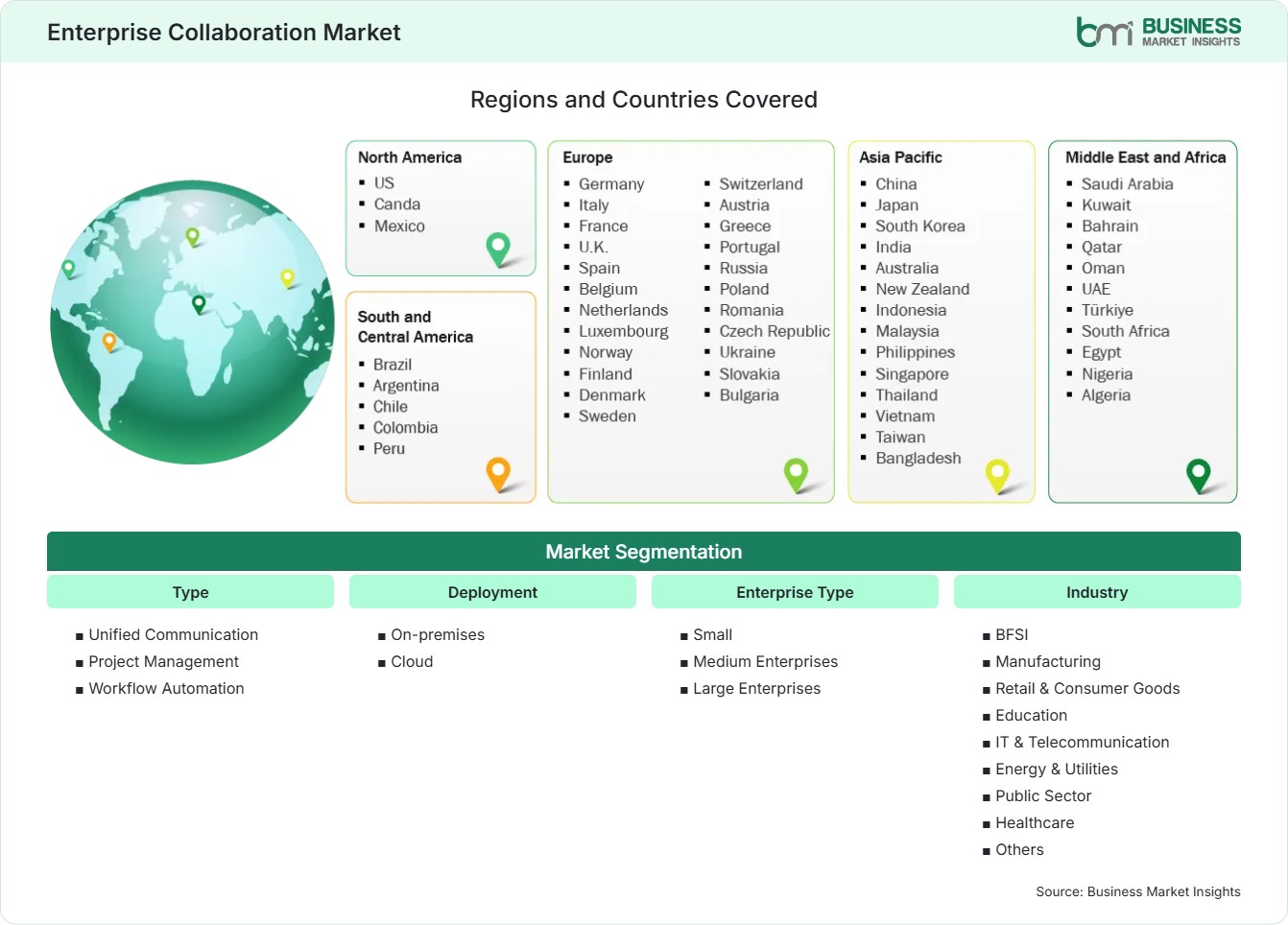
  • Type: Unified Communication, Project Management, Workflow Automation
  • Deployment: On-premises, Cloud
  • Enterprise Type: Small, Medium Enterprises, Large Enterprises
  • Industry: BFSI, Manufacturing, Retail & Consumer Goods, Education, IT & Telecommunication, Energy & Utilities, Public Sector, Healthcare, Others
US$ 62.44 Bn Market size in 2025
US$ 162.67 Bn Market Size by 2033
12.71% CAGR, 2026 - 2033
2026-2033 Forecast Period

AI Overview

Enterprise Collaboration Market Summary

  • North America Region: North America holds a market share of 35%–38% in 2025, growing with a CAGR of 11.5%–12.2% during 2026–2033, supported by hybrid work strategies, cloud migration, AI collaboration assistants, enterprise digitization initiatives, compliance requirements, remote workforce management, workflow integration demand, cybersecurity investments, productivity optimization, and advanced communications infrastructure. The U.S. leads regional adoption, supported by SaaS penetration and digital workplace investments, advancing at 11.8%–12.5% CAGR.
  • Fastest Growing Region: Asia Pacific holds a market share of 27%–31% in 2025 and expands at a CAGR of 14.5%–15.3% during 2026–2033, driven by SME digitization, mobile-first workplaces, cloud adoption, government digital programs, technology investments, startup ecosystems, remote workforce expansion, automation initiatives, business modernization, and enterprise mobility.
  • Leading Segment: Unified Communication accounts for 54%–58% share in 2025 and grows at a CAGR of 12.0%–12.8% due to video conferencing demand, integrated messaging, workforce mobility, digital workplace transformation, AI assistance, employee engagement, enterprise connectivity, communication centralization, regulatory compliance, and operational efficiency.
  • High Growth Segment: Cloud deployment represents 65%–69% share in 2025 and records a CAGR of 14.0%–14.8%, supported by scalability, lower infrastructure costs, remote accessibility, software updates, AI integration, business continuity requirements, cybersecurity enhancements, agile operations, workforce flexibility, and rapid implementation.
  • Key Market Opportunity: AI-powered collaboration ecosystems integrating communication, workflow automation, analytics, content management, and employee engagement functions create substantial value for organizations seeking productivity gains and operational visibility.
  • Major Market Players: Microsoft Corporation, Salesforce, Inc., Cisco Systems, Inc., Google LLC, Zoom Communications, Inc., Slack Technologies, LLC, Atlassian Corporation, Oracle Corporation, OpenText Corporation, Zoho Corporation Pvt. Ltd.
Strategic Insights

Enterprise Collaboration Market: Strategic Insights

Enterprise Collaboration Market Strategic Framework
FREE PDF
Request your free sample
Request free sample
Stakeholder View

Key Takeaways

  • Collaboration ecosystems increasingly combine communication, document management, workflow automation, analytics, and security capabilities into unified platforms, shifting value creation toward integrated digital workplace environments.
  • Cloud-native deployments and AI-enabled productivity tools represent the strongest growth opportunities, particularly among organizations supporting distributed and hybrid workforces.
  • Innovation efforts are centered on generative AI assistants, intelligent search, meeting summarization, workflow orchestration, and contextual knowledge management.
  • India, Southeast Asia, and Gulf Cooperation Council economies offer attractive expansion prospects due to enterprise digitization investments and growing technology adoption.
  • Strategic acquisitions continue to focus on workflow automation, employee experience software, AI-enabled productivity solutions, and collaborative business applications.
  • Long-term competitive differentiation will depend on platform interoperability, cybersecurity capabilities, and seamless integration with enterprise systems of record.
Geographic Outlook

Enterprise Collaboration Market Regional Highlights

North America Enterprise Collaboration Market

The North American market accounts for 35% to 38% of the total market value in 2025 and is forecast to grow at a CAGR of 11.5% to 12.2% through 2033. This market region benefits from well-developed cloud infrastructure, enterprise software adoption, and investments in workplace transformation. Enterprise Collaboration Market share is largest in North America, owing to SaaS penetration and enterprise digitization projects. Growth drivers in this region include hybrid workforce management solutions, AI-powered productivity tools, cybersecurity regulations, and the adoption of communication and workflow platforms.

  • Large enterprises continue replacing fragmented workplace applications with unified digital work hubs supporting communication, project coordination, governance, and employee engagement.
  • AI-powered meeting assistants, automated note generation, and enterprise search functions improve workforce productivity while reducing administrative burdens across knowledge-intensive sectors.
  • Regulatory compliance requirements drive investments in secure communication platforms capable of supporting auditability, identity management, and data governance.
  • Financial services, healthcare, and technology sectors remain major adopters due to complex operational workflows and distributed teams.
  • Vendor ecosystem maturity encourages rapid deployment and integration with existing enterprise software environments.

US Enterprise Collaboration Market

The United States accounts for 80% - 84% of regional demand and is growing at a CAGR of 11.8% - 12.5%. Large enterprise software investments, strong adoption of hybrid work, and advanced cloud infrastructure provide the conditions for further growth. Companies tend to integrate their communication, collaboration, and work tools into a single space. AI-powered business productivity, employee experience platforms, and knowledge-sharing solutions contribute to this trend.

  • Fortune 1000 organizations continue prioritizing integrated collaboration architectures to improve productivity and reduce software complexity.
  • Public-sector modernization programs support adoption of secure cloud communication and workflow management platforms.
  • Technology companies accelerate AI integration initiatives across workplace communication solutions.
  • Strong venture funding activity supports innovation in workplace productivity and workflow automation markets.

Europe Enterprise Collaboration Market

Europe has a market share of 24% to 27% in 2025 and maintains a CAGR of 11.7% to 12.4% until 2033. High digital sovereignty movements, GDPR mandates, and enterprise modernization drives fuel regional demand. Germany is the leading contributor, while Central and Eastern European markets show adoption rates of 13.0% to 14.0%. Enterprises use such secure collaboration platforms to support the coordination of a hybrid, borderless workforce.

  • Germany leads adoption through large enterprise digitization initiatives and industrial technology investments.
  • France strengthens demand through public-sector modernization and cloud collaboration adoption.
  • Nordic countries emphasize secure and sustainable digital workplace strategies.
  • Eastern Europe benefits from expanding technology services and business process transformation projects.
  • AI governance policies accelerate demand for compliant collaboration ecosystems.

Asia Pacific Enterprise Collaboration Market

The Asia Pacific market holds a 27%-31% share by revenue and is among the regions with the highest growth rate, estimated at a CAGR of 14.5%-15.3%. Growth is driven by high spending on digital transformation, increasing cloud usage, and a growing IT workforce. China leads in terms of volume, while India shows impressive growth rates. Adoption of enterprise collaboration is growing rapidly in education, telecommunications, finance, and government.

  • India experiences rapid adoption driven by cloud-first business transformation and startup ecosystem expansion.
  • China benefits from large-scale digital workplace investments and enterprise software modernization.
  • Japan and South Korea focus on productivity improvement through automation and intelligent workplace solutions.
  • Growing SME digitization creates substantial opportunities for subscription-based platforms.
  • Mobile workforce management remains a critical deployment driver across regional economies.

Rest of World Enterprise Collaboration Market

The Rest of World region accounts for an 8%–11% share in 2025 and expands at a CAGR of 12.1%–13.0% through 2033. South and Central America benefit from increasing cloud software adoption and enterprise modernization investments.

Middle East and Africa markets are beginning to take off via digital government, smart cities, and business transformation efforts. The market growth in the region is fueled by increased connectivity, a mobile workforce model, and increased demand for secure collaboration infrastructure.

  • Brazil leads regional software adoption through corporate digital transformation initiatives.
  • Mexico benefits from growing technology services and multinational enterprise investments.
  • GCC countries prioritize collaboration platforms supporting public-sector and enterprise modernization.
  • South Africa demonstrates increasing demand for cloud productivity and communication technologies.
  • Expanding broadband infrastructure improves platform accessibility across developing markets.
Global Market Geography
FREE PDF
Request your free sample
Request free sample
Segment Analysis

Enterprise Collaboration Market Segmentation

Type

The Type Segment remains the cornerstone of platform adoption for companies seeking an integrated communications and workflow solution. The market share of Unified Communication is pegged at 54%–58%, growing at a rate of 12.0%–12.8% CAGR. Enterprise Collaboration Market trends show increased convergence of messaging, meetings, collaboration, and workflows to boost employee productivity.

  • Unified Communication: Integrates messaging, conferencing, voice, content sharing, and team collaboration capabilities, enabling organizations to centralize workplace interactions and support hybrid operating models efficiently.
  • Project Management and Workflow Automation: Supports task orchestration, resource visibility, process standardization, and operational efficiency while improving accountability and cross-functional collaboration throughout enterprise environments.

Deployment

Cloud deployment is prevalent for adopting this service due to its scalability, flexibility, and lower infrastructure complexity, especially for organizations using distributed work models. The Enterprise Collaboration Market Scope is continually expanding based on the availability of the platform and subscription model. Cloud deployment is projected to account for 65%-69% in 2025, with a CAGR of 14.0%-14.8%, outperforming traditional implementations.

  • On-premises: Remains relevant for organizations requiring extensive data control, regulatory compliance management, and highly customized deployments within restricted operational environments.
  • Cloud: Enables rapid scalability, remote accessibility, continuous software updates, AI functionality integration, and streamlined deployment across geographically distributed workforces.

Enterprise Type

Enterprise adoption depends on the organization's size, level of digitalization, and available resources. Large Enterprises will have a 60%-64% share in 2025, with a CAGR of 12.4%-13.1%, owing to the complexity of collaboration, multi-location operations, and the need for integrations across multiple business processes.

  • Small & Medium Enterprises: Increasingly adopt cloud-based collaboration platforms to improve productivity, reduce infrastructure costs, and support flexible workforce arrangements.
  • Large Enterprises: Prioritize integrated ecosystems that connect communication, workflow management, analytics, security, and enterprise applications across global operations.

Industry

Industry-specific considerations shape deployment strategies and feature selection in collaborative settings. The BFSI industry segment leads the pack with a market share of 18%-22% and a CAGR of 12.6%-13.4% in 2025. Increasing demands from digital workplaces, compliance, and customer engagement transformation continue to drive investments in major end-user industry segments.

  • BFSI: Uses collaboration platforms to improve workforce connectivity, compliance management, customer service coordination, and operational resilience.
  • Manufacturing: Supports production coordination, supply-chain visibility, and operational communication across multiple facilities and partner networks.
  • Retail & Consumer Goods: Enhances store operations, workforce engagement, and omnichannel business coordination activities.
  • Education: Facilitates virtual learning, academic communication, administrative collaboration, and institutional knowledge sharing.
  • IT & Telecommunication: Deploys advanced collaboration technologies to support agile development, project coordination, and digital service delivery.
  • Energy & Utilities: Improves field workforce communication, operational coordination, and infrastructure management processes.
  • Public Sector: Drives citizen service modernization, interdepartmental collaboration, and digital governance initiatives.
  • Healthcare: Enables clinical coordination, administrative communication, and workflow management across healthcare ecosystems.
Market Forces

Enterprise Collaboration Market Dynamics

Key Market Drivers

Hybrid Workforce Transformation Across Enterprises

The persistence of hybrid and flexible work arrangements continues driving technology investments. The need for collaboration platforms that can support communication, project management, knowledge sharing, and employee engagement, regardless of geographic location, is essential for an organization. Given developments in workplace modernization from leading enterprise software vendors, demand remains for systems that foster productivity and organizational continuity. Growth in the Enterprise Collaboration Market increasingly depends on organizations that can collaborate through standardized processes, regardless of their geographic locations.

Expansion of Artificial Intelligence in Workplace Software

Generative AI functions have revolutionized business collaboration by automating repetitive work and making information more accessible. Functions such as automated meeting notes, intelligent content suggestions, conversational search, and workflow assistance help reduce employees' workload and speed up decision-making. Enterprise software providers are beginning to incorporate AI into their core communication and productivity tools. The Enterprise Collaboration Market will benefit from increased enterprise demand for productivity solutions that add value to businesses. With AI functions integrated into communication and workflow applications, companies will gain improved visibility, efficiency, and responsiveness across their operations, enabling more sophisticated digital workplace strategies.

Growing Demand for Integrated Digital Workplaces

There is an increasing need for organizations to adopt holistic solutions rather than fragmented ones. Communications, content management, projects, workflow automation, and analytics have been integrated into an environment that simplifies technology complexities. Market trends reflect a preference for solutions that unite people, partners, and processes into a single digital workspace. The benefits of the approach include fewer context switches, greater information availability, and the satisfaction of governance objectives. Besides, their integration with solutions like CRM, ERP, and HCM makes them popular and enhances the effectiveness of business collaboration.

Key Market Opportunities

AI-Native Collaboration Platforms for Knowledge Workers

The AI-native work environment represents an attractive investment proposition over the forecast period. The ecosystem will encompass elements of generative intelligence, workflow automation, contextual search, and enterprise knowledge management. Increasingly, businesses look for solutions that help them convert communication into intelligence with minimal manual intervention. According to the Enterprise Collaboration Market Forecasts, significant value can be generated by intelligent assistants that support planning, execution, reporting, and decision-making. Companies that incorporate AI governance, security, and productivity features into their collaboration platforms will find their enterprise budgets increasing.

Industry-Specific Collaboration Ecosystems

Industry-based collaboration platforms are lucrative commercial propositions. Healthcare entities need security for care coordination, whereas banks need compliance and auditability. Manufacturers need integration of the platform with their operations. Customized solutions enable vendors to cater to the specific needs of particular industries better than generic solutions can. As companies' digital transformation needs change, there is an increasing inclination towards platforms centered on outcomes rather than just communication capabilities. This shift creates opportunities for specialized providers and ecosystem partnerships delivering measurable business improvements through targeted collaboration experiences.

Emerging Economy Digital Transformation Programs

Government-driven digitization projects in Asia, Africa, Latin America, and the Middle East are driving the adoption of enterprise technology solutions. Infrastructure, governance, education, and workforce digitization initiatives drive demand for collaboration applications. New entrants to such markets stand to gain from growing customer bases and greater enterprise software budgets. The ability to localize, multilingual capability, and region-specific compliance will be key success drivers. In the long term, the opportunity will be especially attractive where digital workplace adoption remains relatively early, creating substantial room for platform expansion and ecosystem development.

Market Restraints and Challenges

Data Privacy Requirements and Deployment Complexity

Factor: Data protection regulations represent a substantial challenge for platform providers and enterprise users. Factor: varying jurisdictional requirements regarding data residency, storage, processing, and access controls increase compliance obligations. Impact: organizations face longer implementation cycles, higher governance costs, and additional integration requirements when deploying collaboration systems across multiple regions. Compliance with privacy frameworks such as GDPR and sector-specific regulations requires ongoing investment in security architecture and documentation. Vendors unable to address evolving governance expectations may encounter slower adoption, particularly among regulated industries where compliance and risk management remain strategic priorities.

Platform Fragmentation and Reduced User Adoption

Factor: Many organizations continue operating multiple communication, project management, and workflow tools simultaneously. Fragmented technology environments create inconsistent user experiences and duplicated functionality across departments. Impact: Lower adoption rates, reduced productivity gains, increased administration costs, and inefficient information management undermine expected business value. Employees may struggle with application switching and dispersed knowledge repositories, limiting collaboration effectiveness. Vendors therefore face pressure to improve interoperability and integration capabilities. Success increasingly depends on creating seamless experiences that consolidate workflows and minimize complexity within enterprise technology ecosystems.

Company Analysis

Competitive Landscape

Enterprise Collaboration Market analysis highlights competition centered on AI integration, workflow automation, user experience, interoperability, and enterprise-grade security.

Company Name

Overview

Products and Services relevant to this market

Microsoft Corporation

Global software leader with extensive enterprise productivity and cloud ecosystem presence.

Microsoft Teams, Microsoft 365, SharePoint, Loop, Copilot collaboration solutions.

Salesforce, Inc.

Enterprise software company integrating collaboration with customer relationship management ecosystems.

Slack platform, workflow automation, AI collaboration, enterprise communication tools.

Cisco Systems, Inc.

Networking and communications provider serving enterprise collaboration requirements worldwide.

Webex platform, conferencing, messaging, calling, workplace collaboration technologies.

Google LLC

Technology company offering cloud-native productivity and collaboration solutions.

Google Workspace, Meet, Chat, collaborative documents and knowledge management.

Zoom Communications, Inc.

Unified communications provider supporting hybrid work and digital collaboration.

Video meetings, team chat, phone, contact center and workflow tools.

Slack Technologies, LLC

Workplace collaboration specialist operating within Salesforce ecosystem.

Messaging, channels, workflow automation, AI-powered collaboration capabilities.

Atlassian Corporation

Enterprise software provider focusing on teamwork and workflow management.

Jira, Confluence, project collaboration and knowledge-sharing platforms.

Oracle Corporation

Enterprise applications provider integrating collaboration into business processes.

Cloud applications, workflow tools, communication and enterprise productivity capabilities.

OpenText Corporation

Information management specialist serving enterprise knowledge and collaboration needs.

Content management, digital workplace tools, secure enterprise collaboration solutions.

Zoho Corporation Pvt. Ltd.

Business software vendor supporting collaboration and productivity requirements.

Zoho Workplace, communication applications, project collaboration and workflow tools.

Trust & Transparency

Research Methodology

The market analysis combines proprietary research with secondary data from government agencies, company disclosures, regulatory filings, industry databases and expert interviews. Market estimates are validated through data triangulation, cross-market benchmarking and analyst review.

View Full Research Methodology

Questions Answered

Frequently Asked Questions

Why is cloud deployment gaining market preference?

Cloud environments offer flexibility, scalability, lower infrastructure requirements, continuous updates, stronger accessibility, and easier integration with modern business applications.

What does an Enterprise Collaboration Market Report generally cover?

A Market Report typically evaluates technology trends, deployment models, competitive positioning, investment activity, user adoption patterns, regulatory developments, and future demand outlooks.

Which industry vertical invests most heavily in collaboration technologies?

Financial services, IT and telecommunications, healthcare, and public-sector organizations are among the largest adopters due to complex workflows, regulatory requirements, and distributed workforces.

How are AI capabilities changing enterprise collaboration solutions?

AI assists with meeting summaries, intelligent search, task recommendations, workflow automation, knowledge discovery, and productivity optimization, helping organizations reduce manual effort and improve decision-making.

What factors are accelerating demand for enterprise collaboration platforms?

Hybrid work adoption, AI-enabled productivity tools, cloud migration, workflow automation requirements, and increasing demand for secure digital workplace environments are the primary market accelerators.

Access the Full Enterprise Collaboration Market Report

Get segment-level forecasts, regional estimates, competitive benchmarking, company profiles and downloadable Excel datasets.

Access the full Enterprise Collaboration Market Report
350 pages PDF & Excel | 2026-08-28
Similar Research

Related Market Reports