
Deep Learning Market Outlook: Size, Share, Trends, Growth Analysis, Competitive Landscape & Forecast, 2026-2033

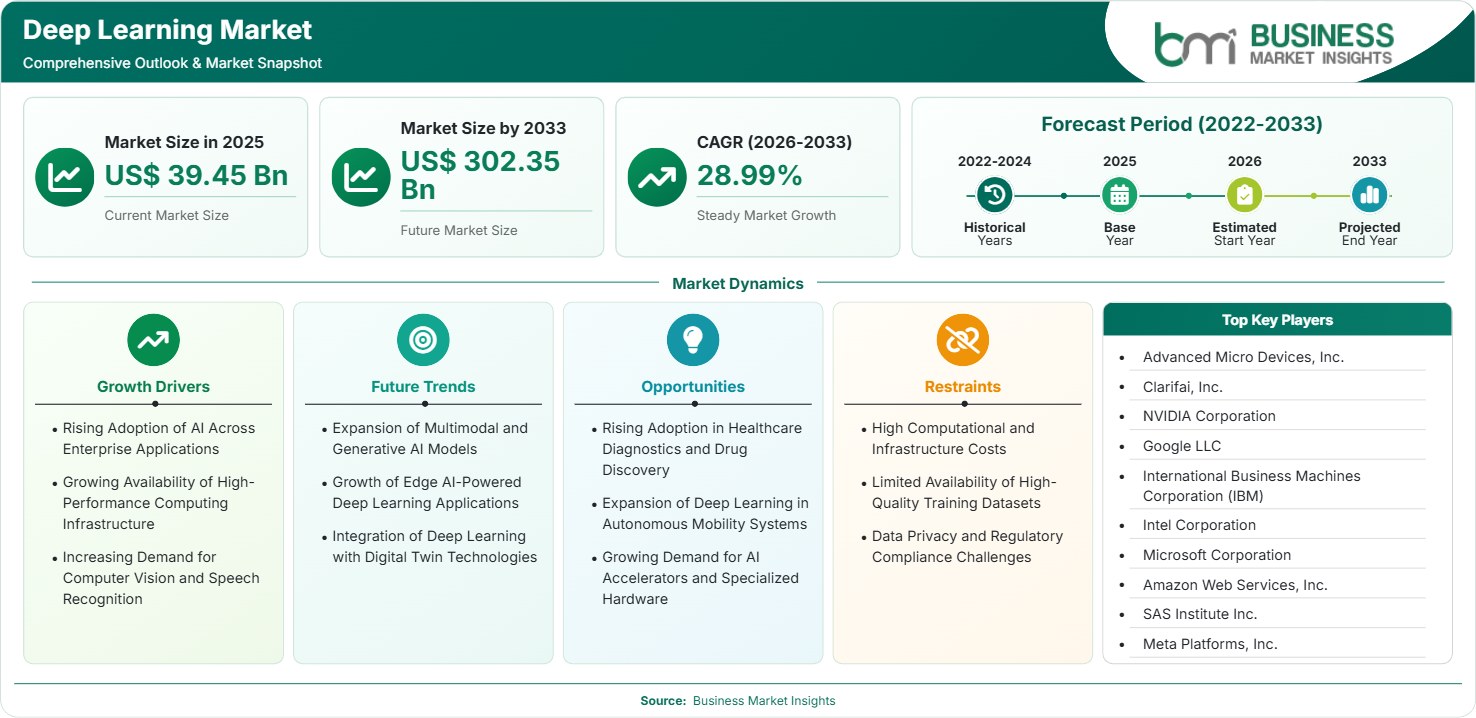
The Deep Learning Market size was valued at US$ 39.45 Billion in 2025 and is projected to reach US$ 302.35 Billion by 2033, growing at a CAGR of 28.99% during 2026–2033. Rising enterprise AI adoption, expanding cloud computing infrastructure, increasing demand for generative AI applications, and rapid investments in high-performance computing continue creating significant growth opportunities across industries.

Report Coverage
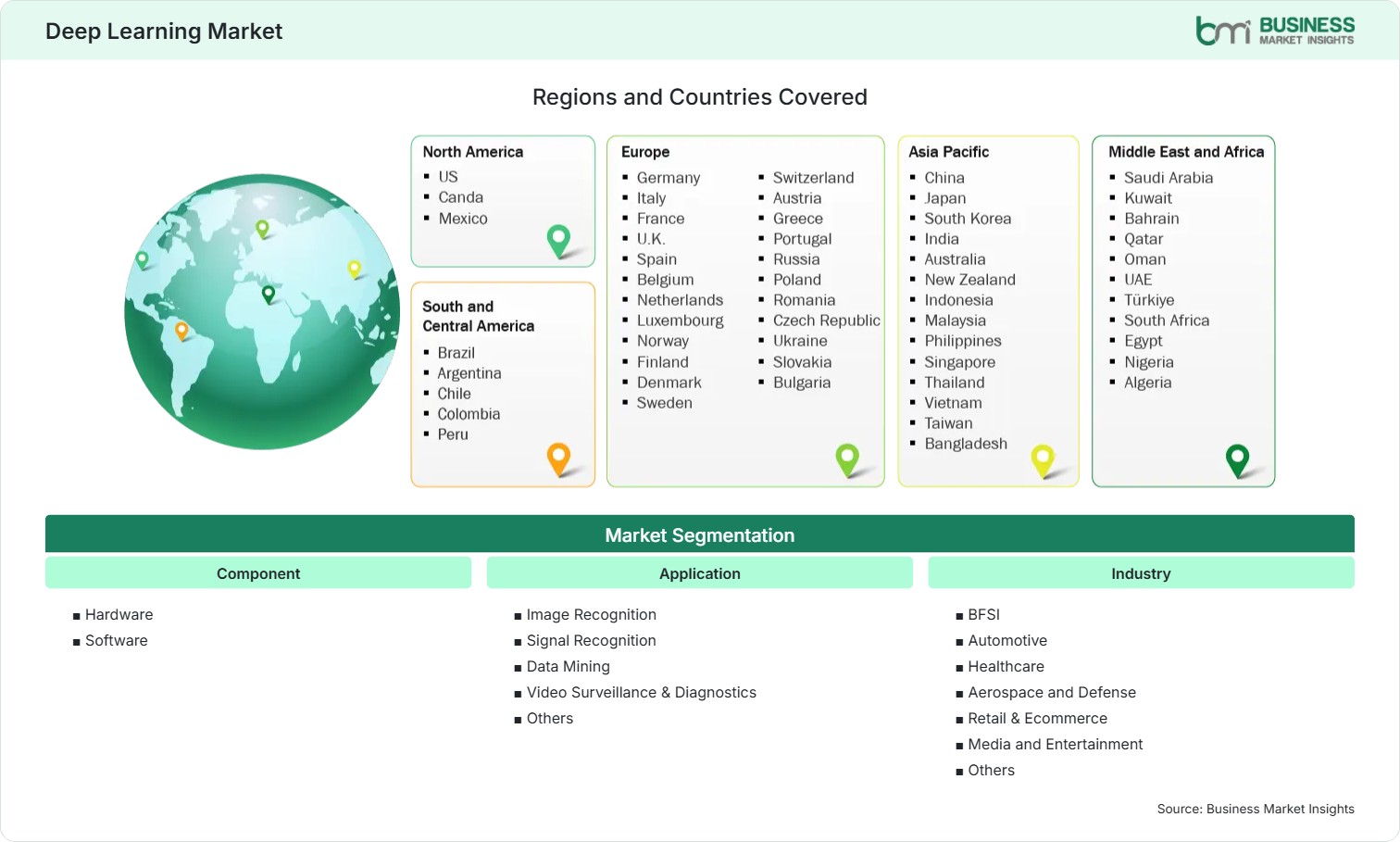
  • Component: Hardware, Software
  • Application: Image Recognition, Signal Recognition, Data Mining, Video Surveillance & Diagnostics, Others
  • Industry: BFSI, Automotive, Healthcare, Aerospace and Defense, Retail & Ecommerce, Media and Entertainment, Others
US$ 39.45 Bn Market size in 2025
US$ 302.35 Bn Market Size by 2033
28.99% CAGR, 2026 - 2033
2026-2033 Forecast Period

AI Overview

Deep Learning Market Summary

  • North America Region: North America holds 37%–40% deep learning market share in 2025 and is projected to expand at a CAGR of 27.1%–27.8% during 2026–2033. Strong AI investments, hyperscale cloud infrastructure, semiconductor innovation, enterprise digital transformation, and growing deployment of generative AI models continue supporting market expansion.
  • Fastest Growing Region: Asia Pacific accounts for 27%–30% of the market in 2025 and is anticipated to grow at a CAGR of 31.2%–31.9%. Expanding AI investments, government digital initiatives, semiconductor manufacturing, cloud adoption, and increasing enterprise automation continue accelerating regional market growth.
  • Leading Segment: Software accounts for 58%–61% market share in 2025 while expanding at a CAGR of 29.5%–30.1%. Growing AI model development, cloud-native platforms, enterprise analytics, and generative AI deployment continue strengthening segment leadership.
  • High Growth Segment: Healthcare represents 15%–18% market share in 2025 and is projected to register a CAGR of 32.5%–33.2%. Increasing AI-assisted diagnostics, medical imaging analysis, drug discovery, predictive healthcare analytics, and precision medicine continue driving rapid adoption.
  • Key Market Opportunity: Growing adoption of multimodal AI, edge intelligence, foundation models, and industry-specific AI platforms is creating new commercialization opportunities across enterprise, industrial, and public sector applications.
  • Major Market Players: Advanced Micro Devices, Inc., Clarifai, Inc., NVIDIA Corporation, Google LLC, International Business Machines Corporation (IBM), Intel Corporation, Microsoft Corporation, Amazon Web Services, Inc., SAS Institute Inc., and Meta Platforms, Inc.
Strategic Insights

Deep Learning Market: Strategic Insights

Deep Learning Market Strategic Framework
FREE PDF
Request your free sample
Request free sample
Stakeholder View

Key Takeaways

  • The value chain becomes more involved with semiconductor firms, cloud computing providers, AI software suppliers, enterprise IT suppliers, and organizations conducting research into how to apply AI commercially.
  • The commercial prospects are best in healthcare, banking, manufacturing, and autonomous driving, where AI solutions can be applied.
  • The focus of development is on foundation models, multimodal AI, edge AI, explainable AI, and energy efficient neural network architectures able to power enterprise-wide applications.
  • Asia Pacific offers an interesting investment opportunity thanks to semiconductor manufacturing capacity growth, government AI strategies, digital transformation efforts, and enterprise adoption growth.
  • Strategic partnerships between cloud providers, AI startups, semiconductor companies, and enterprise software vendors continue accelerating commercial product development and deep learning market expansion.
Geographic Outlook

Deep Learning Market Regional Highlights

North America Deep Learning Market

North America accounted for approximately 37%–40% of global revenue during 2025 and is projected to expand at a CAGR of 27.1%–27.8% through 2033. The region benefits from advanced AI research, mature cloud infrastructure, strong venture capital activity, and continuous enterprise technology investments. The Deep Learning Market share remains supported by widespread adoption of intelligent automation, generative AI, and high-performance computing solutions.

  • Major technology companies continue investing billions in AI infrastructure, data centers, and advanced semiconductor development to support increasingly complex deep learning workloads.
  • Financial institutions increasingly deploy deep learning for fraud detection, risk modeling, algorithmic trading, customer analytics, and regulatory compliance automation.
  • Healthcare organizations expand AI adoption for diagnostic imaging, predictive analytics, precision medicine, and clinical workflow optimization.
  • Universities, research organizations, and technology firms continue strengthening AI innovation through collaborative research, talent development, and commercialization initiatives.

US Deep Learning Market

The United States represents approximately 86%–89% of North American demand and is projected to register a CAGR of 27.3%–27.9% during the forecast period. Strong AI research capabilities, leading cloud providers, semiconductor innovation, and enterprise technology investments continue supporting sustained deep learning market expansion.

  • Hyperscalers’ cloud offerings keep growing in relation to AI computing power for enterprise machine learning model training and inference and generative AI solutions.
  • Tech companies are making more and more foundation models that can be used in enterprise productivity, software development, customer service, and content creation.
  • Venture capital keeps fueling the rapid growth of AI startups in areas such as health care, cybersecurity, fintech, and industry automation.
  • Federal investments in AI research and chip manufacturing keep improving long-term tech competitiveness.

Europe Deep Learning Market

Europe accounted for approximately 23%–26% of global revenue during 2025 and is expected to grow at a CAGR of 28.2%–28.8% through 2033. Growing enterprise AI adoption, digital sovereignty initiatives, and responsible AI regulations continue driving regional expansion. Germany leads regional demand, while the Netherlands records one of the fastest growth rates supported by AI innovation ecosystems.

  • Germany maintains leadership through advanced industrial automation, manufacturing AI adoption, and strong enterprise software capabilities.
  • The Netherlands demonstrates strong growth supported by cloud infrastructure investments, AI research collaboration, and expanding digital innovation ecosystems.
  • Financial institutions increasingly deploy AI-driven analytics for operational efficiency, regulatory compliance, and customer engagement.
  • Public sector digital transformation initiatives continue expanding demand for secure and transparent AI solutions.

Asia Pacific Deep Learning Market

Asia Pacific represented approximately 27%–30% of global revenue during 2025 and is forecast to grow at a CAGR of 31.2%–31.9% through 2033, making it the fastest-growing regional market. Expanding semiconductor manufacturing, AI startup ecosystems, government initiatives, and enterprise digitalization continue accelerating adoption. China leads regional revenue, while India records the fastest growth.

  • China continues strengthening AI leadership through substantial investments in computing infrastructure, intelligent manufacturing, and enterprise AI deployment.
  • India experiences rapid expansion driven by cloud adoption, digital transformation, software development expertise, and expanding AI startup investments.
  • Japan and South Korea continue advancing AI innovation through robotics, autonomous systems, semiconductor development, and industrial automation.
  • Southeast Asian economies increasingly adopt AI-powered analytics across finance, retail, manufacturing, and healthcare sectors.

Rest of World Deep Learning Market

The Rest of World region accounted for approximately 7%–9% of global market revenue during 2025 and is anticipated to grow at a CAGR of 29.0%–29.6% through 2033. South & Central America benefit from accelerating enterprise digitalization, while the Middle East and Africa experience increasing AI investments supported by national innovation strategies. Brazil leads Latin America, whereas the United Arab Emirates records the fastest regional growth.

  • Brazil continues expanding enterprise AI adoption across banking, retail, healthcare, and public administration applications.
  • The United Arab Emirates invests significantly in artificial intelligence, cloud infrastructure, and smart government initiatives to strengthen digital competitiveness.
  • Cloud providers continue expanding regional data center investments supporting enterprise AI deployment.
  • Universities and technology incubators increasingly collaborate to develop skilled AI talent and strengthen regional innovation ecosystems.
Global Market Geography
FREE PDF
Request your free sample
Request free sample
Segment Analysis

Deep Learning Market Segmentation

Component

The Component segment accounted for approximately 58%–61% of the market in 2025 and is projected to expand at a CAGR of 29.2%–29.8% during 2026–2033. Continuous advancements in AI model development, cloud computing, and specialized semiconductor technologies continue driving investments across hardware and software ecosystems. The Deep Learning Market scope continues expanding as organizations deploy increasingly sophisticated AI workloads requiring optimized computing infrastructure and intelligent software platforms.

  • Hardware: High-performance processors remain fundamental for training and inference workloads, supporting faster computation, lower latency, and efficient execution of increasingly complex neural network models.
    • Central Processing Unit (CPU): CPUs continue supporting data preprocessing, orchestration, and inference tasks while complementing specialized AI processors across enterprise computing environments.
    • Graphics Processing Unit (GPU): GPUs dominate deep learning workloads because of their parallel computing capabilities, significantly accelerating neural network training, inference, and large-scale AI model deployment.
    • Field Programmable Gate Array (FPGA): FPGAs provide flexible hardware acceleration, enabling customized AI inference with lower power consumption across industrial automation, telecommunications, and edge computing applications.
    • Application-Specific Integration Circuit (ASIC): ASICs deliver highly optimized AI processing performance by supporting dedicated neural network computations with superior efficiency and lower operational power requirements.
  • Software: Software platforms enable model development, training, deployment, orchestration, monitoring, and lifecycle management while supporting enterprise AI integration across cloud, hybrid, and edge computing environments.

Application

Application-driven adoption continues accelerating as organizations integrate artificial intelligence into mission-critical operations. This segment represented approximately 31%–34% of the market in 2025 and is anticipated to register a CAGR of 30.1%–30.7% during the forecast period. The Deep Learning Market trends highlight growing enterprise demand for intelligent automation, predictive analytics, and advanced pattern recognition capabilities.

  • Image Recognition: Image recognition applications continue expanding across healthcare, manufacturing, retail, automotive, and security sectors through automated visual inspection, facial recognition, and object detection technologies.
  • Signal Recognition: Signal recognition enables intelligent processing of speech, audio, sensor, and communication signals, supporting virtual assistants, industrial monitoring, predictive maintenance, and telecommunications optimization.
  • Data Mining: Deep learning algorithms improve predictive analytics by identifying hidden patterns, customer behavior insights, fraud detection opportunities, and operational intelligence across large enterprise datasets.
  • Video Surveillance & Diagnostics: AI-powered video analytics strengthen public safety, industrial inspection, healthcare diagnostics, traffic monitoring, and anomaly detection through real-time intelligent image interpretation.
  • Others: Emerging applications include recommendation engines, natural language processing, cybersecurity analytics, financial forecasting, robotics, and scientific research supported by advanced neural network architectures.

Industry

Industry adoption continues broadening as organizations prioritize artificial intelligence for operational efficiency, automation, and data-driven decision-making. The segment accounted for approximately 26%–29% of the deep learning market in 2025 and is projected to expand at a CAGR of 29.8%–30.4% through 2033. Growing investments in enterprise AI platforms continue accelerating commercialization across multiple vertical industries.

  • BFSI: Financial institutions deploy deep learning for fraud detection, customer analytics, risk assessment, algorithmic trading, regulatory compliance, and intelligent process automation.
  • Automotive: Automotive companies utilize deep learning for autonomous driving, driver assistance systems, predictive maintenance, quality inspection, and intelligent manufacturing operations.
  • Healthcare: Healthcare organizations increasingly implement AI-assisted diagnostics, medical imaging analysis, precision medicine, drug discovery, and hospital workflow optimization.
  • Aerospace and Defense: Defense agencies and aerospace companies leverage deep learning for surveillance, autonomous systems, predictive maintenance, mission planning, and threat detection.
  • Retail & E-commerce: Retailers utilize intelligent recommendation systems, demand forecasting, inventory optimization, customer behavior analytics, and personalized shopping experiences powered by deep learning.
  • Media and Entertainment: Media organizations deploy AI for content recommendation, automated editing, audience analytics, language translation, and digital content generation.
  • Others: Education, energy, agriculture, logistics, telecommunications, and manufacturing continue expanding AI adoption to improve operational efficiency and intelligent decision-making.
Market Forces

Deep Learning Market Dynamics

Key Market Drivers

Rising Adoption of AI Across Enterprise Applications

Enterprises across banking, healthcare, manufacturing, retail, telecommunications, and public services continue integrating artificial intelligence into business operations to improve productivity and decision-making. Deep learning enables advanced automation, predictive analytics, intelligent customer engagement, and operational optimization through sophisticated neural network models. Organizations increasingly prioritize AI investments to gain competitive advantages, reduce manual processes, and improve service quality. The Deep Learning Market growth continues accelerating as businesses deploy enterprise AI platforms capable of supporting large-scale analytics, generative AI, intelligent automation, and data-driven strategic planning across diverse operational environments.

Growing Availability of High-Performance Computing Infrastructure

The development of hyperscale cloud data centers, high-performance computing clusters, and cutting-edge semiconductor technology is further enhancing the availability of computational power necessary for intricate AI tasks. The use of GPU clusters, AI accelerators, distributed computing systems, and cloud-based machine learning platforms is facilitating a decrease in model training time, while at the same time helping to process greater volumes of data. Investments made by cloud companies and semiconductor companies are further augmenting the infrastructure needed for AI development worldwide.

Increasing Demand for Computer Vision and Speech Recognition

Both computer vision and speech recognition technologies have continued to be adopted across sectors, including the health care, manufacturing, and automotive industries, financial services, retail, and consumer electronics. Many organizations have continued to leverage artificial intelligence-driven image, face, speech, document, and intelligent video analysis to become more efficient and customer-oriented. With continuous improvements in transformer models, multimodal AI models, and real-time inferencing, recognition accuracy has continued to be boosted. Demand from enterprises for intelligent perception technologies is thus a key driver for deep learning adoption.

Key Market Opportunities

Rising Adoption in Healthcare Diagnostics and Drug Discovery

Healthcare providers, pharmaceutical companies, and biotechnology organizations continue increasing investments in artificial intelligence to accelerate diagnostics, precision medicine, clinical decision support, and drug discovery. Deep learning significantly improves medical image interpretation, disease prediction, molecular analysis, and identification of potential therapeutic candidates. The Deep Learning Market Forecasts remain highly favorable as healthcare systems increasingly prioritize AI-enabled clinical workflows and personalized treatment approaches. Organizations investing in medical AI platforms, validated datasets, and regulatory-compliant solutions are expected to capture substantial long-term growth opportunities across the healthcare ecosystem.

Expansion of Deep Learning in Autonomous Mobility Systems

Automated driving cars, ADAS solutions, smart transport systems, and connectivity mobility software solutions are relying more on deep learning algorithms for sensing, navigation, object recognition, and decision-making processes. Car makers are constantly working on the development of new AI models powered by modern sensor technologies, powerful processors, and cloud-based car platforms. The broad deployment of autonomous technology in passenger cars, logistics vehicles, industrial machines, and robots represents an excellent market opportunity for deep learning software companies and chipmakers.

Growing Demand for AI Accelerators and Specialized Hardware

The growing need for powerful computations with regards to large language models, foundation models, and enterprise applications of artificial intelligence will result in more need for special processors like GPUs, AI accelerators, ASICs, and FPGAs. Enterprises need computing platforms that can provide increased computing efficiency while lowering power consumption and inference latency. Semiconductor firms that have been focusing on building next-generation AI hardware platforms, advanced semiconductor packaging, and edge AI processors will be well-placed to take advantage of the growth in enterprise AI usage.

Market Restraints and Challenges

High Computational and Infrastructure Costs

Factor: The development of complex deep learning systems is dependent on heavy spending on GPUs, AI accelerators, cloud infrastructure, data storage infrastructure, networking devices, and power-intensive data center operations.

Impact: Infrastructure-related expenses are major hurdles faced by start-ups and small businesses when developing or implementing complex AI applications. The increasing cost of electricity and the hardware itself affects the operational budget for large scale AI applications as well. Cloud-based AI services and computing infrastructure are used more often nowadays to ensure high efficiency in terms of cost and computing.

Limited Availability of High-Quality Training Datasets

Factor: The deep learning models require large, accurate, representative, and unbiased datasets that can be used for developing robust models across various practical applications.

Impact: The absence of high-quality datasets can affect the accuracy of the model, introduce algorithmic biases, delay model deployment, and limit AI capabilities in various enterprise applications. In addition, privacy concerns, data ownership issues, and poor data quality add to the complexities of developing AI models. The companies are continuously working towards improving data governance and data management approaches.

Company Analysis

Competitive Landscape

Deep Learning Market Analysis is very competitive, dominated by semiconductor vendors, cloud services companies, enterprise software vendors, and AI platforms providers. There are massive investments made in foundation models, AI accelerators, hyperscale cloud computing systems, generative AI platforms, and enterprise machine learning offerings. Strategic acquisitions, AI research partnerships, and constant innovations in hardware & software ecosystem continue to play key roles in staying ahead technologically.

Company Name

Overview

Products and Services Relevant to this Market

Advanced Micro Devices, Inc.

Advanced Micro Devices, Inc. develops high-performance processors and AI accelerators supporting enterprise computing, cloud infrastructure, and advanced artificial intelligence workloads.

CPUs, GPUs, AI accelerators, data center processors, edge computing hardware, and high-performance computing solutions for deep learning applications.

Clarifai, Inc.

Clarifai, Inc. provides enterprise artificial intelligence platforms specializing in computer vision, natural language processing, and machine learning model development.

AI platform, computer vision software, natural language processing, model training tools, workflow automation, and enterprise deep learning solutions.

NVIDIA Corporation

NVIDIA Corporation is a global leader in AI computing infrastructure, supplying advanced GPUs, networking technologies, and software platforms for deep learning workloads.

AI GPUs, CUDA software, DGX systems, networking solutions, AI Enterprise software, and accelerated computing platforms.

Google LLC

Google LLC develops advanced artificial intelligence technologies supported by cloud infrastructure, proprietary AI models, and large-scale machine learning research.

Google Cloud AI, Tensor Processing Units (TPUs), Vertex AI, Gemini models, TensorFlow, and enterprise AI development services.

International Business Machines Corporation (IBM)

IBM delivers enterprise AI solutions integrating hybrid cloud technologies, responsible AI frameworks, and industry-specific machine learning applications.

IBM watsonx, AI software, hybrid cloud platforms, machine learning services, data analytics, and enterprise automation solutions.

Intel Corporation

Intel Corporation develops processors and AI hardware supporting enterprise computing, edge AI deployment, and high-performance artificial intelligence infrastructure.

CPUs, AI accelerators, Gaudi processors, edge AI platforms, data center hardware, and software optimization tools.

Microsoft Corporation

Microsoft Corporation provides cloud-based AI infrastructure, enterprise software, and generative AI capabilities through its global technology ecosystem.

Microsoft Azure AI, Azure Machine Learning, Copilot technologies, AI development services, cloud computing, and enterprise analytics platforms.

Amazon Web Services, Inc.

Amazon Web Services, Inc. delivers scalable cloud infrastructure and managed artificial intelligence services supporting enterprise machine learning deployment worldwide.

Amazon SageMaker, Bedrock, AI infrastructure, cloud computing, machine learning services, AI accelerators, and analytics solutions.

SAS Institute Inc.

SAS Institute Inc. develops advanced analytics and artificial intelligence software supporting enterprise decision-making and predictive business intelligence applications.

AI analytics platforms, machine learning software, predictive analytics, computer vision, data management, and intelligent automation solutions.

Meta Platforms, Inc.

Meta Platforms, Inc. invests extensively in artificial intelligence research, large language models, and open AI frameworks supporting next-generation digital experiences.

Llama models, AI research, machine learning frameworks, generative AI technologies, computer vision, and open-source AI development tools.

Trust & Transparency

Research Methodology

The market analysis combines proprietary research with secondary data from government agencies, company disclosures, regulatory filings, industry databases and expert interviews. Market estimates are validated through data triangulation, cross-market benchmarking and analyst review.

View Full Research Methodology

Questions Answered

Frequently Asked Questions

What does a Deep Learning Market Report typically include?

A comprehensive report covers market size, segmentation, competitive landscape, regional analysis, technology trends, industry adoption, company strategies, investment opportunities, market challenges, and long-term growth forecasts.

How does specialized hardware support deep learning applications?

GPUs, ASICs, FPGAs, and AI accelerators significantly improve computational performance by reducing training time, increasing inference speed, and efficiently processing large neural network models for enterprise-scale workloads.

Why is healthcare one of the fastest-growing industries for deep learning?

Healthcare organizations increasingly use deep learning for medical imaging, disease prediction, drug discovery, precision medicine, clinical decision support, and hospital workflow optimization, improving diagnostic accuracy and operational efficiency.

Which component dominates the market?

Software holds the largest market share because organizations increasingly require AI platforms, model development frameworks, deployment tools, and lifecycle management solutions for enterprise artificial intelligence applications.

What is driving the growth of the market?

The market is expanding due to increasing enterprise AI adoption, rapid growth of cloud computing, availability of high-performance processors, generative AI deployment, and rising demand for intelligent automation across multiple industries.

Access the Full Deep Learning Market Report

Get segment-level forecasts, regional estimates, competitive benchmarking, company profiles and downloadable Excel datasets.

Access the full Deep Learning Market Report
350 pages PDF & Excel | 2026-08-07
Similar Research

Related Market Reports