
Gamification Market Outlook: Size, Share, Trends, Growth Analysis, Competitive Landscape & Forecast, 2026-2033

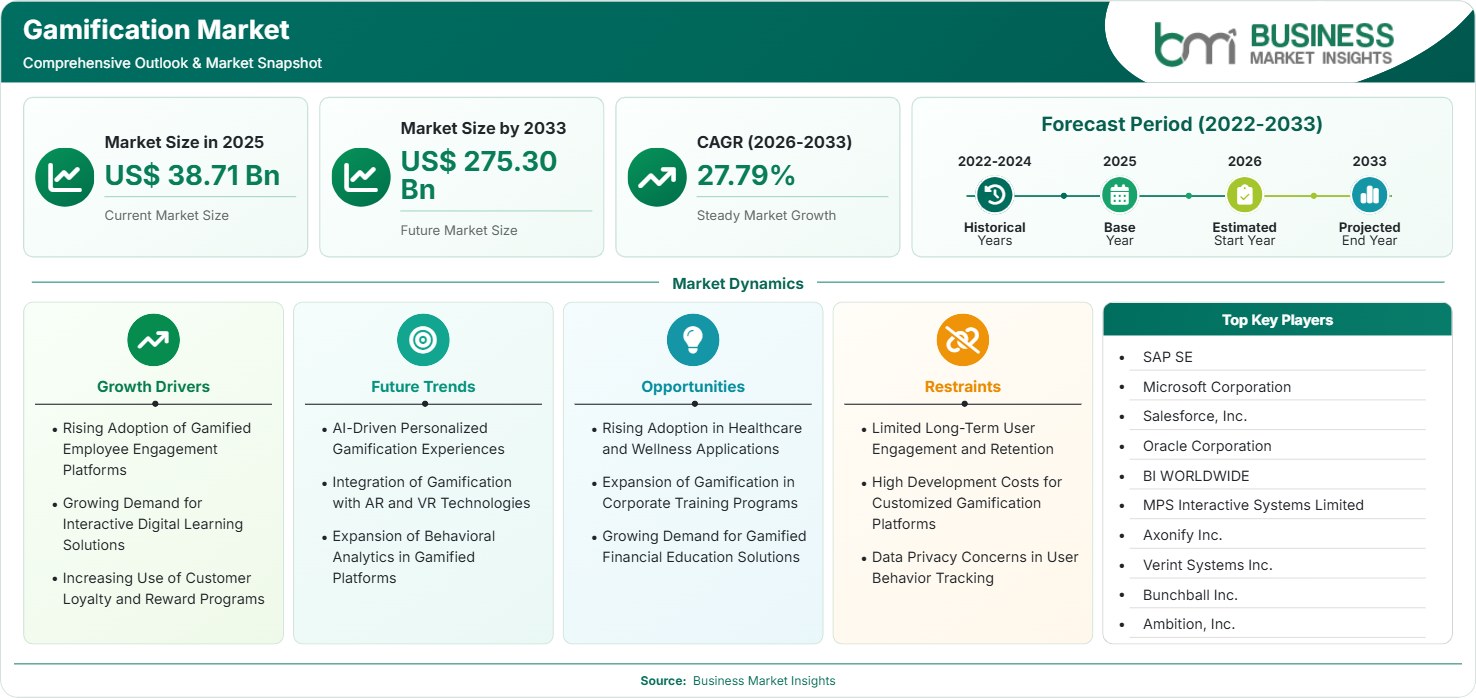
The Gamification Market size was valued at US$ 38.71 Billion in 2025 and is projected to reach US$ 275.30 Billion by 2033, growing at a CAGR of 27.79% during 2026–2033. Rising enterprise digital transformation initiatives, increasing employee engagement programs, growing adoption of learning platforms, and expanding customer loyalty strategies are accelerating demand for gamification solutions globally.

Report Coverage
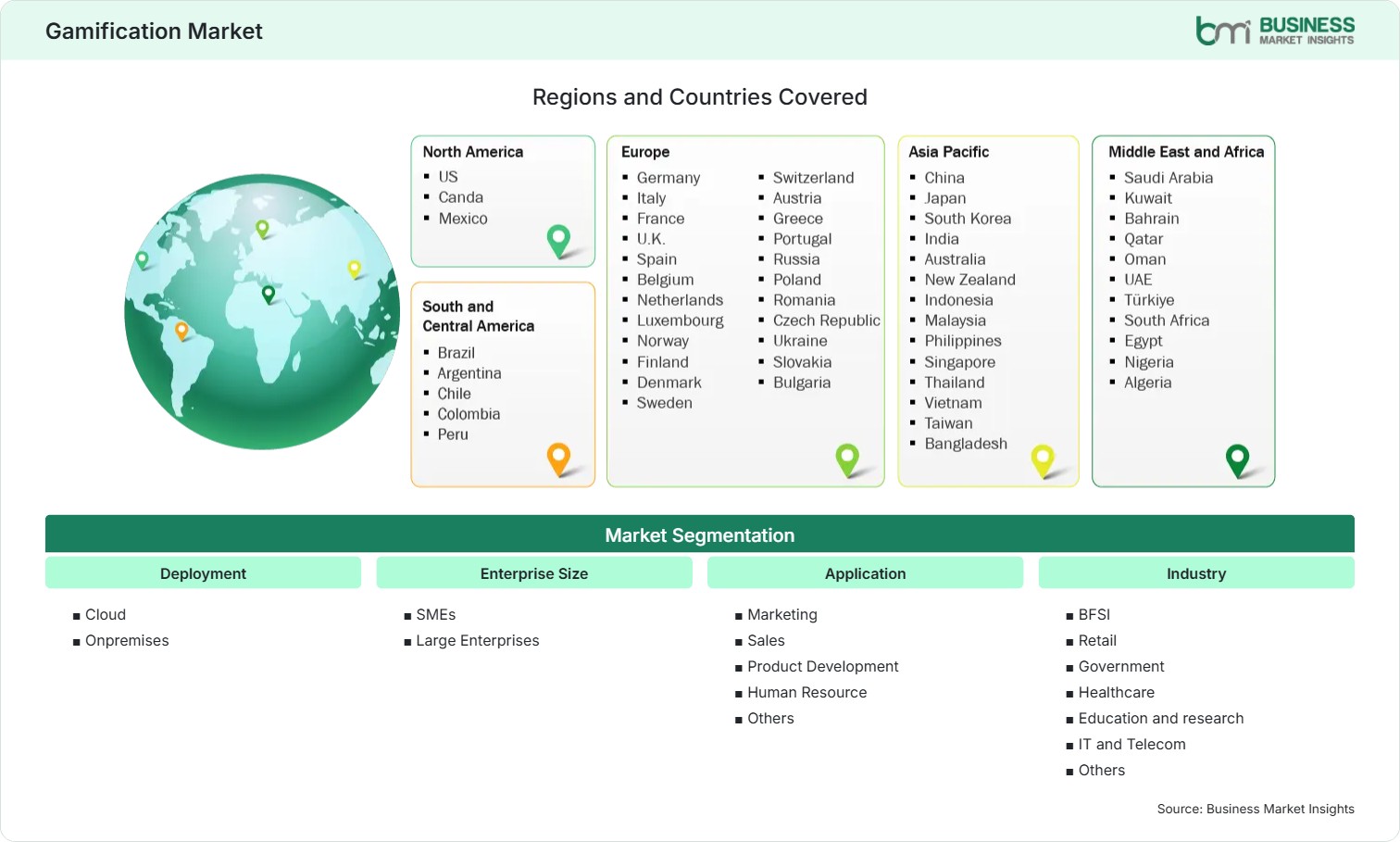
  • Deployment: Cloud, Onpremises
  • Enterprise Size: SMEs, Large Enterprises
  • Application: Marketing, Sales, Product Development, Human Resource, Others
  • Industry: BFSI, Retail, Government, Healthcare, Education and research, IT and Telecom, Others
US$ 38.71 Bn Market size in 2025
US$ 275.30 Bn Market Size by 2033
27.79% CAGR, 2026 - 2033
2026-2033 Forecast Period

AI Overview

Gamification Market Summary

  • North America Region: North America holds a gamification market share of 36%–39% in 2025, growing with a CAGR of 25%–27% during 2026–2033. Strong enterprise digitalization, employee experience initiatives, customer engagement programs, cloud adoption, and widespread use of data-driven incentive platforms continue supporting regional growth. The U.S. market benefits from advanced enterprise software adoption, strong SaaS penetration, and increasing workforce engagement investments, expanding at 25.5%–27.5% CAGR.
  • Fastest Growing Region: Asia Pacific accounts for 24%–27% share in 2025 and is projected to grow at a CAGR of 30%–32% through 2033. Rapid enterprise modernization, mobile-first digital ecosystems, corporate training investments, e-learning expansion, and increasing digital customer engagement initiatives continue driving adoption.
  • Leading Segment: Cloud deployment represents 67%–70% share in 2025 and is expected to grow at a CAGR of 28%–30% through 2033. Scalability advantages, lower deployment costs, subscription-based delivery models, remote accessibility, and continuous software updates support segment dominance.
  • High Growth Segment: Human Resource applications account for 18%–21% share in 2025 and are forecast to grow at a CAGR of 31%–33% during 2026–2033. Employee engagement programs, workforce productivity initiatives, performance management solutions, and organizational learning strategies continue supporting expansion.
  • Key Market Opportunity: Organizations are increasingly integrating gamification into workforce management, customer engagement, digital learning, and brand loyalty initiatives to improve participation rates, user retention, and measurable business outcomes.
  • Major Market Players: Microsoft Corporation, MPS Interactive Systems Limited, SAP SE, BI Worldwide, Verint Systems Inc., Hoopla Software, Inc., Aon plc (cut-e GmbH), Influitive Corporation, Mambo Solutions Ltd., Khoros, LLC.
Strategic Insights

Gamification Market: Strategic Insights

Gamification Market Strategic Framework
FREE PDF
Request your free sample
Request free sample
Stakeholder View

Key Takeaways

  • Enterprise demand is shifting from basic reward-based systems toward advanced platforms integrating analytics, AI-driven recommendations, and personalized engagement experiences.
  • Human resource applications present one of the strongest growth opportunities as organizations prioritize employee retention, learning effectiveness, and workforce productivity improvement.
  • Cloud deployment models continue dominating because they offer scalability, faster implementation, lower infrastructure costs, and seamless integration with enterprise software environments.
  • Asia Pacific presents a compelling investment opportunity due to growing digital workforce initiatives, enterprise modernization, and rapid expansion of e-learning ecosystems.
  • Strategic partnerships between software companies, learning providers, and workforce management vendors are expanding product ecosystems and strengthening gamification market reach.
  • Gamification adoption is increasingly extending beyond training and marketing into performance management, customer communities, sales enablement, and innovation management functions.
Geographic Outlook

Gamification Market Regional Highlights

North America Gamification Market

North America accounts for 36%–39% Gamification Market share in 2025 and is expected to grow at a CAGR of 25%–27% through 2033. The region benefits from mature enterprise software adoption, advanced cloud infrastructure, and increasing investments in workforce engagement technologies. Organizations across BFSI, healthcare, retail, and technology sectors continue utilizing gamification solutions to improve employee performance, customer experiences, and learning effectiveness.

  • Enterprises are increasingly integrating gamification with learning management systems, customer relationship management platforms, and workforce productivity applications. This integration helps organizations improve engagement metrics while generating measurable performance outcomes.
  • Customer loyalty and retention programs continue driving demand for advanced gamification platforms. Brands are increasingly utilizing rewards, challenges, and achievement mechanisms to strengthen long-term customer relationships.
  • Corporate learning and employee training initiatives are shifting toward interactive engagement models. Gamified learning experiences are helping organizations improve knowledge retention and participation levels.
  • Cloud-based engagement platforms remain highly attractive because they deliver scalability, remote accessibility, and rapid deployment capabilities suitable for large enterprise environments.
  • Organizations continue investing in employee wellness, productivity, and culture-building initiatives supported by gamification technologies designed to strengthen workforce engagement.

US Gamification Market

The United States contributes approximately 79%–83% of North American revenue and is projected to register a CAGR of 25.5%–27.5% through 2033. High enterprise technology spending, widespread SaaS adoption, and increasing focus on workforce experience continue driving gamification market growth. Businesses are incorporating gamification into employee development, customer engagement, and sales performance management programs across industries.

  • Leading enterprises continue developing highly personalized engagement programs supported by real-time analytics and behavioral insights.
  • Growing digital workplace adoption is increasing demand for gamified employee productivity and collaboration platforms.
  • Customer engagement initiatives increasingly rely on reward-based participation mechanisms to improve retention and lifetime value.
  • Demand for measurable training effectiveness is accelerating implementation of gamified learning ecosystems across corporate environments.

Europe Gamification Market

Europe represents 24%–27% of global revenue in 2025 and is anticipated to grow at a CAGR of 26%–28% through 2033. Enterprise digital transformation initiatives, workforce modernization programs, and learning technology investments continue supporting growth. Germany remains the leading regional market due to its large enterprise software ecosystem, while Poland demonstrates stronger growth momentum supported by increasing digital workplace investments.

  • Germany leads regional adoption through strong enterprise software spending and increasing adoption of digital employee engagement platforms.
  • Poland is among the fastest-growing markets with an estimated CAGR of 28%–30%, supported by workforce digitization and rapidly expanding corporate training programs.
  • Organizations increasingly utilize gamification to improve employee development, compliance training, and performance management effectiveness.
  • Customer experience management continues emerging as an important adoption area across retail, banking, and service industries.
  • Growing focus on digital skills development is encouraging deployment of interactive learning and engagement technologies.

Asia Pacific Gamification Market

Asia Pacific accounts for 24%–27% of total revenue in 2025 and is expected to achieve the fastest CAGR of 30%–32% through 2033. Rapid digitalization, expanding mobile internet access, growing enterprise technology investments, and increasing adoption of online learning solutions continue supporting gamification market growth. China remains the largest regional market, while India demonstrates exceptional growth potential due to its expanding digital economy and workforce modernization initiatives.

  • China continues leading regional demand through widespread digital platform adoption and increasing enterprise investment in engagement technologies.
  • India is projected to achieve approximately 32%–34% CAGR, supported by strong growth in e-learning, SaaS adoption, and workforce management technologies.
  • Organizations increasingly deploy gamified learning solutions to improve employee skills development and participation outcomes.
  • Mobile-first engagement platforms continue gaining momentum because of strong smartphone penetration and digital workforce adoption.
  • Enterprises are increasingly utilizing gamification within sales enablement and customer retention strategies to improve business performance.

Rest of World Gamification Market

Rest of World accounts for 10%–13% of global revenue in 2025 and is projected to expand at a CAGR of 27%–29% through 2033. Growing digital transformation initiatives, increasing demand for workforce engagement solutions, and expanding use of customer loyalty platforms continue driving adoption. Enterprises across Latin America, the Middle East, and Africa are increasingly modernizing engagement and training strategies.

  • Brazil remains an important gamification market due to growing investments in enterprise software and customer engagement technologies.
  • The UAE continues witnessing increasing adoption of digital workforce management and employee engagement platforms across public and private sectors.
  • Saudi Arabia is expected to achieve approximately 29%–31% CAGR, supported by ongoing digital transformation and workforce modernization initiatives.
  • Increasing use of digital learning technologies is encouraging gamification adoption across education and corporate training environments.
  • Customer engagement and loyalty management programs continue creating opportunities for gamification solution providers across emerging economies.
Global Market Geography
FREE PDF
Request your free sample
Request free sample
Segment Analysis

Gamification Market Segmentation

Deployment

The deployment segment represents the foundation of modern gamification implementation strategies, enabling organizations to integrate engagement tools across employee, customer, and learning ecosystems. The segment accounts for approximately 65%–68% share in 2025 and is expected to grow at a CAGR of 28%–30% through 2033. The expanding Gamification Market scope is driven by increasing cloud adoption, enterprise mobility requirements, digital workplace transformation, and growing demand for scalable engagement platforms capable of supporting geographically distributed user bases.

  • Cloud: Cloud deployment remains the dominant model due to lower infrastructure requirements, simplified implementation, subscription-based pricing, scalability advantages, and seamless integration with enterprise software environments.
  • On-premises: On-premises deployment continues attracting organizations with stringent data governance, security, and compliance requirements, particularly within regulated industries such as BFSI, healthcare, and government sectors.

Enterprise Size

Enterprise adoption is expanding across organizations of all sizes as engagement, productivity, and learning effectiveness become strategic priorities. This segment accounts for approximately 32%–35% share in 2025 and is projected to register a CAGR of 28%–30% through 2033. Current Gamification Market trends highlight increasing investments in employee engagement programs, customer loyalty platforms, digital learning systems, and performance management solutions across both large organizations and growing businesses.

  • SMEs: Small and medium-sized enterprises increasingly adopt gamification platforms to improve workforce productivity, enhance customer engagement, strengthen training outcomes, and compete more effectively in digitally driven markets.
  • Large Enterprises: Large enterprises remain major adopters because of their broad workforce engagement requirements, extensive customer bases, large-scale digital transformation initiatives, and increasing focus on measurable performance outcomes.

Application

Application-based adoption continues broadening as organizations utilize gamification to influence user behavior, improve participation rates, and strengthen business performance. This segment accounts for approximately 35%–38% share in 2025 and is expected to grow at a CAGR of 29%–31% during the forecast period. Enterprises are increasingly integrating gamification into internal processes and customer-facing initiatives to improve engagement and operational effectiveness.

  • Marketing: Marketing applications leverage gamified experiences, rewards systems, and interactive campaigns to strengthen customer acquisition, brand awareness, audience participation, and long-term engagement.
  • Sales: Sales teams increasingly utilize gamification tools to improve employee motivation, performance tracking, target achievement, and competitive collaboration within revenue-generating functions.
  • Product Development: Product development teams apply gamification techniques to encourage innovation, gather user feedback, improve collaboration, and strengthen participation in ideation processes.
  • Human Resource: Human resource applications support employee onboarding, learning, recognition, performance management, engagement initiatives, and workforce development programs.
  • Others: Additional applications include customer communities, operational efficiency programs, compliance training, wellness initiatives, and stakeholder engagement platforms.

Industry

Industry adoption continues diversifying as organizations recognize the value of behavioral engagement technologies across multiple operational functions. This segment accounts for approximately 34%–37% share in 2025 and is projected to grow at a CAGR of 29%–31% through 2033. Businesses increasingly deploy gamification solutions to drive learning outcomes, customer retention, workforce participation, and digital transformation objectives.

  • BFSI: Financial institutions utilize gamification for customer engagement, financial literacy programs, employee training, sales performance improvement, and digital banking adoption initiatives.
  • Retail: Retail companies increasingly deploy gamified loyalty programs, personalized promotions, customer rewards, and employee engagement systems to improve business performance.
  • Government: Government organizations use gamification to encourage citizen engagement, support workforce development, facilitate digital service adoption, and improve training outcomes.
  • Healthcare: Healthcare providers apply gamification to wellness programs, patient engagement initiatives, employee training, rehabilitation activities, and health education platforms.
  • Education and Research: Educational institutions increasingly leverage gamification to improve learning retention, participation levels, student engagement, and digital education outcomes.
  • IT and Telecom: IT and telecom companies utilize gamification for workforce productivity, customer engagement, product adoption, and employee skill development initiatives.
  • Others: Additional industries deploy gamification solutions to improve participation, collaboration, performance management, and stakeholder engagement across diverse operational environments.
Market Forces

Gamification Market Dynamics

Key Market Drivers

Rising Adoption of Gamified Employee Engagement Platforms

Organizations across the globe are relying on gamified employee engagement tools to boost their productivity, retention, cooperation, and employee satisfaction levels. The problem with traditional methods is that they usually fail to sustain participation levels for a long time, which is why gamification is being introduced as an effective tool that will help organizations develop measurable engagement strategies and foster necessary behavior patterns for performance management. Another factor driving the growth of gamification tools is the increasing popularity of the hybrid and remote workplace setting. Companies are more willing than ever to invest in employee-focused technologies.

Growing Demand for Interactive Digital Learning Solutions

Learning environments are now highly relying on gamification strategies in enhancing retention of knowledge, levels of engagement and learning effectiveness. Educational establishments, companies and professional development organizations are implementing gamification methods such as use of points system, a leaderboard, interactive challenges and achievement tools in their learning platforms. This way, they are making learning processes more interesting and at the same time improving outcomes of skills development. With the current emphasis on workforce upskilling and reskilling programs by organizations, there is increasing need for interactive learning technologies.

Increasing Use of Customer Loyalty and Reward Programs

There are many examples in today's world where organizations have started leveraging gamification to improve their relationship and retention of customers. Gamification involves rewards programs, achievements programs, personalized incentives and engagement campaigns, which help organizations build strong customer relationships by making them interact again and again. Loyalty programs of today are going beyond conventional point-based programs and are adopting immersive game-based programs that will help organizations get more customers involved. Increasing emphasis on customer experience management and engagement of brands is another factor behind the increasing adoption of gamification technology.

Key Market Opportunities

Rising Adoption in Healthcare and Wellness Applications

The use of gamification is increasing among providers of healthcare, insurance companies, and wellness providers to promote healthy behaviors, ensure medication compliance, and engage patients in the process. Wellness applications that employ gamification provide means for tracking physical exercise, progress in health, medication compliance, and personal wellness goals in an engaging way. Gamification of wellness is also being implemented by employers in workplace health care solutions, which can help increase their engagement and decrease the costs associated with healthcare. The importance of preventive healthcare and digital healthcare provides great opportunities for solution providers.

Expansion of Gamification in Corporate Training Programs

Gamification features have become common in corporate training programs in order to enhance learning outcomes, employee involvement, and skills acquisition. The interactive form of learning helps organizations deal with shrinking attention spans as well as enhance the rate of knowledge retention. Gamification is useful in facilitating the onboarding program, leadership development, compliance training, and technical training programs among others. Organizations are also using analytics-based platforms to better gauge engagement levels and learning progress. With the increasing pace of workforce transformation, organizations are set to invest heavily in training technology that can offer improved learning experience.

Growing Demand for Gamified Financial Education Solutions

Financial institutions, fintech companies, and educational organizations are increasingly utilizing gamification to improve financial literacy, customer education, and product awareness. Interactive experiences help users better understand savings strategies, investment concepts, budgeting practices, and financial planning frameworks. Digital engagement tools make complex financial topics more accessible while improving participation levels among diverse user groups. Financial service providers are also leveraging gamification to encourage greater use of digital banking and wealth management platforms. Long-term Gamification Market Forecasts remain highly favorable as organizations continue investing in innovative educational experiences that improve learning outcomes and customer engagement.

Market Restraints and Challenges

Limited Long-Term User Engagement and Retention

Factor: While gamification platforms often achieve strong initial participation, maintaining user interest over extended periods can be challenging. Repetitive reward structures, predictable engagement mechanisms, and insufficient content updates may gradually reduce user motivation and platform activity. Impact: Declining engagement can lower return on investment and reduce the effectiveness of gamification initiatives. Organizations must continuously update content, introduce new experiences, and personalize engagement strategies to sustain participation levels. These ongoing requirements increase operational complexity and may affect long-term adoption outcomes for platform providers and enterprise users.

High Development Costs for Customized Gamification Platforms

Factor: Many organizations require highly tailored gamification solutions that align with unique business processes, employee engagement objectives, learning environments, and customer interaction models. Developing customized platforms often involves significant investments in design, software development, analytics integration, content creation, and ongoing maintenance. Impact: High development and deployment costs can discourage adoption among budget-conscious organizations, particularly small and medium-sized businesses. Extended implementation timelines and resource requirements may also delay project execution. These financial barriers can limit gamification market penetration opportunities and influence purchasing decisions across certain customer segments.

Company Analysis

Competitive Landscape

The Gamification Market analysis highlights an increasingly competitive environment characterized by innovation in employee engagement platforms, customer loyalty solutions, digital learning technologies, sales performance management tools, and cloud-based engagement ecosystems. Market participants are focusing on artificial intelligence integration, analytics-driven personalization, mobile-first engagement experiences, and enterprise software interoperability to strengthen competitive positioning and expand adoption across industries.

Company Name

Overview

Products and Services relevant to this market

Microsoft Corporation

Global technology leader offering cloud, productivity, analytics, and business application platforms that support enterprise engagement initiatives.

Cloud-based engagement tools, employee productivity platforms, AI-enabled analytics, learning solutions, collaboration software, and enterprise gamification integrations.

MPS Interactive Systems Limited

Digital learning and engagement specialist providing customized gamified learning experiences for educational and corporate environments.

Gamified learning platforms, interactive training solutions, digital education content, workforce development tools, and engagement analytics platforms.

SAP SE

Enterprise software provider delivering integrated business applications, learning systems, and workforce experience solutions.

Human capital management solutions, employee engagement platforms, learning management systems, analytics solutions, and enterprise gamification capabilities.

BI Worldwide

Employee engagement and customer loyalty specialist offering incentive-based performance improvement programs for organizations worldwide.

Employee recognition platforms, sales incentive programs, customer loyalty solutions, engagement analytics, and performance management systems.

Verint Systems Inc.

Customer engagement and workforce optimization company supporting enterprise experience management initiatives across multiple industries.

Workforce engagement platforms, customer experience solutions, analytics tools, employee performance applications, and gamification-enabled engagement technologies.

Hoopla Software, Inc.

Sales motivation and performance management company focused on improving employee engagement and productivity.

Sales gamification solutions, leaderboards, performance dashboards, employee recognition tools, real-time coaching applications, and engagement platforms.

Aon plc (cut-e GmbH)

Human capital and assessment specialist providing workforce evaluation, talent development, and employee engagement solutions.

Talent assessment platforms, workforce development solutions, employee engagement tools, recruitment technologies, and gamified evaluation systems.

Influitive Corporation

Customer advocacy and engagement platform provider focused on building brand communities and loyalty ecosystems.

Customer engagement platforms, advocacy solutions, reward programs, community management tools, and customer loyalty technologies.

Mambo Solutions Ltd.

Gamification technology company specializing in user engagement and behavioral motivation solutions for organizations.

Gamification software platforms, employee engagement solutions, reward systems, learning engagement tools, and digital participation technologies.

Khoros, LLC

Customer engagement software provider enabling organizations to strengthen digital interactions and community participation.

Community management platforms, customer engagement solutions, loyalty programs, social interaction tools, and digital experience management systems.

Trust & Transparency

Research Methodology

The market analysis combines proprietary research with secondary data from government agencies, company disclosures, regulatory filings, industry databases and expert interviews. Market estimates are validated through data triangulation, cross-market benchmarking and analyst review.

View Full Research Methodology

Questions Answered

Frequently Asked Questions

Which industry sectors are witnessing significant adoption of gamification solutions?

BFSI, retail, healthcare, education and research, government, IT and telecom, and corporate enterprises are among the major adopters due to growing demand for engagement-driven digital experiences and performance improvement initiatives.

What does this Gamification Market Report cover?

This report provides analysis of deployment models, enterprise adoption, application trends, industry-specific opportunities, regional developments, competitive landscape dynamics, growth drivers, opportunities, and market challenges through 2033.

Why are human resource applications emerging as a high-growth segment?

Organizations are increasingly investing in employee engagement, workforce productivity, onboarding, performance management, and learning initiatives where gamification techniques can improve participation rates and measurable outcomes.

Which deployment model currently dominates the market?

Cloud deployment remains the leading segment due to its scalability, lower infrastructure costs, ease of implementation, and ability to support distributed workforces across multiple geographic locations.

What is driving the rapid adoption of gamification solutions across enterprises?

Organizations are increasingly utilizing gamification to improve employee engagement, customer retention, and user participation. The ability to measure behavioral outcomes and drive engagement through interactive experiences remains a major adoption factor.

Access the Full Gamification Market Report

Get segment-level forecasts, regional estimates, competitive benchmarking, company profiles and downloadable Excel datasets.

Access the full Gamification Market Report
350 pages PDF & Excel | 2026-08-07