
Biometric System Market Outlook: Size, Share, Trends, Growth Analysis, Competitive Landscape & Forecast, 2026–2033

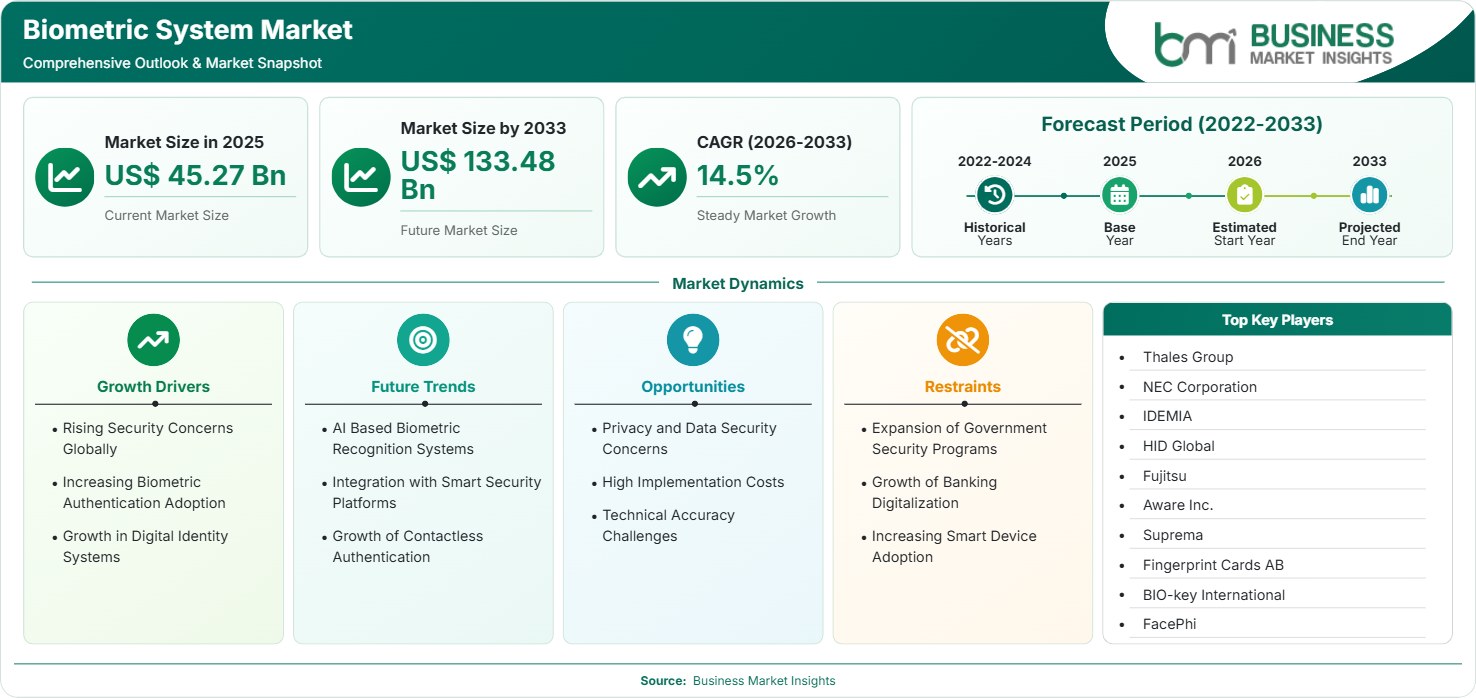
The Biometric System Market size was valued at US$ 45.27 billion in 2025 and is projected to reach US$ 133.48 billion by 2033, growing at a CAGR of 14.5% during 2026–2033, driven by rising security requirements, digital identity adoption, government authentication programs, banking modernization, and increasing demand for contactless verification technologies across industries.

Report Coverage
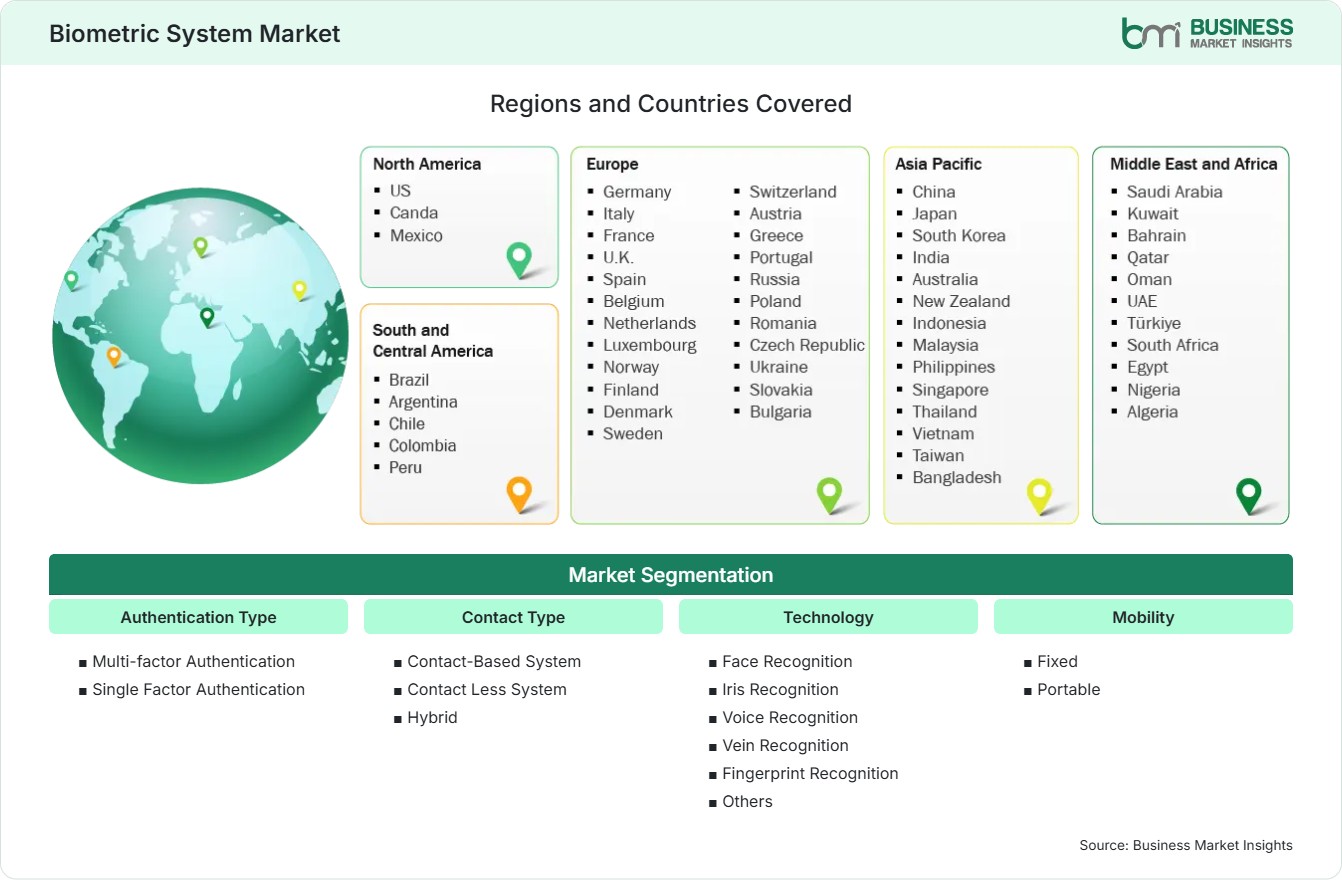
  • Authentication Type: Multi-factor Authentication, Single Factor Authentication
  • Contact Type: Contact-Based System, Contact Less System, Hybrid
  • Technology: Face Recognition, Iris Recognition, Voice Recognition, Vein Recognition, Fingerprint Recognition, Others
  • Mobility: Fixed, Portable
  • End-user: BFSI, Military & Defense, Consumer Electronics, Travel & Transport, Commercial, Smart Home, Government & Public, Others
US$ 45.27 Bn Market size in 2025
US$ 133.48 Bn Market Size by 2033
14.5% CAGR, 2026 - 2033
2026-2033 Forecast Period

01 AI Overview

Biometric System Market Summary

  • North America Region: North America holds a market share of 32%–35% in 2025, growing with a CAGR of 13%–15% influenced by cybersecurity investments, digital identity initiatives, enterprise authentication demand, and government security applications. The US market shows strong adoption through financial services and public sector programs, expanding at a CAGR of 13%–14% during 2026–2033.
  • Fastest Growing Region: Asia Pacific maintains a market share of 29%–32% in 2025, expanding with a CAGR of 15%–17% supported by digital payment growth, smart city initiatives, mobile authentication adoption, and government identity programs.
  • Leading Segment: Face Recognition represents a market share of 34%–37% in 2025, growing with a CAGR of 15%–17% due to widespread deployment in security systems, smartphones, transportation, and public safety applications.
  • High Growth Segment: Vein Recognition represents a market share of 3%–5% in 2025, developing with a CAGR of 16%–18% driven by secure healthcare identification, financial authentication, enterprise security, and advanced identity verification requirements.
  • Key Market Opportunity: Expansion of digital identity platforms, government security programs, banking transformation, and smart device integration creates opportunities for biometric technology providers developing secure and convenient authentication solutions.
  • Major Market Players: Thales Group, NEC Corporation, IDEMIA, HID Global, Fujitsu, Aware Inc., Suprema, Fingerprint Cards AB, BIO-key International, and FacePhi.
02 Strategic Insights

Biometric System Market: Strategic Insights

Biometric System Market Strategic Framework
FREE PDF
Request your free sample
Request free sample
03 Stakeholder View

Key Takeaways

  • The biometric technology ecosystem is shifting toward integrated identity platforms combining artificial intelligence, cloud infrastructure, and multi-modal authentication capabilities.
  • Banking, government services, transportation, and consumer electronics represent high-potential application areas as organizations seek secure and frictionless identity verification.
  • Innovation is accelerating through AI-based recognition algorithms, contactless authentication methods, privacy-focused biometric processing, and edge computing integration.
  • Asia Pacific presents strong investment opportunities due to digital identity programs, mobile payment expansion, and increasing smart infrastructure development.
  • Strategic collaborations, acquisitions, and technology partnerships are increasing as companies compete to strengthen biometric security capabilities.
  • The transition from password-based systems toward identity-centric security models is creating long-term opportunities for biometric technology providers.
04 Geographic Outlook

Biometric System Market Regional Highlights

North America Biometric System Market

North America accounted for a market share of 32%–35% in 2025 and is projected to expand at a CAGR of 13%–15% during 2026–2033. The region benefits from advanced cybersecurity infrastructure, enterprise authentication demand, and government identity programs. The Biometric System Market share is supported by financial institutions, technology companies, and security agencies adopting advanced verification solutions.

  • The United States drives regional demand through digital identity and cybersecurity initiatives.
  • Financial institutions increasingly deploy biometric authentication for secure transactions.
  • Government agencies adopt biometric systems for border and identity management.
  • Enterprises integrate biometric solutions to improve access control and security operations.

US Biometric System Market

The US represented a market share of 29%–32% in 2025 and is expected to grow at a CAGR of 13%–14% during 2026–2033. The country maintains strong adoption due to increasing security concerns, digital banking growth, and enterprise identity management requirements. Market growth is supported by government programs and private sector technology investments.

  • Financial services companies are expanding biometric verification for fraud prevention.
  • Federal and state agencies utilize biometric systems for secure identification.
  • Technology companies are integrating biometrics into consumer devices and platforms.
  • Enterprises are adopting authentication solutions to strengthen cybersecurity frameworks.

Europe Biometric System Market

Europe held a market share of 24%–27% in 2025 and is forecast to achieve a CAGR of 12%–14% between 2026–2033. The region benefits from digital identity initiatives, transportation security investments, and regulatory focus on secure authentication. Germany, the United Kingdom, France, and Italy are key contributors supporting regional adoption.

  • Germany supports biometric adoption through industrial security and digital identity programs.
  • The United Kingdom expands usage across banking and border security applications.
  • France invests in government authentication and transportation security systems.
  • European regulations influence the development of privacy-focused biometric technologies.
  • Financial institutions are adopting advanced customer authentication solutions.

Asia Pacific Biometric System Market

Asia Pacific generated a market share of 29%–32% in 2025 and is expected to register a CAGR of 15%–17% during 2026–2033. The region represents a rapidly expanding market due to digital identity programs, mobile payments, smart cities, and large-scale technology adoption. China, India, Japan, and South Korea are major contributors.

  • China expands biometric adoption through smart city and surveillance infrastructure.
  • India supports growth through large-scale digital identity initiatives.
  • Japan integrates biometric solutions into transportation and consumer applications.
  • South Korea develops advanced authentication technologies for digital services.
  • Mobile payment ecosystems increase demand for secure verification methods.

Rest of World Biometric System Market

South America, the Middle East, and Africa accounted for a combined market share of 9%–12% in 2025. Growth is supported by digital transformation programs, financial inclusion initiatives, border security requirements, and smart infrastructure development. Brazil, UAE, Saudi Arabia, and South Africa represent emerging markets adopting biometric solutions across government, banking, and commercial applications.

  • Brazil increases adoption through banking digitalization and identity verification programs.
  • Middle Eastern countries invest in smart cities and security infrastructure.
  • Saudi Arabia expands biometric applications through government digital services.
  • South Africa adopts identity technologies for financial and public services.
  • Emerging economies provide opportunities through expanding digital ecosystems.
Global Market Geography
FREE PDF
Request your free sample
Request free sample
05 Segment Analysis

Biometric System Market Segmentation

Authentication Type

Authentication Type segmentation defines the adoption of biometric solutions based on security requirements, user convenience, and application complexity. Multi-factor authentication is gaining preference as organizations combine biometric verification with additional security layers to reduce identity fraud. Single factor authentication continues supporting applications requiring fast and convenient access. The Biometric System Market scope is expanding as enterprises, governments, and financial institutions prioritize secure digital identity management. Rising cybersecurity concerns and increasing digital transactions are encouraging adoption of advanced authentication frameworks across industries.

  • Multi-factor Authentication: Multi-factor authentication combines biometric identification with additional verification methods, improving security levels for banking, government, enterprise, and high-risk digital applications.
  • Single Factor Authentication: Single factor authentication provides convenient identity verification through individual biometric characteristics, supporting consumer devices, access control systems, and routine authentication applications.

Contact Type

Contact Type segmentation reflects changing user preferences toward convenient, secure, and hygienic authentication methods. Contactless systems are gaining adoption due to improved user experience and increasing demand for remote verification capabilities. Contact-based systems remain widely used in established fingerprint-based applications, while hybrid solutions combine multiple approaches for enhanced security. The Biometric System Market trends indicate increasing investment in flexible authentication platforms that support diverse operational requirements across commercial, government, and consumer environments.

  • Contact-Based System: Contact-based systems use direct biometric interaction and remain common in fingerprint scanners, access control devices, and secure identification applications.
  • Contactless System: Contactless systems enable remote identity verification through facial, iris, and voice recognition technologies, supporting convenient authentication across multiple digital platforms.
  • Hybrid: Hybrid biometric systems combine contact and contactless methods to provide enhanced security, operational flexibility, and multi-application compatibility across industries.

Technology

Technology segmentation highlights innovation across recognition methods as organizations seek accurate, scalable, and secure authentication solutions. Face recognition remains widely deployed due to convenience and integration with digital platforms, while fingerprint and iris recognition continue supporting security-sensitive applications. Emerging technologies such as vein and voice recognition are gaining attention for specialized use cases. The market trends demonstrate increasing adoption of artificial intelligence, machine learning, and advanced sensors to improve recognition accuracy and reliability.

  • Face Recognition: Face recognition technology enables fast identity verification across smartphones, transportation systems, surveillance applications, and enterprise security platforms.
  • Iris Recognition: Iris recognition provides high-accuracy identification and is used in security-sensitive environments requiring reliable biometric authentication capabilities.
  • Voice Recognition: Voice recognition supports authentication through speech patterns, enabling secure access for digital services, customer platforms, and smart devices.
  • Vein Recognition: Vein recognition offers secure internal biometric identification, supporting healthcare, financial services, and specialized access control applications.
  • Fingerprint Recognition: Fingerprint recognition remains widely adopted due to affordability, accuracy, and integration across consumer electronics, banking, and security systems.

Mobility

Mobility segmentation focuses on the flexibility of the installation process and the use of biometrics, which may be fixed or portable. The fixed system is normally installed in controlled environments like governmental offices, workplaces, and public transport stations. The portable devices are gaining popularity due to the need for remote authentication. The Biometric System Market analysis indicates increasing demand for adaptable systems that support secure identification across diverse locations and operating conditions.

  • Fixed: Fixed biometric systems provide permanent installation solutions for access control, security management, and identity verification in regulated environments.
  • Portable: Portable biometric systems enable flexible authentication through mobile devices and field applications requiring remote identity verification capabilities.

End-user

End-user segmentation has driven the widespread adoption of biometric systems across industries in need of enhanced security, operational effectiveness, and digital identity verification. The BFSI, Government, and travel segments make a significant contribution due to their demand for strong authentication measures. Consumer electronics and smart home applications continue gaining popularity due to increasing connected devices with biometric capabilities. The Biometric System Market scope continues growing as organizations adopt identity-focused security frameworks across multiple operational environments.

  • BFSI: Banking and financial institutions adopt biometric authentication for secure transactions, customer verification, fraud prevention, and digital banking services.
  • Military & Defense: Military and defense organizations use biometric systems for secure identification, access management, and personnel verification in sensitive environments.
  • Consumer Electronics: Consumer electronics integrate biometric features into smartphones, laptops, and wearable devices to enhance security and user convenience.
  • Travel & Transport: Transportation systems utilize biometrics for passenger identification, border management, airport security, and seamless travel experiences.
  • Commercial: Commercial organizations implement biometric solutions for workforce management, facility access, and operational security improvements.
  • Smart Home: Smart home applications use biometric authentication for connected security devices, personalized access, and intelligent home management systems.
  • Government & Public: Government agencies deploy biometric systems for identity programs, public services, citizen verification, and security initiatives.
06 Market Forces

Biometric System Market Dynamics

Key Market Drivers

Rising Security Concerns Globally

Growing security risks, fraud, and cyber threats are compelling businesses to use biometric authentication systems. Both businesses and governments are looking for advanced identity verification tools to help secure their business infrastructure against threats and fraudulent activity. The Biometric System Market growth is driven by the growing demand for these systems from the financial services industry, government sector, transport, and enterprises. As the world becomes increasingly digitized, there is a growing need for additional authentication tools beyond regular passwords. The growing awareness of the need to protect identities is driving the use of these systems worldwide.

Increasing Biometric Authentication Adoption

Increasing use of biometric authentication technologies has completely revolutionized how users interact with their digital services, financial services, and even devices. More users are looking for easier, faster authentication methods than traditional passwords and security codes. Biometric System Market trends are driven by the increasing incorporation of biometrics in smartphones, bank apps, smart devices, and enterprise applications. Artificial intelligence and improved sensor technology have made the process of recognition faster and better for users. Companies are using biometric systems to increase customer engagement through secure technologies.

Growth in Digital Identity Systems

The increase in the deployment of digital identity systems has resulted in a high demand for biometric technology as governments and organizations establish secure identity verification systems. There is an increased use of biometric technology by national identification programs, e-governments, and digital financial systems to authenticate users. The deployment of identity ecosystems has increased accessibility and reduced the likelihood of fraud. Organizations are deploying interoperable biometric platforms that will help in authentication through different applications. Digital identity infrastructures are growing in emerging economies as governments intensify efforts to integrate citizens into the digital space.

Key Market Opportunities

Expansion of Government Security Programs

There is an increase in opportunities for suppliers of biometric solutions due to government initiatives to improve security at national borders, identity management systems, and public safety. Programs related to national-level person identification and smart governance projects drive increased demand for robust, reliable biometric identification platforms. Governments allocate budgets for implementing technologies that can help verify citizens’ identities and prevent fraud and other issues related to service delivery. Suppliers of biometric solutions, which have privacy-oriented and scalable solutions, may take advantage of this trend.

Growth of Banking Digitalization

With the rise of digitalization in the banking industry, more opportunities arise for biometric system suppliers as banks adopt reliable authentication methods to ensure security during online transactions. The development of mobile banking, electronic payments, and customer onboarding remotely calls for the use of trustworthy identification tools. With biometric solutions, banks will be able to protect themselves against potential fraud while making customers’ lives easier. Banks are already starting to invest in biometric systems such as fingerprints and facial or voice authentication. Biometric technology companies have a chance to profit from the growing demand.

Increasing Smart Device Adoption

The increase in the use of smart devices is opening up possibilities for the inclusion of biometric functions in various devices, ranging from smartphones and wearables to other types of devices, for the purposes of securing and personalizing the products. Consumers now prefer authentication features when using everyday technology products. Device makers are now integrating fingerprint, facial recognition, and voice authentication into their products to improve the user experience. The growth of smart homes and interconnected ecosystems has increased the need for biometric access control products. Companies offering efficient and effective biometric technology solutions can capitalize on this trend, supporting the biometric system market forecast.

Market Restraints and Challenges

Privacy and Data Security Concerns

Factor: Biometric systems collect sensitive personal information that requires strong protection against unauthorized access, misuse, and cybersecurity threats. Impact: The problem of privacy may limit the application process, impose more compliance restrictions, and bring problems for businesses using biometrics for authentication purposes. Data breaches involving biometric data pose future security risks, as biometric identifiers, unlike passwords, cannot be changed. Businesses should invest in properly encrypting, storing, and processing biometric data. The rules about the processing of biometric data become stricter by the day.

High Implementation Costs

Factor: Biometric system deployment requires investment in hardware, software integration, infrastructure upgrades, maintenance, and specialized technical support. Impact: Implementation costs are one of the factors that may prevent implementation for small to medium-sized companies with limited technology budgets. Biometric systems may need custom implementation, training, and maintenance. Businesses need to determine the return on investment before implementing the technology. Even though the cost is decreasing due to technology, it remains a barrier in certain regions. Providers are offering cloud-based biometric systems to lower the deployment cost and simplify the implementation process.

07 Company Analysis

Competitive Landscape

The Biometric System Market analysis highlights strong competition among global technology providers developing identity verification platforms, recognition technologies, and security solutions. Key companies are focusing on artificial intelligence integration, contactless authentication, cloud-based identity management, and multi-modal biometric systems. Strategic partnerships, product innovation, and expansion into government, banking, transportation, and consumer applications are shaping competitive strategies across the biometric technology ecosystem.

Company Name

Overview

Products and Services relevant to this market

Thales Group

Global technology company providing digital identity and security solutions.

Biometric identification systems, digital identity platforms, border security, and authentication solutions.

NEC Corporation

Technology company specializing in advanced IT and biometric recognition technologies.

Facial recognition, fingerprint authentication, identity management, and security solutions.

IDEMIA

Digital identity and security solutions provider focused on trusted authentication.

Biometric identity solutions, facial recognition, fingerprint systems, and secure authentication platforms.

HID Global

Identity technology company providing secure access and authentication solutions.

Biometric readers, identity verification systems, access control, and authentication technologies.

Fujitsu

Information technology company delivering digital transformation and security solutions.

Biometric authentication, identity management systems, AI-based recognition, and security services.

Aware Inc.

Software company specializing in biometric identity verification solutions.

Biometric software platforms, fingerprint recognition, facial recognition, and identity management tools.

Suprema

Biometric technology company offering security and access control solutions.

Fingerprint recognition, facial recognition systems, access control devices, and authentication platforms.

Fingerprint Cards AB

Technology company developing biometric sensor solutions.

Fingerprint sensors, biometric modules, smart device authentication, and embedded solutions.

BIO-key International

Identity and authentication solutions provider focused on biometric security.

Fingerprint authentication, identity management platforms, and enterprise security solutions.

FacePhi

Technology company specializing in facial recognition and digital identity solutions.

Facial biometrics, remote onboarding, identity verification, and financial authentication solutions.

08 Industry Activity

Recent Developments

November 2024

NEC Corporation developed a compact face and iris multimodal biometric authentication technology that enables fast and accurate identity verification using a camera module connected to existing PCs or tablets. The technology enhances secure and convenient identity verification.

September 2024

Fujitsu Limited introduced the concept of ambient authentication, a next-generation security approach that combines AI, behavioral data, and biometric technologies to enable continuous and seamless identity verification. The approach aims to strengthen security while improving user convenience.

April 2024

HID Global expanded biometric identity solutions through a collaboration with ASSA ABLOY to introduce AI-driven facial recognition and self-service gate solutions for airports. The solution integrates HID’s U.ARE.U Camera Identification System with automated gates to enable secure, seamless passenger identity verification.

February 2024

IDEMIA reorganized its business structure into three specialized divisions: IDEMIA Secure Transactions, IDEMIA Public Security, and IDEMIA Smart Identity to accelerate growth in identity, biometric security, payment, and public-sector authentication markets. The restructuring aims to strengthen operational focus and support innovation across its core technology areas.

10 Trust & Transparency

Research Methodology

The market analysis combines proprietary research with secondary data from government agencies, company disclosures, regulatory filings, industry databases and expert interviews. Market estimates are validated through data triangulation, cross-market benchmarking and analyst review.

View Full Research Methodology

11 Questions Answered

Frequently Asked Questions

What does the Biometric System Market Report analyze?

The report analyzes market size, regional developments, segmentation trends, competitive landscape, technology advancements, growth drivers, opportunities, and challenges influencing biometric adoption globally.

What challenges affect biometric system implementation?

Privacy concerns, biometric data protection requirements, high deployment costs, infrastructure complexity, and regulatory compliance challenges influence implementation decisions. Companies are developing secure and scalable solutions to address these concerns.

How are governments supporting biometric system adoption?

Governments are implementing digital identity programs, border security systems, and public service authentication platforms that rely on biometric technologies. These initiatives improve identity verification, reduce fraud, and enable secure access to government services.

Which biometric technologies are gaining the most adoption?

Face recognition and fingerprint recognition technologies are widely adopted due to accuracy, convenience, and integration capabilities. Iris, voice, and vein recognition technologies are also expanding in specialized applications requiring enhanced security.

What factors are driving the Biometric System Market growth?

Rising security concerns, increasing digital identity adoption, growing use of biometric authentication, and expansion of government and enterprise security programs are major factors supporting market growth. Demand for contactless verification and fraud prevention solutions is also accelerating adoption.

Access the Full Biometric System Market Report

Get segment-level forecasts, regional estimates, competitive benchmarking, company profiles and downloadable Excel datasets.

Access the full Biometric System Market Report
350 pages PDF & Excel | 2026-07-31