
DevOps Market Outlook: Size, Share, Trends, Growth Analysis, Competitive Landscape & Forecast, 2026-2033

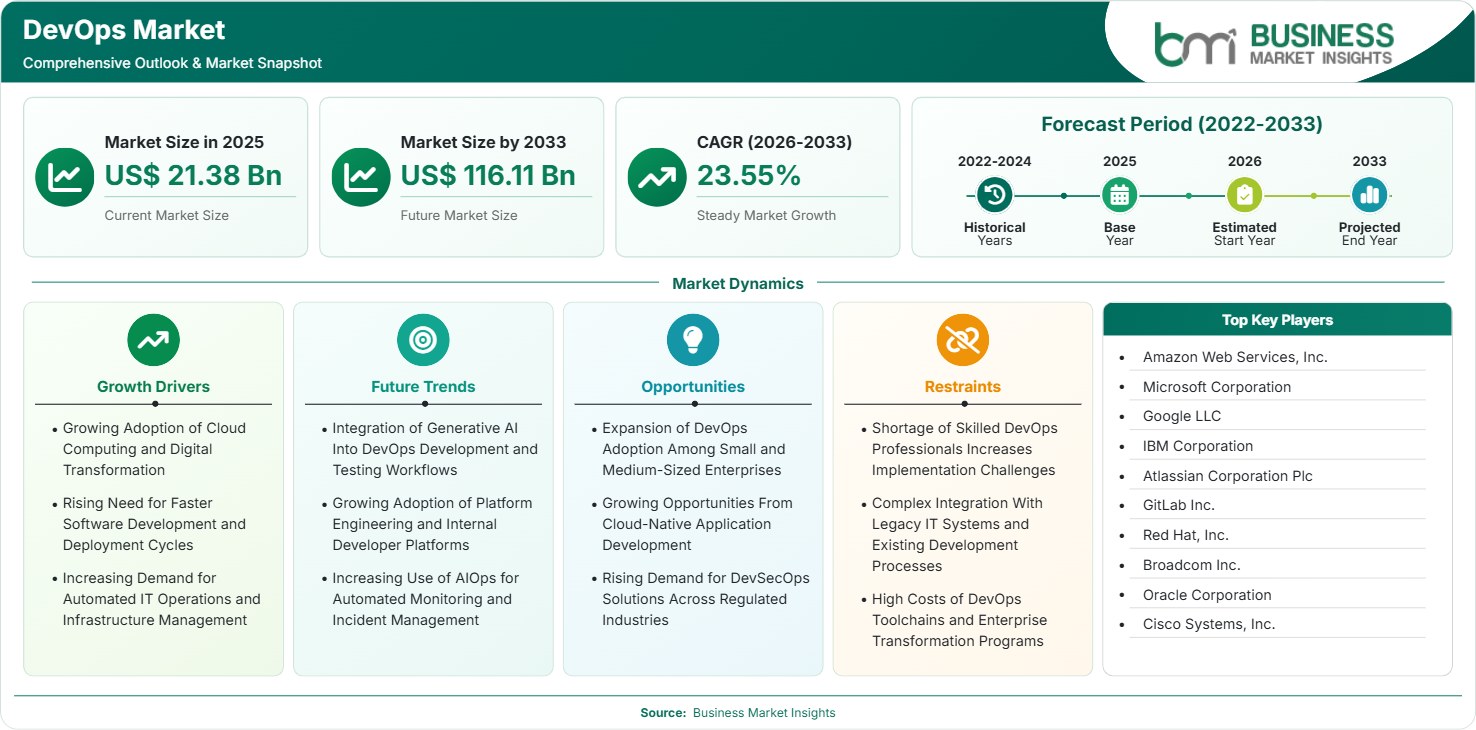
The DevOps Market size was valued at US$ 21.38 Billion in 2025 and is projected to reach US$ 116.11 Billion by 2033, growing at a CAGR of 23.55% during 2026–2033, driven by cloud migration, accelerated software delivery, automated infrastructure, DevSecOps adoption, and cloud-native development.

Report Coverage
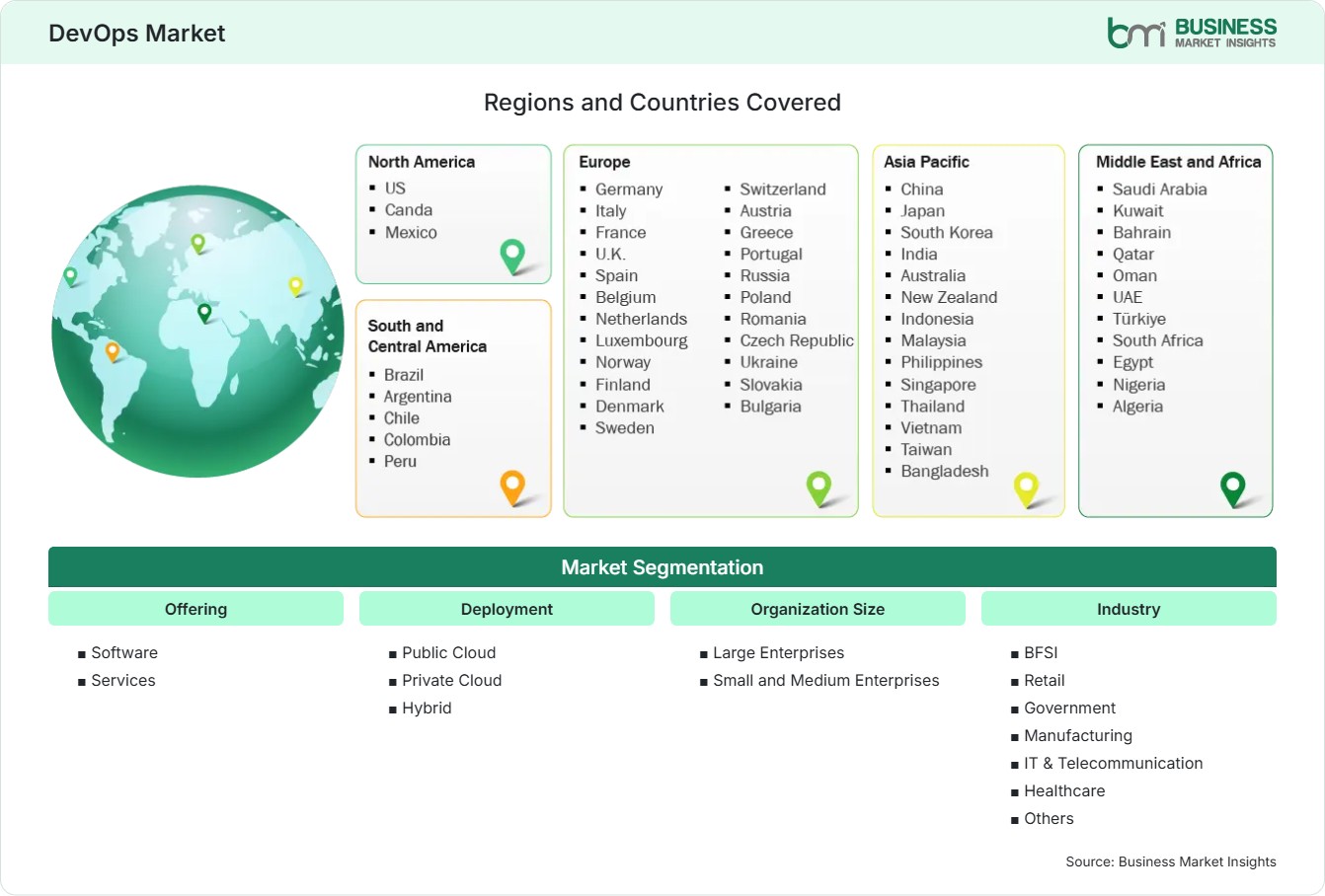
  • Offering: Software, Services
  • Deployment: Public Cloud, Private Cloud, Hybrid
  • Organization Size: Large Enterprises, Small and Medium Enterprises
  • Industry: BFSI, Retail, Government, Manufacturing, IT & Telecommunication, Healthcare, Others
US$ 21.38 Bn Market size in 2025
US$ 116.11 Bn Market Size by 2033
23.55% CAGR, 2026 - 2033
2026-2033 Forecast Period

AI Overview

DevOps Market Summary

  • North America Region: North America holds market share of 38%–42% in 2025, growing with a CAGR of 21.5%–23.5%, supported by enterprise cloud migration, software modernization, platform engineering, automation, and cybersecurity integration. The US market holds 34%–38% share, with a CAGR of 21.8%–24.0%, driven by hyperscale cloud adoption, AI workloads, and enterprise DevOps transformation.
  • Fastest Growing Region: Asia Pacific holds market share of 18%–22% in 2025, growing with a CAGR of 25.0%–27.5%, driven by digital transformation, cloud-native application development, expanding technology services, growing startup ecosystems, and increasing enterprise software modernization.
  • Leading Segment: Software holds market share of 62%–66% in 2025, growing with a CAGR of 22.5%–24.0%, supported by continuous integration, continuous delivery, infrastructure automation, observability, source-code management, containerization, and integrated developer platforms.
  • High Growth Segment: Small and Medium Enterprises holds market share of 31%–35% in 2025, growing with a CAGR of 25.0%–27.0%, driven by affordable cloud services, managed DevOps platforms, low-code automation, SaaS adoption, and increasing demand for rapid digital product development.
  • Key Market Opportunity: Cloud-native development, SME adoption, and DevSecOps integration are creating opportunities for scalable platforms that combine automation, security, observability, and continuous delivery across distributed application environments.
  • Major Market Players: Amazon Web Services, Inc., Microsoft Corporation, Google LLC, IBM Corporation, Atlassian Corporation Plc, GitLab Inc., Red Hat, Inc., Broadcom Inc., Oracle Corporation, and Cisco Systems, Inc.
Strategic Insights

DevOps Market: Strategic Insights

DevOps Market Strategic Framework
FREE PDF
Request your free sample
Request free sample
Stakeholder View

Key Takeaways

  • The value chain is shifting from individual development and operations tools toward integrated platforms that combine source control, CI/CD, infrastructure automation, security, observability, and application performance management.
  • SMEs represent a high-upside customer group because cloud-based DevOps platforms reduce infrastructure requirements and provide access to automation capabilities that previously required substantial internal engineering resources.
  • AI-assisted software development and operations are emerging as major innovation themes, with generative AI supporting code creation, testing, incident analysis, documentation, and infrastructure optimization.
  • Asia Pacific offers a strong investment case as enterprises across India, China, Southeast Asia, Japan, and South Korea accelerate cloud migration and modernize application environments.
  • Competition is increasingly shaped by platform consolidation, strategic partnerships, acquisitions, and integration of security and AI capabilities. Vendors that can offer unified developer experiences are positioned to increase customer retention and expand account value.
  • Long-term differentiation will depend on interoperability and developer experience because enterprises increasingly operate across multiple clouds, Kubernetes environments, SaaS applications, and on-premises infrastructure.
Geographic Outlook

DevOps Market Regional Highlights

North America DevOps Market

North America represents a DevOps Market share of 38%–42% in 2025 and records a CAGR of 21.5%–23.5% during 2026–2033. The region benefits from mature cloud infrastructure, high enterprise software spending, strong technology ecosystems, and early adoption of automation. The US dominates regional demand through extensive cloud migration and application modernization. Canada contributes through financial services, public-sector digitalization, and technology development. Demand is increasingly moving toward integrated platforms combining DevOps, security, observability, AI, and infrastructure management.

  • Enterprise cloud migration continues to drive demand for automated provisioning, infrastructure as code, container orchestration, and continuous delivery across complex multicloud environments.
  • AI adoption is increasing demand for automated software development and operational workflows, creating opportunities for intelligent code assistance, testing, monitoring, and incident management.
  • Platform engineering is gaining traction as enterprises seek standardized internal developer platforms that simplify access to infrastructure and reduce cognitive load for development teams.
  • Strong venture investment and established technology ecosystems support innovation in DevOps tooling, cloud-native platforms, cybersecurity integration, and developer productivity solutions.

US DevOps Market

The US represents a market share of 34%–38% in 2025 and US DevOps market forecast to grow at CAGR of 21.8%–24.0% through 2033. Demand is supported by widespread public cloud adoption, large technology enterprises, software-intensive industries, and high spending on application modernization. Financial services, healthcare, retail, and government agencies are increasingly implementing automated development and security workflows.

  • Large US enterprises are increasingly consolidating fragmented development tools into integrated platforms supporting source control, CI/CD, security, observability, and infrastructure automation.
  • Regulated industries are accelerating DevSecOps implementation as organizations seek to embed security and compliance controls throughout application development and deployment workflows.
  • AI-assisted development is expanding rapidly, creating new demand for automated code generation, testing, vulnerability detection, performance optimization, and operational intelligence.

Europe DevOps Market

Europe accounts for a DevOps Market share of 23%–27% in 2025 and records a CAGR of 21.0%–23.0% through 2033. Germany, the UK, France, and the Netherlands remain leading markets, while Poland and the Nordic countries provide strong growth opportunities. Sovereign cloud initiatives and hybrid infrastructure requirements also create opportunities for flexible DevOps platforms.

  • Germany remains a leading market due to manufacturing digitalization, enterprise software adoption, industrial automation, and increasing cloud modernization requirements.
  • The UK benefits from strong financial services, technology, and public-sector modernization, supporting demand for automated software delivery and DevSecOps.
  • Poland represents a high-growth market at a CAGR of 24.0%–26.0%, supported by expanding IT services, software development, and digital transformation investments.
  • Nordic countries offer a CAGR of 23.5%–25.5%, driven by cloud adoption, digital public services, technology innovation, and strong cybersecurity awareness.

Asia Pacific DevOps Market

Asia Pacific represents a DevOps Market share of 18%–22% in 2025 and achieves a CAGR of 25.0%–27.5% through 2033. China, Japan, India, South Korea, Singapore, and Australia are major demand centers, while India and Southeast Asia offer particularly strong growth. Enterprises are increasingly moving from traditional application development toward containerized, API-driven, and cloud-native architectures.

  • India offers a CAGR of 27.0%–29.0%, supported by digital transformation, cloud migration, software services, fintech growth, and a large technology workforce.
  • China remains a major market as enterprises modernize software environments and invest in cloud-native platforms, automation, and domestic technology ecosystems.
  • Southeast Asia provides a CAGR of 26.0%–28.0%, driven by e-commerce, digital financial services, startup ecosystems, and increasing adoption of public cloud platforms.
  • Japan and South Korea maintain strong enterprise demand through manufacturing digitalization, telecommunications modernization, and investment in advanced software infrastructure.

Rest of World DevOps Market

South and Central America represent approximately 7%–10% of regional demand in 2025 and record a CAGR of 20.0%–22.5%. Brazil and Mexico are leading markets, supported by fintech, e-commerce, telecommunications, and enterprise cloud migration. The Middle East and Africa represent approximately 8%–11% share in 2025 and achieve a CAGR of 22.0%–25.0%. The UAE, Saudi Arabia, Israel, and South Africa lead regional demand.

  • Brazil remains the largest regional opportunity, with fintech and e-commerce companies adopting cloud-native development and automated software delivery.
  • Mexico benefits from nearshoring and technology investment, creating demand for cloud platforms, software development infrastructure, and DevOps-enabled application modernization.
  • The UAE and Saudi Arabia offer high-growth opportunities through digital government, smart-city programs, cloud infrastructure investment, and enterprise modernization.
  • South Africa provides a developed technology ecosystem, while Israel contributes advanced cybersecurity and software engineering capabilities to the broader regional market.
Global Market Geography
FREE PDF
Request your free sample
Request free sample
Segment Analysis

DevOps Market Segmentation

Offering

Software accounted for a DevOps Market share of 62%–66% in 2025 and is projected to grow at a CAGR of 22.5%–24.0% between 2026–2033. Software remains central to continuous integration, delivery, infrastructure automation, monitoring, source control, and security. Increasing platform consolidation is encouraging enterprises to adopt integrated solutions. Services provide implementation, consulting, migration, training, and managed operations, supporting customers that lack internal expertise. As DevOps adoption expands across smaller organizations, managed services can reduce implementation complexity and accelerate time to value.

  • Software: DevOps software includes CI/CD, source-code management, infrastructure automation, container platforms, observability, testing, and security capabilities that streamline software delivery.
  • Services: Consulting, implementation, training, migration, and managed services help organizations establish DevOps practices, integrate tools, and operate complex cloud-native environments.

Deployment

Public Cloud accounted for a market share of 48%–52% in 2025 and is projected to grow at a CAGR of 24.0%–25.5% between 2026–2033. Public cloud platforms provide scalable infrastructure and integrated development services, supporting rapid adoption. Private cloud remains relevant for organizations with strict security or data-control requirements.

  • Public Cloud: Public cloud DevOps platforms provide scalable infrastructure, managed services, integrated tooling, and rapid deployment capabilities for organizations modernizing software delivery.
  • Private Cloud: Private cloud deployments support organizations requiring greater infrastructure control, security, compliance, and customization across sensitive workloads.
  • Hybrid: Hybrid architectures connect public cloud and on-premises environments, creating demand for consistent automation, governance, monitoring, and application deployment across multiple infrastructure locations.

Organization Size

Large Enterprises represented a market share of 65%–69% in 2025 and are projected to grow at a CAGR of 21.5%–23.0% between 2026–2033. Large organizations typically manage complex application portfolios and require automation to coordinate distributed development teams. SMEs represent the faster-growing customer group as cloud-based tools reduce upfront infrastructure requirements.

  • Large Enterprises: Large organizations adopt DevOps to manage complex application portfolios, distributed development teams, multicloud infrastructure, compliance requirements, and large-scale software release cycles.
  • Small and Medium Enterprises: SMEs increasingly use cloud-based and managed DevOps platforms to access automation capabilities without substantial investment in specialized infrastructure or internal engineering resources.

Industry

IT & Telecommunication accounted for a DevOps Market share of 28%–32% in 2025 and is projected to grow at a CAGR of 22.5%–24.5% between 2026–2033. Software-intensive industries remain major adopters because frequent application releases and digital services require automated delivery. BFSI and healthcare are increasingly adopting DevSecOps to address security and compliance.

  • BFSI: Banks and financial institutions use DevOps to accelerate digital banking releases while integrating automated testing, security controls, regulatory compliance, and infrastructure monitoring.
  • Retail: Retailers adopt DevOps to improve e-commerce platforms, personalization, payment systems, inventory applications, and omnichannel customer experiences.
  • Government: Government organizations increasingly modernize digital services through cloud migration, automated delivery, secure development, and scalable citizen-facing applications.
  • Manufacturing: Manufacturers use DevOps to support industrial software, IoT platforms, connected operations, digital twins, and cloud-based production applications.
  • IT & Telecommunication: Technology companies and telecom operators use DevOps extensively to automate software delivery, manage distributed infrastructure, and accelerate digital service deployment.
  • Healthcare: Healthcare organizations adopt DevOps to modernize applications, improve interoperability, automate deployment, and integrate security into software development workflows.
Market Forces

DevOps Market Dynamics

Key Market Drivers

Growing Adoption of Cloud Computing and Digital Transformation

Cloud computing is fueling DevOps adoption as organizations need an automated approach to provisioning, deploying, and handling dynamic workloads. Public cloud, private cloud, and hybrid cloud environments create operational complexities that manual approaches cannot effectively address. Through Infrastructure as Code (IaC), containerization, Kubernetes, and pipelines, organizations can standardize deployment practices across environments and improve scalability. Digital transformations in BFSI, Retail, Healthcare, Manufacturing, Telecoms, and Government sectors are driving the adoption of cloud-native architectures.

Rising Need for Faster Software Development and Deployment Cycles

Increasing competitive pressure is pushing organizations to roll out software releases more often without compromising on their security and reliability. DevOps helps meet this demand through continuous integration, continuous delivery, testing, versioning, and deployment automation. Frequent software releases will allow organizations to adapt rapidly to changing customer tastes, new regulations, competition, and technology. Companies operating digitally in finance, retail, telecommunications, and technology industries especially depend on frequent software updates.

Increasing Demand for Automated IT Operations and Infrastructure Management

The growing complexity of multicloud and hybrid infrastructure is increasing demand for automated IT operations. Organizations manage thousands of virtual machines, containers, databases, APIs, and cloud services that require continuous monitoring and configuration. Infrastructure as code enables repeatable provisioning, while observability platforms provide visibility into application performance and system health. Automation can also accelerate incident response by identifying anomalies and triggering remediation workflows. This DevOps market trend increasingly important as enterprises operate distributed environments with limited specialist resources.

Key Market Opportunities

Expansion of DevOps Adoption Among Small and Medium-Sized Enterprises

SMEs represent an important expansion opportunity because cloud-based DevOps platforms reduce the need for large upfront infrastructure investments. SaaS delivery, managed services, and integrated developer platforms allow smaller organizations to access CI/CD, monitoring, infrastructure automation, and security capabilities without building extensive internal teams. As SMEs digitize customer engagement, payments, e-commerce, and business operations, demand for faster software delivery is increasing. Vendors can capture this market through simplified pricing, low-code configuration, managed implementation, and pre-integrated toolchains.

Growing Opportunities from Cloud-Native Application Development

Cloud-native development is creating opportunities for DevOps vendors as organizations redesign applications around containers, microservices, APIs, Kubernetes, and serverless architectures. These environments require automated deployment, observability, security, and lifecycle management across distributed components. Enterprises are increasingly seeking platforms that simplify cloud-native operations while providing consistent governance across multiple cloud providers. Vendors capable of combining application lifecycle management with cloud-native infrastructure automation can expand their addressable market as enterprises transition from traditional monolithic architectures.

Rising Demand for DevSecOps Solutions Across Regulated Industries

The regulated industries are adopting security as an integral part of software development, not just a process at the end of the software development lifecycle. DevSecOps incorporates vulnerability testing, code analysis, compliance, and identity and policy management directly into the development pipeline. BFSI, healthcare, government, and telecoms companies have to confront increasing challenges related to cyber-attacks and regulations, resulting in the need to automate the security process. Platforms that provide continuous visibility into vulnerabilities and compliance status will eliminate the conflict between developers and security staff.

Market Restraints and Challenges

Shortage of Skilled DevOps Professionals Increases Implementation Challenges

Factor: Implementing DevOps requires skills across software development, cloud, automation, security, containers, CI/CD, monitoring, and system engineering. The overlap between all these skills results in a shortage of a skilled workforce that possesses enough skills in these areas. Impact: The lack of a skilled workforce may slow the implementation of DevOps tools and increase labor costs. However, the training and certification programs may solve this problem.

Complex Integration with Legacy IT Systems and Existing Development Processes

Factor: Many enterprises continue to operate legacy applications, mainframes, proprietary databases, and manually managed infrastructure that were not designed for automated continuous delivery. Integrating these environments with modern DevOps pipelines can require extensive customization and specialized migration work. Impact: Legacy integration increases implementation time, creates interoperability challenges, and can slow the transition toward fully automated development and deployment. These challenges can delay adoption and encourage phased implementation, particularly among large enterprises with complex technology estates and significant dependencies on established development workflows.

Company Analysis

Competitive Landscape

DevOps Market analysis indicates an increasingly competitive ecosystem spanning hyperscale cloud providers, enterprise software companies, source-code management specialists, infrastructure vendors, and integrated platform providers. Competition is shifting toward unified developer experiences that combine development, security, cloud infrastructure, observability, AI, and automation.

Company Name

Overview

Products and Services relevant to this market

Amazon Web Services, Inc.

Leading cloud provider offering broad DevOps capabilities integrated across infrastructure, application development, security, and deployment workflows.

AWS CodePipeline, CodeBuild, CodeDeploy, CodeCommit, Amazon EKS, infrastructure automation, monitoring, and cloud-native development services.

Microsoft Corporation

Major enterprise technology provider combining Azure cloud infrastructure with development, source control, CI/CD, security, and developer productivity solutions.

Azure DevOps, GitHub, Azure Pipelines, Azure Kubernetes Service, infrastructure automation, application monitoring, and DevSecOps capabilities.

Google LLC

Cloud and technology provider with strong capabilities in Kubernetes, cloud-native development, application modernization, and developer tooling.

Google Cloud, Google Kubernetes Engine, Cloud Build, Artifact Registry, Cloud Deploy, observability, security, and AI development tools.

IBM Corporation

Enterprise technology company providing hybrid cloud, automation, application modernization, and AI-enabled development solutions.

Red Hat OpenShift, IBM Cloud, continuous integration tools, application modernization, automation, security, and hybrid cloud DevOps services.

Atlassian Corporation Plc

Developer collaboration and workflow software provider with strong adoption across software development and agile project management teams.

Jira Software, Bitbucket, Bamboo, Compass, Jira Service Management, developer workflows, CI/CD integrations, and team collaboration tools.

GitLab Inc.

DevSecOps platform company providing an integrated environment for source code management, CI/CD, security, compliance, and software lifecycle management.

GitLab DevSecOps Platform, source control, continuous integration, continuous delivery, security testing, observability, and project management.

Red Hat, Inc.

Open-source enterprise software provider specializing in hybrid cloud infrastructure and Kubernetes-based application development environments.

Red Hat OpenShift, Ansible Automation Platform, container management, application modernization, automation, and hybrid cloud DevOps capabilities.

Broadcom Inc.

Enterprise technology company with software assets serving infrastructure management, application delivery, automation, and software development environments.

VMware Tanzu, application modernization, Kubernetes management, infrastructure automation, application performance, and enterprise software lifecycle solutions.

Oracle Corporation

Enterprise technology provider offering cloud infrastructure, databases, application development, and automation capabilities for large organizations.

Oracle Cloud Infrastructure, Kubernetes Engine, developer services, infrastructure automation, application monitoring, and cloud-native development tools.

Cisco Systems, Inc.

Networking and technology company extending into observability, application performance, security, and cloud-native infrastructure management.

Cisco ThousandEyes, AppDynamics, cloud observability, application performance management, security, networking, and infrastructure monitoring solutions.

Trust & Transparency

Research Methodology

The market analysis combines proprietary research with secondary data from government agencies, company disclosures, regulatory filings, industry databases and expert interviews. Market estimates are validated through data triangulation, cross-market benchmarking and analyst review.

View Full Research Methodology

Questions Answered

Frequently Asked Questions

What does the Market Report cover?

The DevOps Market Report evaluates offering, deployment, organization size, and industry segments, alongside regional demand, and emerging growth opportunities.

How does DevOps support software security?

DevOps integrates security testing and compliance controls directly into development pipelines. Automated scanning, vulnerability detection, and reduce the risk of vulnerabilities reaching production.

Why is platform engineering becoming important for enterprises?

Platform engineering creates standardized internal developer platforms that abstract infrastructure complexity.

Why are SMEs increasingly adopting managed DevOps services?

Managed services allow SMEs to access cloud infrastructure, CI/CD, monitoring, and security capabilities without maintaining large internal engineering teams.

How is generative AI changing DevOps workflows?

Generative AI is automating code creation, test generation, documentation, vulnerability identification, incident analysis, and infrastructure recommendations.

Access the Full DevOps Market Report

Get segment-level forecasts, regional estimates, competitive benchmarking, company profiles and downloadable Excel datasets.

Access the full DevOps Market Report
350 pages PDF & Excel | 2026-08-10
Similar Research

Related Market Reports