
Repeaters Market Outlook: Size, Share, Trends, Growth Analysis, Competitive Landscape & Forecast, 2026-2033

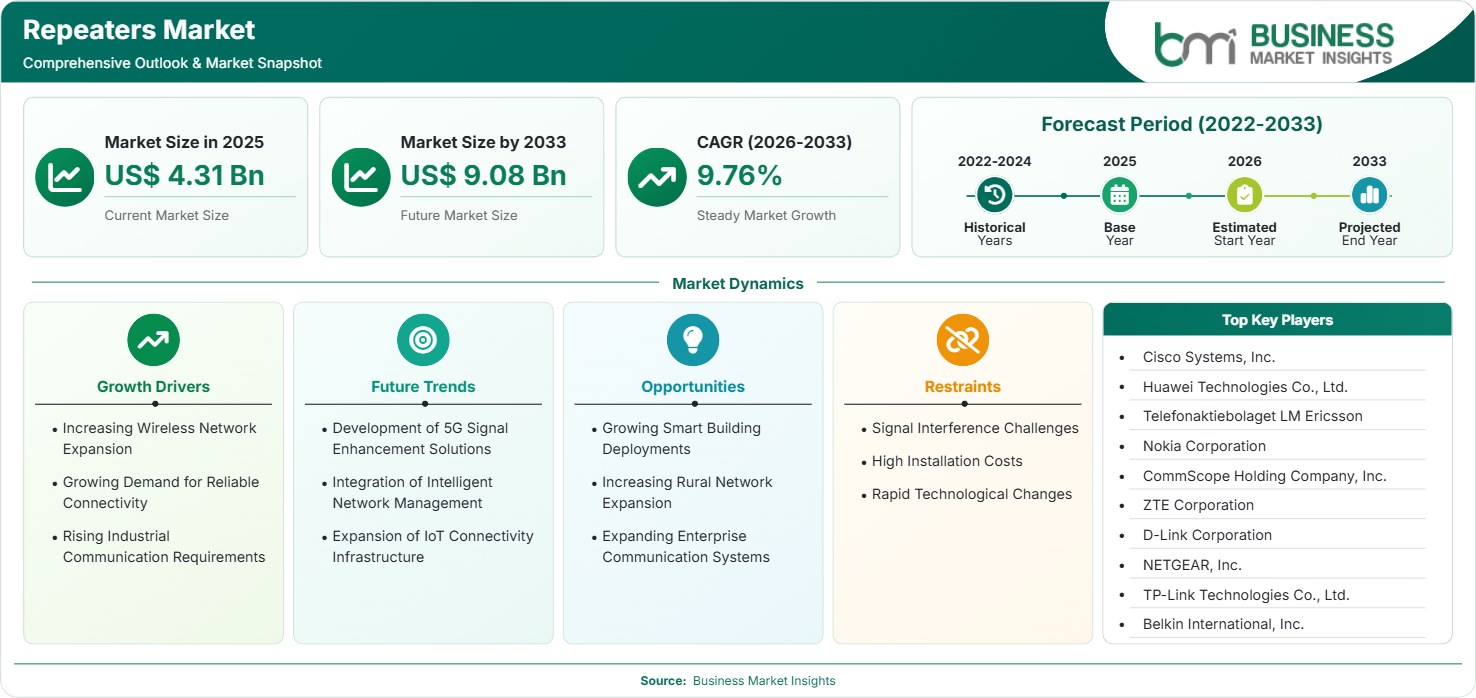
The Repeaters Market size was valued at US$ 4.31 Billion in 2025 and is projected to reach US$ 9.08 Billion by 2033, growing at a CAGR of 9.76% during 2026–2033. Rising wireless infrastructure investments, expanding industrial communication networks, increasing public safety requirements, and smart connectivity deployments continue creating attractive opportunities for advanced repeater technologies.

Report Coverage
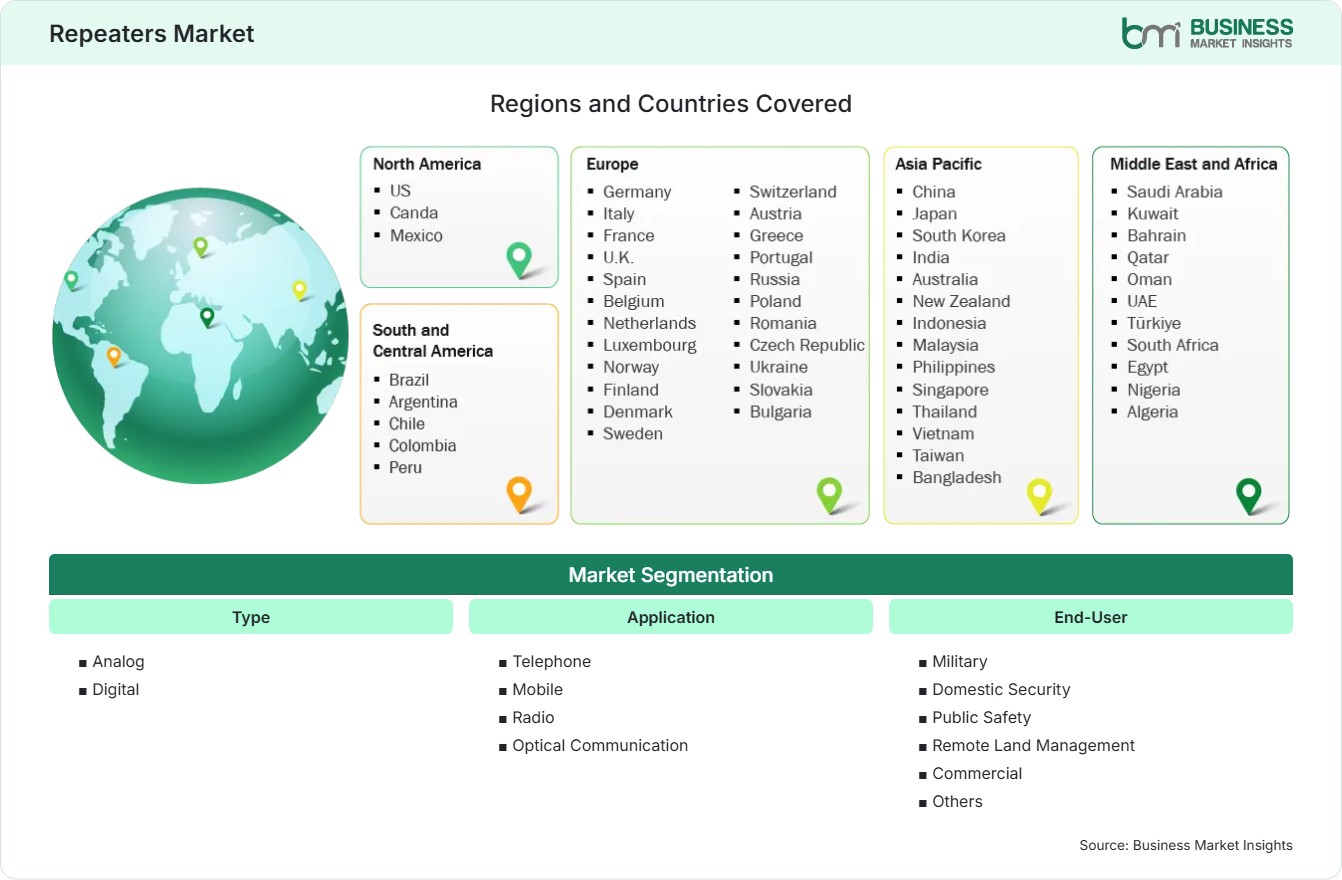
  • Type: Analog, Digital
  • Application: Telephone, Mobile, Radio, Optical Communication
  • End-User: Military, Domestic Security, Public Safety, Remote Land Management, Commercial, Others
US$ 4.31 Bn Market size in 2025
US$ 9.08 Bn Market Size by 2033
9.76% CAGR, 2026 - 2033
2026-2033 Forecast Period

01 AI Overview

Repeaters Market Summary

  • North America Region: North America holds a market share of 34%–37% in 2025, growing with a CAGR of 9.2%–9.8% during 2026–2033, supported by extensive 5G deployment, enterprise wireless modernization, public safety communications, and industrial connectivity investments. The U.S. market benefits from nationwide 5G expansion, private wireless deployments, and critical communication infrastructure investments, recording a CAGR of 9.4%–10.0%.
  • Fastest Growing Region: Asia Pacific holds a market share of 24%–27% in 2025 and is projected to expand at a CAGR of 10.5%–11.2% through 2033, driven by accelerating urbanization, telecom infrastructure expansion, industrial digitization, and increasing broadband accessibility across emerging economies.
  • Leading Segment: Digital repeaters account for 61%–64% market share in 2025 and are projected to register a CAGR of 10.0%–10.6%, supported by superior signal quality, intelligent network management, compatibility with modern communication protocols, and expanding enterprise deployments.
  • High Growth Segment: Mobile communication applications represent 36%–39% market share during 2025 while expanding at a CAGR of 10.4%–11.0%, driven by continuous mobile traffic growth, extensive cellular coverage requirements, and increasing deployment of next-generation wireless infrastructure.
  • Key Market Opportunity: Growing investments in private wireless networks, smart manufacturing, rural broadband initiatives, intelligent transportation systems, and mission-critical communication infrastructure create substantial long-term opportunities for advanced repeater manufacturers worldwide.
  • Major Market Players: Cisco Systems, Inc., Huawei Technologies Co., Ltd., Telefonaktiebolaget LM Ericsson, Nokia Corporation, CommScope Holding Company, Inc., ZTE Corporation, D-Link Corporation, NETGEAR, Inc., TP-Link Technologies Co., Ltd., and Belkin International, Inc.
02 Strategic Insights

Repeaters Market: Strategic Insights

Repeaters Market Strategic Framework
FREE PDF
Request your free sample
Request free sample
03 Stakeholder View

Key Takeaways

  • The industry value chain increasingly integrates semiconductor suppliers, antenna manufacturers, telecom equipment providers, software developers, network operators, system integrators, and enterprise customers, creating stronger collaboration throughout communication infrastructure deployment.
  • Digital repeaters and mobile communication applications present the strongest commercial opportunities as telecom operators accelerate 5G deployment, private wireless implementation, and enterprise connectivity modernization across industrial and commercial sectors.
  • Artificial intelligence-enabled signal optimization, cloud-based network management, software-defined radio technologies, and energy-efficient hardware are becoming primary innovation priorities, helping manufacturers improve coverage quality while lowering operational costs.
  • Asia Pacific offers the most compelling long-term investment opportunity owing to expanding telecom infrastructure, industrial automation initiatives, increasing smartphone adoption, government-backed broadband programs, and accelerating smart city development.
  • Strategic collaborations among telecom equipment manufacturers, communication software developers, semiconductor companies, and network operators are accelerating product innovation, strengthening competitive positioning, and expanding integrated connectivity solutions across multiple end-use industries.
  • Public safety organizations, defense agencies, transportation operators, and industrial enterprises are increasingly adopting advanced repeater systems capable of supporting secure, uninterrupted, and mission-critical communications under demanding operating environments.
04 Geographic Outlook

Repeaters Market Regional Highlights

North America Repeaters Market

North America accounts for 34%–37% of the global market in 2025 and is projected to expand at a CAGR of 9.2%–9.8% during 2026–2033. The Repeaters Market share remains the largest globally because network operators continue strengthening indoor and outdoor wireless coverage while industries increasingly adopt private wireless networks supporting manufacturing, logistics, healthcare, and commercial operations.

  • Telecom operators continue expanding 5G coverage, increasing demand for digital repeaters that improve indoor signal strength across commercial buildings, transportation hubs, hospitals, and educational campuses while supporting higher network capacity.
  • Public safety agencies are investing in resilient communication infrastructure supporting emergency response, disaster recovery, and interoperable radio systems, encouraging deployment of advanced repeaters with secure and uninterrupted connectivity.
  • Manufacturing facilities increasingly deploy private LTE and 5G networks requiring intelligent signal amplification solutions that ensure reliable communication between connected equipment, industrial sensors, and automated production systems.
  • Smart building developments across the United States and Canada are increasing installations of wireless coverage enhancement systems supporting IoT devices, enterprise communication, building automation, and energy management applications.

US Repeaters Market

The United States Repeaters Market represents nearly 66%–70% of North American revenue and is forecast to grow at 9.4%–10.0% through 2033. Strong investments in 5G infrastructure, enterprise connectivity, industrial automation, defense communication modernization, and expanding smart infrastructure projects continue supporting stable market expansion across multiple commercial and government sectors.

  • Federal infrastructure investments continue supporting broadband expansion into underserved communities, creating sustained opportunities for repeater deployment in rural communication networks and public infrastructure projects.
  • Defense modernization programs increasingly require secure wireless communication systems capable of maintaining uninterrupted connectivity across military facilities, command centers, and operational environments.
  • Hospitals, airports, universities, and commercial complexes continue upgrading in-building wireless systems to improve communication reliability, emergency response capability, and digital service accessibility.
  • Private enterprises increasingly invest in dedicated wireless infrastructure supporting industrial automation, warehouse operations, logistics management, and real-time operational communications.

Europe Repeaters Market

Europe captures approximately 27%–30% Repeaters Market share in 2025 while expanding at a CAGR of 8.8%–9.5% through 2033. Digital transformation initiatives, industrial automation, and increasing investment in secure communication infrastructure support regional demand. Germany remains the largest national market, while Poland and other Central European economies demonstrate comparatively faster adoption supported by industrial modernization and broadband expansion.

  • European Union digital connectivity strategies continue encouraging advanced wireless infrastructure deployment across transportation, manufacturing, healthcare, and smart city applications requiring dependable signal coverage.
  • Germany maintains regional leadership due to its advanced manufacturing sector, industrial automation capabilities, and large-scale enterprise investment in Industry 4.0 communication technologies.
  • Poland experiences one of the fastest regional growth rates as telecom operators accelerate broadband deployment, industrial digitization, and nationwide communication infrastructure modernization.
  • Public transportation operators increasingly adopt communication repeaters to strengthen operational reliability across railways, tunnels, airports, and metropolitan transit systems.
  • Industrial enterprises continue investing in secure wireless communication systems supporting connected factories, predictive maintenance, robotics, and automated logistics.

Asia Pacific Repeaters Market

Asia Pacific Repeaters Market accounts for 24%–27% of global revenue during 2025 and is expected to record the fastest CAGR of 10.5%–11.2% through 2033. China leads overall regional revenue, while India demonstrates the highest growth momentum supported by expanding telecom infrastructure and rural connectivity initiatives.

  • China maintains regional leadership through extensive 5G deployment, domestic telecommunications equipment manufacturing, and continuous investment in digital infrastructure supporting enterprise communication.
  • India records the strongest growth owing to nationwide broadband expansion, telecom network upgrades, smart city initiatives, and increasing enterprise digital transformation investments.
  • Japan and South Korea continue advancing industrial wireless technologies supporting manufacturing automation, robotics, semiconductor production, and connected factory operations.
  • Expanding e-commerce logistics networks require reliable warehouse communication systems, encouraging greater deployment of advanced repeater technologies across distribution centers.

Rest of World Repeaters Market

The Rest of World region contributes approximately 10%–13% of global revenue while advancing at a CAGR of 8.5%–9.2% during the forecast period. Growing telecommunications investment, expanding industrial activities, improving broadband infrastructure, and increasing public safety communication requirements continue supporting gradual adoption across South America, the Middle East, and Africa.

South & Central America benefit from expanding mobile broadband infrastructure and digital transformation initiatives, while Middle Eastern countries invest heavily in smart cities, industrial diversification, and next-generation communication networks. South Africa and the United Arab Emirates remain important regional adopters due to ongoing investments in telecommunications modernization.

  • Brazil continues investing in nationwide communication infrastructure supporting industrial expansion, smart utilities, and broadband accessibility across urban and rural regions.
  • The United Arab Emirates strengthens regional demand through smart city investments, advanced transportation systems, and digital government infrastructure projects requiring reliable wireless communication.
  • Mining, oil and gas, and utility operators increasingly deploy repeaters to maintain uninterrupted communication across geographically challenging operational environments.
  • Expanding transportation infrastructure throughout Latin America and the Middle East continues generating demand for reliable communication coverage across tunnels, railways, highways, and airports.
  • Emergency response agencies increasingly modernize communication systems capable of supporting resilient operations during natural disasters and critical public safety incidents.
Global Market Geography
FREE PDF
Request your free sample
Request free sample
05 Segment Analysis

Repeaters Market Segmentation

Type

The Type segment accounted for the largest contribution to industry revenue, with Digital technologies representing the dominant category. This segment held 61%–64% market share in 2025 and is anticipated to register a CAGR of 10.0%–10.6% during 2026–2033. The Repeaters Market scope continues expanding as enterprises migrate toward digital communication infrastructure requiring higher efficiency, lower latency, improved spectral utilization, and intelligent network management capabilities.

  • Analog: Analog repeaters continue serving legacy communication infrastructure across public safety, industrial facilities, and remote communication environments where cost-effective operation, equipment compatibility, and long service life remain important purchasing considerations.
  • Digital: Digital repeaters provide enhanced signal quality, greater network capacity, improved interference management, and seamless integration with modern communication standards, making them increasingly preferred across commercial, industrial, and government communication networks.

Application

Mobile communication represents the leading application category with an estimated 36%–39% share in 2025 and is forecast to expand at a CAGR of 10.4%–11.0% through 2033. Increasing smartphone penetration, extensive 5G deployment, enterprise mobility, and expanding wireless broadband services continue strengthening adoption across both developed and emerging economies.

  • Telephone: Telephone communication repeaters continue supporting enterprise voice communication, institutional facilities, commercial buildings, and rural telecommunication infrastructure requiring reliable signal transmission over extended distances.
  • Mobile: Mobile communication repeaters improve wireless coverage, enhance indoor connectivity, reduce signal dead zones, and strengthen network performance for consumers, enterprises, and telecom operators deploying advanced cellular infrastructure.
  • Radio: Radio repeaters remain essential for emergency response organizations, military operations, transportation systems, utilities, and industrial users requiring secure long-range communication across geographically challenging environments.
  • Optical Communication: Optical communication repeaters improve long-distance data transmission performance, enabling high-capacity fiber communication networks supporting cloud computing, data centers, and telecommunications backbone infrastructure.

End-User

Commercial organizations account for the largest end-user contribution, holding approximately 32%–35% Repeaters Market share during 2025 while expanding at a CAGR of 10.1%–10.8% through the forecast period. Growing enterprise connectivity requirements, digital transformation initiatives, smart buildings, industrial wireless deployments, and expanding corporate communication infrastructure continue driving sustained investment throughout commercial sectors.

  • Military: Military organizations deploy advanced repeaters to ensure secure, uninterrupted communication across tactical operations, command centers, surveillance systems, and defense communication networks operating under demanding environmental conditions.
  • Domestic Security: Domestic security agencies increasingly adopt reliable wireless communication infrastructure supporting law enforcement, disaster management, border surveillance, and emergency response coordination.
  • Public Safety: Public safety organizations rely on repeater systems to maintain dependable communication among firefighters, emergency medical services, police departments, and disaster response personnel during mission-critical operations.
  • Remote Land Management: Forestry departments, mining operators, agriculture organizations, and environmental monitoring agencies deploy repeaters to maintain communication across remote operational locations with limited network accessibility.
  • Commercial: Commercial enterprises implement repeater technologies to improve workplace connectivity, warehouse communication, logistics operations, retail facilities, hospitality environments, and corporate campus wireless performance.
  • Others (Electricity Generation Plant, Transportation): Power generation facilities and transportation operators deploy repeater systems to support operational monitoring, maintenance coordination, infrastructure management, and secure communications across distributed assets.
06 Market Forces

Repeaters Market Dynamics

Key Market Drivers

Increasing Wireless Network Expansion

The continuous expansion of wireless communication infrastructure remains a major growth driver as governments and telecom operators accelerate broadband deployment, private wireless implementation, and nationwide 5G rollout. Repeaters Market growth is favoured by increased investments into indoor wireless networks, connectivity solutions for industries and public communication systems. Enterprises need continuous wireless communication capable of supporting cloud services, IoT devices and automation systems. Increased network density makes it necessary to use repeaters to minimize coverage holes and maintain high-quality communication performance.

Growing Demand for Reliable Connectivity

Wireless connectivity has become very important in industries such as manufacturing, health care, transportation, education, logistics, and business premises. Firms have become increasingly dependent on communications to facilitate their workflows, remote monitoring, connectivity between different equipment and continuity in operations. The use of hybrid working methods, cloud services, and delivery of services through digital means further boosts the need for such connectivity. Companies keep upgrading themselves by using intelligent repeaters that can handle high traffic with minimal latency. Improvements in signal amplification technologies, energy efficiency, and software-based network optimization further encourage replacement of legacy communication systems across multiple industries.

Rising Industrial Communication Requirements

Industrial digitalization continues increasing the need for resilient wireless communication supporting robotics, autonomous equipment, predictive maintenance, industrial IoT, and connected production environments. Effective communications among machines, control units, warehouses, and the operators in the factory is imperative to achieve maximum efficiency in the manufacturing process. Repeaters Market is improving wireless performance in manufacturing facilities that are physically tough in nature and face problems with conventional communication systems due to signal degradation. The increasing usage of Industry 4.0 technologies and smart manufacturing solutions is further bolstering the demand for industrial repeaters.

Key Market Opportunities

Growing Smart Building Deployments

The expansion of intelligent commercial buildings creates substantial opportunities for repeater manufacturers as organizations integrate smart lighting, intelligent security systems, HVAC automation, occupancy monitoring, and connected workplace technologies. Property owners are more inclined towards continuous wireless connectivity, which helps improve operations and user experience. The Repeaters Market forecast indicates that smart investments in commercial infrastructures will keep growing as companies upgrade their infrastructures using IoT-based management systems. Modern repeaters that allow for multiple wireless protocols and have the capability of efficient network management and energy efficiency are likely to see an increase in adoption rates.

Increasing Rural Network Expansion

Investment continues by governments and telecommunication companies in improving the rural broadband network to decrease the gap between people in terms of access to communication. Providing wireless communication in geographically distant locations involves amplifying signals that can be used for communication despite the lack of infrastructure development. Dependence has grown on the part of rural health care, education, agriculture, emergency services, and business entities on wireless communication technology. Companies providing cost-effective, sustainable, and power-saving repeater systems will gain from government infrastructural investments.

Expanding Enterprise Communication Systems

Modern businesses are utilizing integrated communication solutions that support hybrid workspaces, digital manufacturing, logistics automation, and connected business campuses. Wireless connectivity solutions help to facilitate collaboration, asset tracking, warehouse management, and industrial automation processes. Enterprise digital transformation efforts are promoting the need for repeaters that have improved bandwidth and support a variety of communication protocols along with reducing downtime. Vendors that provide scalable and software-managed communication solutions have an opportunity to benefit from growing enterprise needs.

Market Restraints and Challenges

Signal Interference Challenges

Factor: Dense wireless environments containing multiple communication systems, overlapping frequencies, and expanding connected devices increase the probability of signal interference and network congestion. Impact: The quality of communication can be affected by weak signals, unreliable transmission, and increased difficulty of operations. Complex network planning and frequency optimization together with smart signal handling are necessary in most organizations to limit interference. More expenditure on professional installation, frequency coordination, and software optimization further complicates the process of implementation and extends its time frame.

High Installation Costs

Factor: Enterprise-grade repeater deployments frequently require specialized engineering, network planning, infrastructure upgrades, compliance testing, and professional installation services. Impact: Higher initial capital expenditure can discourage adoption among small businesses and budget-constrained organizations despite long-term operational benefits. Organizations must carefully evaluate return on investment before undertaking large communication modernization projects. Manufacturers capable of delivering modular, scalable, and simplified installation solutions are better positioned to reduce customer implementation barriers while improving overall market competitiveness.

07 Company Analysis

Competitive Landscape

The competitive environment is characterized by continuous investments in network modernization, AI-enabled monitoring, multi-band repeater development, and software-defined radio technologies. The Repeaters Market analysis indicates that manufacturers are focusing on 5G-ready solutions, energy-efficient hardware, remote management platforms, and enterprise connectivity offerings to strengthen their competitive positions.

Company Name

Overview

Products and Services Relevant to this Market

Cisco Systems, Inc.

Global networking leader delivering enterprise connectivity, wireless infrastructure, and secure communication solutions for public and private networks.

Network repeaters, enterprise networking equipment, wireless infrastructure, network management software, industrial networking solutions, and communication platforms.

Huawei Technologies Co., Ltd.

Telecommunications equipment manufacturer with strong capabilities across wireless access, optical networking, and digital infrastructure.

Digital repeaters, DAS solutions, 5G communication equipment, signal enhancement systems, optical networking products, and enterprise connectivity platforms.

Telefonaktiebolaget LM Ericsson

Global telecom infrastructure provider supporting operators through advanced radio access technologies and mobile communication platforms.

Radio repeaters, 5G network equipment, in-building coverage systems, mobile communication infrastructure, and network optimization solutions.

Nokia Corporation

International communications technology company focused on secure broadband infrastructure and next-generation wireless networking.

Cellular repeaters, radio access products, network software, private wireless solutions, and communication management platforms.

CommScope Holding Company, Inc.

Infrastructure specialist providing communication connectivity solutions across enterprise, telecom, and public network environments.

Signal repeaters, distributed antenna systems, wireless infrastructure, RF components, broadband connectivity products, and network optimization equipment.

ZTE Corporation

Telecommunications equipment manufacturer serving operators and enterprise communication markets with advanced networking technologies.

Wireless repeaters, communication base station equipment, broadband networking products, optical communication systems, and smart networking solutions.

D-Link Corporation

Networking equipment manufacturer supplying residential, commercial, and industrial communication products worldwide.

Wi-Fi repeaters, wireless extenders, networking switches, routers, enterprise wireless products, and smart connectivity solutions.

NETGEAR, Inc.

Consumer and enterprise networking company recognized for high-performance wireless networking devices and connectivity products.

Wi-Fi range extenders, wireless repeaters, mesh networking systems, routers, enterprise networking hardware, and cloud management services.

TP-Link Technologies Co., Ltd.

Global networking equipment supplier emphasizing affordable wireless connectivity and smart networking technologies.

Signal boosters, wireless repeaters, routers, mesh Wi-Fi systems, broadband networking devices, and enterprise communication products.

Belkin International, Inc.

Consumer electronics company expanding wireless connectivity portfolios for homes, businesses, and smart environments.

Wi-Fi extenders, connectivity accessories, networking hardware, smart home communication devices, and wireless networking solutions.

10 Trust & Transparency

Research Methodology

The market analysis combines proprietary research with secondary data from government agencies, company disclosures, regulatory filings, industry databases and expert interviews. Market estimates are validated through data triangulation, cross-market benchmarking and analyst review.

View Full Research Methodology

11 Questions Answered

Frequently Asked Questions

What technologies are expected to shape future market competition?

AI-enabled network optimization, software-defined networking, cloud-managed repeaters, multi-band communication, energy-efficient hardware, intelligent remote monitoring, and integration with private 5G infrastructure are expected to transform future competitive dynamics.

How does this Repeaters Market Report support strategic planning?

The report provides insights into market segmentation, regional opportunities, competitive positioning, technology developments, investment priorities, and future demand patterns that assist manufacturers, telecom operators, distributors, and investors.

Which region offers the strongest long-term investment potential?

Asia Pacific offers the highest long-term expansion opportunities due to accelerating 5G rollouts, smart city investments, industrial digitalization, and continuous broadband infrastructure development across China, India, Southeast Asia, and developed East Asian economies.

Which application segment contributes the largest revenue?

Mobile communication represents the largest application because telecom operators continue expanding wireless coverage, improving signal quality, and supporting rising subscriber traffic across urban buildings, transportation corridors, and rural locations.

What factors are accelerating adoption of repeaters across industries?

Growing mobile data consumption, expanding 5G deployments, smart manufacturing initiatives, enterprise digitalization, and increasing requirements for uninterrupted indoor and outdoor wireless communication are driving widespread adoption across commercial, industrial, and public safety environments.

Access the Full Repeaters Market Report

Get segment-level forecasts, regional estimates, competitive benchmarking, company profiles and downloadable Excel datasets.

Access the full Repeaters Market Report
350 pages PDF & Excel | 2026-08-12