
Tokenization Market Outlook: Size, Share, Trends, Growth Analysis, Competitive Landscape & Forecast, 2026-2033

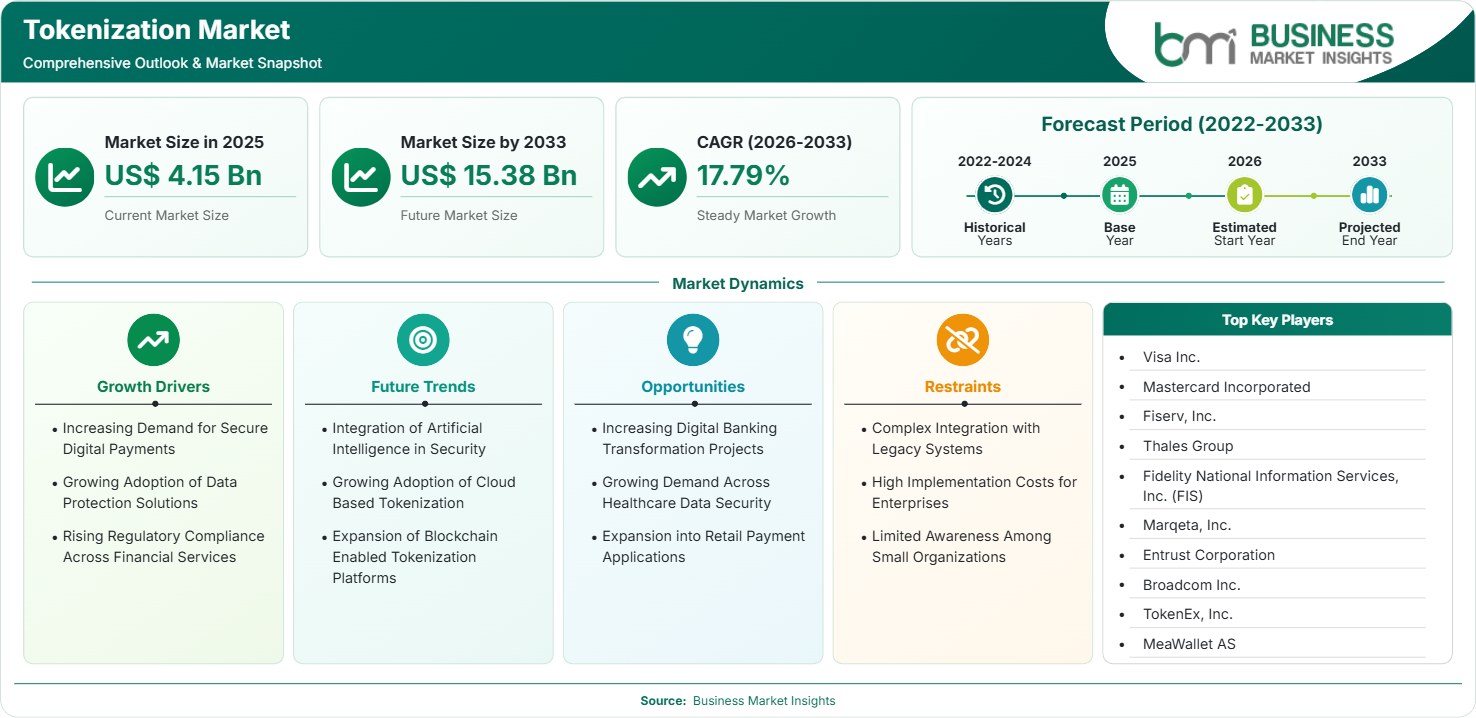
The Tokenization Market size was valued at US$ 4.15 Billion in 2025 and is projected to reach US$ 15.38 Billion by 2033, growing at a CAGR of 17.79% during 2026–2033, driven by rising digital payment security needs, regulatory compliance, enterprise data protection adoption, and expanding opportunities across banking, healthcare, retail, and telecommunications.

Report Coverage
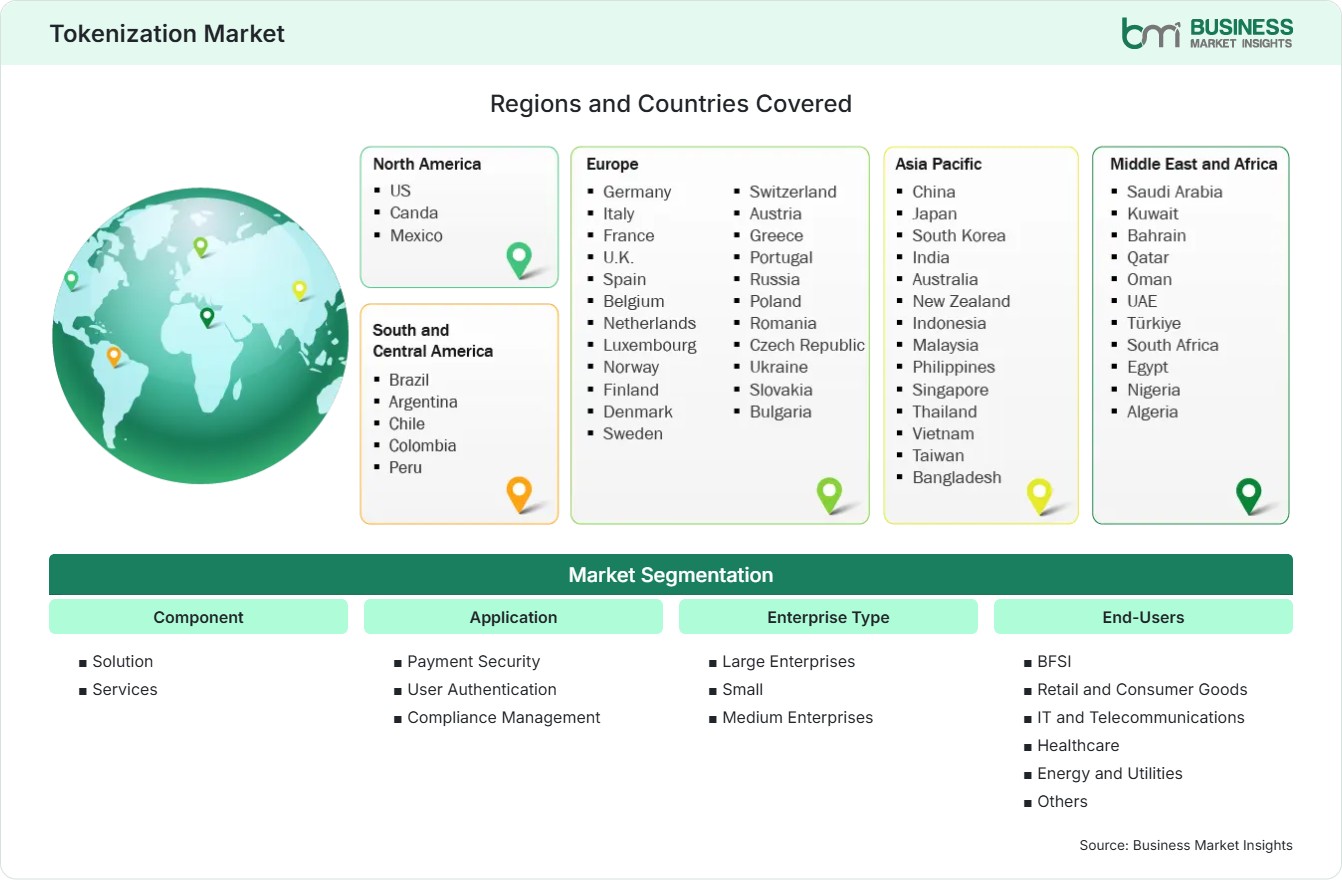
  • Component: Solution, Services
  • Application: Payment Security, User Authentication, and Compliance Management
  • Enterprise Type: Large Enterprises, Small, Medium Enterprises
  • End-Users: BFSI, Retail and Consumer Goods, IT and Telecommunications, Healthcare, Energy and Utilities, Others
US$ 4.15 Bn Market size in 2025
US$ 15.38 Bn Market Size by 2033
17.79% CAGR, 2026 - 2033
2026-2033 Forecast Period

AI Overview

Tokenization Market Summary

  • North America Region: North America holds a 38%–42% share in 2025, growing with a CAGR of 16%–18% during 2026–2033, influenced by advanced payment infrastructure, cybersecurity investments, compliance requirements, and enterprise adoption of secure digital transactions. The US market benefits from financial institutions deploying token-based security frameworks, with growth supported by cloud adoption, payment modernization initiatives, and increasing demand for privacy-preserving technologies at a CAGR of 16%–18% between 2026 and 2033.
  • Fastest Growing Region: Asia Pacific captures a 24%–28% share in 2025, expanding at a CAGR of 19%–22% during 2026–2033, supported by digital banking expansion, mobile payment adoption, fintech innovation, cybersecurity awareness, and government-backed digital transformation programs across emerging economies.
  • Leading Segment: Solution component represents a 60%–64% share in 2025, advancing at a CAGR of 16%–18% during 2026–2033, driven by enterprise demand for payment tokenization platforms, data security solutions, fraud prevention capabilities, and scalable integration with financial technology ecosystems.
  • High Growth Segment: Healthcare end-users demonstrate a CAGR of 20%–23% during 2026–2033, supported by increasing electronic health record protection, regulatory compliance requirements, secure patient data exchange, and growing investment in privacy-focused healthcare technology infrastructure.
  • Key Market Opportunity: The market presents opportunities through digital banking transformation, cloud-based security platforms, retail payment expansion, healthcare data protection, and enterprise adoption of token-based architectures for reducing cybersecurity risks.
  • Major Market Players: Visa Inc., Mastercard Incorporated, Fiserv, Inc., Thales Group, Fidelity National Information Services, Inc. (FIS), Marqeta, Inc., Entrust Corporation, Broadcom Inc., TokenEx, Inc., and MeaWallet AS.
Strategic Insights

Tokenization Market: Strategic Insights

Tokenization Market Strategic Framework
FREE PDF
Request your free sample
Request free sample
Stakeholder View

Key Takeaways

  • The ecosystem is shifting toward integrated security platforms where payment networks, cybersecurity providers, cloud companies, and financial technology firms collaborate to deliver comprehensive token management capabilities.
  • Payment security applications represent a major growth opportunity as organizations seek alternatives to storing sensitive financial information, particularly with increasing digital wallet adoption and cross-border transaction complexity.
  • Innovation is focused on advanced token lifecycle management, cloud-native security solutions, artificial intelligence-enabled fraud detection, and improved interoperability between payment processors, enterprises, and technology platforms.
  • Regional investment opportunities remain strong in Asia Pacific markets including India, China, Singapore, and Southeast Asian economies where digital payments and fintech ecosystems continue expanding rapidly.
  • Strategic partnerships, acquisitions, and platform integrations are increasing as established payment companies and cybersecurity providers compete to strengthen their tokenization capabilities and expand enterprise customer reach.
Geographic Outlook

Tokenization Market Regional Highlights

North America Tokenization Market

North America maintains a leading position with a 38%–42% share in 2025 and expands at a CAGR of 16%–18% during 2026–2033, supported by mature payment infrastructure, cybersecurity investments, and strict data protection requirements. The region’s Tokenization Market share reflects strong adoption among banks, merchants, and technology providers. The Tokenization Market growth is supported by increasing cloud security deployments, digital wallet penetration, and enterprise compliance initiatives.

  • The United States remains the dominant contributor as financial institutions deploy token-based payment systems, supporting secure transactions, fraud reduction, and compliance with evolving cybersecurity frameworks across banking ecosystems.
  • Canada demonstrates increasing adoption through digital payment modernization, open banking initiatives, and enterprise investments in secure data management technologies supporting financial and consumer applications.
  • Large enterprises across North America are integrating tokenization platforms with cloud environments to improve sensitive information protection and reduce risks associated with centralized data storage.
  • Technology providers are expanding partnerships with payment networks and financial institutions, creating integrated security ecosystems that improve scalability, interoperability, and adoption among commercial users.

US Tokenization Market

The US represents approximately 32%–36% of the global Tokenization Market share in 2025, growing at a CAGR of 16%–18% through 2026–2033 due to strong payment technology adoption, cybersecurity spending, and regulatory focus on consumer data protection. Financial institutions, retailers, and technology companies are accelerating implementation of token-based security frameworks to support digital transactions, cloud services, and enterprise applications.

  • US banks and payment processors are adopting advanced tokenization solutions to strengthen transaction security, minimize payment data exposure, and improve customer trust in digital financial services.
  • Growth is supported by increasing enterprise migration toward cloud-based security infrastructure and demand for scalable solutions that protect sensitive information across distributed technology environments.
  • Healthcare organizations are exploring tokenization technologies to secure patient information, enhance compliance capabilities, and support digital healthcare platforms requiring stronger privacy protection mechanisms.

Europe Tokenization Market

Europe accounts for a 25%–29% share in 2025 and is projected to grow at a CAGR of 15%–17% during 2026–2033. The region benefits from stringent privacy regulations, advanced financial services infrastructure, and increasing cybersecurity investments. Countries including Germany, the United Kingdom, France, and the Netherlands are supporting adoption through digital transformation initiatives. European enterprises are implementing secure data management frameworks to meet regulatory expectations and improve operational resilience.

  • Germany leads regional adoption through strong industrial digitization, banking technology modernization, and increasing enterprise investment in secure transaction processing systems.
  • The United Kingdom demonstrates strong demand from financial institutions adopting token-based payment security solutions for digital banking and fintech applications.
  • France is expanding adoption through government-supported digital transformation initiatives and increased cybersecurity awareness among businesses and public organizations.
  • European payment providers are integrating tokenization capabilities to support compliance with financial regulations and enhance protection against payment fraud risks.

Asia Pacific Tokenization Market

Asia Pacific represents a 24%–28% share in 2025 and records the highest growth rate with a CAGR of 19%–22% during 2026–2033. The region benefits from rapid digital payment adoption, expanding fintech ecosystems, increasing smartphone usage, and government-backed financial inclusion programs. China, India, Japan, South Korea, and Singapore are major contributors. Rising cybersecurity awareness and enterprise technology investments are strengthening regional demand for token-based security platforms.

  • China supports regional growth through extensive digital payment networks, fintech innovation, and increasing enterprise adoption of advanced data security solutions.
  • India presents significant opportunities due to rapid UPI expansion, digital banking initiatives, and increasing demand for secure transaction technologies among businesses and consumers.
  • Japan and South Korea are adopting tokenization solutions across financial services, telecommunications, and enterprise applications requiring advanced cybersecurity infrastructure.
  • Southeast Asian economies are accelerating adoption through mobile commerce growth, fintech expansion, and investments in digital financial ecosystems.

Rest of World Tokenization Market

Rest of World contributes approximately 8%–12% of the global market share in 2025 and grows at a CAGR of 17%–20% during 2026–2033. South and Central America are experiencing increased adoption due to expanding digital payments, fintech development, and merchant modernization. Middle East and Africa markets are benefiting from banking digitization, cybersecurity investments, and government-led technology programs.

  • Brazil and Mexico are emerging as important markets through fintech expansion, digital wallet adoption, and increasing demand for secure payment processing infrastructure.
  • Middle Eastern countries including the United Arab Emirates and Saudi Arabia are investing in digital banking ecosystems and cybersecurity modernization initiatives.
  • African markets are adopting tokenization solutions as mobile financial services expand and organizations seek stronger protection for digital transactions.
  • Regional enterprises are partnering with global security providers to overcome infrastructure challenges and accelerate adoption of advanced data protection frameworks.
Global Market Geography
FREE PDF
Request your free sample
Request free sample
Segment Analysis

Tokenization Market Segmentation

Component

The Component segment is categorized into Solution and Services, with solutions accounting for a 60%–64% share in 2025 and expanding at a CAGR of 16%–18% during 2026–2033. Enterprises are prioritizing integrated token management platforms, while services support implementation, customization, and lifecycle management. The Tokenization Market trends indicate increasing demand for scalable security architectures.

  • Solution: Solution offerings dominate adoption as organizations deploy tokenization platforms for payment security, sensitive data protection, compliance management, and integration with enterprise technology ecosystems requiring advanced cybersecurity capabilities.
  • Services: Services support implementation, consulting, integration, maintenance, and managed security operations, enabling enterprises to optimize tokenization deployments while addressing technical complexity and evolving compliance requirements.

Application

The Application segment includes Payment Security, User Authentication, and Compliance Management, with payment security representing the largest application area due to increasing digital transaction volumes. This segment holds a 55%–59% share in 2025 and grows at a CAGR of 17%–19% during 2026–2033. Tokenization Market scope is expanding as industries adopt secure methods for protecting financial and operational data.

  • Payment Security: Payment security applications enable organizations to replace sensitive card information with secure tokens, reducing fraud exposure and supporting safer digital transactions across multiple payment channels.
  • User Authentication: User authentication solutions use token-based approaches to strengthen identity verification processes, improve access control, and protect enterprise systems against unauthorized access attempts.
  • Compliance Management: Compliance management applications help organizations meet regulatory obligations by securing sensitive information, improving audit readiness, and reducing risks associated with data handling practices.

Enterprise Type

The Enterprise Type segment consists of Large Enterprises and Small & Medium Enterprises (SMEs). Large enterprises maintain a 58%–62% share in 2025, supported by extensive digital infrastructure and higher cybersecurity requirements. SMEs are witnessing faster adoption as cloud-based solutions reduce implementation barriers. Both segments contribute to market expansion through increasing awareness of data protection needs.

  • Large Enterprises: Large enterprises adopt tokenization platforms to secure complex technology environments, manage extensive transaction volumes, and maintain compliance across global business operations.
  • Small & Medium Enterprises (SMEs): SMEs are adopting cost-effective tokenization solutions through cloud platforms, enabling improved security capabilities without requiring extensive internal cybersecurity resources.

End-Users

The End-Users segment covers BFSI, Retail and Consumer Goods, IT and Telecommunications, Healthcare, Energy and Utilities, and Others. BFSI remains the leading end-user segment with a 45%–49% share in 2025 and a CAGR of 16%–18% during 2026–2033. Healthcare and telecommunications demonstrate faster adoption due to rising data security requirements and digital transformation initiatives.

  • BFSI: Banks, insurance companies, and financial institutions implement tokenization to protect payment information, improve fraud prevention, and support secure digital banking services.
  • Retail and Consumer Goods: Retail organizations adopt token-based security solutions to protect customer payment data, enhance e-commerce security, and improve consumer confidence in digital transactions.
  • IT and Telecommunications: Technology and communication companies deploy tokenization for protecting customer information, securing network environments, and supporting cloud-based service delivery.
  • Healthcare: Healthcare organizations utilize tokenization to safeguard patient records, secure electronic health information, and support compliance-driven healthcare data management practices.
  • Energy and Utilities: Energy companies implement tokenization technologies to protect operational data, strengthen cybersecurity frameworks, and secure connected infrastructure environments.
  • Others: Other industries adopt tokenization solutions to improve sensitive information protection, support regulatory compliance, and enhance cybersecurity resilience across specialized applications.
Market Forces

Tokenization Market Dynamics

Key Market Drivers

Increasing Demand for Secure Digital Payments

Rising digital payment adoption is accelerating demand for token-based security systems as businesses seek alternatives to storing sensitive financial information. Tokenization solutions are being utilized by global card networks, merchants, and banking institutions as a mechanism to protect themselves from risks of fraud and provide better transaction security. The Tokenization Market growth is driven by the adoption of contactless payment methods, mobile wallets, and eCommerce transactions, which require high-security methods. Based on the observations of the industry payment ecosystem, it has been seen that digital transactions are rising in both developed and developing countries, hence the need for safe methods of authentications.

Growing Adoption of Data Protection Solutions

Growing volumes of sensitive enterprise data are encouraging organizations to adopt tokenization platforms that minimize exposure risks and strengthen information security frameworks. Firms from financial services, healthcare, retail, and telecommunications sectors have been using data protection technologies to protect customer records, transaction information, and operational information. The growth in cloud computing and distributed systems is generating new demands for security architectures that support privacy. Tokenization allows firms to preserve the usability of data without increasing risk when storing and transmitting it. Growing cyber security spending and the growing threat of ransomware are contributing to this trend.

Rising Regulatory Compliance Across Financial Services

Financial institutions are adopting tokenization solutions to comply with increasingly stringent security and privacy requirements across global markets. Regulatory policies and industry standards concerning payment protection, data privacy, and financial data handling are motivating firms to adopt security tokenization as a more secure substitute for data storage processes. Financial regulatory activities of authorities and standards bodies are still affecting technological decisions. The increasing focus on secure digital finance ecosystems is further driving the adoption of security tokenization among entities that need secure mechanisms.

Key Market Opportunities

Increasing Digital Banking Transformation Projects

Digital banking transformation initiatives represent a major opportunity as financial institutions modernize platforms, expand mobile services, and improve cybersecurity capabilities. The banks are using tokenization technology for supporting their digital transactions, keeps customer data safe and ensuring payment innovations. The emerging markets where there are fast-growing ecosystems for digital banking offer more opportunities for expanding the market. Growing use of fintech collaborations, embedded finance models and digital wallets brings more opportunities for deployment. The Tokenization Market Forecasts are affected by investments in security infrastructures of financial technology companies.

Growing Demand Across Healthcare Data Security

Healthcare digitization is creating opportunities for tokenization providers as organizations require stronger protection for electronic health records, insurance information, and patient data. Healthcare providers, technology firms, and service firms have embraced privacy-driven solutions due to growing volumes of private information. Growth in telemedicine applications, connected medical devices, and cloud healthcare systems has raised the need for cybersecurity measures. Tokenization assists healthcare providers in ensuring the privacy of their personal information while still accessing the information by authorized users. Increased regulations aimed at protecting information in the healthcare sector have encouraged adoption of secure information management technologies.

Expansion into Retail Payment Applications

Retail payment applications are expanding rapidly as merchants adopt digital commerce platforms, mobile payments, and omnichannel customer experiences. Tokenization allows retail businesses to ensure payment credential security, minimize fraud and boost consumer confidence when conducting transactions online. The rising use of digital wallets and subscription-based payments is raising the need for secure payment facilities. Retail companies are in need of tokenization solutions that would work well with the payment gateway, e-commerce site, and consumer engagement system. Providers of technology are designing adaptable tokenization solutions for the global payment ecosystem and multi-channel transactions.

Market Restraints and Challenges

Complex Integration with Legacy Systems

Factor: Many enterprises operate outdated payment processing systems and fragmented data architectures that require extensive customization before integration. Impact: The deployment process can be complicated by long timelines, disruptions in operations, and the need for extra technical resources to make the adoption process effective. Banks and other big companies have multiple systems integrated, making the token management process difficult.

High Implementation Costs for Enterprises

Factor: Advanced tokenization platforms require investment in software deployment, system integration, employee training, and ongoing maintenance activities. Impact: Smaller organizations may delay implementation due to financial limitations, reducing adoption speed across certain industry segments. Cloud-based solutions and managed security services are helping reduce cost barriers by offering flexible deployment models.

Company Analysis

Competitive Landscape

The Tokenization Market analysis highlights a competitive ecosystem shaped by payment networks, cybersecurity providers, fintech platforms, and enterprise security companies. Market participants are focusing on platform innovation, strategic partnerships, cloud-based deployment models, and expanded token lifecycle management capabilities to address growing demand across financial services, healthcare, retail, and technology sectors.

Company Name

Overview

Products and Services relevant to this market

Visa Inc.

Visa Inc. is a global payments technology company providing digital payment infrastructure and security solutions across international financial ecosystems.

Provides payment tokenization services, network tokens, digital payment security solutions, and transaction protection technologies for issuers, merchants, and financial institutions.

Mastercard Incorporated

Mastercard Incorporated operates a global payment network focused on secure transaction processing, digital commerce, and innovative payment technologies.

Offers Mastercard Digital Enablement Service, payment tokenization platforms, authentication solutions, and secure digital transaction capabilities.

Fiserv, Inc.

Fiserv, Inc. provides financial technology solutions supporting banks, merchants, and financial institutions through integrated digital platforms.

Delivers payment processing solutions, tokenization capabilities, digital banking security services, and fraud prevention technologies.

Thales Group

Thales Group is a technology company specializing in cybersecurity, digital identity, and secure data protection solutions for global organizations.

Provides data security platforms, payment security solutions, encryption technologies, hardware security modules, and tokenization services.

Fidelity National Information Services, Inc. (FIS)

FIS is a financial technology provider offering payment processing, banking software, and digital commerce solutions worldwide.

Supports secure payment processing, token management, digital banking platforms, and cybersecurity solutions for financial institutions.

Marqeta, Inc.

Marqeta, Inc. is a modern card issuing platform enabling businesses to build customized payment experiences and financial products.

Provides payment tokenization capabilities, card issuing infrastructure, digital payment APIs, and secure transaction management solutions.

Entrust Corporation

Entrust Corporation specializes in digital security, identity verification, encryption, and enterprise data protection technologies.

Offers payment security solutions, digital identity platforms, encryption services, and token-based protection technologies for enterprises.

Broadcom Inc.

Broadcom Inc. develops infrastructure technology solutions including cybersecurity software and enterprise security platforms.

Provides cybersecurity solutions, identity management technologies, and enterprise protection platforms supporting secure data environments.

TokenEx, Inc.

TokenEx, Inc. is a cloud-based data security company focused on tokenization and sensitive data protection services.

Offers cloud tokenization platforms, data discovery tools, compliance solutions, and secure data vaulting capabilities.

MeaWallet AS

MeaWallet AS provides payment technology solutions supporting digital wallets, token services, and secure mobile payment ecosystems.

Delivers payment tokenization, digital wallet enablement, card token services, and secure payment integration solutions.

Trust & Transparency

Research Methodology

The market analysis combines proprietary research with secondary data from government agencies, company disclosures, regulatory filings, industry databases and expert interviews. Market estimates are validated through data triangulation, cross-market benchmarking and analyst review.

View Full Research Methodology

Questions Answered

Frequently Asked Questions

How can businesses evaluate solutions from a Tokenization Market Report?

Businesses can evaluate solutions by analyzing security capabilities, compliance support, integration flexibility, scalability, deployment models, and vendor expertise across relevant industries and enterprise technology environments.

What role do cloud platforms play in tokenization adoption?

Cloud platforms enable scalable tokenization deployment by reducing infrastructure complexity, improving integration flexibility, and allowing enterprises to implement security capabilities across distributed applications and digital environments.

Which industries are expected to create new demand opportunities for tokenization technologies?

Financial services remains a major adopter, while healthcare, telecommunications, retail, and energy sectors are creating new opportunities through increasing digital transformation projects and rising requirements for secure data management.

How does tokenization improve payment security compared with traditional methods?

Tokenization replaces sensitive payment information with unique digital identifiers, reducing exposure of financial data during transactions. This approach helps merchants and payment providers minimize fraud risks while supporting secure digital payment experiences.

What factors are accelerating adoption of tokenization solutions across industries?

Organizations are adopting tokenization due to increasing cybersecurity risks, digital payment expansion, regulatory requirements, and the need to protect sensitive information while maintaining operational efficiency across financial, healthcare, and retail environments.

Access the Full Tokenization Market Report

Get segment-level forecasts, regional estimates, competitive benchmarking, company profiles and downloadable Excel datasets.

Access the full Tokenization Market Report
350 pages PDF & Excel | 2026-08-25
Similar Research

Related Market Reports