
GameFi Market Outlook: Size, Share, Trends, Growth Analysis, Competitive Landscape & Forecast, 2026-2033

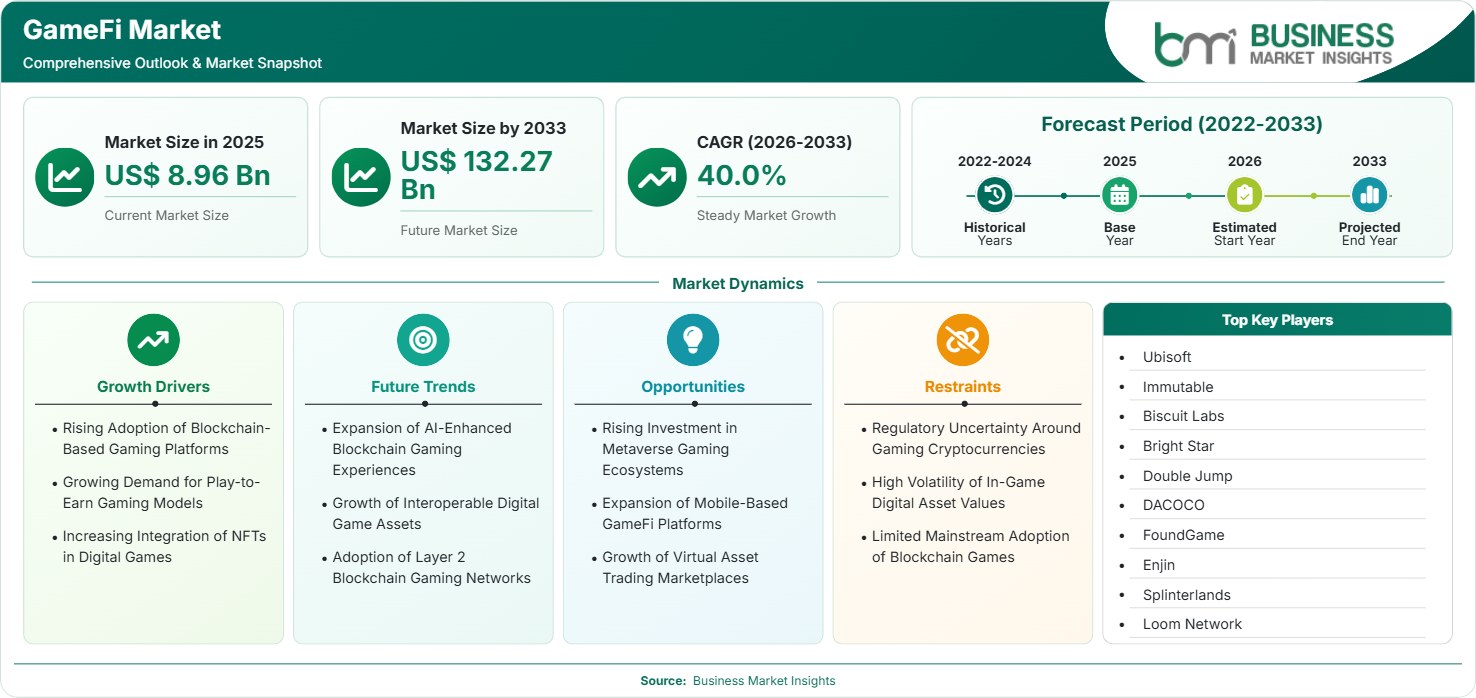
The GameFi Market size was valued at US$ 8.96 Billion in 2025 and is projected to reach US$ 132.27 Billion by 2033, growing at a CAGR of 40.0% during 2026–2033. Increasing integration of blockchain technology, growing adoption of non-fungible tokens (NFTs), and rising interest in play-to-earn gaming models are driving market growth. Expansion of decentralized gaming ecosystems and increasing investments in blockchain-based entertainment platforms continue creating significant opportunities.

Report Coverage
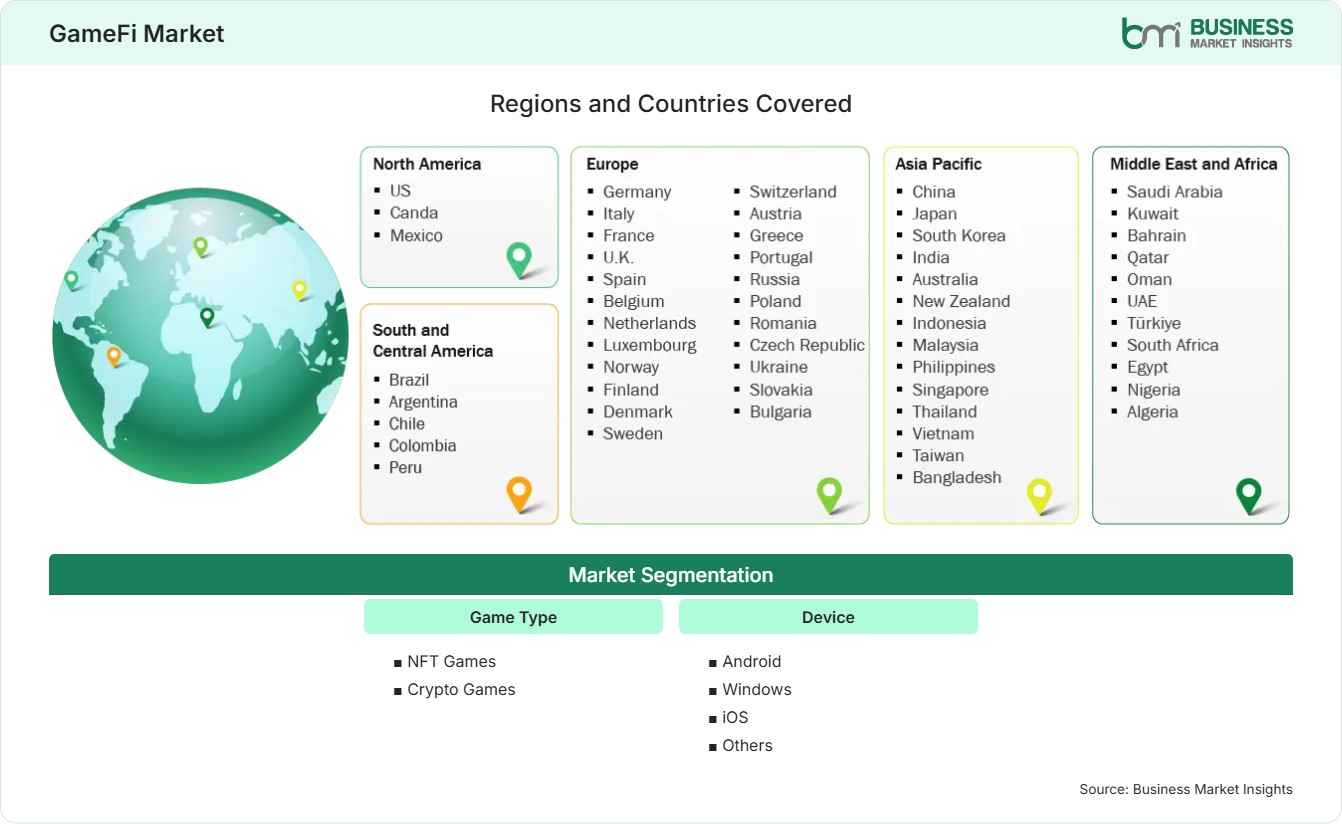
  • Game Type: NFT Games, Crypto Games
  • Device: Android, Windows, iOS, Others
US$ 8.96 Bn Market size in 2025
US$ 132.27 Bn Market Size by 2033
40.0% CAGR, 2026 - 2033
2026-2033 Forecast Period

01 AI Overview

GameFi Market Summary

  • North America Region: North America holds a market share of 32%–35% in 2025 and is projected to grow at a CAGR of 38.5%–39.5% during 2026–2033. Strong blockchain adoption, gaming investments, and the presence of technology developers support regional growth. The US remains the largest regional market, expanding at a CAGR of 38.8%–39.8%.
  • Fastest Growing Region: Asia Pacific accounts for 36%–39% of the market in 2025 and is expected to register the fastest CAGR of 41.0%–42.0% during the forecast period. Growing gaming communities, cryptocurrency adoption, and increasing blockchain development activities continue driving regional expansion.
  • Leading Segment: Game Type – NFT Games accounts for 58%–61% of the market in 2025 and is projected to grow at a CAGR of 40.2%–40.8%. Growing ownership of digital assets, collectible-based gameplay, and NFT trading ecosystems support segment dominance.
  • High Growth Segment: Device – Android accounts for 42%–45% of the market in 2025 while registering a CAGR of 41.0%–41.8%. Increasing mobile gaming adoption and accessibility of blockchain-based games continue accelerating growth.
  • Key Market Opportunity: Expansion of decentralized gaming platforms, integration of metaverse ecosystems, and increasing adoption of blockchain-based digital ownership models are creating strong opportunities.
  • Major Market Players: Ubisoft, Immutable, Biscuit Labs, Bright Star, Double Jump, DACOCO, FoundGame, Enjin, Splinterlands, and Loom Network.
02 Strategic Insights

GameFi Market: Strategic Insights

GameFi Market Strategic Framework
FREE PDF
Request your free sample
Request free sample
03 Stakeholder View

Key Takeaways

  • The market ecosystem includes blockchain gaming developers, NFT platforms, cryptocurrency providers, gaming studios, digital asset marketplaces, and technology infrastructure providers.
  • NFT games represent the largest growth opportunity due to increasing demand for digital ownership, collectible assets, and player-driven virtual economies.
  • Mobile-based GameFi platforms are gaining traction due to wider smartphone adoption and easy accessibility among casual gamers.
  • Asia Pacific offers significant growth opportunities due to large gaming populations, increasing cryptocurrency adoption, and expanding blockchain development ecosystems.
  • Strategic partnerships between traditional gaming companies and blockchain platforms are accelerating the development of next-generation gaming experiences.
  • Integration of metaverse platforms, decentralized finance (DeFi), and artificial intelligence is expected to further transform GameFi ecosystems.
04 Geographic Outlook

GameFi Market Regional Highlights

North America GameFi Market

North America accounts for 32%–35% of the global market in 2025 and is projected to grow at a CAGR of 38.5%–39.5% during 2026–2033. The GameFi Market share is supported by strong blockchain adoption, established gaming infrastructure, venture capital investments, and the presence of leading gaming technology companies. Increasing interest in digital ownership, NFT-based gaming assets, and decentralized gaming platforms continues driving regional expansion.

  • The United States leads regional adoption due to strong gaming communities, blockchain development activities, and increasing investments in Web3 gaming platforms.
  • Gaming companies are increasingly integrating blockchain features to introduce digital asset ownership, token-based rewards, and decentralized gaming economies.
  • Venture capital investments in blockchain gaming startups continue supporting innovation across GameFi platforms.
  • Increasing adoption of cryptocurrency wallets and digital asset marketplaces is improving accessibility to blockchain-based gaming ecosystems.
  • Partnerships between traditional gaming developers and blockchain technology providers are accelerating GameFi adoption.

US GameFi Market

The United States represents 27%–30% of the global market in 2025 and is expected to register a CAGR of 38.8%–39.8% through 2033. Strong gaming industry presence, technology innovation, and increasing adoption of blockchain-based entertainment platforms continue supporting market growth.

  • Major gaming studios are exploring blockchain integration to enhance player engagement and digital asset ownership.
  • Increasing consumer interest in NFT-based collectibles and virtual economies is supporting GameFi platform adoption.
  • Growing developer ecosystem for blockchain applications continues strengthening innovation in decentralized gaming.
  • Expansion of Web3 infrastructure providers is improving scalability and accessibility of GameFi platforms.

Europe GameFi Market

Europe holds 22%–25% of the global market in 2025 and is projected to grow at a CAGR of 39.0%–39.8% during the forecast period. Growing blockchain adoption, strong gaming culture, and increasing investments in digital entertainment technologies support regional growth. The United Kingdom leads the regional market, while Germany records strong growth due to increasing blockchain gaming activities.

  • The United Kingdom maintains regional leadership through advanced gaming infrastructure and increasing Web3 technology adoption.
  • Germany is witnessing rising GameFi investments through blockchain startups and digital entertainment initiatives.
  • European gaming developers are increasingly exploring NFT-based gaming models and decentralized platforms.
  • Growing interest in metaverse applications is supporting integration of blockchain-based gaming experiences.
  • Regulatory developments around digital assets continue influencing market strategies among GameFi companies.

Asia Pacific GameFi Market

Asia Pacific accounts for 36%–39% of the global market in 2025 and is projected to register the fastest CAGR of 41.0%–42.0% during 2026–2033. Large gaming populations, increasing smartphone penetration, and growing blockchain adoption continue driving regional growth. China dominates the regional market, while South Korea records rapid growth due to strong gaming and blockchain ecosystems.

  • China continues influencing regional demand through its large gaming user base and technology development capabilities.
  • South Korea is witnessing rapid GameFi adoption due to strong online gaming culture and blockchain innovation.
  • Japan continues exploring blockchain gaming through established gaming companies and digital entertainment platforms.
  • Southeast Asian countries are increasingly adopting play-to-earn gaming models due to growing cryptocurrency participation.
  • Rising investments in metaverse and Web3 gaming platforms continue strengthening regional opportunities.

Rest of World GameFi Market

The Rest of World accounts for 7%–10% of the global market in 2025 and is projected to grow at a CAGR of 40.0%–41.0% during the forecast period.

South & Central America continues to witness increasing adoption of blockchain gaming platforms due to growing cryptocurrency awareness and digital entertainment demand. Brazil leads the regional market, while Argentina records increasing interest in play-to-earn gaming models.

The Middle East & Africa continues to emerge as a growth region due to rising digital transformation initiatives, increasing gaming participation, and growing blockchain technology adoption. The United Arab Emirates leads regional adoption, while Saudi Arabia records strong growth through investments in digital entertainment ecosystems.

  • Brazil continues expanding blockchain gaming adoption through growing gaming communities and cryptocurrency engagement.
  • Argentina is witnessing increasing interest in decentralized gaming platforms and digital reward-based gaming models.
  • The United Arab Emirates continues investing in digital entertainment, blockchain, and metaverse initiatives.
  • Saudi Arabia is strengthening its gaming ecosystem through investments in gaming infrastructure and technology development.
  • Emerging markets are increasingly adopting GameFi platforms due to growing digital connectivity and interest in alternative gaming economies.
Global Market Geography
FREE PDF
Request your free sample
Request free sample
05 Segment Analysis

GameFi Market Segmentation

Game Type

The game type influences the architecture of gaming systems built on blockchain technology, like digital ownership, reward structures, and player engagement. In 2025, NFT Games represent 58%–61% of the market share and have a CAGR between 40.2% and 40.8% in 2026–2033. The GameFi Market scope is increasing because players are becoming interested in owning in-game objects and earning tokens as a reward.

  • NFT Games: NFT games dominate the market due to increasing adoption of blockchain-based ownership models, allowing players to collect, trade, and monetize unique digital assets such as characters, virtual land, and in-game items.
  • Crypto Games: Crypto games are gaining adoption through token-based reward systems, cryptocurrency payments, and decentralized gaming economies. These platforms enable players to earn digital currencies through gameplay and participation.

Device

Device accessibility plays an important role in GameFi adoption as developers focus on delivering blockchain gaming experiences across multiple platforms. Android accounts for 42%–45% of the market in 2025 and is projected to grow at a CAGR of 41.0%–41.8% during the forecast period. Increasing smartphone adoption continues shaping GameFi Market trends.

  • Android: Android-based GameFi platforms dominate due to widespread smartphone adoption, lower entry barriers, and availability of blockchain gaming applications across diverse user groups.
  • Windows: Windows-based platforms remain important for advanced blockchain games requiring higher processing capabilities, enhanced graphics, and complex gameplay environments.
  • iOS: iOS-based GameFi adoption is supported by increasing interest among premium gaming users and developers focusing on secure mobile gaming ecosystems.
  • Others: Other devices include gaming consoles, web-based platforms, and emerging virtual reality devices that support the expansion of blockchain-enabled gaming experiences.
06 Market Forces

GameFi Market Dynamics

Key Market Drivers

Rising Adoption of Blockchain-Based Gaming Platforms

The application of blockchain technology in the gaming sector has led to the emergence of decentralized systems that guarantee enhanced transparency, security, and ownership of digital assets. While conventional games feature in-game assets that are controlled by game publishers, blockchain-enabled systems give players control over their in-game assets through decentralized networks. Transactions within blockchain networks are secured by means of smart contracts, which also help perform several tasks in a game automatically. Many game developers have started implementing blockchain systems to increase player engagement and to ensure better interoperability of digital assets.

Growing Demand for Play-to-Earn Gaming Models

Gaming based on the play-to-earn principle has been gaining momentum as it brings possibilities of earning digital rewards through participation in game activities. In such ecosystems, players can collect tokens, virtual currencies, NFTs, and other blockchain-powered assets, which might have some value in the real world. The play-to-earn principle has gained popularity for combining entertainment and economic benefits, giving rise to new forms of digital interaction. Game developers are implementing various reward mechanisms to foster long-term participation and community building. Besides, increased interest in decentralized finance and alternative ways to earn digital money is contributing to the model's popularity.

Increasing Integration of NFTs in Digital Games

The integration of NFTs is becoming one of the key avenues for growth in the GameFi ecosystem, providing players with ownership over verifiable and unique digital assets. The trend among game makers is to incorporate NFT-based characters, skins, weapons, virtual lands, collectibles, and other tradable assets that can be bought, sold, and exchanged on supported marketplaces. This method helps to increase user engagement by ensuring that players own some valuable in-game assets that go beyond each gaming session. NFTs also create additional monetization opportunities for developers through marketplace transactions and secondary sales. Furthermore, the ability to establish scarcity and authenticity for digital items is encouraging wider adoption among gaming communities, supporting innovation and long-term expansion across blockchain-powered gaming platforms.

Key Market Opportunities

Rising Investment in Metaverse Gaming Ecosystems

Increasing investments in metaverse platforms are creating significant growth opportunities for GameFi developers seeking to build immersive digital environments powered by blockchain technologies. These virtual ecosystems combine gaming, social interaction, digital ownership, and decentralized economies, enabling users to participate in engaging experiences while owning and monetizing virtual assets. Game developers are integrating blockchain infrastructure, NFTs, and cryptocurrencies into metaverse environments to support secure transactions and player-driven economies. Additionally, growing interest from technology companies, gaming publishers, and digital asset investors is accelerating innovation in this space. GameFi Market Forecasts indicate increasing convergence between blockchain gaming, virtual worlds, social platforms, and digital marketplaces, creating long-term opportunities for ecosystem expansion, user engagement, and new revenue generation models across the metaverse landscape.

Expansion of Mobile-Based GameFi Platforms

Increasing smartphone usage and developments in mobile blockchain technology are opening up immense possibilities for GameFi platforms built specifically for mobile devices. Mobile phones provide convenient access to games running on blockchains, thus allowing developers to attract an audience that goes beyond PC and console gamers. To increase accessibility and engagement, there is a noticeable trend among companies to create lightweight GameFi platforms that have simpler gameplay, quick registration processes, and streamlined management of digital assets. Developments in mobile internet, cloud computing, and blockchain technology are further assisting platform expansion. Also, the increasing interest in casual games is leading to the creation of fun, play-to-earn, and reward-based games designed specifically for mobile users.

Growth of Virtual Asset Trading Marketplaces

The continued expansion of digital asset marketplaces is creating valuable opportunities across the GameFi ecosystem by enabling efficient trading of in-game items, NFTs, virtual collectibles, and other blockchain-based assets. These marketplaces provide players with secure environments to buy, sell, exchange, and monetize digital possessions acquired through gameplay. As the number of blockchain games increases, demand for reliable asset trading platforms is also growing, supporting greater liquidity and user participation. Developers benefit from additional revenue streams through marketplace activity, while players gain enhanced flexibility in managing their digital portfolios. Furthermore, improvements in transaction security, interoperability, and user experience are strengthening adoption of the marketplace. This growth is contributing to a more dynamic and interconnected GameFi ecosystem, supporting the sustained expansion of virtual asset ownership and exchange activities.

Market Restraints and Challenges

Regulatory Uncertainty Around Gaming Cryptocurrencies

Factor: The GameFi market operates across gaming, blockchain, cryptocurrencies, and NFTs, making it highly sensitive to evolving regulations. Differences in policies regarding token issuance, digital asset trading, taxation, and decentralized platforms create compliance challenges for developers expanding across multiple regions. Uncertainty over future legal frameworks also complicates platform development and investment planning.

Impact: Regulatory uncertainty increases compliance costs, slows platform expansion, and may require developers to modify features or restrict services in certain markets. It can also reduce investor confidence, limit cross-border operations, and delay innovation, creating obstacles to the long-term growth and global adoption of GameFi ecosystems.

High Volatility of In-Game Digital Asset Values

Factor: GameFi platforms rely on cryptocurrencies, NFTs, and blockchain-based assets that experience significant price fluctuations due to market sentiment, investor behavior, technological developments, and overall cryptocurrency market conditions. These changing values create uncertainty within in-game economies and digital reward systems.

Impact: Volatile token and NFT prices can reduce player confidence, lower user engagement, and disrupt sustainable in-game economies. Developers face challenges in maintaining balanced reward mechanisms, forecasting revenues, and ensuring long-term ecosystem stability. Managing digital asset volatility remains essential for supporting user trust, platform growth, and the overall success of GameFi projects.

07 Company Analysis

Competitive Landscape

The GameFi Market analysis is characterized by competition among blockchain gaming developers, NFT ecosystem providers, gaming technology companies, and digital asset platform operators. Companies are focusing on blockchain integration, NFT-based gaming experiences, decentralized economies, and metaverse connectivity to enhance user engagement and strengthen their market position.

Company Name

Overview

Products and Services Relevant to this Market

Ubisoft

Global video game developer and publisher exploring blockchain-based gaming ecosystems.

Blockchain gaming initiatives, NFT-based gaming assets, digital collectibles, and gaming platforms.

Immutable

Blockchain gaming platform focused on NFT infrastructure and Web3 game development.

NFT gaming platforms, blockchain infrastructure, digital asset solutions, and developer tools for GameFi applications.

Biscuit Labs

Blockchain gaming company developing decentralized gaming experiences.

Web3 games, blockchain gaming platforms, NFT-based gaming solutions, and digital asset ecosystems.

Bright Star

Gaming technology company involved in blockchain-enabled entertainment solutions.

Blockchain gaming applications, digital assets, and decentralized gaming experiences.

Double Jump

Japanese blockchain gaming company specializing in Web3 gaming solutions.

NFT gaming development, blockchain integration services, digital asset management, and gaming infrastructure.

DACOCO

Blockchain gaming company focused on decentralized gaming ecosystems.

Blockchain-based games, virtual assets, NFT ecosystems, and decentralized gaming platforms.

FoundGame

Gaming company developing blockchain-based gaming experiences.

GameFi platforms, digital collectibles, blockchain gaming solutions, and virtual asset systems.

Enjin

Blockchain gaming ecosystem provider supporting NFT creation and management.

NFT development tools, blockchain gaming platforms, digital asset wallets, and gaming ecosystem solutions.

Splinterlands

Blockchain-based trading card game platform.

NFT-based collectible games, digital card assets, play-to-earn gaming models, and blockchain gaming ecosystems.

Loom Network

Blockchain infrastructure provider supporting decentralized applications and gaming platforms.

Blockchain infrastructure, decentralized application support, gaming development solutions, and scalable blockchain networks.

08 Industry Activity

Recent Developments

July 2026

Vulcan Forged launched VulcanX Everything, a unified GameFi platform integrating games, NFTs, quests, trading, and rewards into a single PYR-powered ecosystem with an increased weekly prize pool.

June 2026

Enjin introduced its comprehensive Platform v3 roadmap, expanding blockchain developer tools with advanced NFT creation features, automated transaction fuel tanks, and native Unity and Unreal Engine plug-in extensions.

February 2026

Immutable expanded its Web3 gaming ecosystem by officially launching Mintory to optimize player economies, alongside rolling out major Titan Arena infrastructure updates for developer support.

September 2025

The9 Limited announced that its the9bit Web3.5 GameFi platform surpassed 2 million users, driven by rapid adoption in Southeast Asia and expanded blockchain-based gaming rewards and community features.

10 Trust & Transparency

Research Methodology

The market analysis combines proprietary research with secondary data from government agencies, company disclosures, regulatory filings, industry databases and expert interviews. Market estimates are validated through data triangulation, cross-market benchmarking and analyst review.

View Full Research Methodology

11 Questions Answered

Frequently Asked Questions

What are the major opportunities in the market?

Key opportunities include rising investment in metaverse gaming ecosystems, expansion of mobile-based GameFi platforms, growth of virtual asset trading marketplaces, and increasing integration of blockchain technologies.

Who are the major companies operating in the market?

Major companies include Ubisoft, Immutable, Biscuit Labs, Bright Star, Double Jump, DACOCO, FoundGame, Enjin, Splinterlands, and Loom Network.

Which region is expected to witness the fastest growth?

Asia Pacific is projected to witness the fastest growth due to large gaming communities, increasing blockchain adoption, smartphone penetration, and rising investments in Web3 gaming platforms.

Which segment dominates the gamefi market report?

The NFT Games segment dominates the market due to increasing adoption of digital ownership models, collectible gaming assets, and NFT-based monetization opportunities.

What is driving the market?

The market is driven by increasing adoption of blockchain-based gaming platforms, rising demand for play-to-earn gaming models, growing NFT integration in digital games, and increasing investments in Web3 gaming ecosystems.

Access the Full GameFi Market Report

Get segment-level forecasts, regional estimates, competitive benchmarking, company profiles and downloadable Excel datasets.

Access the full GameFi Market Report
350 pages PDF & Excel | 2026-07-31