
Business Information Market Outlook: Size, Share, Trends, Growth Analysis, Competitive Landscape & Forecast, 2026-2033

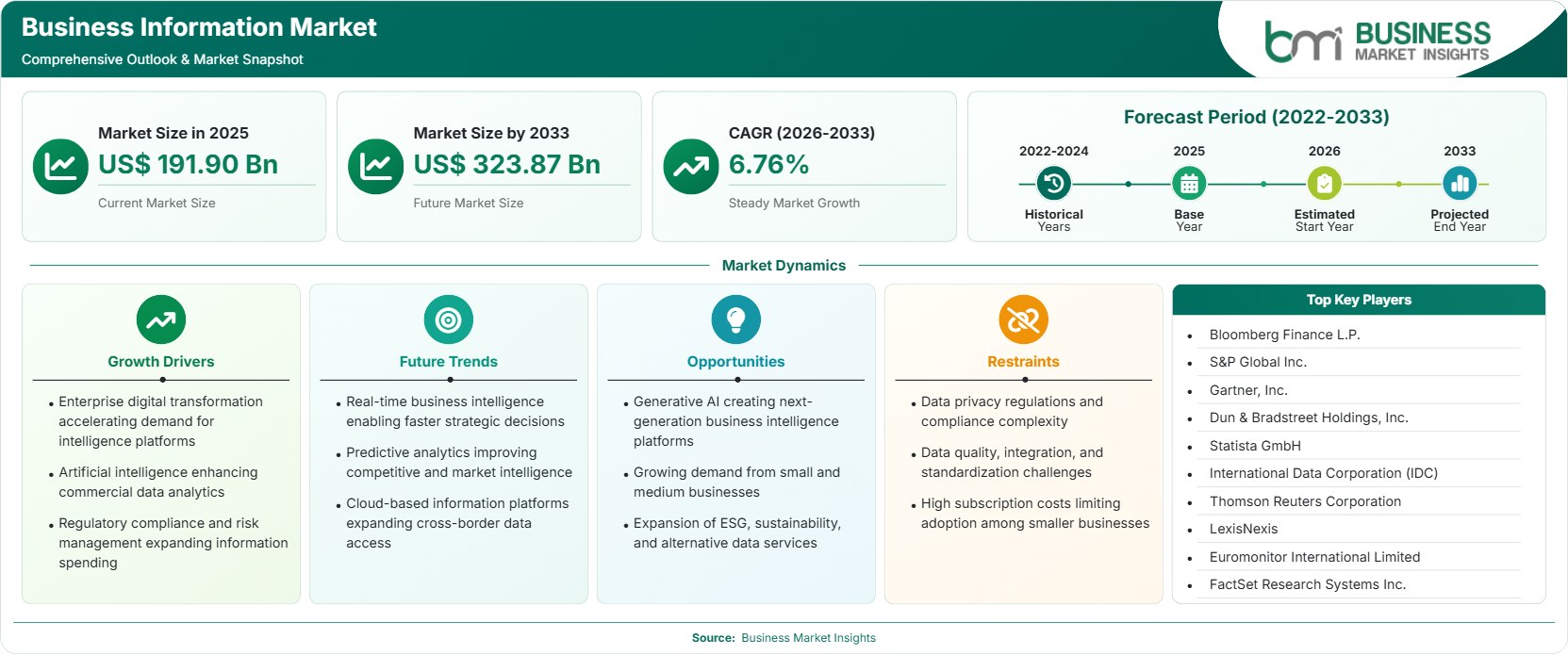
The Business Information Market size was valued at US$ 191.90 billion in 2025 and is projected to reach US$ 323.87 billion by 2033, growing at a CAGR of 6.76% during 2026–2033. Growth is supported by rising enterprise demand for real-time intelligence, AI-driven analytics, regulatory compliance requirements, expanding digital transformation initiatives, and increasing investments in predictive decision-making platforms across financial, government, technology, and research sectors.

Report Coverage
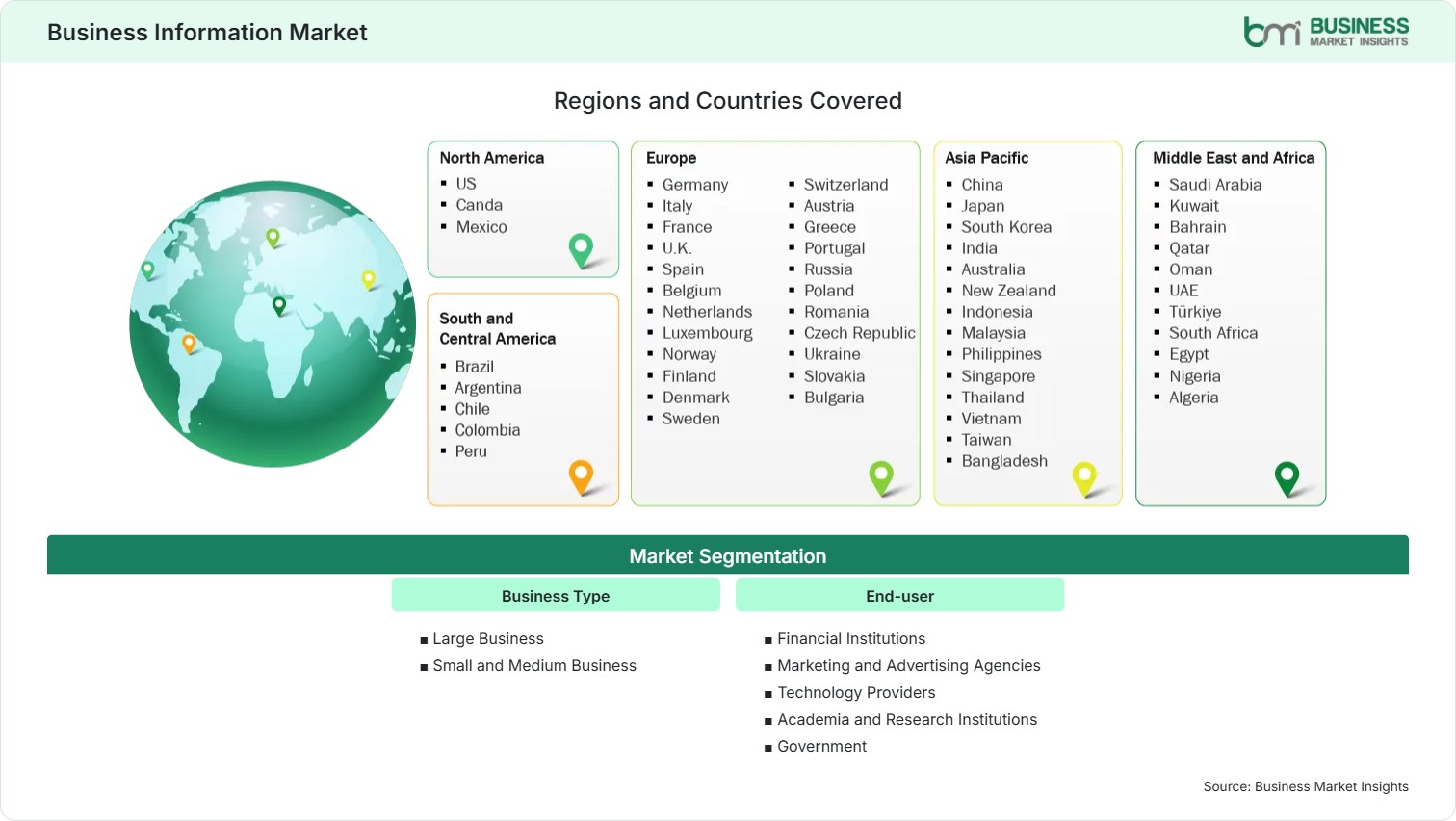
  • Business Type: Large Business, Small and Medium Business
  • End-user: Financial Institutions, Marketing and Advertising Agencies, Technology Providers, Academia and Research Institutions, Government
US$ 191.90 Bn Market size in 2025
US$ 323.87 Bn Market Size by 2033
6.76% CAGR, 2026 - 2033
2026-2033 Forecast Period

AI Overview

Business Information Market Summary

  • North America Region: North America holds a 36%–39% market share in 2025 and is projected to grow at a 6.0%–6.5% CAGR during 2026–2033. Growth is supported by enterprise digitalization, AI-powered intelligence platforms, and increasing investments in predictive analytics across industries. The U.S. remains the regional leader because of mature enterprise intelligence ecosystems, strong SaaS adoption, and continuous investments in AI-powered data platforms, expanding at approximately 6.1%–6.4% CAGR.
  • Fastest Growing Region: Asia Pacific accounts for 25%–28% business information market share in 2025 while expanding at a 8.0%–8.6% CAGR through 2026–2033. Enterprise digitization, expanding startup ecosystems, growing cloud infrastructure, increasing SME adoption, government digital initiatives, financial inclusion programs, and demand for localized business intelligence continue accelerating regional market development.
  • Leading Segment: Large Business represents 60%–63% market share in 2025 and advances at a 6.2%–6.8% CAGR through 2033. Enterprise-scale analytics investments, regulatory compliance requirements, integrated risk management platforms, global operations, advanced forecasting capabilities, and AI-enabled competitive intelligence.
  • High Growth Segment: Technology Providers account for 22%–25% market share in 2025 while recording a 8.5%–9.1% CAGR during the forecast period. Rising AI integration, and expanding enterprise software ecosystems continue creating significant commercial opportunities globally.
  • Key Market Opportunity: Expanding generative AI, knowledge automation, industry-specific intelligence platforms, multilingual data analytics, ESG reporting solutions, and real-time decision-support systems are creating sustainable revenue opportunities for information service providers serving enterprises globally.
  • Major Market Players: Bloomberg Finance L.P., S&P Global Inc., Gartner, Inc., Dun & Bradstreet Holdings, Inc., Statista GmbH, International Data Corporation (IDC), Thomson Reuters Corporation, LexisNexis, Euromonitor International Limited, and FactSet Research Systems Inc.
Strategic Insights

Business Information Market: Strategic Insights

Business Information Market Strategic Framework
FREE PDF
Request your free sample
Request free sample
Stakeholder View

Key Takeaways

  • The industry is undergoing evolution from individual information sources into full-fledged digital intelligence ecosystems encompassing financial databases, AI analytics, and workflow automation.
  • Another promising area for future growth is small and medium enterprises due to the affordability of cloud services, AI-driven analytics, and business intelligence platforms.
  • AI is facilitating rapid innovation in automated report creation, predictive risk modeling, natural language search, knowledge graphs, and decision support systems.
  • The Asia-Pacific region offers one of the most favorable business landscapes due to enterprise digital transformation and digital economy policies of governments.
  • Acquisition strategies increasingly involve analytics specialists, and AI software developers.
  • Future success will be determined by data quality, reliable information sources, AI governance models, cybersecurity practices, multilingual analytics tools, and cloud computing infrastructures for enterprise-level decision intelligence.
Geographic Outlook

Business Information Market Regional Highlights

North America Business Information Market

North America accounted for 36%–39% of the global Business Information Market share in 2025 and is projected to expand at a 6.0%–6.5% CAGR through 2033. The region benefits from widespread enterprise digitization, mature cloud infrastructure, extensive adoption of AI-powered analytics, and strong demand for financial risk intelligence.

  • The US and Canada have robust enterprise spending on AI-driven analytics, regulatory intelligence, and market research platforms.
  • Increasing spending on cybersecurity intelligence, ESG reporting systems, and alternative data providers has enhanced competitive differentiation of information vendors along with recurrent subscription income from enterprise clients looking for reliable business intelligence.
  • The financial sector keeps increasing its purchases of economic data, credit intelligence, and competitive benchmarking tools to make better lending decisions, manage portfolios, prevent fraud and comply with regulations amid changing supervisory regimes.
  • Cloud-based information platforms, API-driven data delivery, and enterprise software integration provide continuous access to up-to-date intelligence by simplifying processes and speeding up decision making within multinational businesses.
  • Continuous investment in generative AI, natural language search, and predictive analytics platforms accelerates innovation and allows vendors to offer personalized intelligence services with greater analytical precision and efficiency.

US Business Information Market

The United States represents nearly 82%–85% of the North American market while expanding at approximately 6.1%–6.4% CAGR during 2026–2033. High enterprise technology spending, advanced digital infrastructure, and the presence of globally recognized information providers strengthen market leadership.

  • The use of AI-driven business intelligence systems among large corporations is increasing as they look to combine their financial, operational, customer, and macroeconomic data for executive decision-making with the help of predictive analytics and real-time monitoring.
  • Government agencies continue expanding procurement of commercial intelligence, economic forecasting, and risk assessment solutions to strengthen public policy planning, infrastructure investments, and cybersecurity preparedness across federal and state organizations in business information market.
  • Funding from venture capitalists in enterprise software, alternative data platforms, and generative AI technologies keeps growing and helps foster ecosystems that promote cooperation between incumbent information suppliers and new analytics technology firms.
  • The adoption of subscription-based information systems enhances revenue generation potential while ensuring product improvement and scalable cloud hosting and customer retention.

Europe Business Information Market

Europe represented approximately 27%–30% of global market revenue in 2025 and is forecast to register a 6.3%–6.8% CAGR through 2033. Effective regulations, digitalization efforts, and increased investment in artificial intelligence continue to drive demand for enterprise intelligence services. Business intelligence platforms are being deployed by more organizations to enhance compliance, ESG reporting, transparency, and planning. The region with the highest adoption rates of business intelligence is Germany, while Central & Eastern Europe continues to experience better growth prospects due to digitalization efforts.

  • As a result of industrial digitization, financial services, and the adoption of AI analytics platforms in enterprises, Germany retains its position as the largest regional market.
  • The United Kingdom continues strengthening demand for regulatory intelligence, financial information services, and consulting-driven analytics as organizations adapt to evolving governance, sustainability reporting, and international trade requirements in business information market.
  • France and the Nordics continue their efforts to create digital public infrastructure, implement cloud computing and enterprise data governance, promoting the adoption of commercial intelligence in government and private organizations.
  • Poland is one of the regions where the rate of growth is very high and is fueled by investments in technologies, startups, enterprise cloud computing, and the digital economy.

Asia Pacific Business Information Market

Asia Pacific accounted for approximately 25%–28% of global revenue during 2025 and is anticipated to record the fastest regional CAGR of 8.0%–8.6% through 2033. Rapid enterprise digitalization, expanding cloud infrastructure, increasing financial inclusion, and strong government support for digital economies continue accelerating adoption of commercial intelligence platforms. China remains the largest regional contributor, while India demonstrates the highest long-term growth potential because of expanding technology ecosystems, digital enterprises, and AI adoption across multiple industries.

  • China continues investing heavily in enterprise digital transformation, artificial intelligence, cloud computing, and financial technology, encouraging organizations to adopt advanced information services supporting competitive strategy and operational optimization.
  • India represents the fastest-growing national market as startups, financial institutions, consulting firms, and technology providers increasingly invest in cloud-based analytics, AI-enabled decision support, and commercial intelligence platforms in business information market.
  • Japan maintains stable enterprise demand driven by manufacturing modernization, financial analytics, supply chain optimization, and advanced digital governance supporting high-value information service adoption across established corporations.
  • Southeast Asian economies continue expanding demand because of SME digitalization, government-backed technology initiatives, rising foreign direct investment, and increasing cloud adoption among rapidly growing enterprises.

Rest of World Business Information Market

The Rest of World region accounted for approximately 8%–10% of global revenue in 2025 and is expected to expand at a 6.8%–7.3% CAGR through 2033. South & Central America continues benefiting from financial sector modernization and enterprise cloud adoption. Meanwhile, the Middle East & Africa gains momentum through digital government programs, economic diversification initiatives, and increasing investments in knowledge-based industries.

Growing digital infrastructure, financial inclusion strategies, and public-private technology partnerships continue strengthening enterprise demand for business intelligence platforms. Brazil leads South & Central America, while the United Arab Emirates demonstrates the strongest expansion within the Middle East because of rapid AI adoption, smart government initiatives, and significant investments in digital economy transformation.

  • Brazil continues strengthening regional demand through financial modernization, enterprise cloud adoption, regulatory digitization, and increasing investments in commercial analytics supporting banking, insurance, and corporate strategy applications in business information market.
  • The United Arab Emirates has proven the most promising growth potential in the region due to aggressive digital transformation projects, AI investments, smart government initiatives, and growing enterprise IT ecosystems that foster knowledge-based economic development.
  • Saudi Arabia continues its efforts in digital economy diversification and modernizing enterprises, which leads to rising needs for commercial intelligence systems that help achieve national development goals.
  • For South Africa, the reason is that enterprises use more cloud analytics, financial intelligence, and market research tools to increase their competitiveness and compliance with regulations.
Global Market Geography
FREE PDF
Request your free sample
Request free sample
Segment Analysis

Business Information Market Segmentation

Business Type

The Business Type segment represents the primary demand structure of the market, reflecting differences in analytical maturity, technology investment, and information requirements across organizations. In 2025, Large Business accounted for approximately 60%–63% of total revenue and is projected to expand at a 6.2%–6.8% CAGR through 2033. The Business Information Market scope continues broadening as organizations of every size increasingly adopt cloud-based intelligence platforms, AI-enabled analytics, and integrated decision-support solutions to improve operational efficiency, regulatory compliance, and competitive positioning.

  • Large Business: Large enterprises generate the highest demand for business information platforms because of multinational operations, extensive regulatory obligations, sophisticated risk management frameworks, and continuous investment in artificial intelligence, predictive analytics, competitive intelligence, and enterprise-wide data integration supporting strategic decision-making.
  • Small and Medium Business (SMB): Small and medium businesses increasingly adopt subscription-based intelligence platforms, cloud analytics, and automated reporting tools as implementation costs decline, enabling organizations to strengthen market visibility, improve customer targeting, optimize operations, and support informed investment decisions without maintaining extensive internal research teams.

End-user

The End-user segment reflects the expanding application of business intelligence solutions across industries requiring reliable commercial, financial, and strategic information for operational and investment decisions. In 2025, Financial Institutions held approximately 29%–32% of market revenue and are projected to grow at a 6.4%–6.9% CAGR through 2033, supported by increasing demand for risk assessment, regulatory compliance, fraud detection, and real-time economic intelligence. The Business Information Market trends indicate rising adoption of AI-powered analytics, cloud-based information services, and industry-specific data platforms across both public and private organizations.

  • Financial Institutions: Banks, insurance companies, investment firms, and asset managers rely on business information platforms to strengthen credit evaluation, portfolio management, anti-money laundering compliance, market forecasting, and enterprise risk management through timely, verified, and data-driven intelligence.
  • Marketing and Advertising Agencies: Agencies increasingly utilize commercial intelligence, consumer behavior analytics, competitive benchmarking, and demographic datasets to optimize campaign planning, audience segmentation, media allocation, brand positioning, and measurable marketing performance across digital and traditional channels.
  • Technology Providers: Software developers, cloud service providers, AI companies, and digital platform operators leverage business information services to identify market opportunities, evaluate competitive landscapes, enhance product development strategies, and support data-driven innovation through advanced analytics and industry insights.
  • Academia and Research Institutions: Universities, think tanks, and independent research organizations utilize structured commercial databases, industry reports, macroeconomic indicators, and market intelligence to support academic studies, innovation programs, policy research, forecasting models, and evidence-based decision-making across multiple disciplines.
  • Government: National, regional, and local government agencies employ business information solutions to evaluate economic performance, formulate public policies, attract investments, monitor industrial development, strengthen regulatory oversight, and improve long-term strategic planning through reliable commercial and economic intelligence.
Market Forces

Business Information Market Dynamics

Key Market Drivers

Enterprise Digital Transformation Accelerating Demand for Intelligence Platforms

Organizations across industries continue prioritizing digital transformation initiatives to improve operational efficiency, customer engagement, and strategic planning, significantly increasing demand for integrated business information solutions. Enterprises are replacing fragmented databases with centralized platforms that combine financial intelligence, competitive benchmarking, regulatory updates, and predictive analytics. The Business Information Market growth is supported by increasing adoption of cloud-native intelligence platforms, artificial intelligence, and machine learning technologies that enable real-time decision-making.

Artificial Intelligence Enhancing Commercial Data Analytics

AI technology is radically transforming the manner in which businesses gather and use information pertaining to their operations. Contemporary AI applications automate the collection of data, discovery of market patterns, derivation of insights, and decision-making through structured and unstructured data sets. NLP allows users to extract business intelligence by conversing with systems, while the use of generative AI speeds up reporting and analysis.

Regulatory Compliance and Risk Management Expanding Information Spending

The growing complexities of regulation in sectors such as finance, healthcare, manufacturing, energy, and public administration are continuing to drive more costs in reliable commercial intelligence. Companies need updated information to meet the demands of anti-money laundering regulations, ESG regulations, cybersecurity compliance, tax regulations, and international trade regulations.

Key Market Opportunities

Generative AI Creating Next-Generation Business Intelligence Platforms

The rapid commercialization of generative artificial intelligence is creating substantial opportunities for information providers to transform traditional data services into intelligent decision-support ecosystems. These capabilities reduce research time while improving executive productivity. The Business Information Market Forecasts indicate growing enterprise investment in conversational analytics, automated report generation, multilingual intelligence, and industry-specific knowledge models.

Growing Demand from Small and Medium Businesses

Small and medium businesses have become one of the most appealing customer segments in terms of affordability due to cloud subscription packages, software-as-a-service delivery methods, and AI analytics that make integration easier. Before, advanced business intelligence systems were available mainly to big companies due to the costly deployment process and technical difficulty. However, now that it is easy to integrate through subscription-based models, SMEs can gain financial benchmarking, market research, customer analysis, and competitive intelligence.

Expansion of ESG, Sustainability, and Alternative Data Services

The requirement of environmental, social, and governance information is opening up avenues of earning income by providing sustainable intelligence along with business intelligence. Investors, regulatory bodies, and multinational companies need to assess their performances through such environmental, social, and governance data, climate risk information, and corporate governance metrics.

Market Restraints and Challenges

Data Privacy Regulations and Compliance Complexity

Factor: Organizations must comply with evolving frameworks such as the EU General Data Protection Regulation (GDPR), the California Consumer Privacy Act (CCPA), and other regional privacy laws governing data collection, processing, storage, and cross-border transfers. Impact: Compliance increases operational costs, extends product development timelines, and requires continuous investment in governance frameworks, encryption technologies, and legal expertise.

Data Quality, Integration, and Standardization Challenges

Factor: Variations in data formats, inconsistent reporting standards, duplicate records, incomplete datasets, and interoperability limitations make it difficult to maintain consistently accurate and reliable commercial intelligence. Impact: Poor data quality reduces analytical accuracy, weakens forecasting reliability, and limits confidence in strategic decision-making.

Company Analysis

Competitive Landscape

The competitive environment is characterized by strong investments in artificial intelligence, cloud-native analytics, proprietary datasets, regulatory intelligence, and subscription-based information services. The Business Information Market analysis indicates that established providers continue strengthening their portfolios through acquisitions, strategic partnerships, product innovation, and industry-specific analytical platforms.

Company Name

Overview

Products and Services relevant to this market

PwC (U.K.)

Global professional services firm providing business advisory, risk consulting, digital transformation, and market intelligence solutions for multinational enterprises and public organizations.

Business consulting, economic intelligence, ESG advisory, risk assessment, digital transformation services, market analysis, and strategic business insights.

Bloomberg Finance L.P. (U.S.)

Leading financial information provider offering real-time market intelligence, analytics, news, and enterprise data solutions supporting investment professionals globally.

Bloomberg Terminal, financial data, economic indicators, market news, analytics platforms, enterprise data feeds, and research solutions.

S&P Global (U.S.)

International provider of financial information, credit analytics, commodity intelligence, and enterprise research supporting informed commercial and investment decisions.

Credit ratings, market intelligence, commodity insights, financial analytics, ESG data, benchmarking, and risk management solutions.

Boston Consulting Group (U.S.)

Global management consulting company helping organizations improve strategic planning through advanced analytics, industry research, and digital transformation expertise.

Strategic consulting, market intelligence, AI advisory, competitive analysis, digital strategy, and business performance optimization.

Gartner (U.S.)

Research and advisory company delivering technology insights, enterprise benchmarks, and executive guidance for organizations worldwide.

Technology research, market forecasts, executive advisory, benchmarking, CIO guidance, and enterprise analytics.

Dun & Bradstreet Holdings Inc. (U.S.)

Global provider of commercial data and business analytics focused on risk management, sales intelligence, and corporate information.

Business databases, credit intelligence, supplier risk, compliance solutions, sales acceleration, and commercial analytics.

Statista (Germany)

Digital statistics platform aggregating verified industry, economic, consumer, and market information across multiple business sectors.

Statistical databases, industry reports, consumer insights, forecasts, and business intelligence resources.

International Data Corporation (U.S.)

Market intelligence firm specializing in information technology research, enterprise digital transformation analysis, and technology forecasts.

ICT research, market forecasts, technology consulting, vendor assessments, and enterprise analytics.

Thomson Reuters (Canada)

Global provider of professional information services serving legal, tax, accounting, compliance, media, and corporate markets.

Legal intelligence, tax solutions, compliance platforms, regulatory information, business research, and news services.

The Nielsen Company (U.S.)

Consumer intelligence company specializing in audience measurement, retail analytics, and market behavior research.

Consumer analytics, audience measurement, retail intelligence, advertising insights, and market research services.

LexisNexis (U.S.)

Information analytics company delivering legal, corporate, regulatory, and risk intelligence through advanced digital platforms.

Legal databases, compliance intelligence, due diligence, fraud detection, corporate research, and analytics solutions.

CB Information Services, Inc. (U.S.)

Technology intelligence provider focused on private company data, venture capital activity, innovation tracking, and emerging industries.

Startup intelligence, investment databases, innovation research, competitive intelligence, and AI-powered analytics.

Morningstar, Inc. (U.S.)

Independent investment research company delivering financial analysis, portfolio intelligence, and market insights for institutional and retail investors.

Investment research, fund analysis, portfolio analytics, financial data, ESG ratings, and market intelligence.

Euromonitor International (U.K.)

Global market research organization providing strategic industry intelligence, consumer insights, and international market analysis.

Industry reports, consumer research, strategic forecasts, economic analysis, and business intelligence solutions.

Kantar Group Ltd. (U.K.)

Data analytics and brand consulting company delivering consumer behavior intelligence and market measurement solutions worldwide.

Brand analytics, consumer insights, audience measurement, market research, and consulting services.

Fitch Solutions, Inc. (U.S.)

Provider of macroeconomic forecasts, political risk analysis, industry intelligence, and financial market research.

Country risk analysis, industry forecasts, macroeconomic intelligence, credit insights, and research solutions.

Moody's Investors Service, Inc. (U.S.)

Global credit ratings agency providing financial intelligence, economic research, and enterprise risk assessment services.

Credit ratings, financial analytics, economic research, ESG intelligence, and risk management solutions.

FactSet (U.S.)

Financial data and analytics company delivering integrated market intelligence to investment professionals and corporate organizations.

Financial databases, portfolio analytics, market intelligence, ESG datasets, enterprise analytics, and workflow solutions.

Trust & Transparency

Research Methodology

The market analysis combines proprietary research with secondary data from government agencies, company disclosures, regulatory filings, industry databases and expert interviews. Market estimates are validated through data triangulation, cross-market benchmarking and analyst review.

View Full Research Methodology

Questions Answered

Frequently Asked Questions

How is artificial intelligence transforming business information platforms?

Artificial intelligence improves automated data collection, predictive analytics, natural language search, report generation, knowledge management, and personalized decision support.

What does the market report typically include?

A comprehensive Business Information Market Report generally covers market size, segmentation, competitive landscape, regional analysis, technology trends, regulatory developments, company profiles, investment outlook, strategic recommendations, and long-term market forecasts for stakeholders.

Which region offers the strongest long-term investment opportunity?

Asia Pacific presents the strongest long-term opportunity owing to rapid enterprise digitalization, expanding cloud infrastructure, government-backed digital economy initiatives, increasing AI adoption, and growing demand from technology providers and SMEs.

Which end-user industry generates the highest revenue for this market?

Financial institutions represent the largest end-user because they require reliable commercial intelligence for credit assessment, investment analysis, regulatory compliance, fraud detection, portfolio management, and enterprise risk evaluation.

What are the primary factors driving demand for business information market?

Growing enterprise digitalization, AI adoption, regulatory compliance requirements, financial risk management, and increasing dependence on real-time commercial intelligence are encouraging organizations to invest in advanced business information platforms for strategic decision-making.

Access the Full Business Information Market Report

Get segment-level forecasts, regional estimates, competitive benchmarking, company profiles and downloadable Excel datasets.

Access the full Business Information Market Report
350 pages PDF & Excel | 2026-09-02