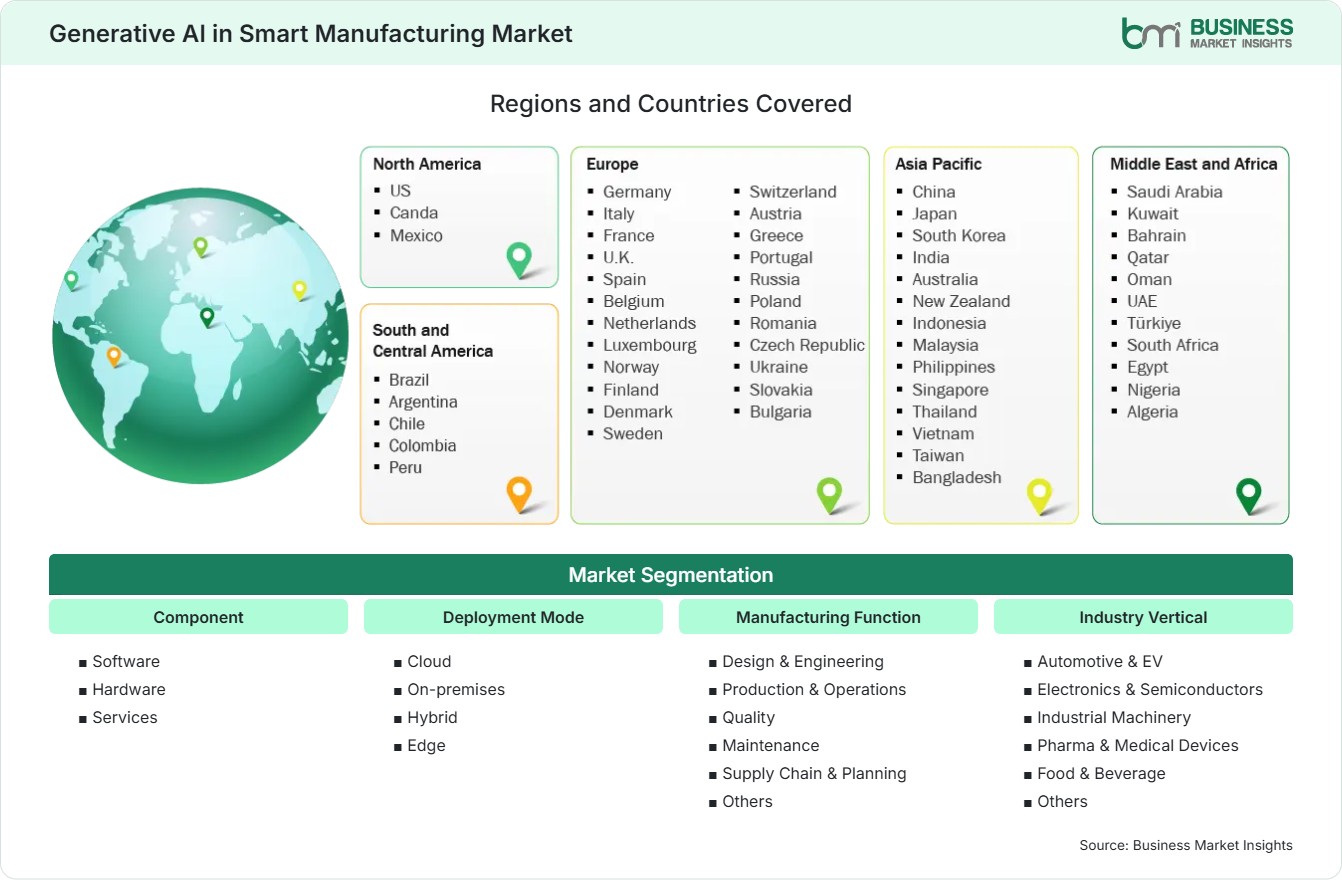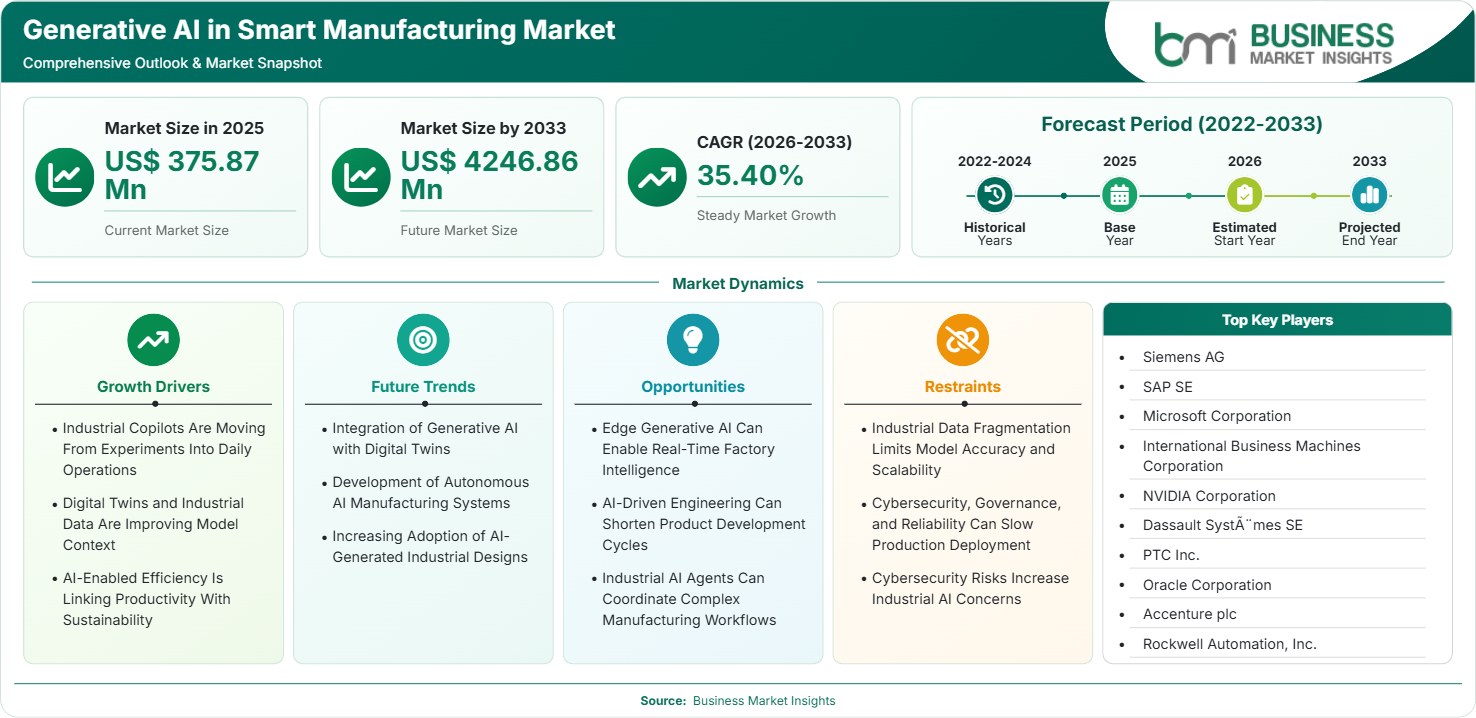
Generative AI in Smart Manufacturing Market Regional Highlights
North America Generative AI In Smart Manufacturing Market
North America holds an estimated 35%–38% Generative AI In Smart Manufacturing Market share in 2025 and is projected to expand at a 33%–36% CAGR during 2026–2033. U.S. manufacturers lead regional adoption, while Canada contributes through aerospace, energy equipment, and advanced manufacturing.
- Industrial software integration is accelerating as manufacturers connect ERP, MES, PLM, and IoT environments, enabling generative models to access richer operational context and produce more useful recommendations.
- Automotive, aerospace, electronics, and semiconductor producers are prioritizing engineering copilots and digital twins, particularly where product complexity creates large volumes of technical documentation and configuration data.
- Cloud and hyperscale infrastructure supports large-model deployment, while edge architectures increasingly handle latency-sensitive workloads such as machine assistance, visual inspection, and autonomous production monitoring.
- Workforce shortages are encouraging AI assistants that retrieve technical knowledge, summarize maintenance histories, generate procedures, and help less-experienced personnel resolve complex production issues faster.
US Generative AI In Smart Manufacturing Market
The U.S. represents approximately 78%–82% of North American demand in 2025 and is advancing at a 34%–37% CAGR through 2033. Strong enterprise AI investment, domestic semiconductor initiatives, aerospace manufacturing, automotive electrification, and defense production support adoption.
- Federal support for domestic semiconductor and advanced manufacturing capacity strengthens demand for AI-enabled engineering, factory planning, process optimization, and automated quality management across strategically important industries.
- Large manufacturers increasingly seek secure enterprise architectures that combine proprietary data with foundation models, creating demand for retrieval-augmented generation, model governance, and industrial knowledge management capabilities.
- Manufacturing workforce constraints are creating demand for natural-language interfaces that allow technicians and engineers to access complex operational information without extensive software training.
Europe Generative AI In Smart Manufacturing Market
Europe accounts for an estimated 25%–28% Generative AI In Smart Manufacturing Market share in 2025 and is expanding at a 31%–35% CAGR during 2026–2033. Germany remains the leading country, supported by automotive, machinery, chemicals, and industrial automation, while France, Italy, the United Kingdom, and the Nordic economies provide additional demand. Germany is estimated to grow at 32%–35%, while France is advancing at 34%–37%.
- Germany's industrial engineering base supports adoption of AI copilots across product lifecycle management, factory engineering, maintenance, and production optimization, particularly among automotive and machinery manufacturers.
- European manufacturers increasingly prioritize sovereign data architectures and controlled AI deployment, creating opportunities for private cloud, hybrid infrastructure, and industrial edge solutions.
- The European Union's planned AI gigafactories could strengthen access to advanced computing resources, supporting industrial AI development while reducing dependence on external infrastructure providers.
- Sustainability requirements are encouraging AI applications that optimize energy, materials, equipment utilization, and production planning, aligning generative systems with broader industrial efficiency objectives.
Asia Pacific Generative AI In Smart Manufacturing Market
Asia Pacific represents an estimated 28%–31% share in 2025 and records the fastest expansion at a 38%–42% CAGR through 2033. China leads regional deployment, while Japan, South Korea, Singapore, Taiwan, and India contribute strong growth. China is estimated to expand at 39%–43%, while India advances at 42%–46%.
- China combines extensive manufacturing capacity with rapid industrial AI investment, creating opportunities for localized foundation models, intelligent factories, autonomous production, and supply-chain optimization.
- Japan's mature robotics and precision manufacturing sectors favor AI applications that combine machine data, engineering knowledge, and human expertise to improve productivity and maintenance decisions.
- South Korea and Taiwan benefit from semiconductor and electronics ecosystems where generative AI can support process engineering, yield improvement, equipment diagnostics, and rapid production changeovers.
- India offers long-term potential through expanding electronics, automotive, pharmaceutical, and industrial manufacturing capacity, supported by growing digital infrastructure and engineering talent.
Rest of World Generative AI In Smart Manufacturing Market
Rest of World accounts for an estimated 9%–12% Generative AI In Smart Manufacturing Market share in 2025 and is projected to expand at a 29%–34% CAGR through 2033. South and Central America are led by Brazil and Mexico, where automotive, food processing, aerospace, and industrial production support adoption.
- Mexico's manufacturing expansion creates demand for AI-assisted production planning, quality inspection, maintenance, and supplier coordination as companies establish or expand regional production networks.
- Brazil offers opportunities across food processing, automotive, chemicals, and machinery, where generative systems can help integrate fragmented operational data and improve workforce productivity.
- Gulf economies are investing in AI infrastructure and industrial diversification, creating demand for intelligent asset management, process optimization, and AI-enabled engineering capabilities.
- South Africa provides opportunities for industrial AI in mining, automotive, and energy-related operations, particularly where predictive maintenance and technical knowledge access can reduce operational disruptions.