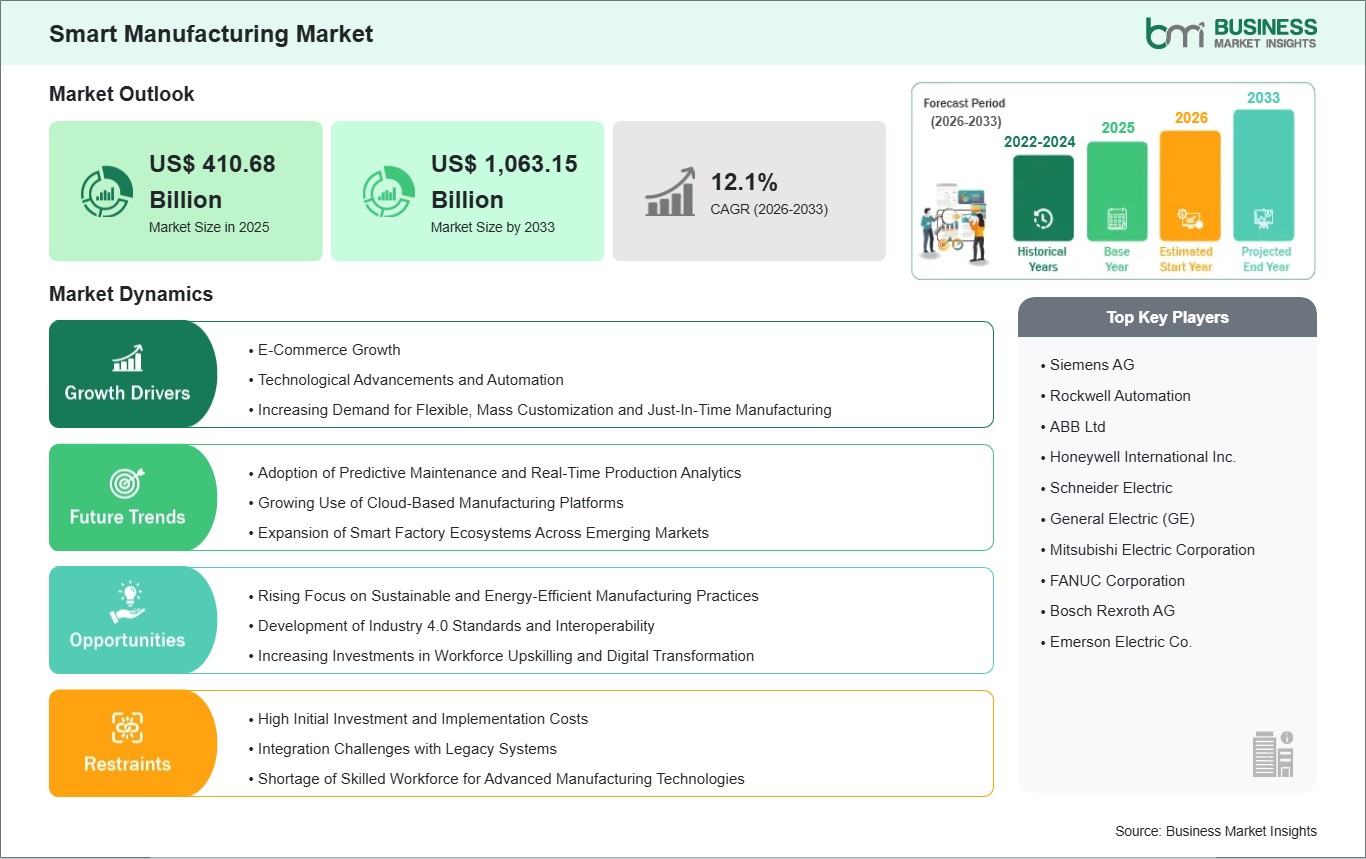
The Smart Manufacturing market size is expected to reach US$ 1,063.15 billion by 2033 from US$ 410.68 billion in 2025. The market is estimated to record a CAGR of 12.1% from 2026 to 2033.
Smart Manufacturing is revolutionizing the way production is carried out worldwide by in large enabling real-time monitoring, automation, and data-driven decision-making. These changes are spreading across industries like automotive, electronics, pharmaceuticals, and consumer goods. What used to be a slow and expensive process is now made efficient with the adoption of IoT, AI, robotics, and digital twins, which in turn are driving productivity, minimizing downtime, and improving product quality. The need for mass customization, I4.0 initiatives, and the desire for production systems that are flexible and can quickly respond to changes are some of the main factors behind the growth of this market. In addition to this, innovations in predictive maintenance, cloud-based analytics, and smart supply chain integration are speeding up the process even more, to the point of business facing almost zero inefficiencies and increasing their competitive advantage.
On the other hand, growth in the market is limited by the fact that the initial investment in technology is quite high, there is a difficulty in the integration of old and new systems, there is the risk of cyber-attacks, and there is a lack of people equipped with the necessary skills in advanced manufacturing technologies. Compliance with regulations and standardization issues may also be impeding the progress that the market makes in different parts of the world. In fact, there are a lot of challenges that Smart Manufacturing has to deal with; however, the adoption of energy-efficient and sustainable manufacturing practices, the increase in smart factory setups in emerging economies, and the use of AI-driven optimization for cost reduction and improved productivity are significant opportunities. Moreover, the sector is expected to continue to grow in the long run as more and more enterprises keep investing in digitalization and industrial automation.

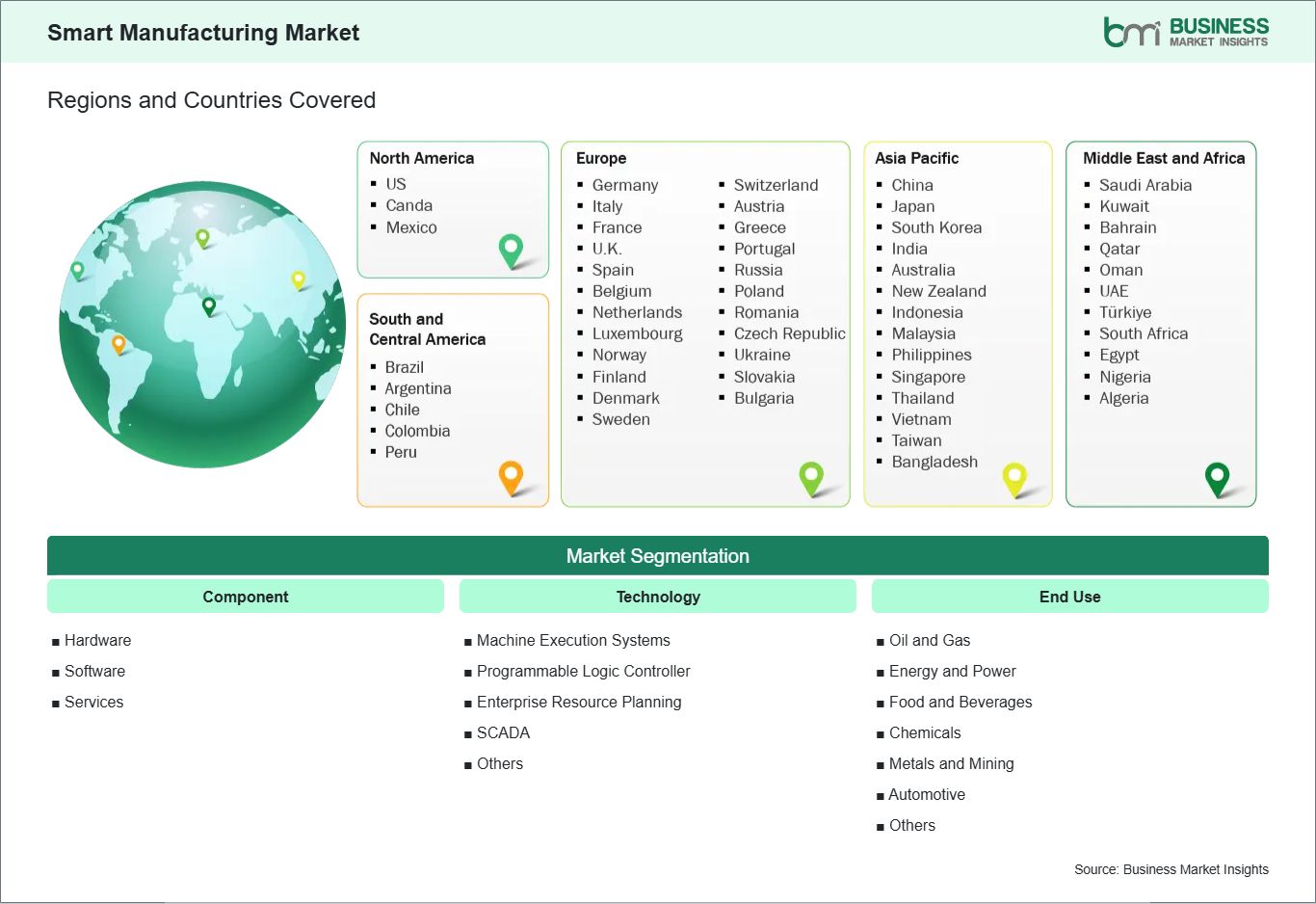
Key segments that contributed to the derivation of the Smart Manufacturing market analysis are component, technology, and end use.
The rapid growth of global eCommerce has emerged as a pivotal factor positively driving the Smart Manufacturing market. With the global e-commerce boom is becoming one of the key factors behind the Smart Manufacturing market expansion. The digital platform spread has changed the consumer behavior drastically, as there is a notable rise in online purchases for the sectors of electronics, fashion, pharmaceuticals, home goods, and consumer packaged goods. The change is forcing manufacturers to abandon old production patterns and use advanced, flexible manufacturing systems that are able to meet the requirements of the digital economy.
In such a situation, the adoption of Smart Manufacturing technologies that combine automation, robotics, AI, and IoT is the only way for companies to survive. These technologies provide companies with the possibility of achieving shorter production cycles, facilitating mass customization, and guaranteeing the accuracy and consistency of order fulfillment at a high level. Producers can manage their operations efficiently through real-time production process monitoring, thus they can quickly respond to demand changes, eliminate idling time, and optimize resource usage, which in return guarantees the required speed and reliability in the e-commerce sector. The major e-commerce players like Amazon, Alibaba, and Shopify are not only benefiting from this trend but are also instrumental in speeding it up. Their willingness to rapid order processing, high-volume throughput, and seamless integration across supply chains are some of the key factors behind manufacturing strategies' changes worldwide. To satisfy the consumers’ demand for rapid delivery of good quality and personalized products, enterprises have been more enthusiastic about the smart factory concept, which encompasses automated production lines, advanced material handling systems, and data-driven analytics.
Smart Manufacturing market is evolving rapidly due to the breakthrough technologies in AI, IoT, robotics, and digital twins. To achieve the goals of operational excellence, cost savings, and customer satisfaction, manufacturers across various sectors are embracing these new innovations in their production facilities. The deployment of such technologies paves the way for on-demand monitoring, maintenance prediction, and decision-making based on complex data analytics, to name just a few benefits. As a result, these enterprises can run their assets at full capacity, avoid interruptions in production, and ensure the quality of their output at the highest level at all times.
For instance, AI-based tools are instrumental in heavy production data processing, pinpointing energy wastage, and suggesting workflow changes. Robotics take over not only simple but also complex and time-consuming tasks in an automated manner, which results in increased accuracy and speed, and human operators are given more room to perform higher-value, strategic activities. The IoT-enabled sensors and devices that are installed in machinery, production lines, and supply chains allow companies to have real-time views of operations, thus giving the performance they achieve and problems they face the clues necessary for solving and even preventing them. The digital twins, which are essentially identical computer models of real assets or processes, help industries to pretest various scenarios so that errors are reduced, saving and time-to-market accelerated.Besides, these technologies when combined together facilitate the adoption of agile manufacturing practices that make companies be able to answer quickly to changing market-demand, efficiently produce customized products and easily implement flexible production schedules. They also contribute to quality control and operational decision-making at the same time as real-time analytics through predictive maintenance that is aimed at cutting drastically unplanned downtime by noticing in advance the equipment that is going to fail.

By component, the Smart Manufacturing market is divided into Hardware, Software, and Services. The hardware segment dominated the market in 2024, driven by increasing investments in IoT sensors, robotics, and automation equipment. Software and services are also witnessing strong growth as manufacturers adopt analytics, cloud platforms, and predictive maintenance solutions.
By technology, the market is divided into Machine Execution Systems, Programmable Logic Controller, Enterprise Resource Planning, SCADA, and Others. Machine Execution Systems (MES) held the largest share in 2024, as manufacturers prioritize real-time production monitoring, efficiency optimization, and quality control. ERP and SCADA systems are also gaining traction due to their ability to integrate operations and streamline decision-making.
By end use, the market is segmented into Oil and Gas, Energy and Power, Food and Beverages, Chemicals, Metals and Mining, Automotive, and Others. The automotive sector accounted for the largest market share in 2024, reflecting strong adoption of automation, robotics, and connected manufacturing solutions. Food and beverages, pharmaceuticals, and metals & mining are emerging as key growth verticals due to increasing demand for efficiency, compliance, and traceability.
| Report Attribute | Details |
|---|---|
| Market size in 2025 | US$ 410.68 Billion |
| Market Size by 2033 | US$ 1,063.15 Billion |
| Global CAGR (2026 - 2033) | 12.1% |
| Historical Data | 2022-2024 |
| Forecast period | 2026-2033 |
| Segments Covered | By Component
|
| Regions and Countries Covered | North America
|
| Market leaders and key company profiles |
|
The Smart Manufacturing Market Size and Forecast (2022–2033) report provides a detailed analysis of the market covering below areas:
The geographical scope of the Smart Manufacturing market report is divided into five regions: North America, Asia Pacific, Europe, Middle East &; Africa, and South & Central America. The Smart Manufacturing market in Asia Pacific is expected to grow significantly during the forecast period.
The Asia-Pacific Smart Manufacturing market is segmented into China, Japan, South Korea, India, Australia, New Zealand, Indonesia, Malaysia, the Philippines, Singapore, Thailand, Vietnam, Taiwan, Bangladesh, and the Rest of Asia regions. This area's growth is driven by the increased industrial output, the high investments in the Industry 4.0 technologies, and the governments' supportive initiatives that promote automation, digitalization, and the smart factory development. The major economies, for instance, China, Japan, South Korea, and India, are at the forefront of the implementation of Smart Manufacturing solutions. They use AI, IoT, robotics, and digital twins to improve productivity, operational efficiency, and quality control.
The region gets strong demand from various major industries, such as automotive, electronics, pharmaceuticals, food and beverages, and consumer goods, among others. The growth is further fueled by investments in advanced manufacturing infrastructures like robotics, predictive maintenance systems, and data-driven production platforms. Collaborative initiatives among governments, technology providers, and manufacturing companies are innovation drivers that help in the upskilling of the workforce and the expansion of the smart factory ecosystems deployment.

The Smart Manufacturing market is evaluated by gathering qualitative and quantitative data post primary and secondary research, which includes important corporate publications, association data, and databases. A few of the key developments in the Smart Manufacturing market are:
The Smart Manufacturing Market is valued at US$ 410.68 Billion in 2025, it is projected to reach US$ 1,063.15 Billion by 2033.
As per our report Smart Manufacturing Market, the market size is valued at US$ 410.68 Billion in 2025, projecting it to reach US$ 1,063.15 Billion by 2033. This translates to a CAGR of approximately 12.1% during the forecast period.
The Smart Manufacturing Market report typically cover these key segments-
The historic period, base year, and forecast period can vary slightly depending on the specific market research report. However, for the Smart Manufacturing Market report:
The Smart Manufacturing Market is populated by several key players, each contributing to its growth and innovation. Some of the major players include:
The Smart Manufacturing Market report is valuable for diverse stakeholders, including:
Essentially, anyone involved in or considering involvement in the Smart Manufacturing Market value chain can benefit from the information contained in a comprehensive market report.
Please tell us your area of interest
(Market Segments/ Regions and Countries/ Companies)