
Smart Parking System Market Outlook: Size, Share, Trends, Growth Analysis, Competitive Landscape & Forecast, 2026-2033

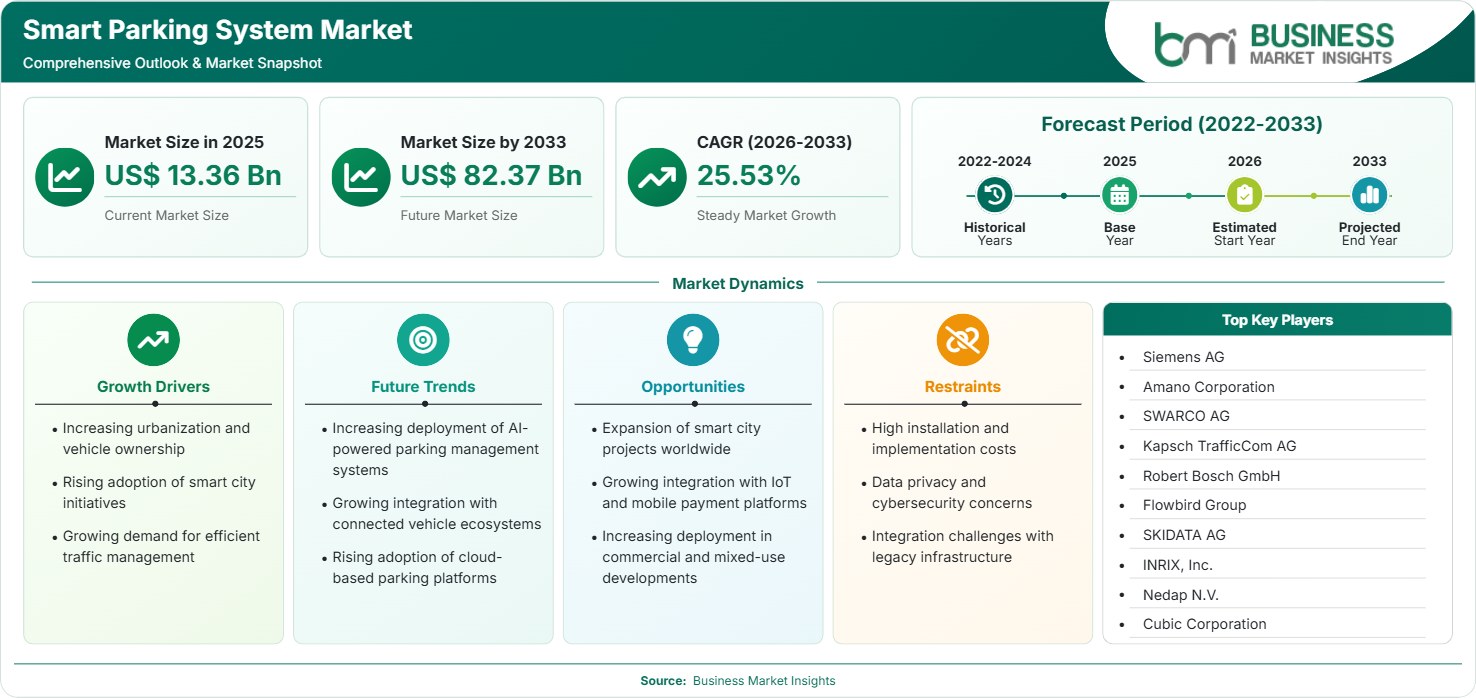
The Smart Parking System Market size was valued at US$ 13.36 Billion in 2025 and is projected to reach US$ 82.37 Billion by 2033, growing at a CAGR of 25.53% during 2026–2033. Increasing urban congestion, rising vehicle ownership, smart city investments, and demand for efficient parking management are driving adoption, while IoT integration, digital payments, and connected mobility solutions create attractive opportunities.

Report Coverage
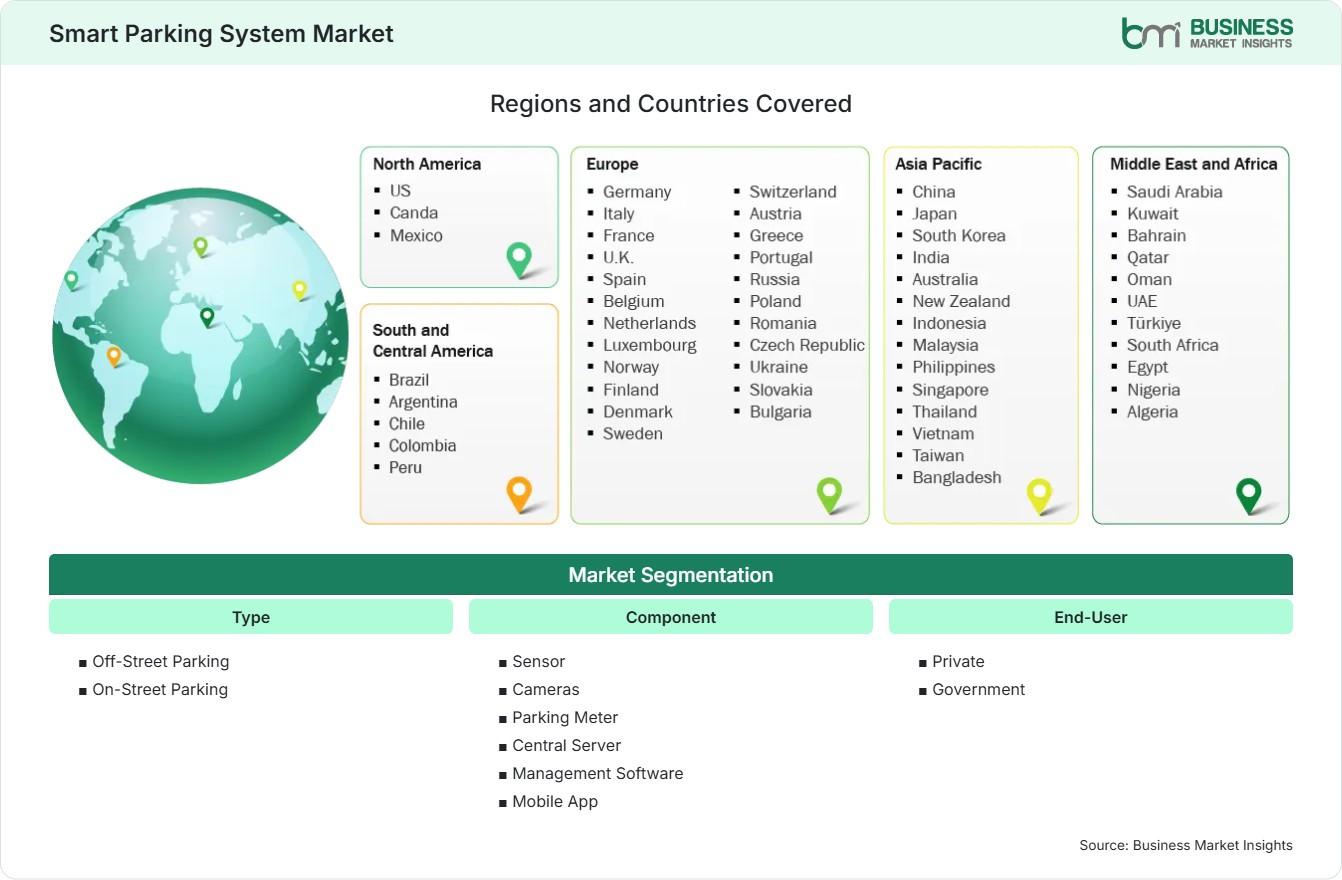
  • Type: Off-Street Parking, On-Street Parking
  • Component: Sensor, Cameras, Parking Meter, Central Server, Management Software, Mobile App
  • End-User: Private, Government
US$ 13.36 Bn Market size in 2025
US$ 82.37 Bn Market Size by 2033
25.53% CAGR, 2026 - 2033
2026-2033 Forecast Period

01 AI Overview

Smart Parking System Market Summary

  • North America Region: North America holds 35%–38% share in 2025 and is projected to grow at a 24.2%–25.0% CAGR during 2026–2033, supported by advanced transportation infrastructure, smart city programs, and connected parking technologies. The US market is expanding at a 24.8%–25.6% CAGR due to municipal modernization, digital payment adoption, and increasing deployment of intelligent parking platforms.
  • Fastest Growing Region: Asia Pacific represents 27%–30% share in 2025 and is growing at a 27.5%–28.4% CAGR through 2033, supported by rapid urbanization, increasing vehicle ownership, government-backed smart city projects, and growing investments in intelligent transportation infrastructure.
  • Leading Segment: Off-Street Parking accounts for 61%–64% share in 2025 and expands at a 24.8%–25.6% CAGR, driven by adoption across airports, hospitals, shopping centers, office complexes, and residential developments requiring centralized parking management.
  • High Growth Segment: Management Software contributes 20%–23% share in 2025 and grows at a 28.5%–29.4% CAGR, supported by cloud platforms, AI-powered analytics, automated reporting, and integration with connected mobility ecosystems.
  • Key Market Opportunity: Increasing adoption of AI, IoT, digital payment platforms, and smart city infrastructure creates opportunities for technology providers to improve parking efficiency, reduce congestion, and develop integrated mobility services.
  • Major Market Players: Siemens AG, Amano Corporation, SWARCO AG, Kapsch TrafficCom AG, Robert Bosch GmbH, Flowbird Group, SKIDATA AG, INRIX, Inc., Nedap N.V., Cubic Corporation.
02 Strategic Insights

Smart Parking System Market: Strategic Insights

smart-parking-system-market-market-strategic-framework
FREE PDF
Request your free sample
Request free sample
03 Stakeholder View

Key Takeaways

  • The market ecosystem is evolving from traditional parking equipment toward integrated mobility platforms combining sensors, software, payment systems, analytics, and cloud infrastructure.
  • Commercial properties, airports, hospitals, universities, and mixed-use developments represent major adoption opportunities because operators require better utilization, automated management, and improved user experiences.
  • Artificial intelligence, predictive analytics, license plate recognition, and IoT connectivity are becoming central technologies for improving parking availability, enforcement, and operational decision-making.
  • Asia Pacific presents strong investment potential due to rapid urban development, expanding vehicle ownership, government smart city initiatives, and increasing transportation infrastructure spending.
  • Strategic collaborations between technology providers, municipalities, and mobility companies are accelerating deployment of scalable parking solutions and expanding market reach.
  • Future competitiveness will depend on cybersecurity capabilities, interoperability with transportation networks, cloud-based platforms, and integration with electric vehicle charging infrastructure.
04 Geographic Outlook

Smart Parking System Market Regional Highlights

North America Smart Parking System Market

North America represents 35%–38% Smart Parking System Market share in 2025 and is projected to grow at a 24.2%–25.0% CAGR from 2026–2033. The region maintains leadership due to advanced digital infrastructure, strong smart city investments, and increasing adoption of connected mobility technologies. The United States remains the largest contributor, supported by municipal modernization projects, commercial infrastructure upgrades, and demand for automated parking management solutions across urban areas.

  • Municipalities are deploying intelligent parking systems to improve traffic management, reduce congestion, and optimize curbside utilization.
  • Airports, universities, hospitals, and commercial facilities increasingly adopt cloud-connected parking platforms for operational efficiency.
  • Digital payment adoption is accelerating replacement of conventional parking systems with automated solutions.
  • Integration with electric vehicle charging infrastructure is creating additional opportunities for connected parking providers.
  • Advanced communication networks support wider deployment of IoT sensors and real-time parking analytics.

US Smart Parking System Market

The US market accounts for 29%–31% share in 2025 and expands at a 24.8%–25.6% CAGR during 2026–2033. Increasing urban congestion, government transportation initiatives, and private infrastructure investments are supporting market development. Cities and businesses are adopting intelligent parking systems to improve space management, enhance customer convenience, and integrate parking operations with broader smart mobility ecosystems.

  • Smart city programs are supporting AI-enabled parking guidance and real-time availability monitoring.
  • Commercial developers are integrating intelligent parking systems into new office and retail infrastructure.
  • Mobile applications and digital payment services are improving parking accessibility for users.
  • Transportation operators are adopting analytics-based solutions for better parking utilization.

Europe Smart Parking System Market

Europe contributes 27%–29% share in 2025 and is expected to grow at a 25.0%–25.8% CAGR during the forecast period. Sustainability goals, environmental regulations, and investments in intelligent transportation infrastructure are supporting adoption. Germany leads regional deployment due to advanced mobility systems, while Poland demonstrates rapid expansion with a 26.5%–27.3% CAGR driven by urban modernization and digital infrastructure development.

  • European cities are implementing smart parking platforms to reduce emissions and improve mobility efficiency.
  • Governments are encouraging digital transportation solutions through sustainability-focused urban policies.
  • Parking operators are adopting automated payment systems and cloud-based management platforms.
  • Integration between parking systems and public transportation networks is increasing.
  • Commercial facilities are upgrading parking infrastructure with connected technologies.

Asia Pacific Smart Parking System Market

Asia Pacific accounts for 27%–30% share in 2025 and records the highest growth at a 27.5%–28.4% CAGR through 2033. Rapid urbanization, rising vehicle ownership, and government-backed smart city initiatives are driving regional adoption. China leads market development, while India demonstrates faster expansion with a 29.2%–30.0% CAGR due to infrastructure investments and increasing digital mobility adoption.

  • Governments are investing heavily in intelligent transportation and connected urban infrastructure.
  • Growing metropolitan populations are increasing demand for automated parking management systems.
  • Mobile payment adoption is supporting wider acceptance of digital parking services.
  • Commercial developments are integrating smart parking into modern infrastructure projects.
  • IoT-enabled solutions are improving parking monitoring and operational efficiency.

Rest of World Smart Parking System Market

Rest of World represents 8%–10% share in 2025 and expands at a 25.5%–26.3% CAGR through 2033. South and Central America are witnessing increasing adoption due to urban mobility challenges, while the Middle East and Africa are benefiting from smart city investments and commercial infrastructure development. The United Arab Emirates is growing at a 27.0%–27.8% CAGR due to advanced digital infrastructure projects.

  • Brazil is expanding smart mobility investments across major urban centers.
  • Middle Eastern countries are deploying intelligent parking solutions within smart city developments.
  • Tourism infrastructure projects are increasing demand for automated parking technologies.
  • Commercial real estate projects are adopting connected parking platforms.
  • Digital transformation initiatives are improving adoption across emerging markets.
global-market-geography
FREE PDF
Request your free sample
Request free sample
05 Segment Analysis

Smart Parking System Market Segmentation

Type

The type segment is expanding as governments, commercial operators, and property developers increasingly replace traditional parking infrastructure with intelligent solutions. Off-Street Parking remains the leading category due to extensive deployment across airports, shopping centers, hospitals, residential complexes, and office facilities requiring centralized control and automated operations. It accounted for 61%–64% share in 2025 and is projected to grow at a 24.8%–25.6% CAGR during 2026–2033. The Smart Parking System Market scope continues expanding as organizations prioritize efficient space utilization, automated payments, and real-time parking management capabilities.

  • Off-Street Parking: Off-street solutions are widely adopted across commercial facilities, airports, hospitals, and residential developments because they provide centralized monitoring, automated payment systems, and improved parking capacity management.
  • On-Street Parking: Smart on-street parking solutions help municipalities manage curbside spaces, improve enforcement efficiency, reduce congestion, and provide drivers with real-time availability information through connected digital platforms.

Component

The component segment is experiencing strong transformation due to increasing integration of hardware, software, and cloud-based technologies in smart parking system market. Management Software remains the fastest expanding component because organizations require centralized monitoring, data analytics, automated reporting, and integration with intelligent transportation networks. It accounted for 20%–23% share in 2025 and is projected to grow at a 28.5%–29.4% CAGR during the forecast period. Increasing demand for AI-driven insights and connected mobility solutions continues strengthening adoption of advanced software platforms.

  • Sensor: Sensors provide real-time vehicle detection, occupancy monitoring, and data collection, enabling parking operators to improve availability management and optimize infrastructure utilization.
  • Cameras: Camera-based systems support vehicle identification, license plate recognition, security monitoring, and automated access management across public and private parking facilities.
  • Parking Meter: Digital parking meters enable cashless payments, remote monitoring, dynamic pricing, and improved revenue management for municipal and commercial parking operators.
  • Central Server: Central servers coordinate information from multiple devices, manage system communication, process parking data, and support integration with wider transportation platforms.
  • Management Software: Software platforms provide analytics, reporting, reservation management, automated billing, and centralized control capabilities for efficient parking operations.
  • Mobile App: Mobile applications allow users to locate available spaces, reserve parking, complete digital payments, and receive real-time parking notifications.

End-User

The end-user segment is expanding as public and private organizations increasingly invest in intelligent parking infrastructure. Private users represent the dominant category due to adoption across commercial buildings, shopping centers, airports, hospitals, and mixed-use developments. The segment accounted for 63%–66% share in 2025 and is expected to expand at a 25.6%–26.4% CAGR between 2026–2033. The Smart Parking System Market benefits from private operators seeking improved operational efficiency, revenue optimization, and enhanced customer experience.

  • Private: Private organizations deploy smart parking solutions to improve facility management, enhance customer convenience, optimize space utilization, and generate operational insights.
  • Government: Government authorities implement intelligent parking systems to reduce congestion, improve urban mobility, support smart city objectives, and enhance public infrastructure management.
06 Market Forces

Smart Parking System Market Dynamics

Key Market Drivers

Increasing urbanization and vehicle ownership

The fast-growing urbanization and increase in the number of automobiles are posing a problem to existing parking facilities. According to the United Nations, the urban population will expand in the future, necessitating mobility solutions. The development in the Smart Parking System Market growth is based on the requirement to minimize parking time, make smooth traffic flow and maximize the use of limited space. Municipalities and private operators are investing in connected parking technologies that provide real-time availability, automated payments, and better utilization of parking assets. These systems also contribute to sustainability goals by reducing unnecessary vehicle circulation, fuel consumption, and emissions associated with searching for parking spaces.

Rising adoption of smart city initiatives

The governments around the world are making more and more investments in smart city initiatives, which include connectivity in infrastructure, sustainable transport systems, and better public service. The smart parking initiatives are gaining popularity as a key component of intelligent transport ecosystems that will integrate with traffic management systems, digital payment systems, and mobility apps. Public-private partnerships are rapidly growing in the implementation of these parking solutions in cities, airports, commercial areas, and transport hubs. This promotes adoption of innovative parking solutions that enhance allocation of resources and give useful data for the future planning of urban areas.

Growing demand for efficient traffic management

Rising congestion levels in major cities are encouraging adoption of intelligent parking technologies capable of improving traffic flow and reducing unnecessary vehicle movement. Smart Parking System Market trends indicate increasing deployment of IoT sensors, artificial intelligence, predictive analytics, and automated guidance systems. The benefits of the technologies include enabling the driver to locate open spots easily, while at the same time making it easier for the operators to observe utilization patterns and increase operational efficiency. The smart parking solutions promote environmental goals by decreasing fuel use and emissions through reduced searching for spots.

Key Market Opportunities

Expansion of smart city projects worldwide

Smart city development initiatives around the world are providing many lucrative prospects for intelligent parking systems suppliers. Government authorities are focusing on developing connectivity solutions for transportation infrastructure, public services using digital tools, and urban sustainability solutions that will need parking management systems. Smart parking system market forecasts suggests that there is an ever-growing need for advanced parking management systems which will be able to integrate with the entire mobility ecosystem. Companies dealing in cloud-based solutions, AI-based analytical platforms, and interoperable solutions stand to gain from infrastructural development initiatives.

Growing integration with IoT and mobile payment platforms

The IoT connectivity and mobile payments have led to the evolution of the traditional parking system to become a digitally connected service. The operators have incorporated the use of sensors, cloud-based platforms, mobile apps, and payment solutions in order to enhance the customer experience and provide better management. This technology has made it possible to perform occupancy detection, predictive maintenance, dynamic pricing, and efficient resource allocation. The rise in popularity of cashless transactions is making these integrated parking systems more popular. Technology vendors are coming up with solutions that integrate parking and mobility technology.

Increasing deployment in commercial and mixed-use developments

It is common practice nowadays to integrate smart parking solutions into office parks, retail complexes, airports, hospitals, and multi-use facilities. Customers receive the benefits of greater convenience from booking systems, payment methods, guided navigation, and up-to-date availability information. Building operators can also reap the advantages of greater efficiency, more visibility, and data-based management of their properties. It is believed that further development of the market of smart buildings will lead to continuous demand for smart parking systems. Companies are working on platforms which will allow to manage several facilities at once.

Market Restraints and Challenges

High installation and implementation costs

Factor: Smart parking systems require substantial investment in sensors, cameras, communication networks, software platforms, and infrastructure upgrades, increasing initial deployment expenses for operators.

Impact: High capital requirements may limit the use of the technology by smaller municipalities and private facility owners with low budgets. Additional costs for installation, integration, maintenance, and updates raise the total cost of ownership. The organizations may choose to either delay their adoption or implement the technology in phases due to financial challenges. The technology vendors are designing flexible, cloud-based solutions to reduce infrastructure requirements and make them more affordable.

Data privacy and cybersecurity concerns

Factor: Smart parking platforms collect vehicle identification details, location information, payment records, and user activity data, increasing exposure to cybersecurity threats.

Impact: Security threats may lead to unauthorized access, system failures, financial losses, and reduced user trust in parking systems. Companies should follow the changing rules regarding the protection of personal data and use encryption, authentication, and security monitoring. The integration of parking systems into the entire city network introduces new cybersecurity challenges due to greater connectivity. The vendors are building the security system based on cloud protection, data management, and communication.

07 Company Analysis

Competitive Landscape

The competitive landscape includes global technology providers, mobility solution companies, infrastructure specialists, and software developers investing in intelligent transportation technologies. Smart Parking System market analysis highlights that leading companies are focusing on AI-based solutions, IoT-enabled platforms, digital payment integration, and smart city partnerships to improve operational efficiency and expand market presence.

Company Name

Overview

Products and Services relevant to this market

Siemens AG

Global technology company providing digital infrastructure and intelligent mobility solutions.

Smart parking platforms, intelligent transportation systems, IoT infrastructure, mobility software, and traffic management solutions.

Amano Corporation

Parking technology provider specializing in automation, access control, and management systems.

Parking management solutions, automated payment systems, access control, parking meters, and facility technologies.

SWARCO AG

Mobility company delivering traffic management and smart transportation technologies worldwide.

Parking guidance systems, digital signage, traffic solutions, sensors, and integrated mobility platforms.

Kapsch TrafficCom AG

Transportation technology company focused on connected mobility and intelligent infrastructure.

Smart parking software, traffic management systems, mobility platforms, and transportation analytics solutions.

Robert Bosch GmbH

Technology leader developing connected mobility and IoT-enabled infrastructure solutions.

Parking sensors, connected devices, cloud services, mobility software, and intelligent parking technologies.

Flowbird Group

Mobility solutions provider specializing in digital parking and transportation payment systems.

Parking meters, mobile payment platforms, parking management software, and urban mobility services.

SKIDATA AG

Provider of access management and revenue control systems for mobility facilities.

Parking access solutions, digital ticketing, automated entry systems, and management software platforms.

INRIX, Inc.

Mobility analytics company providing transportation intelligence and parking data solutions.

Parking analytics, real-time availability information, mobility intelligence, and navigation services.

Nedap N.V.

Technology company specializing in vehicle identification and intelligent access systems.

Vehicle detection solutions, RFID technologies, parking automation, and access management systems.

Cubic Corporation

Transportation technology provider supporting connected mobility infrastructure.

Intelligent transportation systems, payment solutions, mobility software, and parking integration platforms.


10 Trust & Transparency

Research Methodology

The market analysis combines proprietary research with secondary data from government agencies, company disclosures, regulatory filings, industry databases and expert interviews. Market estimates are validated through data triangulation, cross-market benchmarking and analyst review.

View Full Research Methodology

11 Questions Answered

Frequently Asked Questions

What insights are provided in the Smart Parking System Market Report?

The report provides analysis of market size, competitive landscape, regional opportunities, technology trends, segmentation, investment areas, and future strategies supporting business decisions.

How are emerging technologies influencing parking management?

Artificial intelligence, IoT sensors, cloud computing, and analytics platforms are enabling predictive parking availability, automated monitoring, digital payments, and integration with connected mobility networks.

Why is Asia Pacific considered the fastest-growing region?

Asia Pacific benefits from rapid urbanization, government-supported smart city programs, rising vehicle ownership, digital infrastructure development, and increasing investment in intelligent transportation systems.

Which segment dominates the Smart Parking System Market?

Off-Street Parking dominates because airports, hospitals, commercial buildings, shopping centers, and residential facilities require centralized parking management, automated payments, and improved space utilization.

What factors are accelerating adoption of smart parking systems?

Adoption is increasing due to urban congestion, vehicle growth, smart city initiatives, digital payment acceptance, and demand for automated solutions that improve parking efficiency and enhance driver convenience.

Access the Full Smart Parking System Market Report

Get segment-level forecasts, regional estimates, competitive benchmarking, company profiles and downloadable Excel datasets.

Access the full Smart Parking System Market Report
350 pages PDF & Excel | 2026-08-04