
Smart Ring Market Outlook: Size, Share, Trends, Growth Analysis, Competitive Landscape & Forecast, 2026-2033

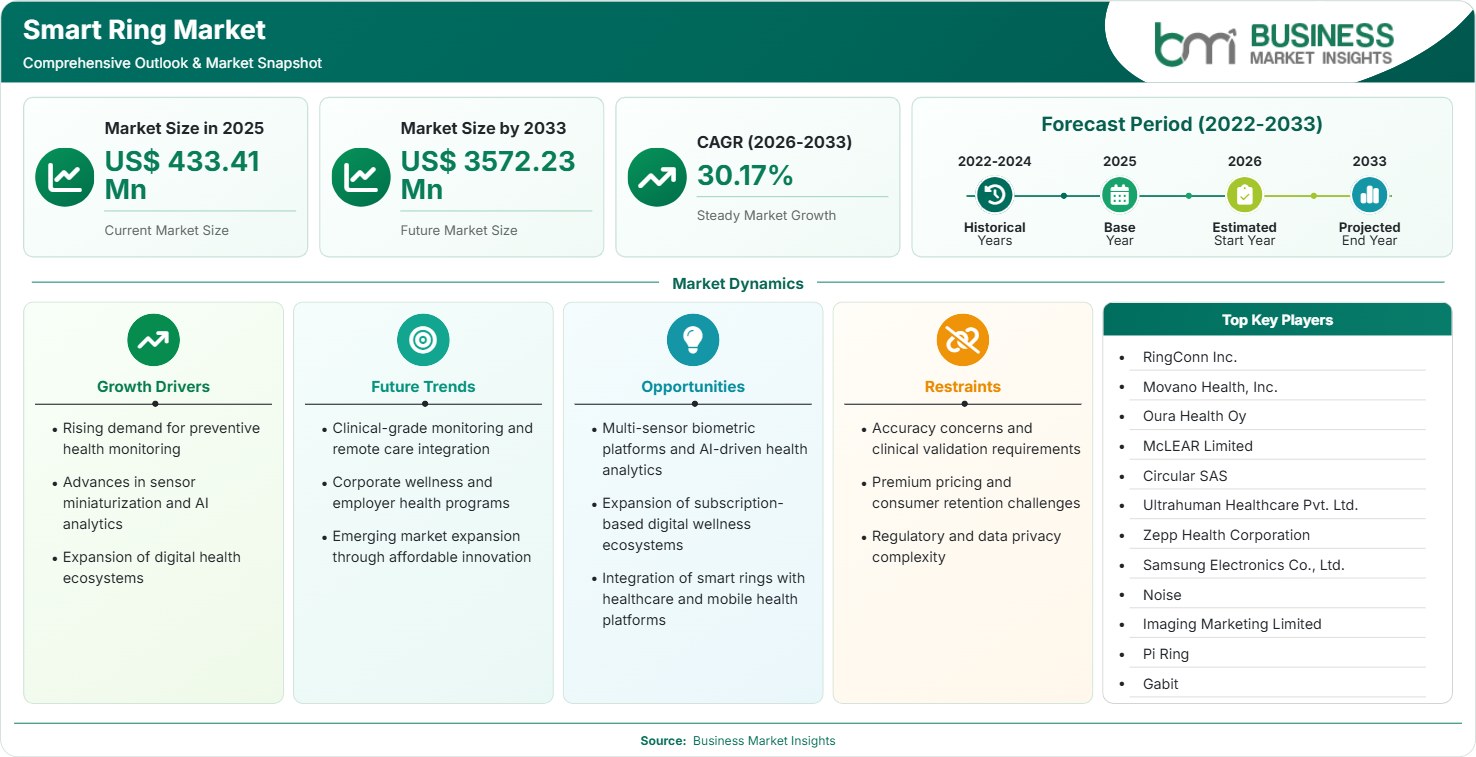
The Smart Ring Market size was valued at US$ 433.41 Million in 2025 and is projected to reach US$ 3572.23 Million by 2033, growing at a CAGR of 30.17% during 2026–2033, driven by wearable health monitoring adoption, AI-enabled biometrics, preventive healthcare demand, digital wellness ecosystems, enterprise health programs, and expanding clinical-grade sensor innovation opportunities.

Report Coverage
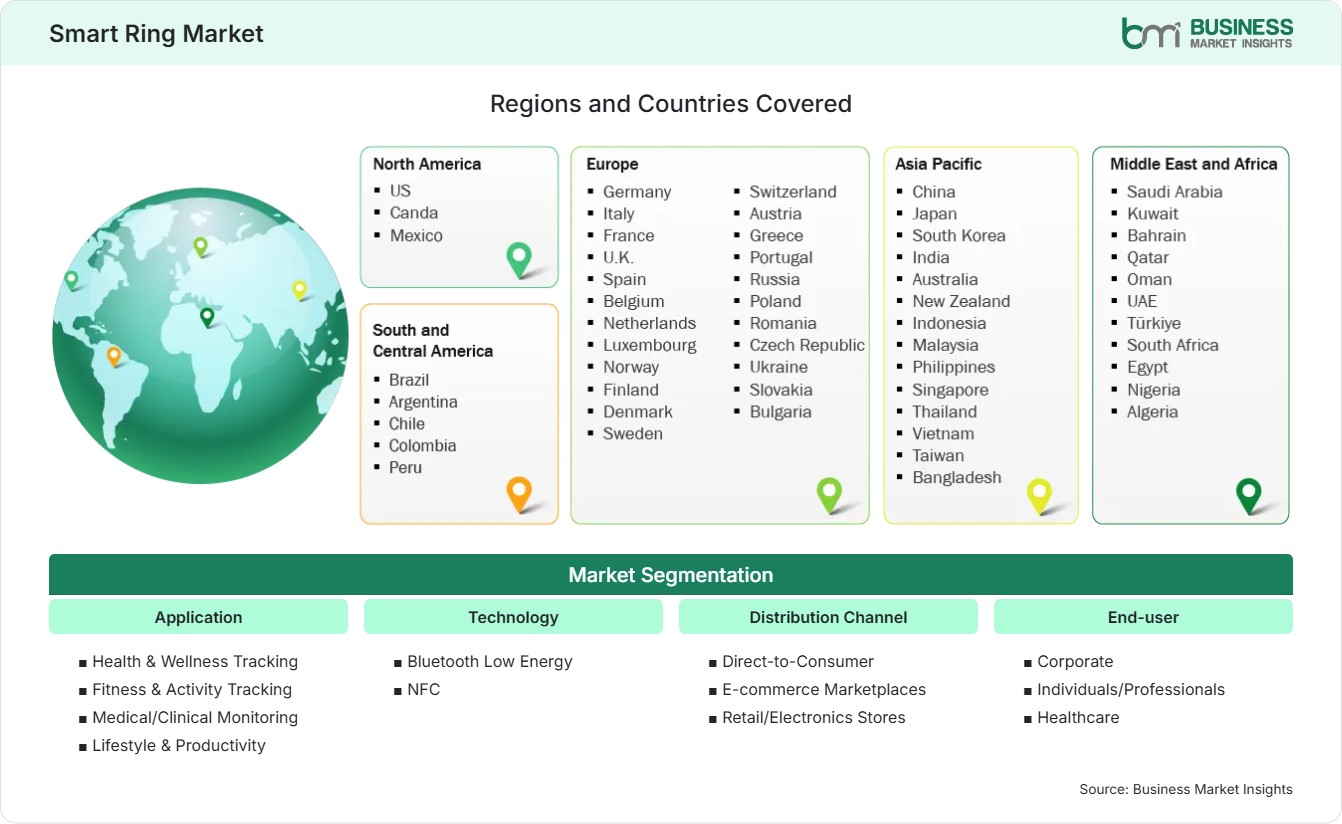
  • Application: Health & Wellness Tracking, Fitness & Activity Tracking, Medical/Clinical Monitoring, Lifestyle & Productivity
  • Technology: Bluetooth Low Energy, NFC
  • Distribution Channel: Direct-to-Consumer, E-commerce Marketplaces, Retail/Electronics Stores
  • End-user: Corporate, Individuals/Professionals, Healthcare
US$ 433.41 Mn Market size in 2025
US$ 3572.23 Mn Market Size by 2033
30.17% CAGR, 2026 - 2033
2026-2033 Forecast Period

AI Overview

Smart Ring Market Summary

  • North America Region: North America holds a market share of 37%–40% in 2025, growing at a CAGR of 27%–29% during 2026–2033. Growth is supported by digital health adoption, subscription wellness ecosystems, insurer engagement, advanced consumer electronics penetration, biometric monitoring demand, corporate wellness investments, connected healthcare expansion, AI-enabled analytics adoption, premium wearable spending, and clinical validation initiatives. The U.S. market benefits from strong wearable adoption and healthcare technology investment, expanding at approximately 28%–30%.
  • Fastest Growing Region: Asia Pacific accounts for a 24%–27% share in 2025 and is projected to expand at a CAGR of 33%–35% during 2026–2033. Growth is fueled by rising health awareness, expanding e-commerce channels, domestic innovation, increasing disposable income, preventive healthcare demand, fitness culture adoption, localized manufacturing capabilities, digital healthcare investments, consumer electronics penetration, and emerging startup ecosystems.
  • Leading Segment: Health & Wellness Tracking represents 40%–43% of revenue share in 2025 and advances at a CAGR of 29%–31%. Growth is supported by sleep monitoring demand, stress management applications, recovery analytics, continuous biometric tracking, wellness subscriptions, personalized health insights, AI recommendations, consumer engagement programs, preventive care adoption, and long-term behavioral health optimization.
  • High Growth Segment: Medical/Clinical Monitoring contributes 18%–21% share in 2025 and expands at a CAGR of 34%–36%. Expansion is driven by remote patient monitoring adoption, chronic disease management, clinical research applications, healthcare digitization, biometric accuracy improvements, physician integration initiatives, telehealth growth, regulatory progress, predictive analytics development, and patient engagement technologies.
  • Key Market Opportunity: Integration of clinical-grade biometrics with healthcare platforms creates opportunities across remote monitoring, digital therapeutics, insurer partnerships, preventive care programs, AI diagnostics support, and subscription-based health management ecosystems globally.
  • Major Market Players: RingConn Inc., Movano Health, Inc., Oura Health Oy, McLEAR Limited, Circular SAS, Ultrahuman Healthcare Pvt. Ltd., Zepp Health Corporation, Samsung Electronics Co., Ltd., Noise, Imaging Marketing Limited, Pi Ring, Gabit, Jackcom Technology Co., Ltd., Nuanic Oy.
Strategic Insights

Smart Ring Market: Strategic Insights

Smart Ring Market Strategic Framework
FREE PDF
Request your free sample
Request free sample
Stakeholder View

Key Takeaways

  • The value chain is increasingly integrating sensor manufacturers, semiconductor suppliers, AI analytics providers, healthcare platforms, and subscription service operators, creating recurring revenue opportunities beyond device sales.
  • Medical monitoring and corporate wellness applications offer the strongest upside due to increasing healthcare digitization, preventive care investments, and employer-led health engagement initiatives.
  • Product innovation is shifting toward multi-sensor biometric platforms capable of measuring sleep quality, stress indicators, heart-rate variability, temperature trends, and recovery metrics.
  • Asia Pacific presents a compelling investment case because of expanding digital health awareness, domestic manufacturing capabilities, rapidly growing online retail channels, and favorable consumer demographics.
  • Venture funding, strategic partnerships, and acquisitions are increasingly targeting health analytics, AI-driven wellness platforms, and remote monitoring capabilities to strengthen competitive positioning.
  • Subscription-based health intelligence ecosystems are becoming critical differentiators, improving customer retention and creating higher lifetime value across wearable technology portfolios.
Geographic Outlook

Smart Ring Market Regional Highlights

North America Smart Ring Market

North America maintains leadership with a 37%–40% Smart Ring Market share in 2025 and records a CAGR of 27%–29% through 2033. Strong consumer spending, advanced digital health adoption, widespread wearable penetration, and healthcare technology investments sustain regional demand. Corporate wellness programs, insurer participation, and growing acceptance of biometric monitoring support commercialization. The region benefits from mature distribution networks, subscription wellness ecosystems, and continuous innovation by established wearable technology developers.

  • Strong digital health infrastructure supports integration of biometric data with wellness, fitness, and healthcare platforms.
  • Corporate wellness adoption is expanding demand among employers seeking preventive health engagement tools.
  • Premium wearable spending remains high across technologically engaged consumer segments.
  • Partnerships between healthcare providers and technology companies accelerate innovation and validation efforts.
  • AI-driven analytics capabilities enhance user engagement and long-term subscription retention.

US Smart Ring Market

The United States accounts for about 78% to 82% of regional revenues and has an annual growth rate of 28% to 30%. High consumer awareness, technological advancements in healthcare, venture capital investments, and healthcare digitization continue to fuel adoption. Growth drivers include sleep monitoring, recovery tracking, personalized wellness advice, and acceptance of connected health systems.

  • Healthcare technology startups continue attracting investment for biometric innovation and analytics platforms.
  • Subscription-based wellness services improve monetization and customer retention.
  • Clinical research collaborations support validation of advanced monitoring capabilities.
  • Consumer demand increasingly favors discreet wearable form factors over larger devices.

Europe Smart Ring Market

The Europe region holds 27%-30% of the global market in 2025, growing with a CAGR of 28%-30%. Privacy laws, wellness trends, and developments in health technology promote the adoption of wearables. Finland is leading due to its existing expertise in wearable technology, and Germany continues to show high demand for consumer electronics. One of the fastest-growing regions is France, owing to entrepreneurial activity in health technology and digital wellness.

  • Regulatory emphasis on data privacy strengthens consumer confidence in biometric technologies.
  • Finland remains a leading innovation hub due to established wearable technology companies.
  • Germany benefits from strong healthcare expenditure and technology adoption.
  • France records high growth driven by startup activity and digital health investments.
  • Preventive healthcare trends continue expanding wearable adoption across consumer groups.

Asia Pacific Smart Ring Market

Asia Pacific has a market share of 24%-27% in 2025 and is projected to achieve the highest CAGR of 33%-35%. Rising disposable income, growing fitness knowledge, and the presence of advanced e-commerce platforms fuel the adoption of smart rings. China is the leader in production capacity and consumer electronics in the region, while India is the fastest-growing market, owing to increased health awareness, startup growth, and digital health adoption. Smart Ring Market share gains are increasingly visible across urban consumer segments.

  • China benefits from manufacturing scale, innovation capabilities, and extensive distribution networks.
  • India records the strongest regional expansion supported by digital health awareness and startup ecosystems.
  • Online marketplaces improve accessibility across diverse consumer demographics.
  • Localized product development enhances affordability and market penetration.
  • Health-conscious younger populations accelerate adoption of wearable technologies.

Rest of World Smart Ring Market

Rest of World represents 8%-10% of the revenue base and is growing at a CAGR of 29%-31%. South and Central America benefit from rising awareness of wearables and increased e-commerce availability. In the Middle East and Africa regions, the adoption of premium consumer electronics nd digital healthcare projects helps fuel growth. Brazil is the leader among Latin American countries, while the UAE shows rapid growth.

  • Brazil benefits from rising consumer interest in connected fitness technologies.
  • Gulf countries are investing in digital health and wellness infrastructure.
  • E-commerce expansion improves product availability across developing economies.
  • Premium wearable adoption is increasing among affluent urban consumers.
  • Healthcare modernization initiatives create opportunities for advanced monitoring solutions.
Global Market Geography
FREE PDF
Request your free sample
Request free sample
Segment Analysis

Smart Ring Market Segmentation

Application

Application-driven demand is headed by Health & Wellness Tracking with a 40%–43% market share in 2025 and a 29%–31% CAGR. The Smart Ring Market scope continues to grow in preventive healthcare, fitness optimization, recovery monitoring, and personalized wellness engagement, while Medical/Clinical Monitoring holds the record for the fastest growth.

  • Health & Wellness Tracking: Strong demand for sleep, recovery, stress, and lifestyle monitoring continues supporting consumer adoption and subscription engagement.
  • Fitness & Activity Tracking: Increasing fitness participation drives interest in biometric performance insights and recovery optimization.
  • Medical/Clinical Monitoring: Healthcare providers are evaluating wearable biometrics for remote monitoring and patient engagement initiatives.
  • Lifestyle & Productivity: Users increasingly adopt biometric insights to improve focus, productivity, and daily wellness routines.

Technology

Bluetooth Low Energy is the most widely adopted technology, with a market share of 70%-73% and a CAGR of 29%-31%, due to its ability to work across all mobile platforms and its energy-saving nature. NFC-based technologies are becoming popular due to their contactless capabilities and digital access.

  • Bluetooth Low Energy (BLE): Enables continuous connectivity, efficient battery performance, and broad smartphone compatibility.
  • NFC: Supports secure transactions, access management, and convenient contactless interactions.

Distribution Channel

The Direct-to-Consumer model accounts for 42%-45% of market share and records growth at a 30%-32% CAGR as companies focus on nurturing relationships, subscriptions, and customer engagement through data. E-commerce platforms will continue to expand their global accessibility.

  • Direct-to-Consumer: Facilitates customer engagement, subscription integration, and premium brand positioning.
  • E-commerce Marketplaces: Expand reach across geographies and improve product discoverability.
  • Retail/Electronics Stores: Allow hands-on product evaluation and support premium purchasing decisions.

End-user

Individuals/Professionals account for 55%–58% share and expand at 29%–31% CAGR due to rising wellness awareness and wearable adoption. Healthcare applications represent the fastest-growing end-user category as clinical integration advances.

  • Corporate: Employer wellness initiatives increasingly incorporate biometric engagement tools.
  • Individuals/Professionals: Consumer demand centers on health optimization and lifestyle improvement.
  • Healthcare: Remote monitoring and patient engagement drive institutional adoption.
Market Forces

Smart Ring Market Dynamics

Key Market Drivers

Rising Demand for Preventive Health Monitoring

The increasing importance of sleep quality, stress management, metabolism, and recovery optimization further drives adoption. According to the WHO, a large number of deaths are due to non-communicable diseases. This leads people to actively consider their health parameters. Continuous biometric monitoring provides useful information for making behavioral changes and wellness engagement. The Smart Ring Market Trends indicate that demand for passive health tracking that does not interfere with everyday activities is growing. With the help of sensors, artificial intelligence analysis, and personalized recommendations, product value increases and supports further engagement.

Advances in Sensor Miniaturization and AI Analytics

Advancements in technology continue to improve accuracy, battery life, and other functions. Improvements in semiconductors enable the incorporation of temperature sensors, heart rate variability, sleep, and physical activity monitoring into small form factors. Advanced AI technologies enable the analysis of collected data and the generation of valuable consumer insights. The Smart Ring Market is continually benefiting from advances in sensor performance and low-power processing. Major efforts are underway by companies to develop advanced algorithms and machine learning capabilities to outperform competitors.

Expansion of Digital Health Ecosystems

The trends of healthcare digitalization, telemedicine, and integration with wellness platforms are creating greater market opportunities. The connected ecosystem enables data synchronization across mobile apps, healthcare providers, and wellness solutions. Patient monitoring programs are driving the need to collect continuous data on biometric parameters. Wearable devices are being investigated by employers, insurance companies, and healthcare providers to develop prevention and engagement programs. Integration into the broader ecosystem of digital healthcare solutions adds value beyond consumer health and fitness applications.

Key Market Opportunities

Clinical-Grade Monitoring and Remote Care Integration

Healthcare professionals are increasingly looking to scalable remote patient monitoring technology to improve patient engagement and lower the cost of care. Improvements in sensor accuracy and validation algorithms are enabling their incorporation into chronic disease management programs, clinical trials, and telemedicine ecosystems. Smart Ring Market Forecasts indicate increased demand for wearable devices, which will support healthcare processes. Firms that invest in regulatory validation, clinical relationships, and interoperability with the healthcare industry will be able to tap into valuable institution-level opportunities.

Corporate Wellness and Employer Health Programs

Employee well-being, productivity, and preventive health care remain top priorities for organizations. The use of wearable technology offers insight into engagement and recovery efforts related to employee well-being. When combined with incentive-based wellness programs, there are possibilities of subscription and enterprise business models. Organizations are seeking data-driven products that can help manage stress, improve sleep, and increase health awareness. Due to rising healthcare costs, organizations are exploring preventive healthcare solutions to improve employee performance. Vendors offering secure data management, scalable deployment capabilities, and actionable analytics can capitalize on growing enterprise demand.

Emerging Market Expansion Through Affordable Innovation

Increasing smartphone usage and health consciousness create numerous opportunities in developing countries. Localization of production, regional partnerships, and direct sales increase accessibility and reduce prices. Firms may target larger groups of people using differentiated pricing and local health apps. The development of e-commerce platforms would also aid market expansion. Involvement in developing regional supply chains and educating consumers can speed up the process. Producers that can combine affordability with functionality are likely to capitalize on rising demand in Asia, Latin America, and certain Middle Eastern regions.

Market Restraints and Challenges

Accuracy Concerns and Clinical Validation Requirements

Factor: Consumers and healthcare stakeholders increasingly demand reliable biometric accuracy and validated health insights.

Impact: Products lacking strong validation may face adoption barriers, reduced trust, and limited healthcare integration. Variations in measurement conditions, user behavior, and sensor placement can influence data quality. Regulatory scrutiny is increasing as devices move closer to healthcare applications. Companies must invest significantly in testing, algorithm refinement, and validation studies to support credibility. These requirements increase development timelines and costs while creating challenges for smaller participants competing against established technology providers.

Premium Pricing and Consumer Retention Challenges

Factor: Many advanced devices remain positioned within premium price categories and often depend on subscription-based ecosystems.

Impact: High ownership costs can limit adoption among price-sensitive consumers and increase churn risk. Competitive wearable alternatives including smartwatches and fitness bands create pricing pressure. Manufacturers must balance innovation investments with affordability while maintaining profitability. Subscription fatigue among consumers may also affect long-term engagement. Sustained differentiation through superior analytics, ecosystem integration, and user experience remains essential to maintaining retention and supporting scalable growth.

Company Analysis

Competitive Landscape

Smart Ring Market analysis indicates competition is centered on biometric innovation, AI-driven wellness platforms, ecosystem integration, and clinical monitoring capabilities.

Company Name

Overview

Products and Services relevant to this market

RingConn Inc.

Wearable technology company focused on advanced biometric monitoring and long battery-life smart rings.

Health tracking rings, sleep monitoring, wellness analytics, mobile applications.

Movano Health, Inc.

Digital health company developing wearable technologies emphasizing health data accessibility.

Health-focused rings, biometric monitoring, healthcare analytics platforms.

Oura Health Oy

Leading wearable wellness technology provider with global consumer presence.

Smart rings, sleep tracking, readiness scores, wellness subscriptions.

McLEAR Limited

Technology company specializing in connected wearable solutions and digital transactions.

NFC-enabled rings, payment solutions, wearable connectivity services.

Circular SAS

European wearable innovator focused on personalized health intelligence.

Smart rings, AI insights, wellness monitoring applications.

Ultrahuman Healthcare Pvt. Ltd.

Health optimization company integrating wearable biometrics and metabolic insights.

Smart rings, health analytics, wellness ecosystem services.

Zepp Health Corporation

Global connected device company with extensive wearable technology expertise.

Biometric wearables, health monitoring platforms, connected applications.

Samsung Electronics Co., Ltd.

Major consumer electronics manufacturer expanding wearable technology offerings.

Smart rings, connected ecosystem integration, health monitoring solutions.

Noise

Indian wearable electronics brand with strong consumer reach.

Smart rings, wellness tracking, connected lifestyle products.

Imaging Marketing Limited

Consumer technology distributor and wearable solutions participant.

Smart ring distribution, technology retail and support services.

Pi Ring

India-based wearable technology participant targeting health-conscious consumers.

Smart rings, biometric monitoring, wellness applications.

Gabit

Digital wellness company integrating wearable data with health management.

Smart rings, health coaching, analytics services.

Jackcom Technology Co., Ltd.

Technology company offering multifunctional connected ring solutions.

NFC rings, access control, wearable connectivity products.

Nuanic Oy

Nordic technology company focused on wearable innovation.

Smart wearable solutions, biometric monitoring technologies.

Trust & Transparency

Research Methodology

The market analysis combines proprietary research with secondary data from government agencies, company disclosures, regulatory filings, industry databases and expert interviews. Market estimates are validated through data triangulation, cross-market benchmarking and analyst review.

View Full Research Methodology

Questions Answered

Frequently Asked Questions

Why are subscription ecosystems becoming important?

Subscription services generate recurring revenue while providing personalized analytics, wellness insights, coaching features, and long-term customer engagement capabilities.

What does a Smart Ring Market Report typically evaluate?

A Market Report generally examines market size, technology trends, competitive dynamics, regulatory developments, regional opportunities, and future demand outlook.

Which application area offers the highest future potential?

Medical and clinical monitoring presents strong long-term potential due to remote patient monitoring, telehealth integration, and increasing healthcare digitization initiatives.

How are smart rings different from smartwatches?

Smart rings provide continuous biometric monitoring in a compact form factor, offering greater comfort, longer wearability, and less visual intrusion during daily activities.

What factors are accelerating adoption of smart rings?

Consumer demand for discreet wearables, preventive healthcare awareness, AI-enabled biometric insights, and expanding digital health ecosystems are the primary growth catalysts.

Access the Full Smart Ring Market Report

Get segment-level forecasts, regional estimates, competitive benchmarking, company profiles and downloadable Excel datasets.

Access the full Smart Ring Market Report
350 pages PDF & Excel | 2026-08-31