
Smart Space Market Outlook: Size, Share, Trends, Growth Analysis, Competitive Landscape & Forecast, 2026–2033

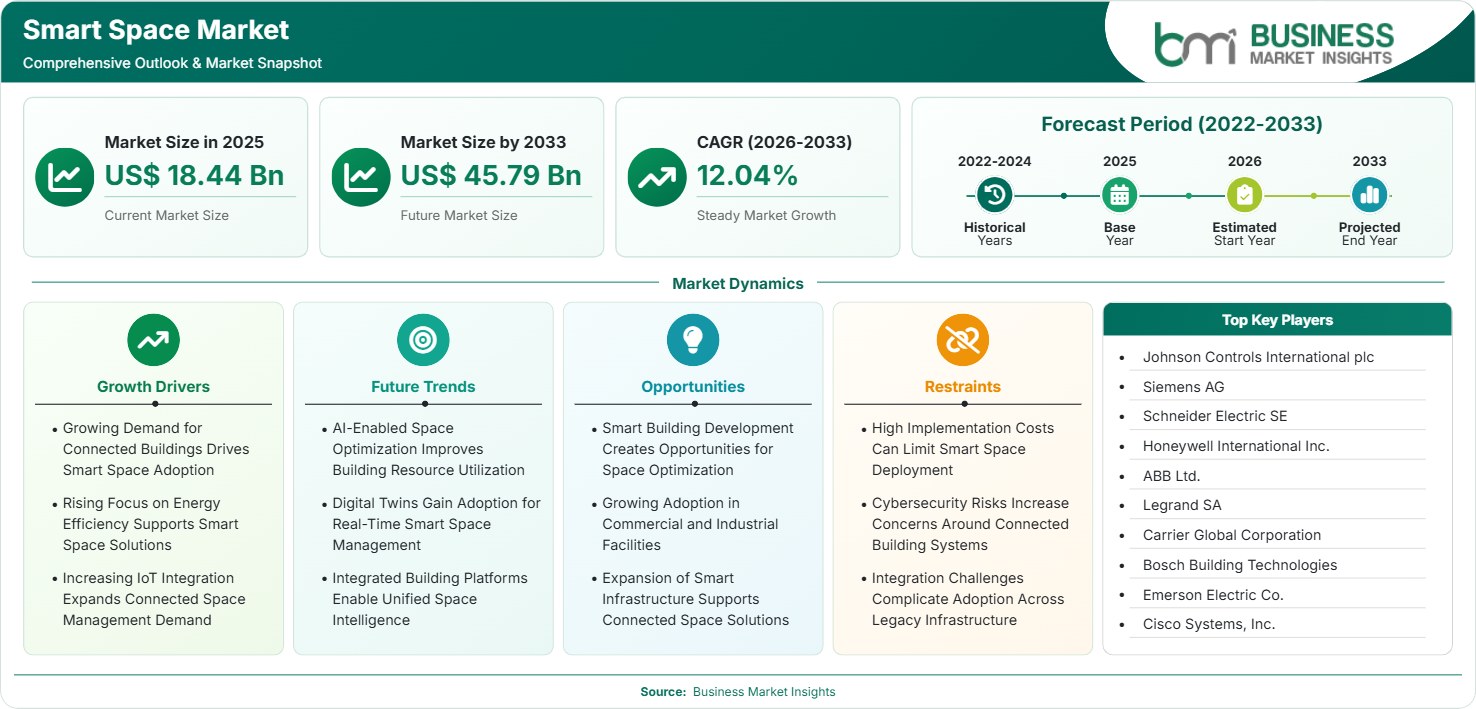
The Smart Space Market size was valued at US$ 18.44 Billion in 2025 and is projected to reach US$ 45.79 Billion by 2033, growing at a CAGR of 12.04% during 2026–2033, driven by connected buildings, energy optimization, security automation, and expanding IoT adoption.

Report Coverage
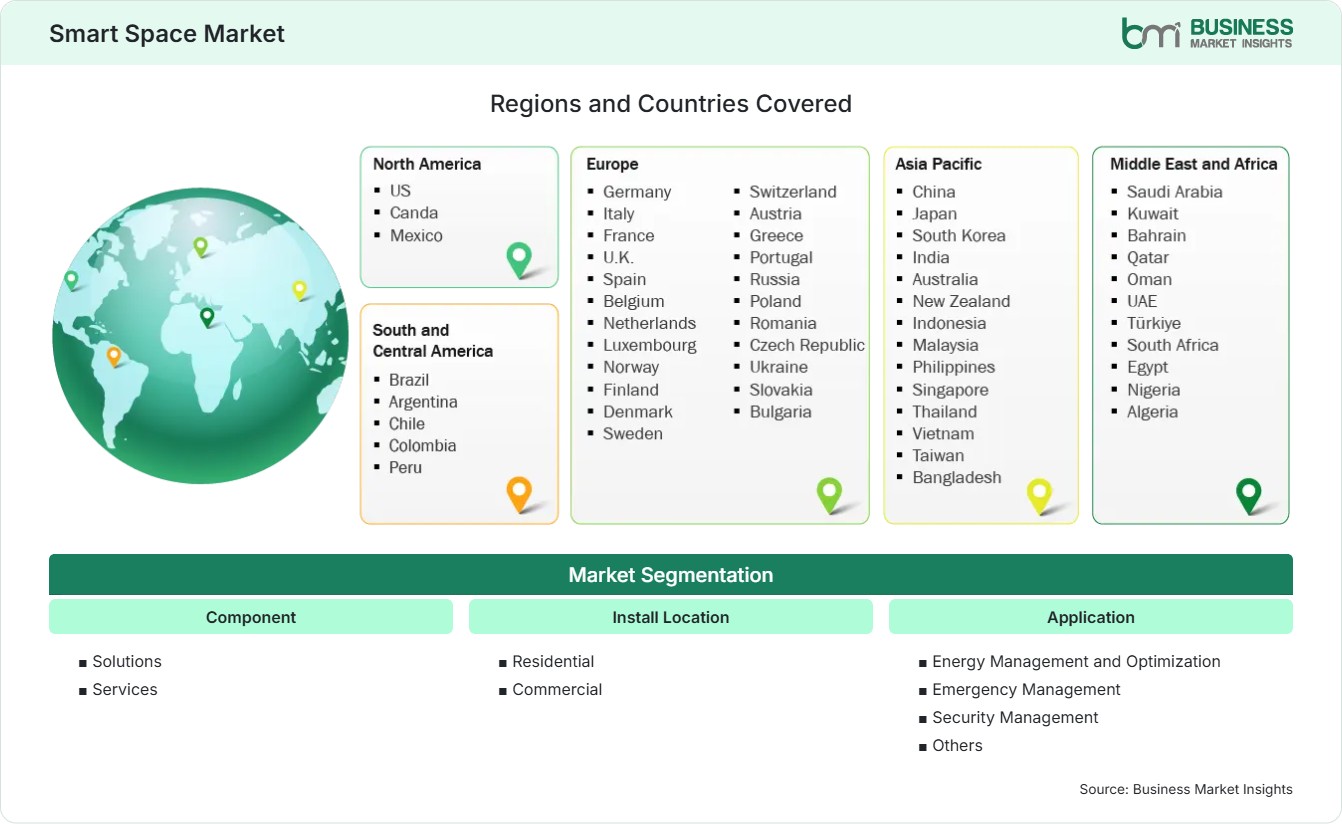
  • Component: Solutions, Services
  • Install Location: Residential, Commercial
  • Application: Energy Management and Optimization, Emergency Management, Security Management, Others
US$ 18.44 Bn Market size in 2025
US$ 45.79 Bn Market Size by 2033
12.04% CAGR, 2026 - 2033
2026-2033 Forecast Period

AI Overview

Smart Space Market Summary

  • North America Region: North America holds a 27%–30% share in 2025, growing at a CAGR of 10.5%–11.5%, supported by building automation upgrades, energy efficiency mandates, and demand for integrated security and facility management. The U.S. represents 75%–80% of North American demand, with a 10.8%–11.8% CAGR through 2033, supported by commercial retrofits, and energy management requirements.
  • Fastest Growing Region: Asia Pacific holds a 35%–39% share in 2025 and records the fastest CAGR of 13.0%–14.2%, driven by urbanization, smart-city investment, commercial construction, digital infrastructure expansion, energy efficiency programs, and growing adoption of connected building management platforms.
  • Leading Segment: Solutions holds a 60%–64% share in 2025 and is projected to grow at a CAGR of 11.5%–12.5%, supported by integrated energy management, security platforms, automation controls, analytics, connected devices, and demand for centralized building operations.
  • High Growth Segment: Emergency Management holds an 18%–22% share in 2025 and is projected to grow at a CAGR of 13.5%–14.5%, supported by connected alarms, real-time monitoring, automated response, safety compliance, integrated communication, and resilient building infrastructure.
  • Key Market Opportunity: Smart Space Market expansion will center on integrated platforms connecting energy, security, occupancy, and automation systems, creating recurring software and service revenue across commercial and residential properties.
  • Major Market Players: Johnson Controls International plc, Siemens AG, Schneider Electric SE, Honeywell International Inc., ABB Ltd., Legrand SA, Carrier Global Corporation, Bosch Building Technologies, Emerson Electric Co., Cisco Systems, Inc.
Strategic Insights

Smart Space Market: Strategic Insights

Smart Space Market Strategic Framework
FREE PDF
Request your free sample
Request free sample
Stakeholder View

Key Takeaways

  • The competitive structure is moving toward integrated ecosystems in which building controls, connectivity, analytics, security, and energy systems operate through interoperable platforms.
  • Commercial facilities provide the strongest near-term demand base because energy costs, occupancy management, security requirements, and asset utilization directly influence operating expenses.
  • Technology development is shifting toward cloud-connected controls, edge processing, artificial intelligence, predictive analytics, and open communication standards.
  • Asia Pacific presents the strongest regional expansion opportunity, supported by urban development, commercial construction, smart-city programs, and increasing digital infrastructure investment.
  • Partnerships, technology acquisitions, and ecosystem development are likely to remain important as suppliers seek broader software capabilities and recurring service revenues.
  • Suppliers that provide secure architectures, simplified deployment, and lifecycle support can reduce implementation barriers and strengthen long-term customer retention.
Geographic Outlook

Smart Space Market Regional Highlights

North America Smart Space Market

North America accounts for 27%–30% of global demand in 2025 and is projected to expand at a CAGR of 10.5%–11.5% through 2033. The region benefits from mature building automation infrastructure, commercial retrofit activity, and stronger demand for energy optimization. The Smart Space Market share remains supported by technology investment, sustainability targets, and demand for centralized building operations.

  • Commercial building modernization is supporting connected controls, occupancy monitoring, security automation, and energy management across established building portfolios.
  • Demand is shifting toward integrated platforms capable of connecting legacy equipment with newer cloud, IoT, and analytics systems.
  • Energy efficiency remains a major purchasing consideration as property owners seek lower operating costs and stronger building performance.
  • Cybersecurity requirements are encouraging investment in secure connectivity, access controls, data governance, and managed building technology services.

US Smart Space Market

The U.S. represents 75%–80% of North American demand in 2025 and is projected to grow at a CAGR of 10.8%–11.8% through 2033. Commercial offices, healthcare facilities, campuses, and industrial properties remain important deployment areas. The Smart Space Market is supported by retrofit requirements, digital building investments, energy management priorities, and connected security adoption.

  • Building owners are increasingly evaluating integrated platforms that improve energy visibility, asset performance, occupancy management, and facility-level decision-making.
  • Demand for connected HVAC, lighting, access, and security systems is encouraging replacement of fragmented building controls with centralized management architectures.
  • Cloud-connected monitoring and analytics are expanding service opportunities by allowing facility teams to manage multiple sites through common digital environments.

Europe Smart Space Market

Europe holds a 23%–26% share in 2025 and is projected to expand at a CAGR of 10.0%–11.0% through 2033. Germany, the United Kingdom, France, and Italy represent leading markets, while Spain and the Netherlands offer comparatively strong growth prospects. The Smart Space Market growth is supported by energy performance requirements, building renovation, electrification, and digitalization priorities.

  • Germany remains a leading market because industrial facilities, commercial buildings, and public infrastructure require stronger energy monitoring and automation capabilities.
  • The United Kingdom continues to develop demand for connected building controls as property owners focus on energy efficiency, operational visibility, and building performance.
  • France and Italy are supported by renovation activity and increasing integration of digital energy management within commercial and public properties.
  • Spain and the Netherlands provide high-growth opportunities through smart-city development, efficient building infrastructure, and expanding connected facility technologies.

Asia Pacific Smart Space Market

Asia Pacific accounts for 35%–39% of global demand in 2025 and is forecast to grow at a CAGR of 13.0%–14.2%. China, Japan, South Korea, and Australia are leading markets, while India and Southeast Asia offer higher expansion potential. Rapid urbanization, commercial construction, smart-city programs, and digital infrastructure investment are strengthening regional adoption.

  • China remains a major deployment market as commercial construction, industrial digitalization, and smart-city programs increase demand for connected building infrastructure.
  • Japan and South Korea benefit from advanced automation capabilities, mature technology ecosystems, and demand for efficient building management in developed urban areas.
  • India offers high-growth potential through urban infrastructure development, commercial construction, energy management programs, and increasing investment in connected facilities.
  • Southeast Asian markets are developing demand as commercial buildings, industrial sites, and urban infrastructure increasingly incorporate connected monitoring and automation.

Rest of World Smart Space Market

Rest of World accounts for 10%–14% of global demand in 2025 and is projected to grow at a CAGR of 9.0%–10.5% through 2033. South America is supported by commercial modernization and infrastructure investment, while Brazil represents the leading regional market with expanding digital building adoption. Middle Eastern markets are increasingly focused on efficient buildings, integrated security, and digitally managed infrastructure.

  • Brazil and Mexico provide comparatively strong opportunities in South and Central America as commercial facilities modernize controls and energy management systems.
  • Gulf markets are supporting demand through large-scale urban development, commercial construction, and requirements for efficient building operation under demanding climatic conditions.
  • Saudi Arabia and the United Arab Emirates remain leading Middle Eastern markets, supported by infrastructure development and increasing digitalization of large facilities.
  • South Africa provides a developing opportunity as commercial and institutional facilities seek improved energy monitoring, security management, and operational control.
Global Market Geography
FREE PDF
Request your free sample
Request free sample
Segment Analysis

Smart Space Market Segmentation

Component

Solutions represent 60%–64% of the market in 2025 and are projected to grow at a CAGR of 11.5%–12.5% through 2033. Demand is supported by integrated energy, security, automation, and monitoring capabilities. Services are gaining importance as customers require installation, system integration, maintenance, analytics, and continuous optimization.

  • Solutions: Integrated platforms combine connected devices, automation controls, analytics, energy management, and security functions, helping building owners consolidate fragmented systems and improve operational visibility.
  • Services: Installation, consulting, integration, maintenance, monitoring, and optimization services support deployment while reducing technical complexity and extending system performance throughout the building lifecycle.

Install Location

Commercial installations account for 55%–60% of demand in 2025 and are projected to grow at a CAGR of 12.0%–13.0% through 2033. Commercial facilities require stronger energy control, security, occupancy management, and asset monitoring. Residential adoption is also expanding as connected home technologies become easier to install and operate.

  • Residential: Connected energy controls, security systems, and automation devices are gaining adoption as households seek convenience, remote monitoring, and better control over energy consumption.
  • Commercial: Offices, retail properties, hospitality facilities, healthcare sites, and industrial buildings increasingly require integrated systems to manage energy, security, occupancy, and facility operations.

Application

Energy Management and Optimization represents 32%–36% of demand in 2025 and is projected to grow at a CAGR of 12.0%–13.0%. Energy costs, electrification, sustainability targets, and operational efficiency are strengthening adoption across building portfolios. Security Management and Emergency Management also support demand where real-time monitoring and automated response are operational priorities.

  • Energy Management and Optimization: Connected meters, sensors, controls, and analytics help operators monitor consumption, identify inefficiencies, coordinate equipment, and improve building energy performance.
  • Emergency Management: Integrated alarms, sensors, communication systems, and automated controls improve response coordination and support safer building operations during critical events.
  • Security Management: Access control, surveillance integration, intrusion detection, and centralized monitoring strengthen protection while allowing security information to be managed alongside other building functions.
Market Forces

Smart Space Market Dynamics

Key Market Drivers

Growing Demand for Connected Buildings Drives Smart Space Adoption

Connected buildings are becoming a core requirement as owners seek centralized visibility across energy, security, occupancy, and equipment systems. IoT-enabled sensors provide continuous operating information, while cloud platforms allow facility teams to monitor multiple assets remotely. This shift supports growth by creating demand for integrated software, controls, connectivity, and services rather than isolated devices. The direction of Smart Space Market trends also reflects stronger interoperability requirements, particularly where existing building systems must be connected to newer digital infrastructure.

Rising Focus on Energy Efficiency Supports Smart Space Solutions

Energy efficiency is increasingly influencing building technology investment because electricity, heating, cooling, and lighting represent major operating expenses. Smart controls allow building operators to coordinate equipment according to occupancy, operating conditions, and energy requirements. The broader Smart Space Market is benefiting as building owners seek measurable operating improvements rather than standalone technology upgrades. Regulatory pressure and corporate sustainability targets further strengthen investment in connected energy management across new developments and existing facilities.

Increasing IoT Integration Expands Connected Space Management Demand

IoT integration is broadening the number of building functions that can be monitored and controlled through connected platforms. Sensors, gateways, controllers, and software can provide information on occupancy, temperature, equipment condition, security, and energy use. The resulting architecture also encourages recurring service models covering monitoring, analytics, maintenance, and optimization. Smart Space Market trends increasingly favor platforms capable of handling large device networks while maintaining cybersecurity and interoperability.

Key Market Opportunities

Smart Building Development Creates Opportunities for Space Optimization

Space optimization provides a strong commercial opportunity because building owners increasingly need better utilization of existing floor areas. Occupancy information, environmental sensors, and connected access systems can reveal usage patterns and support adjustments to lighting, heating, cooling, and facility services. The opportunity also extends to portfolio management, where centralized platforms can compare building performance and identify underused areas or inefficient systems. Smart Space Market Forecasts are therefore increasingly linked with technologies that combine occupancy intelligence and facility management.

Growing Adoption in Commercial and Industrial Facilities

Commercial and industrial properties provide a broad expansion opportunity because many facilities operate complex equipment, security systems, energy assets, and occupancy environments. Connecting these functions can reduce fragmented management and provide better visibility across sites. Industrial facilities also require reliable monitoring of critical equipment and environmental conditions, creating demand for integrated automation and analytics. Commercial properties have additional requirements around occupant comfort, access management, energy efficiency, and facility services.

Expansion of Smart Infrastructure Supports Connected Space Solutions

Smart infrastructure investment is creating opportunities to connect buildings with wider energy, mobility, communication, and municipal systems. This creates a broader operating environment in which building data can support resource management and infrastructure planning. Demand will increase for platforms that can exchange information across multiple technology layers while maintaining security and clear data ownership. Connected infrastructure also supports more coordinated energy management as buildings become active participants in increasingly digital power systems.

Market Restraints and Challenges

High Implementation Costs Can Limit Smart Space Deployment

Factor: The high cost of implementing the solution is caused by hardware such as sensors, controllers, networking components, software, integration processes, installation, and people resources needed within complex building environments. Impact: It might result in higher initial expenses that can cause delays in project execution, especially for firms with limited technology budgets. Projects involving retrofits might experience increased costs if existing systems need gateways or specific integrations before connecting to new platforms.

Cybersecurity Risks Increase Concerns Around Connected Building Systems

Factor: Increasing numbers of connected devices, remote interfaces, cloud services, and third-party integrations expand the potential attack surface of building infrastructure. Impact: Security concerns can slow procurement decisions and increase spending on authentication, network segmentation, monitoring, software updates, and data protection. Building operators must protect systems that control energy, access, environmental conditions, and critical facility functions.

Company Analysis

Competitive Landscape

The Smart Space Market analysis indicates competition is shifting from individual building products toward integrated technology portfolios combining hardware, software, connectivity, analytics, energy management, and services.

Company Name

Overview

Products and Services relevant to this market

Johnson Controls International plc

Global building technology supplier with strong capabilities in automation, HVAC, energy management, and connected building operations.

Building management systems, OpenBlue digital solutions, HVAC controls, energy optimization, connected equipment, analytics, and facility services.

Siemens AG

Technology provider offering integrated digital infrastructure for building automation, energy efficiency, and connected facility management.

Building X, Desigo building automation, energy management, IoT connectivity, building controls, analytics, and digital services.

Schneider Electric SE

Energy technology company combining electrical infrastructure, automation, digital platforms, and building management capabilities.

EcoStruxure Building, energy management, automation, power monitoring, connected controls, analytics, and building software.

Honeywell International Inc.

Building technology supplier focused on automation, security, energy management, connected operations, and intelligent facility systems.

Honeywell Forge, building management systems, connected building platforms, security, automation, analytics, and energy optimization.

ABB Ltd.

Industrial technology company providing electrification, automation, and digital solutions for connected and efficient buildings.

Building automation, energy management, electrification, controls, connected devices, digital monitoring, and automation software.

Legrand SA

Specialist in electrical and digital building infrastructure serving residential and commercial applications.

Connected electrical systems, building automation, energy management, access systems, digital infrastructure, and connected controls.

Carrier Global Corporation

Building technology company with strong expertise in HVAC, controls, indoor environment management, and connected building solutions.

HVAC controls, building automation, connected equipment, energy management, indoor environmental systems, and digital monitoring.

Bosch Building Technologies

Building technology business focused on security, automation, connectivity, and intelligent facility management.

Video security, access control, intrusion detection, building integration, communication systems, and connected security technologies.

Emerson Electric Co.

Automation and technology provider supporting building operations through controls, monitoring, and energy-related technologies.

Automation controls, measurement technologies, monitoring, software, facility controls, and connected operational solutions.

Cisco Systems, Inc.

Networking and technology company enabling connected building infrastructure through secure communications and IoT connectivity.

Network infrastructure, IoT platforms, cybersecurity, connected devices, data management, and building connectivity solutions.

Trust & Transparency

Research Methodology

The market analysis combines proprietary research with secondary data from government agencies, company disclosures, regulatory filings, industry databases and expert interviews. Market estimates are validated through data triangulation, cross-market benchmarking and analyst review.

View Full Research Methodology

Questions Answered

Frequently Asked Questions

How can smart space systems support portfolio-level management?

Centralized platforms can aggregate operational information from multiple properties, allowing facility teams to compare performance, identify inefficient assets, standardize controls, and prioritize maintenance or modernization activities.

What factors influence smart space technology selection?

Customers typically assess integration capability, cybersecurity, scalability, energy performance, lifecycle cost, installation complexity, software functionality, and availability of technical support before committing to a platform.

How do services influence smart space adoption in Smart Space Market report?

Integration, monitoring, maintenance, analytics, and optimization services reduce technical burdens for building owners and create recurring revenue opportunities for technology providers while supporting long-term system performance.

Why is interoperability important for smart space projects?

Interoperability allows equipment and software from different technology layers to exchange information, reducing dependence on isolated systems and helping property owners expand connected capabilities without replacing all existing infrastructure.

Which technology architecture is most suitable for smart space deployments?

An interoperable architecture combining connected sensors, edge controls, cloud software, analytics, and secure networking provide flexibility for phased deployment and integration with existing building infrastructure.

Access the Full Smart Space Market Report

Get segment-level forecasts, regional estimates, competitive benchmarking, company profiles and downloadable Excel datasets.

Access the full Smart Space Market Report
350 pages PDF & Excel | 2026-08-19
Similar Research

Related Market Reports