
Generative Design Market Outlook: Size, Share, Trends, Growth Analysis, Competitive Landscape & Forecast, 2026-2033

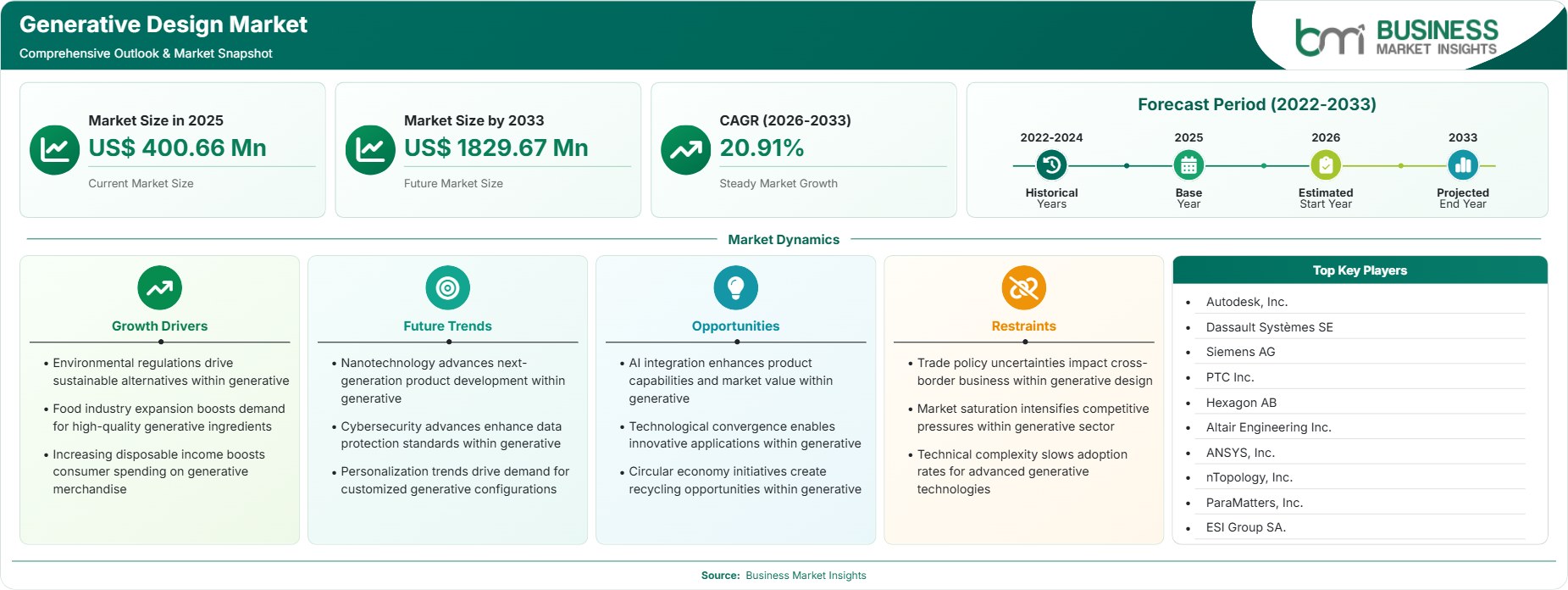
The Generative Design Market size was valued at US$ 400.66 Million in 2025 and is projected to reach US$ 1829.67 Million by 2033, growing at a CAGR of 20.91% during 2026–2033. Key drivers include AI-enabled engineering workflows, additive manufacturing adoption, lightweight product development, and cloud computing expansion, while opportunities arise from digital twins, sustainable design requirements, and industrial automation integration.

Report Coverage
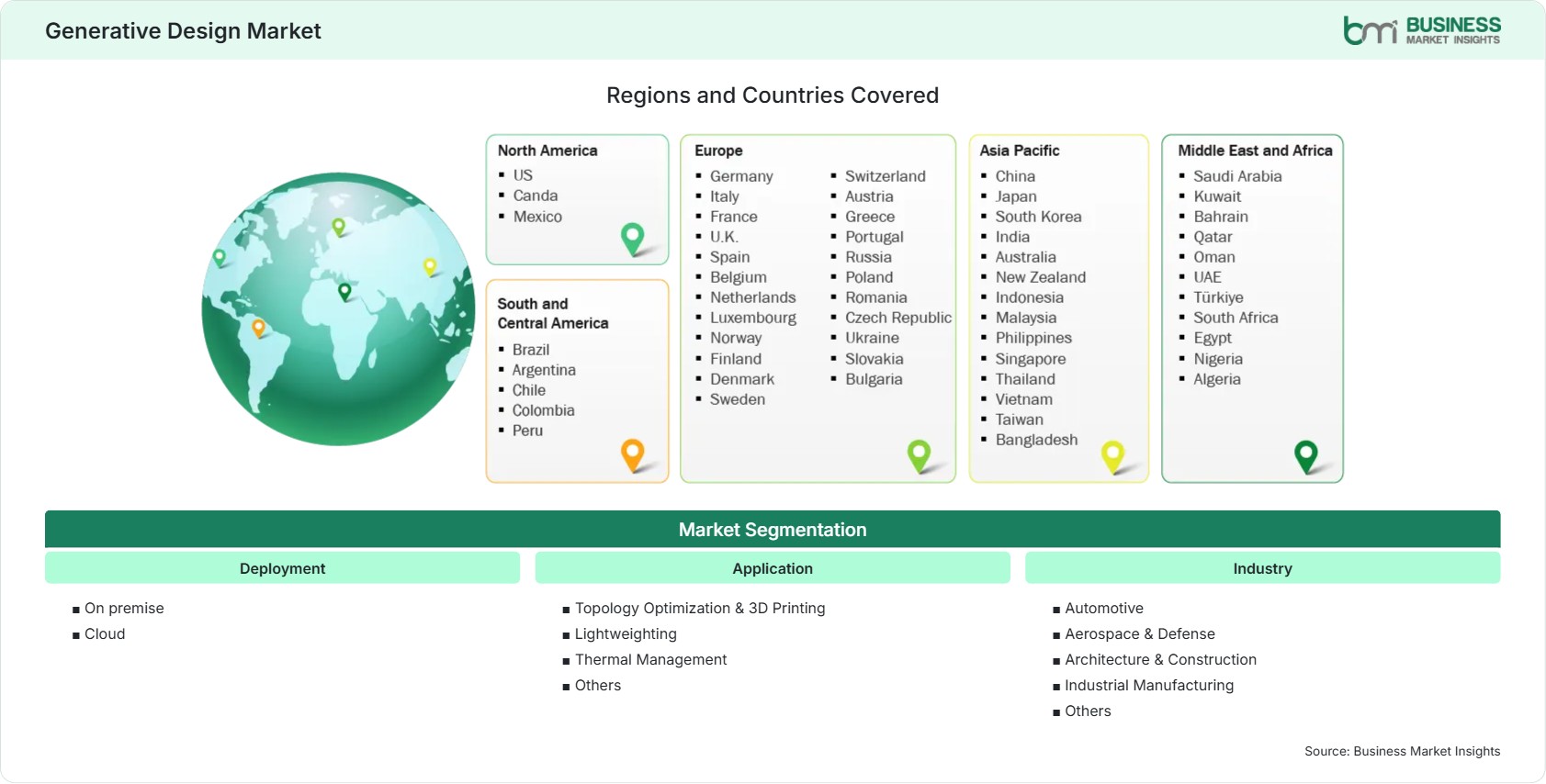
  • Deployment: On premise, Cloud
  • Application: Topology Optimization & 3D Printing, Lightweighting, Thermal Management, Others
  • Industry: Automotive, Aerospace & Defense, Architecture & Construction, Industrial Manufacturing, Others
US$ 400.66 Mn Market size in 2025
US$ 1829.67 Mn Market Size by 2033
20.91% CAGR, 2026 - 2033
2026-2033 Forecast Period

AI Overview

Generative Design Market Summary

  • North America Region: North America holds a market share of 34%–37% in 2025, growing with a CAGR of 19%–21% during 2026–2033. Growth is supported by aerospace innovation, advanced manufacturing investments, additive production deployment, engineering software adoption, digital twins, cloud simulation platforms, design optimization initiatives, research funding, sustainability goals, supply-chain modernization programs. Brief U.S. analysis: The U.S. dominates regional demand through aerospace, automotive, and cloud engineering investments, advancing at approximately 19.5%–21.5% CAGR.
  • Fastest Growing Region: Asia Pacific holds a market share of 26%–29% in 2025, expanding at a CAGR of 23%–25% during 2026–2033. Growth stems from manufacturing digitalization, industrial automation, smart factory deployment, semiconductor investments, additive manufacturing expansion, engineering software adoption, infrastructure development, government modernization initiatives, innovation funding, workforce transformation.
  • Leading Segment: Topology Optimization & 3D Printing accounts for 38%–41% share in 2025 and advances at a CAGR of 21%–23%. Adoption rises through lightweight parts, additive manufacturing integration, material savings, design flexibility, performance enhancement, rapid prototyping, production efficiency, engineering optimization, sustainability requirements, reduced development cycles.
  • High Growth Segment: Cloud deployment represents 54%–57% share in 2025 and records a CAGR of 22%–24%. Expansion is supported by scalable computing, collaborative workflows, lower infrastructure costs, remote engineering access, digital transformation initiatives, AI integration, simulation capacity, accelerated design iterations, enterprise modernization.
  • Key Market Opportunity: Integration of generative design tools with digital twins, simulation software, and AI-driven manufacturing ecosystems creates scalable opportunities for predictive engineering, resource optimization, sustainability improvements, and accelerated product commercialization globally.
  • Major Market Players: Autodesk, Inc.; Dassault Systèmes SE; Siemens AG; PTC Inc.; Hexagon AB; Altair Engineering Inc.; ANSYS, Inc.; nTopology, Inc.; ParaMatters, Inc.; ESI Group SA.
Strategic Insights

Generative Design Market: Strategic Insights

Generative Design Market Strategic Framework
FREE PDF
Request your free sample
Request free sample
Stakeholder View

Key Takeaways

  • The ecosystem increasingly connects CAD, simulation, additive manufacturing, cloud computing, and PLM systems, creating integrated engineering value chains that reduce development time and improve product performance.
  • Strong upside exists in topology optimization and cloud-based deployment environments where computational scalability and collaborative engineering capabilities deliver measurable productivity gains.
  • AI-enhanced generative engines are shifting product development from manual iteration toward automated design exploration, enabling engineers to assess thousands of feasible design alternatives rapidly.
  • Asia-Pacific presents a compelling investment destination due to industrial automation programs, manufacturing expansion, and accelerating adoption of advanced engineering software across China, India, Japan, and Southeast Asia.
  • Technology vendors continue expanding through partnerships, acquisitions, and platform integration strategies to strengthen simulation, digital twin, and additive manufacturing capabilities within unified engineering environments.
  • Sustainability initiatives across transportation, aerospace, and industrial manufacturing sectors are reinforcing demand for optimized materials utilization, weight reduction, and lifecycle efficiency improvements.
Geographic Outlook

Generative Design Market Regional Highlights

North America Generative Design Market

North America accounted for approximately 34%–37% of global revenue in 2025 and is projected to expand at a CAGR of 19%–21% through 2033. Strong adoption across aerospace, automotive, defense, and industrial manufacturing supports regional leadership. The region benefits from established digital engineering infrastructure, significant R&D spending, and early implementation of AI-enabled design platforms. Generative Design Market share remains concentrated among technologically advanced enterprises deploying simulation-driven development methods. Demand also reflects growing sustainability targets, additive manufacturing investments, and increasing integration of optimization software within enterprise engineering environments.

  • Aerospace manufacturers are applying topology optimization tools to reduce aircraft component weight while meeting performance requirements and certification standards, supporting broad engineering software investments across the region.
  • Automotive OEMs increasingly use generative workflows for electric vehicle development, battery enclosure optimization, and lightweight structural components that improve efficiency and manufacturing performance.
  • Cloud-based engineering platforms continue expanding among mid-sized organizations seeking scalable computational resources without major infrastructure expenditures, strengthening accessibility and collaboration.
  • Defense modernization programs support advanced engineering technologies that reduce design cycles, improve system performance, and strengthen domestic manufacturing capabilities.

US Generative Design Market

The United States represents roughly 72%–76% of regional spending and advances at a CAGR of 19.5%–21.5% through 2033. Demand is supported by aerospace innovation centers, automotive engineering programs, and extensive software development ecosystems. The country maintains leadership in cloud infrastructure and industrial digitalization. Generative Design Market growth is reinforced by increasing deployment of digital twins, simulation technologies, and additive manufacturing systems. Investments by large enterprises and technology providers continue driving commercialization of advanced engineering solutions across numerous industrial sectors.

  • Aerospace leaders accelerate adoption of optimization-driven development to improve fuel efficiency, structural performance, and manufacturing flexibility across commercial and defense applications.
  • Industrial manufacturers increasingly integrate AI-enabled design tools with product lifecycle management platforms to streamline development workflows and reduce engineering complexity.
  • Cloud-service availability enables broader usage among smaller engineering organizations that require high-performance computational environments without large capital commitments.
  • Research institutions and innovation hubs contribute to commercialization of advanced computational design methodologies across multiple end-use industries.

Europe Generative Design Market

Europe held approximately 27%–30% of global Generative Design Market revenue in 2025 and is expected to register a CAGR of 20%–22% during the forecast period. Sustainability regulations, advanced automotive production, and industrial digitalization programs support adoption. Germany remains the leading country, while Nordic markets and the United Kingdom demonstrate strong growth trajectories approaching 21%–23%. Engineering-intensive industries increasingly deploy algorithmic optimization to achieve carbon reduction objectives and manufacturing efficiency gains. Regional competitiveness is strengthened by collaborative innovation programs and advanced manufacturing investment initiatives.

  • Germany leads regional adoption through its industrial automation ecosystem, automotive engineering strengths, and widespread deployment of digital manufacturing technologies.
  • The United Kingdom benefits from aerospace innovation programs emphasizing lightweight materials, advanced simulation, and next-generation manufacturing solutions.
  • Sustainability mandates motivate optimization-driven design approaches that reduce waste, energy consumption, and material usage across industrial sectors.
  • Manufacturing modernization initiatives support greater integration between design software, simulation tools, and intelligent production systems.

Asia Pacific Generative Design Market

Asia Pacific accounted for around 26%–29% of revenue in 2025 and is forecast to expand at 23%–25%, making it the fastest-growing regional market. China leads adoption through manufacturing digitalization and industrial modernization initiatives, while India records some of the highest growth rates near 24%–26%. Expanding additive manufacturing infrastructure, rising engineering investments, and smart factory implementation support regional momentum. Technology adoption increasingly extends from large enterprises toward emerging manufacturers seeking competitive differentiation through advanced design and optimization capabilities.

  • China continues investing heavily in intelligent manufacturing, industrial software, and advanced engineering systems supporting digital transformation goals.
  • India benefits from expanding industrial capacity, engineering talent availability, and government-backed manufacturing development initiatives.
  • Japan maintains strong adoption within automotive, robotics, and precision manufacturing sectors focused on performance optimization.
  • Semiconductor and electronics industries increasingly utilize advanced computational design tools for product innovation and performance enhancement.

Rest of World Generative Design Market

The rest of the world represented approximately 8%–11% of the Generative Design Market revenue in 2025 and is projected to grow at 18%–20% through 2033. South and Central America experience adoption through automotive and industrial modernization initiatives, particularly in Brazil and Mexico. The Middle East and Africa benefit from diversification programs emphasizing advanced manufacturing and technology investment. Regional demand remains comparatively smaller but continues expanding as organizations pursue digital engineering capabilities, productivity improvements, and sustainable manufacturing practices.

  • Brazil leads South American adoption through industrial modernization and increasing use of advanced manufacturing technologies.
  • Mexico benefits from automotive production growth and stronger integration with international manufacturing supply chains.
  • Gulf countries support advanced engineering software adoption through diversification initiatives focused on technology and manufacturing.
  • Industrial development programs across selected African economies encourage digitalization, engineering capability expansion, and manufacturing efficiency improvements.
Global Market Geography
FREE PDF
Request your free sample
Request free sample
Segment Analysis

Generative Design Market Segmentation

Deployment

Deployment models shape software accessibility and processing capabilities. This segment accounted for 100% of market demand, with Cloud emerging as the leading deployment model. Cloud held 54%–57% market share in 2025 and records 22%–24% CAGR. The Generative Design Market scope continues expanding as organizations prioritize scalability, remote collaboration, and cost-efficient computational resources for simulation-intensive engineering workflows.

  • On premise: Preferred by organizations requiring strict data governance, regulatory compliance, and internal infrastructure control. Adoption remains strong among defense, aerospace, and security-focused manufacturing environments.
  • Cloud: Gains momentum through scalable computing power, subscription-based economics, collaborative engineering workflows, and integration with AI-enabled simulation environments supporting rapid design exploration.

Application

Application demand reflects increasing reliance on optimization-driven engineering. Topology Optimization & 3D Printing maintained the largest position with 38%–41% market share during 2025 and a CAGR of 21%–23%. References to Generative Design Market trends increasingly focus on automated design generation, additive manufacturing compatibility, and performance-focused engineering outcomes across complex industrial applications.

  • Topology Optimization & 3D Printing: Widely implemented to create lightweight, high-performance parts while reducing material consumption and facilitating additive manufacturing production methods.
  • Lightweighting: Supports transportation, aerospace, and industrial equipment producers seeking enhanced efficiency, lower emissions, and improved structural performance through optimized geometries.
  • Thermal Management: Adoption grows in electronics, automotive, and energy applications where optimized heat dissipation and component performance remain critical design objectives.

Industry

Industry adoption is led by automotive applications, accounting for approximately 30%–33% market share in 2025 and expanding at 21%–23% CAGR. Demand reflects pressure to accelerate innovation, reduce development costs, and improve product performance. Advanced engineering sectors increasingly integrate algorithm-driven design processes into broader digital manufacturing and product lifecycle management strategies.

  • Automotive: Automakers deploy optimization software for electric vehicle structures, battery systems, lightweight components, and accelerated product development workflows.
  • Aerospace & Defense: Extensive use focuses on weight reduction, component consolidation, certification support, and high-performance engineering outcomes across mission-critical applications.
  • Architecture & Construction: Architects employ computational design methods to optimize structural performance, sustainability objectives, and material utilization within complex projects.
  • Industrial Manufacturing: Manufacturers adopt automated design exploration tools to improve operational efficiency, reduce waste, and accelerate engineering innovation across production environments.
Market Forces

Generative Design Market Dynamics

Key Market Drivers

Expansion of Additive Manufacturing Ecosystems

Generative design technologies align naturally with additive manufacturing because optimization algorithms create geometries difficult to produce through conventional methods. Aerospace and automotive firms have started making greater use of 3D printing technologies for their lighter and high-performing parts. As per the aviation and manufacturing programs in the industry, demand for material-efficient structures has been increasing at a rapid pace owing to efforts in lowering the carbon footprints and improving the performance of firms. With the use of additive manufacturing and computational designing, there is a reduction in the need for prototypes and a better scope for customization.

Growing Adoption of AI-Enabled Engineering Platforms

As artificial intelligence continues to automate the process of exploring complex design, it helps the engineer to analyze numerous options at once. It increases efficiency while also uncovering designs that are not possible using traditional design methods. Generative Design Market growth can be attributed to investments made by enterprises on the creation of AI-enabled engineering ecosystems that feature simulation, optimization, and digital twins. Machine learning functionalities have continued to be included by software providers in their product development suites. Enterprises looking for quicker innovation cycles and better engineering efficiency consider algorithm-assisted design to be an important capability.

Industrial Digital Transformation Initiatives

Manufacturers globally continue investing in Industry 4.0 strategies focused on interconnected engineering workflows, intelligent automation, and digital product development. The technologies that make use of generative design tools become vital facilitators in these systems due to the ability to carry out simulations for optimization and virtual validation. The fusion of cloud computing, digital twins, PLM systems, and analytics facilitates the widespread application of such solutions within enterprise systems. Companies aiming at improving efficiency and achieving sustainable operations adopt optimization techniques in engineering, thus ensuring competitiveness and becoming part of the industrial transformation process.

Key Market Opportunities

Digital Twin Integration Across Product Lifecycles

The digital twin solution has considerable business potential because of its continuous optimization capabilities using operational feedback loops. It becomes possible to enhance the performance of a product continuously with the integration of real-time asset data and computational design software. The manufacturers need engineering ecosystems that integrate the process of design, simulation, production, and operation. Generative Design Market Forecasts indicate rising interest in closed-loop engineering frameworks that leverage data-driven decision making. Such vendors which provide seamless interoperability among optimization solutions, simulation tools, and digital twins will be well placed to attract considerable enterprise investments during the forecast period.

Expansion into Mid-Market Manufacturing Enterprises

Historically, large enterprises dominated adoption because high-performance computing requirements created implementation barriers. Cloud delivery systems have decreased costs and eased implementation, thus providing a chance for mid-size manufacturing firms. There is an increase in the demand for advanced engineering services by these firms due to stiff competition from big firms. This has been facilitated by subscription-based licensing, scalable processing system, and user friendly interface. With increasing digitalization of manufacturing across the world, there is an opportunity to serve new markets that have been ignored.

Sustainability-Oriented Product Development

Pressure to reduce emissions, material waste, and lifecycle environmental impacts is transforming engineering priorities. Optimization-based design systems enable corporations to attain sustainable results by optimizing their materials and designing lightweight products. It is also becoming mandatory for companies to adopt energy-efficient product designs in compliance with the regulatory requirements and their environmental policies. Companies that use the state-of-the-art computational design systems are able to optimize resources while sustaining the performance criteria. Sustainable objectives set for various industries offer immense potential for vendors that demonstrate their value proposition through optimization.

Market Restraints and Challenges

High Implementation Complexity and Skills Requirements

Factor: The successful implementation of such designs normally entails a lot of technical knowledge relating to computational engineering and simulation techniques.

Impact: Companies without dedicated skills have a lot of time-consuming implementations, reduced improvements in productivity, and reliance on outside consultants for help. There is also the possibility that integration with CAD, PLM, and manufacturing systems might complicate implementation even more. Companies that are too small in size will not be able to fully use optimization solutions due to lack of proper workforce skills. Interfaces become better, but training is still needed by engineering departments.

Data Security and Intellectual Property Concerns

Factor: The cloud engineering platforms necessitate that companies keep their confidential development details in digitally connected systems.

Impact: Intellectual property security issues, cybersecurity risk factors, and regulatory compliance worries can affect a company's decision to transition to the cloud environment. The aerospace, defense, and other highly regulated industries tend to be particularly careful in their assessment of the outside computing infrastructure. Security certification needs may drive up the cost of implementation and extend procurement timelines. Although providers constantly upgrade their security framework, perceived risks still influence buying decisions.

Company Analysis

Competitive Landscape

The competitive environment reflects ongoing Generative Design Market analysis focused on AI integration, simulation capabilities, cloud deployment, and additive manufacturing compatibility.

Company Name

Overview

Products and Services relevant to this market

Autodesk, Inc.

Leading design software company with strong presence across manufacturing, architecture, and engineering workflows.

Fusion generative design, CAD tools, cloud collaboration platforms, simulation and manufacturing optimization solutions.

Dassault Systèmes SE

Global engineering software provider serving aerospace, automotive, industrial, and life sciences sectors.

CATIA, 3DEXPERIENCE platform, simulation solutions, optimization and digital engineering applications.

Siemens AG

Industrial technology leader integrating design, simulation, automation, and digital twin capabilities.

NX software, Simcenter, Teamcenter, cloud engineering, generative design and optimization tools.

PTC Inc.

Product development technology company focused on connected engineering and lifecycle management.

Creo generative design, PLM solutions, simulation tools, digital engineering software.

Hexagon AB

Industrial technology company delivering measurement, manufacturing, and engineering software solutions.

Design optimization software, simulation platforms, manufacturing intelligence and digital engineering tools.

Altair Engineering Inc.

Computational intelligence specialist with extensive optimization and simulation capabilities.

HyperWorks platform, topology optimization, AI-powered engineering and cloud simulation services.

ANSYS, Inc.

Engineering simulation leader supporting multiphysics validation and performance optimization.

Simulation software, design exploration tools, digital engineering and optimization platforms.

nTopology, Inc.

Advanced computational design vendor focused on additive manufacturing applications.

Engineering design software, lattice structures, optimization workflows and additive manufacturing tools.

ParaMatters, Inc.

Specialized optimization software provider serving manufacturing and engineering applications.

Topology optimization solutions, automated design generation and performance-focused engineering software.

ESI Group SA

Industrial software company focused on simulation-driven product development.

Virtual prototyping, simulation technologies, design validation and engineering optimization platforms.

Trust & Transparency

Research Methodology

The market analysis combines proprietary research with secondary data from government agencies, company disclosures, regulatory filings, industry databases and expert interviews. Market estimates are validated through data triangulation, cross-market benchmarking and analyst review.

View Full Research Methodology

Questions Answered

Frequently Asked Questions

Why is a Generative Design Market Report valuable for stakeholders?

It helps investors, technology providers, manufacturers, and strategic planners understand competitive positioning, technology trends, growth opportunities, adoption patterns, and long-term revenue potential.

What role does artificial intelligence play in optimization workflows?

AI accelerates design exploration, identifies patterns, automates routine engineering tasks, and helps evaluate large volumes of design alternatives more efficiently than conventional methods.

Can small and medium-sized manufacturers benefit from these solutions?

Yes. Cloud deployment models reduce infrastructure requirements and provide scalable access to advanced computational capabilities, making adoption more economically feasible for mid-sized organizations.

What industries are adopting generative design most rapidly?

Automotive, aerospace and defense, industrial manufacturing, construction, and advanced electronics sectors demonstrate the strongest adoption due to requirements for optimization, lightweighting, and accelerated product development.

How does generative design differ from traditional CAD design?

Generative design automatically creates and evaluates numerous design alternatives based on predefined goals and constraints, whereas traditional CAD relies primarily on manual modeling and iterative engineering processes.

Access the Full Generative Design Market Report

Get segment-level forecasts, regional estimates, competitive benchmarking, company profiles and downloadable Excel datasets.

Access the full Generative Design Market Report
350 pages PDF & Excel | 2026-08-31
Similar Research

Related Market Reports