
Generative AI Chatbot Market Outlook: Size, Share, Trends, Growth Analysis, Competitive Landscape & Forecast, 2026-2033

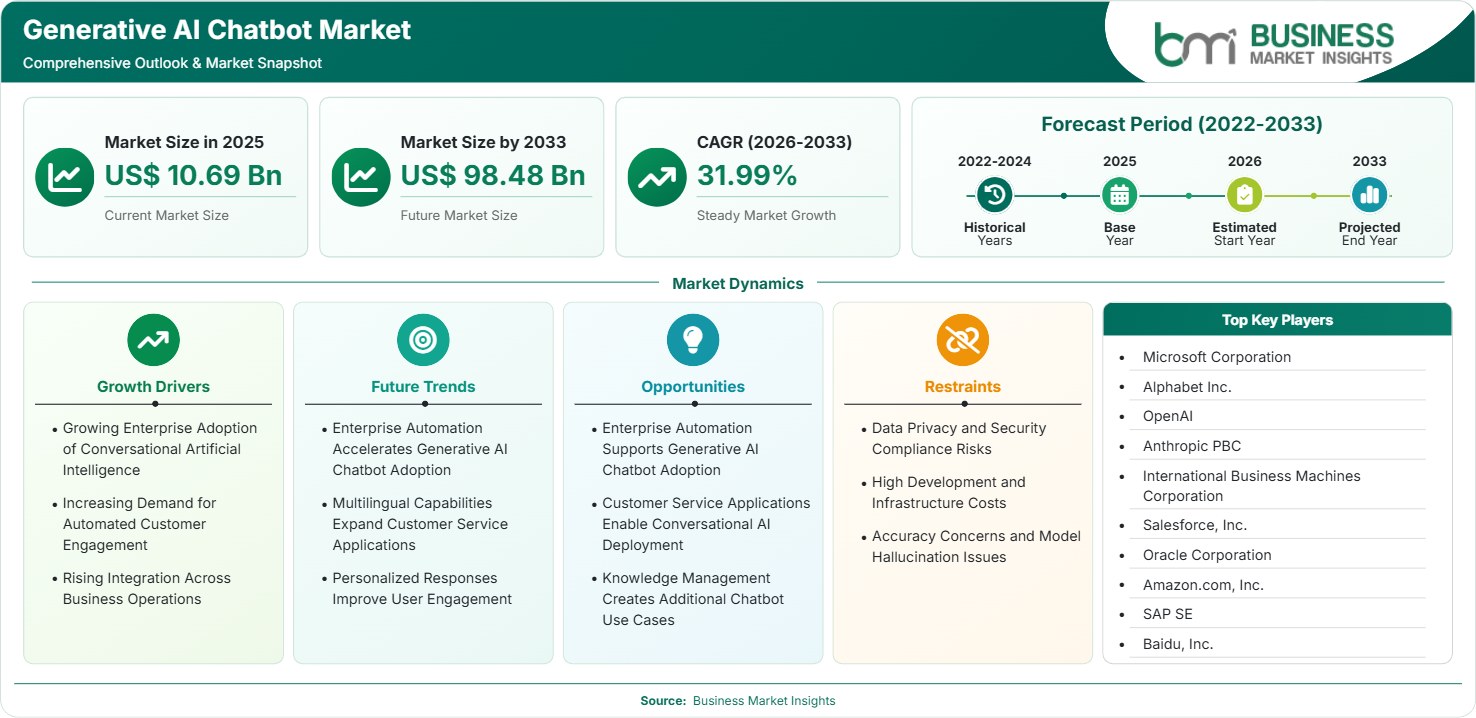
The Generative AI Chatbot Market size was valued at US$ 10.69 Billion in 2025 and is projected to reach US$ 98.48 Billion by 2033, growing at a CAGR of 31.99% during 2026–2033. Rapid enterprise AI adoption, customer experience automation, multilingual conversational interfaces, productivity enhancement, and industry-specific copilots are accelerating deployment opportunities across global organizations.

Report Coverage
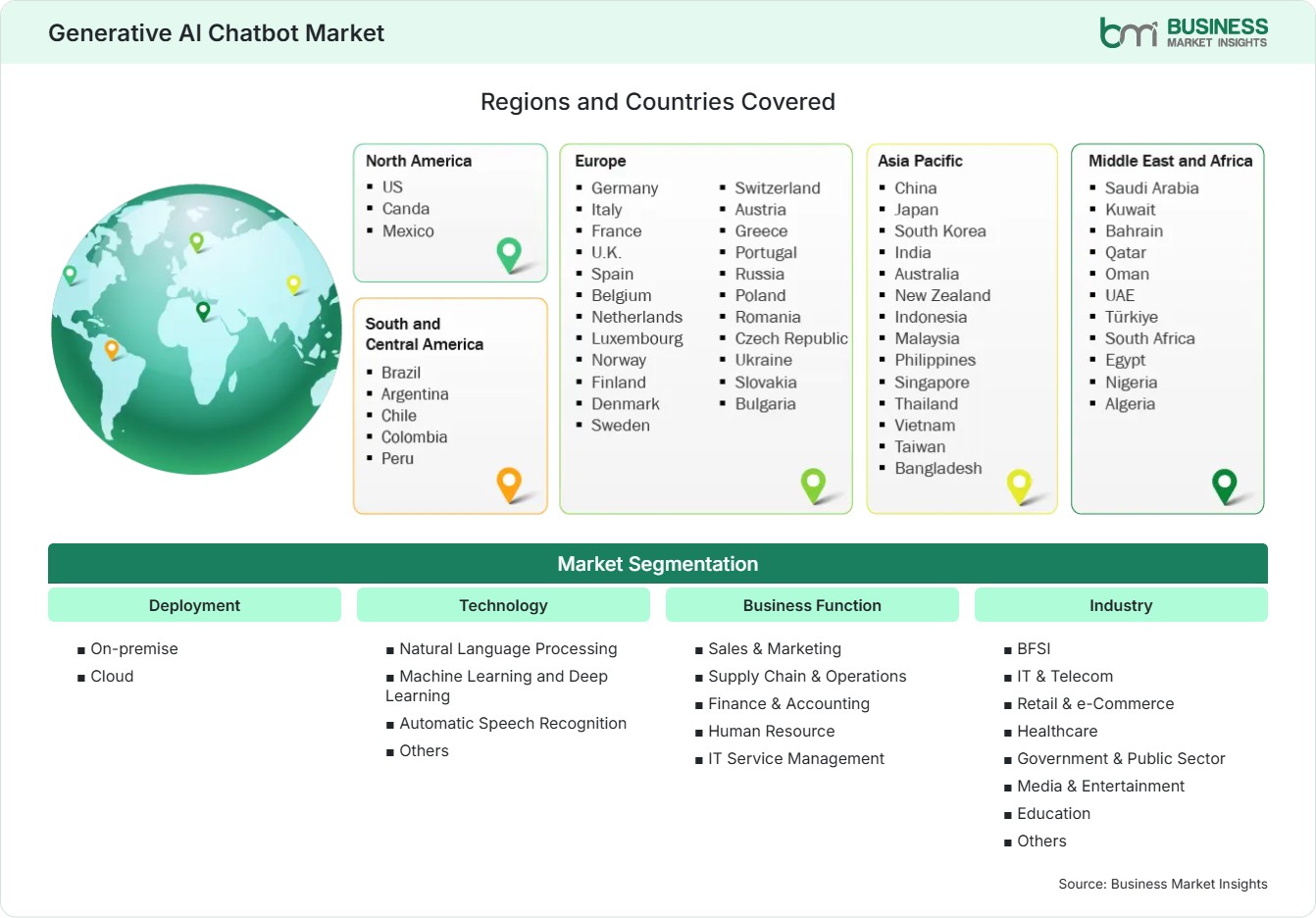
  • Deployment: On-premise, Cloud
  • Technology: Natural Language Processing, Machine Learning and Deep Learning, Automatic Speech Recognition, Others
  • Business Function: Sales & Marketing, Supply Chain & Operations, Finance & Accounting, Human Resource, IT Service Management
  • Industry: BFSI, IT & Telecom, Retail & e-Commerce, Healthcare, Government & Public Sector, Media & Entertainment, Education, Others
US$ 10.69 Bn Market size in 2025
US$ 98.48 Bn Market Size by 2033
31.99% CAGR, 2026 - 2033
2026-2033 Forecast Period

AI Overview

Generative AI Chatbot Market Summary

  • North America Region: North America holds a market share of 36%–39% in 2025, growing at a CAGR of 29%–32% during 2026–2033. Strong cloud infrastructure, enterprise AI spending, hyperscale investments, and advanced digital transformation programs support expansion across industries. The U.S. benefits from widespread enterprise deployment, AI platform innovation, and adoption across customer service and productivity applications, with CAGR of 29%–32%.
  • Fastest Growing Region: Asia Pacific holds a market share of 24%–27% in 2025, growing at a CAGR of 35%–38% during 2026–2033. Rapid digitalization, expanding developer ecosystems, government AI initiatives, language localization demand, and growing cloud adoption create substantial opportunities.
  • Leading Segment: Cloud holds a market share of 68%–72% in 2025, growing at a CAGR of 32%–35% during 2026–2033. Flexible deployment, API accessibility, lower infrastructure costs, rapid scaling, and continuous model updates strengthen enterprise implementation across sectors.
  • High Growth Segment: Healthcare holds a market share of 10%–13% in 2025, growing at a CAGR of 35%–39% during 2026–2033. Rising demand for patient engagement, clinical documentation automation, virtual assistants, and workforce efficiency initiatives supports accelerated adoption.
  • Key Market Opportunity: Industry-specific conversational agents integrated with enterprise data ecosystems are creating new revenue streams through workflow automation, decision support, regulatory compliance assistance, and personalized customer engagement across sectors.
  • Major Market Players: Microsoft Corporation, Alphabet Inc., OpenAI, Anthropic PBC, International Business Machines Corporation, Salesforce, Inc., Oracle Corporation, Amazon.com, Inc., SAP SE, Baidu, Inc.
Strategic Insights

Generative AI Chatbot Market: Strategic Insights

Generative AI Chatbot Market Strategic Framework
FREE PDF
Request your free sample
Request free sample
Stakeholder View

Key Takeaways

  • The value chain increasingly revolves around foundation model providers, cloud infrastructure companies, software vendors, and enterprise integrators, creating a layered ecosystem with strong partnership dependence.
  • Industry-focused deployments in healthcare, BFSI, and government applications offer the highest monetization potential because of workflow complexity and demand for compliant conversational automation.
  • Multimodal AI capabilities combining text, voice, image, and document understanding are becoming central R&D priorities as enterprises seek unified digital assistant platforms.
  • Asia Pacific provides one of the strongest investment cases due to regional language diversity, smart city initiatives, and accelerating enterprise cloud migration programs.
  • Strategic investments and partnerships among AI model developers, cloud providers, and enterprise software vendors are intensifying as organizations compete for platform leadership.
  • Demand is shifting from standalone chatbots toward embedded enterprise copilots capable of supporting productivity, analytics, customer engagement, and decision-making workflows.
Geographic Outlook

Generative AI Chatbot Market Regional Highlights

North America Generative AI Chatbot Market

North America accounted for 36%–39% share in 2025 and is projected to grow at 29%–32% CAGR through 2033. The region benefits from strong AI investment, hyperscale cloud infrastructure, venture capital activity, and early enterprise adoption. The Generative AI Chatbot Market share remains highest in this region due to concentration of leading technology companies and mature digital transformation programs.

  • Enterprise spending on customer service automation continues expanding across banking, retail, and healthcare sectors.
  • Cloud providers accelerate deployment through integrated AI development platforms and industry-specific solutions.
  • Regulatory discussions increasingly focus on governance, transparency, and responsible AI implementation practices.
  • Advanced data availability supports development of highly customized enterprise conversational systems.
  • Strong startup ecosystems foster innovation in generative interfaces and workflow automation applications.

US Generative AI Chatbot Market

The U.S. represents 78%–82% of the regional Generative AI Chatbot Market revenue and is expected to expand at 29%–32% CAGR. Significant investment in artificial intelligence, widespread use of the cloud, and business software adoption have been contributing factors to the growing demand. Companies have now progressed from using pilot programs to implementing them at the production stage, that help engage customers and increase internal efficiency.

  • Fortune 500 companies increasingly deploy conversational AI across multiple business functions.
  • Financial institutions adopt AI assistants for service delivery, compliance support, and knowledge management.
  • Healthcare organizations focus on documentation automation and patient communication optimization.
  • Federal and state initiatives encourage responsible innovation while addressing governance requirements.

Europe Generative AI Chatbot Market

Europe held 23%–26% Generative AI Chatbot Market share in 2025 and is forecast to grow at 30%–33% CAGR. Adoption is based on enterprise digitization and regulations aimed at promoting the development of trustworthy AI solutions. Germany has the highest revenues generated regionally, while Spain and Poland show high growth rates above the regional average.

  • Enterprises prioritize explainability, security, and compliance-focused deployments.
  • Manufacturing companies integrate conversational intelligence with industrial workflows.
  • Public sector digitization programs drive procurement of advanced citizen-service platforms.
  • Strong demand exists for multilingual solutions accommodating diverse linguistic requirements.
  • Financial services organizations expand AI-enabled customer engagement capabilities.

Asia Pacific Generative AI Chatbot Market

Asia Pacific captured 24%–27% share during 2025 and is expected to register 35%–38% CAGR according to the Generative AI Chatbot Market Forecasts, the highest globally. Fast cloud adoption, growth of digital economies, and government-sponsored AI initiatives hasten deployment. China is at the forefront of regional revenue generation, whereas India experiences the quickest growth rate due to digitization and developer expertise.

  • Regional language processing capabilities remain a major innovation priority.
  • E-commerce firms deploy conversational commerce solutions to improve engagement.
  • Governments support AI ecosystem growth through funding and innovation policies.
  • Telecom operators leverage virtual assistants to improve customer service efficiency.
  • Growing startup activity expands market competitiveness and application diversity.

Rest of World Generative AI Chatbot Market

The Rest of World region accounted for 12%–15% share in 2025 and is projected to expand at 31%–34% CAGR through 2033. Both South and Central America benefit from digital banking and improved customer service. The Middle East and Africa are driven by smart government initiatives and national AI strategies. Brazil takes the lead in Latin America, whereas the UAE records the highest growth rate in its region.

  • Banking digitization remains a major adoption catalyst across emerging economies.
  • Public sector modernization initiatives create demand for citizen-facing assistants.
  • Regional cloud infrastructure investments improve deployment feasibility.
  • Retail and telecom sectors increasingly implement automated support solutions.
  • AI education and workforce programs strengthen long-term ecosystem development.
Global Market Geography
FREE PDF
Request your free sample
Request free sample
Segment Analysis

Generative AI Chatbot Market Segmentation

Deployment

Deployment accounted for significant adoption, with Cloud representing the largest category. This segment benefits from scalability, rapid implementation, and ongoing model updates. The Generative AI Chatbot Market scope continues expanding as enterprises prioritize flexible architectures. Main deployment categories collectively account for 100% market participation, with cloud holding 68%–72% share and growing at 32%–35% CAGR.

  • On-premise: Preferred by highly regulated organizations seeking data sovereignty, security control, and customization flexibility while supporting complex compliance requirements.
  • Cloud: Supports fast deployment, consumption-based pricing, integration capabilities, and access to continuously improving foundation models.

Technology

Technology innovation drives competitive differentiation. Natural language understanding, speech capabilities, and advanced model architectures improve conversational quality. This segment holds broad enterprise relevance, supported by growing model efficiency and multimodal functionality.

  • Natural Language Processing: Enables contextual interactions, intent recognition, knowledge retrieval, and multilingual communication across customer and employee applications.
  • Machine Learning and Deep Learning: Powers response generation, personalization, adaptive learning, and advanced reasoning functionality.
  • Automatic Speech Recognition: Supports voice-based interactions, accessibility improvements, and omnichannel engagement experiences.

Business Function

Business applications are expanding rapidly as organizations automate repetitive processes and improve workforce productivity. Adoption increasingly shifts toward enterprise-wide deployments integrated with operational systems.

  • Sales & Marketing: Supports lead qualification, campaign assistance, customer engagement, and personalized communication initiatives.
  • Supply Chain & Operations: Improves knowledge access, process support, logistics coordination, and workflow efficiency.
  • Finance & Accounting: Enables reporting assistance, policy inquiries, documentation support, and operational productivity.
  • Human Resource: Assists recruitment, onboarding, employee support, and workforce engagement initiatives.
  • IT Service Management: Delivers ticket automation, troubleshooting guidance, knowledge management, and service optimization.

Industry

Industry adoption varies based on data availability, workflow complexity, and customer engagement requirements. Generative AI Chatbot Market trends indicate expanding penetration across both private and public sector organizations.

  • BFSI: Focuses on customer service, advisory support, fraud monitoring assistance, and operational efficiency improvements.
  • IT & Telecom: Utilizes conversational tools for service management, technical support, and customer experience enhancement.
  • Retail & e-Commerce: Enables personalized recommendations, shopping assistance, and omnichannel engagement optimization.
  • Healthcare: Supports patient communication, documentation workflows, and administrative efficiency initiatives.
  • Government & Public Sector: Improves citizen engagement, information access, and service delivery effectiveness.
  • Media & Entertainment: Enhances content discovery, audience engagement, and personalized recommendations.
  • Education: Supports tutoring, administrative assistance, and learner engagement experiences.
Market Forces

Generative AI Chatbot Market Dynamics

Key Market Drivers

Enterprise Automation and Productivity Enhancement

Organizations increasingly deploy conversational AI to automate customer service, knowledge management, and administrative processes. Businesses continue to be more generous with their software investments in AI-based productivity tools. The increased need for efficiency improvements, quick responses, and assistance in the workforce has further fuelled adoption. WEF and tech firms are also signaling increased adoption of AI copilots in the enterprise to streamline workflows. All of this continues to speed up technology adoption and improve ROI outcomes.

Advances in Foundation Models and Multimodal AI

Rapid advancements in foundation models and multimodal AI are transforming enterprise technology capabilities. Advancements in reasoning, retrieval, augmented generation, bigger context window sizes, and multimodal operations help in enabling AI technologies to comprehend and process text, speech, images, and documents in one process. Such developments lead to higher accuracy, better contextual results, and reliability of the outputs while making it easier and less expensive to deploy AI. Moreover, AI solutions for different industries are now becoming available from vendors, which helps businesses become more efficient, make better decisions, automate processes, and use AI.

Expansion of Cloud-Based AI Infrastructure

Global hyperscale cloud providers are significantly increasing investments in AI infrastructure, model hosting platforms, and enterprise development environments to meet growing demand for artificial intelligence solutions. The increasing availability of scalable computing services allows enterprises to leverage AI solutions without any need for making massive upfront capital expenditures in building up the hardware infrastructure. This results in accelerated implementation cycles, better accessibility, and lower operational complexities. Furthermore, the evolution of the cloud-based AI environment enables innovation, improved performance, and integration with existing enterprise software.

Key Market Opportunities

Industry-Specific Copilot Platforms

Significant opportunities exist in industry-specific Copilot platforms designed for sectors such as healthcare, finance, legal services, and public administration. Such intelligent assistants are trained using domain-specific data and can therefore understand jargon, process workflows, and regulations. The increasing pace of digital transformation in enterprises has led to an increasing need for AI technologies that can boost efficiency, streamline operations, and make better decisions. Predictions around generative AI chatbots reveal huge market potential for verticalized systems delivering business value while maintaining compliance, security, governance, and responsible AI.

Emerging Language and Localization Markets

Large growth opportunities remain underserved across multilingual regions where localized conversational experiences are increasingly important for businesses and consumers alike. As digital penetration increases, firms are looking to regional language models to ensure accessibility and inclusivity within their operations and to improve customer engagement. Such models will enable firms to communicate more effectively while taking into account the nuances of culture and language. Vendors who can offer contextually relevant and culturally appropriate communication are poised to benefit significantly.

Conversational Commerce and Digital Services

Retail, banking, telecommunications, and public sector organizations are increasingly adopting conversational interfaces across digital platforms to enhance customer engagement and service delivery. They allow for personalized recommendations of products, seamless transaction processing, and smooth self-service processes, increasing customer satisfaction while cutting down on costs. The conversational technology also opens up additional avenues to generate revenue. Moreover, the growing number of mobile-first worlds and digital lifestyles is boosting the adoption of intelligent conversational engagement technologies around the world.

Market Restraints and Challenges

Data Privacy and Regulatory Compliance Risks

Issues relating to increased focus on personal data usage, AI transparency, and governance present considerable problems to organizations implementing AI technologies. Companies need to meet certain legal requirements and therefore have to spend more time implementing AI solutions due to the costs of complying with regulations, increased deployment time, and complex implementation. The AI governance framework entails monitoring, risk assessment, auditing, and documentation processes that organizations will have to undertake. Organizations working in different countries will have added difficulties in complying with regulations.

Model Accuracy and Hallucination Concerns

There have been cases where generative AI models generate false, misleading, biased, and outright fabrications. This problem is commonly known as hallucinations. These flaws may negatively affect user trust, brand reputation, and decision-making quality, among other consequences. However, there are mechanisms in place that help to reduce the likelihood of such issues. The use of retrieval augmented generation (RAG), manual verification, testing protocols, monitoring, and governance can help to address some of these problems. Nevertheless, this makes the implementation process costly.

Company Analysis

Competitive Landscape

Generative AI Chatbot Market analysis indicates competition is centered on foundation models, cloud ecosystems, enterprise integrations, and industry-specific capabilities.

Company Name

Overview

Products and Services relevant to this market

Microsoft Corporation

Major AI platform provider leveraging cloud and productivity ecosystems for enterprise adoption.

Microsoft Copilot, Azure AI services, conversational AI integration tools.

Alphabet Inc.

Global technology leader investing heavily in advanced language models and AI infrastructure.

Gemini models, Vertex AI, conversational and productivity solutions.

OpenAI

Pioneer in large language models with strong enterprise and developer adoption.

ChatGPT, GPT APIs, enterprise conversational AI solutions.

Anthropic PBC

Enterprise-focused AI developer emphasizing reliability and safety.

Claude models, API services, enterprise assistants.

International Business Machines Corporation

Long-standing enterprise AI provider serving regulated industries.

watsonx platform, AI assistants, automation solutions.

Salesforce, Inc.

CRM leader embedding generative AI into customer engagement platforms.

Einstein Copilot, customer service and sales automation tools.

Oracle Corporation

Enterprise software provider integrating AI capabilities into cloud applications.

Oracle AI agents, cloud applications, analytics tools.

Amazon.com, Inc.

Cloud infrastructure leader supporting AI model deployment and scalability.

Amazon Bedrock, Q, conversational AI services.

SAP SE

Enterprise application leader focusing on workflow intelligence and automation.

Joule AI assistant, ERP-integrated AI solutions.

Baidu, Inc.

Chinese technology provider with advanced generative AI capabilities.

ERNIE models, enterprise conversational platforms.

Trust & Transparency

Research Methodology

The market analysis combines proprietary research with secondary data from government agencies, company disclosures, regulatory filings, industry databases and expert interviews. Market estimates are validated through data triangulation, cross-market benchmarking and analyst review.

View Full Research Methodology

Questions Answered

Frequently Asked Questions

What is the biggest implementation challenge for organizations?

Maintaining data security, compliance, output accuracy, and governance while integrating conversational AI systems into existing enterprise workflows remains a critical challenge.

How does this Generative AI Chatbot Market Report support decision-makers?

It provides strategic insights into regional dynamics, competitive positioning, growth segments, investment priorities, and technology developments supporting informed planning.

What makes industry-specific assistants attractive to enterprises?

They deliver higher relevance by incorporating domain knowledge, regulatory understanding, and specialized workflows, improving accuracy and business value.

How do cloud deployments influence adoption rates?

Cloud environments reduce deployment time, simplify scaling, and provide access to continuously updated AI models, making enterprise implementation more cost-effective and flexible.

What industries are adopting generative AI chatbots most rapidly?

Healthcare, BFSI, retail, telecom, and government sectors are among the strongest adopters due to demand for workflow automation, customer engagement, and operational efficiency improvements.

Access the Full Generative AI Chatbot Market Report

Get segment-level forecasts, regional estimates, competitive benchmarking, company profiles and downloadable Excel datasets.

Access the full Generative AI Chatbot Market Report
350 pages PDF & Excel | 2026-09-22
Similar Research

Related Market Reports