
Big Data Security Market Outlook: Size, Share, Trends, Growth Analysis, Competitive Landscape & Forecast, 2026-2033

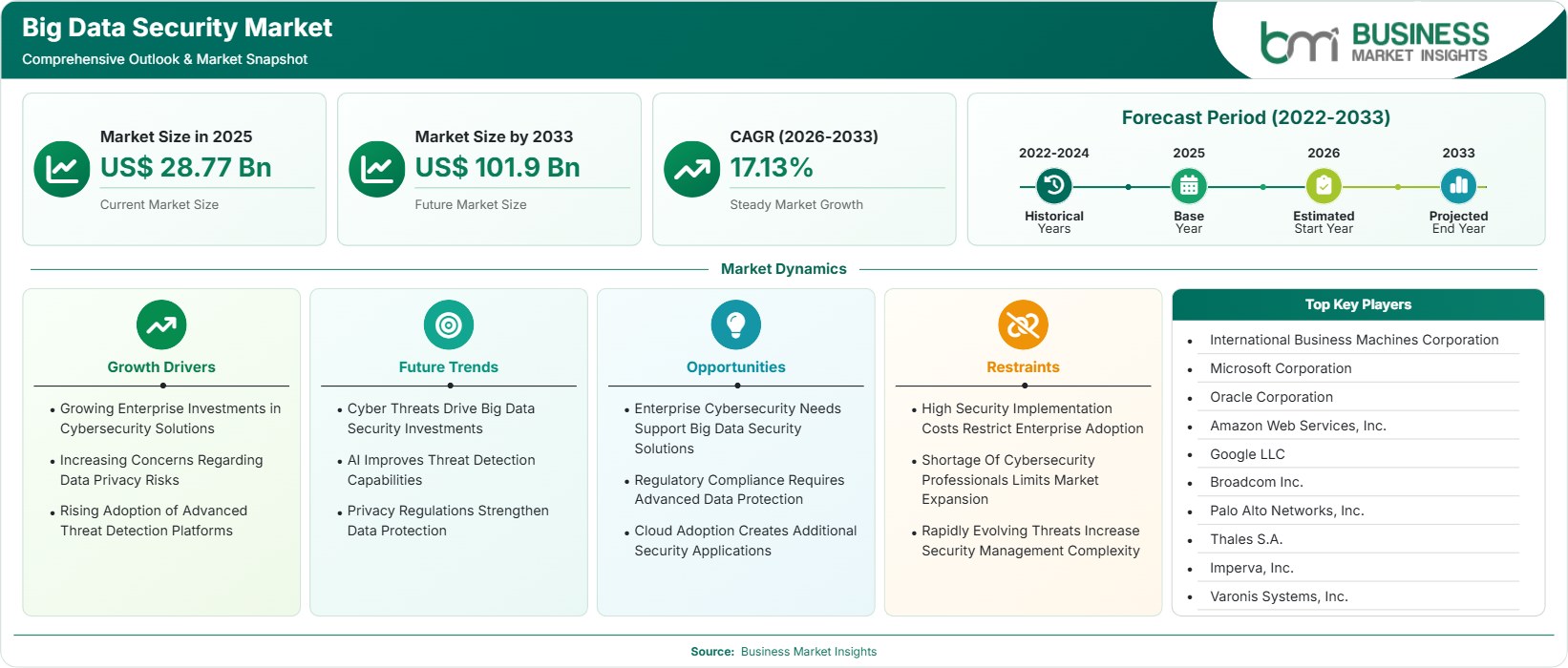
The Big Data Security Market size was valued at US$ 28.77 Billion in 2025 and is projected to reach US$ 101.9 Billion by 2033, growing at a CAGR of 17.13% during 2026–2033, driven by escalating cyberattacks, stricter data privacy regulations, cloud migration, AI adoption, and expanding enterprise investments in data governance and security analytics.

Report Coverage
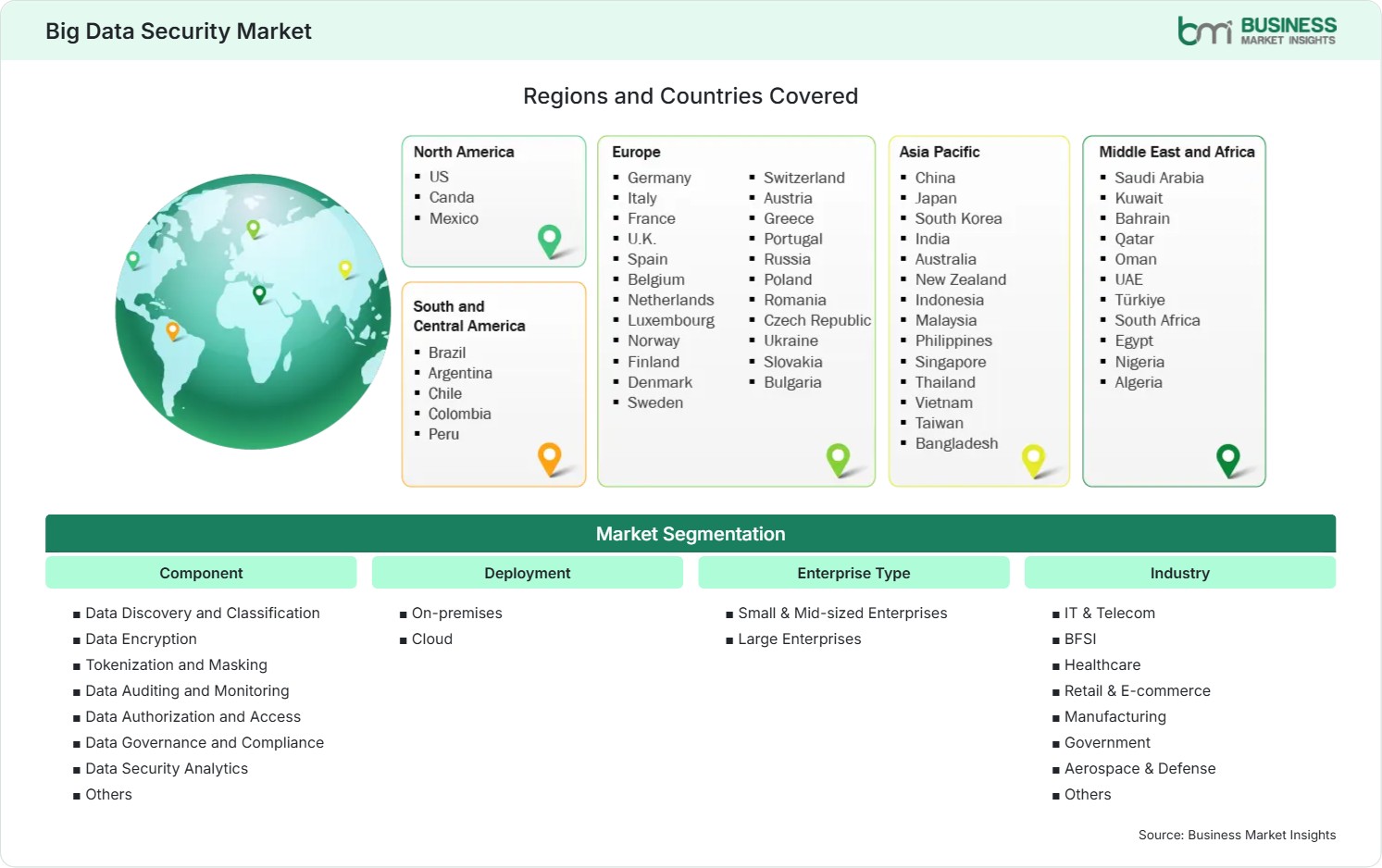
  • Component: Data Discovery and Classification, Data Encryption, Tokenization and Masking, Data Auditing and Monitoring, Data Authorization and Access, Data Governance and Compliance, Data Security Analytics, Others
  • Deployment: On-premises, Cloud
  • Enterprise Type: Small & Mid-sized Enterprises, Large Enterprises
  • Industry: IT & Telecom, BFSI, Healthcare, Retail & E-commerce, Manufacturing, Government, Aerospace & Defense, Others
US$ 28.77 Bn Market size in 2025
US$ 101.9 Bn Market Size by 2033
17.13% CAGR, 2026 - 2033
2026-2033 Forecast Period

AI Overview

Big Data Security Market Summary

  • North America Region: North America holds a market share of 39%–42% in 2025, growing at a CAGR of 15.5%–16.5% during 2026–2033. Demand is supported by zero-trust adoption, cloud workloads, regulatory compliance, AI-driven cybersecurity programs, enterprise modernization initiatives, and higher spending on advanced threat detection and data governance platforms. US market benefits from large-scale cloud deployments, federal cybersecurity mandates, and enterprise investments, with CAGR ranging 15.8%–16.8%.
  • Fastest Growing Region: Asia Pacific holds a Big Data Security Market share of 24%–27% in 2025, growing at a CAGR of 19.0%–20.5% during 2026–2033. Rapid digitalization, expanding data centers, fintech expansion, government cybersecurity programs, rising cloud adoption, stronger privacy regulations, increasing ransomware incidents, and enterprise modernization continue accelerating deployment across industries.
  • Leading Segment: Cloud deployment accounts for a 56%–60% share in 2025 and advances at a CAGR of 18.0%–19.0%. Growth is driven by scalable security architectures, multicloud management requirements, remote workforce security needs, AI-enabled protection tools, continuous monitoring capabilities, and improved compliance management effectiveness.
  • High Growth Segment: Data Security Analytics represents a 11%–14% share in 2025 and grows at a CAGR of 20.0%–21.5%. Organizations increasingly require real-time threat intelligence, behavioral analytics, automated incident response, insider-risk visibility, machine-learning detection capabilities, and proactive protection across distributed data environments.
  • Key Market Opportunity: Expanding adoption of generative AI, data lakes, sovereign cloud environments, and privacy-enhancing technologies is creating opportunities for integrated encryption, governance, monitoring, and analytics solutions across regulated industries globally.
  • Major Market Players: International Business Machines Corporation, Microsoft Corporation, Oracle Corporation, Amazon Web Services, Inc., Google LLC, Broadcom Inc., Palo Alto Networks, Inc., Thales S.A., Imperva, Inc., Varonis Systems, Inc.
Strategic Insights

Big Data Security Market: Strategic Insights

Big Data Security Market Strategic Framework
FREE PDF
Request your free sample
Request free sample
Stakeholder View

Key Takeaways

  • The industry value chain is shifting toward integrated platforms combining discovery, protection, governance, monitoring, and analytics rather than standalone security products.
  • Healthcare, BFSI, and cloud-native digital services offer the strongest expansion potential due to strict compliance requirements and growing sensitivity of distributed datasets.
  • AI-enhanced threat detection, automated policy enforcement, and behavioral analytics are becoming essential innovation priorities across enterprise security architectures.
  • India, Southeast Asia, and Gulf economies present compelling investment opportunities because of accelerating digital transformation initiatives and rising cybersecurity budgets.
  • Strategic partnerships between hyperscale cloud providers and cybersecurity vendors are increasing, improving platform interoperability and expanding managed security service offerings.
  • Consolidation activity remains active as vendors seek specialized capabilities in data governance, privacy-enhancing technologies, and real-time analytics.
Geographic Outlook

Big Data Security Market Regional Highlights

North America Big Data Security Market

North America represents the largest regional market, accounting for 39%–42% of revenue in 2025 while advancing at a CAGR of 15.5%–16.5% through 2033. The Big Data Security Market share in the region is supported by mature cloud infrastructure, strong cybersecurity expenditure, and stringent sector regulations. Financial services, healthcare organizations, government agencies, and technology providers continue adopting advanced encryption, governance, and AI-powered monitoring platforms to address sophisticated cyber threats and expanding compliance requirements.

  • Extensive adoption of zero-trust frameworks improves visibility across hybrid environments and strengthens enterprise security governance.
  • Federal cybersecurity initiatives encourage investments in continuous monitoring, threat intelligence, and critical infrastructure protection.
  • Rapid cloud-native application deployment increases demand for scalable access-control and data-protection technologies.
  • Healthcare and BFSI entities prioritize advanced auditing capabilities to satisfy evolving compliance mandates.

US Big Data Security Market

The United States contributes 80%–84% of North American revenue and records a CAGR of 15.8%–16.8% during the forecast period. Growth stems from enterprise digital transformation, hyperscale cloud expansion, AI deployment, and persistent cybersecurity risks. Large organizations increasingly deploy integrated data governance, monitoring, and analytics solutions across multicloud infrastructure. Substantial federal investments in cyber resilience further strengthen demand across public and private sectors.

  • Large enterprises emphasize automated compliance management and real-time monitoring capabilities.
  • AI adoption increases requirements for protecting training datasets and sensitive business information.
  • Financial institutions continue investing in advanced analytics to reduce fraud and insider risks.
  • Cloud migration programs accelerate implementation of centralized security platforms.

Europe Big Data Security Market

Europe accounts for 27%–30% of market revenue in 2025 and expands at a CAGR of 16.5%–17.5% of the Big Data Security Market through 2033. GDPR compliance, digital sovereignty priorities, and increasing cloud adoption support sustained demand. Germany leads regional deployment, while Eastern European markets exhibit faster expansion. Organizations are strengthening governance frameworks and encryption practices to secure cross-border data flows while addressing regulatory complexity and evolving cyber threats.

  • Germany maintains leadership through industrial digitalization and advanced cybersecurity investments.
  • Poland and Romania demonstrate stronger growth trajectories, recording estimated CAGRs above regional averages.
  • DORA implementation encourages financial institutions to enhance operational resilience and monitoring.
  • Sovereign cloud initiatives stimulate adoption of privacy-centric security architectures.
  • Manufacturing and automotive ecosystems increasingly secure connected operational technology environments.

Asia Pacific Big Data Security Market

The Asia Pacific region accounts for 24% to 27% of total global revenue and is the fastest-growing, with a CAGR of 19.0% to 20.5%. This region benefits from the adoption of digital banking, industrial automation, e-commerce growth, and regulatory maturity. China accounts for the largest share, and India is the market leader in the Big Data Security Market growth. Rising cyberattacks and expanding cloud infrastructure continue encouraging advanced security deployments across diverse sectors.

  • China leads spending due to extensive digital infrastructure and large enterprise adoption.
  • India records the highest growth rates driven by cloud investments and digital public initiatives.
  • Southeast Asian economies accelerate cybersecurity modernization programs across critical industries.
  • Retail and fintech platforms deploy advanced analytics to secure expanding transaction volumes.
  • National privacy regulations increase demand for governance, encryption, and auditing capabilities.

Rest of World Big Data Security Market

Rest of World generates 8% to 11% of revenues in 2025 and grows at a CAGR of 17.0% to 18.0%. Digital banking and e-commerce ecosystems are on the rise in South & Central America. The Middle East and Africa are gaining momentum through smart city developments, government digitization, and increasing use of cloud services. Brazil is leading in Latin America, and Saudi Arabia/ UAE have seen impressive growth via cybersecurity upgrades.

  • Brazil remains the largest regional contributor through financial-sector technology investments.
  • Saudi Arabia and the UAE expand cybersecurity spending under national transformation agendas.
  • Cloud data centers increase adoption of governance and monitoring solutions.
  • Energy and public-sector organizations prioritize critical infrastructure protection capabilities.
  • Regional regulations encourage stronger privacy controls and risk-management practices.
Global Market Geography
FREE PDF
Request your free sample
Request free sample
Segment Analysis

Big Data Security Market Segmentation

Component

The contribution of component solutions to market revenue is 100%. In addition, there is a growing trend towards security analytics and governance platforms. These component solutions can be attributed to factors such as increased compliance requirements, cyber risk, and enterprise digitalization. The scope of the Big Data Security Market continues to expand. Component solutions drive the 17.0%–18.5% CAGR, while governance, monitoring, and analytics receive priority funding.

  • Data Discovery and Classification: Enables identification of sensitive information across complex environments, supporting compliance, risk management, and policy-based protection strategies.
  • Data Encryption: Protects data at rest and in transit while supporting industry-specific regulatory requirements and security frameworks.
  • Tokenization and Masking: Reduces exposure of critical records by replacing identifiable elements with secure substitutes during processing and sharing.
  • Data Auditing and Monitoring: Delivers continuous oversight, anomaly detection, and accountability across distributed enterprise ecosystems.
  • Data Authorization and Access: Strengthens control over privileged users and ensures appropriate permissions across workloads.
  • Data Governance and Compliance: Helps organizations align policies, retention practices, and reporting obligations with evolving regulations.
  • Data Security Analytics: Applies machine learning and behavioral analysis to identify threats and accelerate response capabilities.

Deployment

Deployment trends are shifting towards cloud-based systems. The cloud-based system holds a 56%–60% market share in 2025 and has grown at a CAGR of 18.0%–19.0%, owing to scalability and flexibility. The on-premises deployment is crucial for strictly regulated industries needing local control.

  • On-premises: Preferred by organizations with stringent sovereignty, latency, and compliance requirements requiring direct management.
  • Cloud: Enables scalable monitoring, analytics, governance, and data protection across hybrid and multicloud environments.

Enterprise Type

Large organizations have 68%-72% market share and a 16.5%-17.5% CAGR through 2025, driven by the complexity of their data environments. SMEs will turn to cloud-based security solutions that improve their resilience and lessen the burden of implementation and maintenance.

  • Small & Mid-sized Enterprises (SMEs): Increasingly access enterprise-grade security capabilities through subscription-based cloud platforms and managed services.
  • Large Enterprises: Require comprehensive governance, encryption, auditing, and analytics solutions across extensive global operations.

Industry

Adoption across industries has been widespread, with BFSI and IT & Telecom as the major spend categories. The Big Data Security Market trends show growing investment in this sector to manage sensitive information.

  • IT & Telecom: Secures network data, subscriber information, and cloud infrastructure supporting digital services.
  • BFSI: Prioritizes fraud prevention, governance, compliance management, and real-time threat detection capabilities.
  • Healthcare: Protects patient records, medical research information, and connected healthcare ecosystems.
  • Retail & E-commerce: Secures transaction data and customer information across omnichannel operations.
  • Manufacturing: Protects intellectual property and industrial systems from sophisticated cyber threats.
  • Government: Enhances protection of citizen data, national infrastructure, and administrative systems.
  • Aerospace & Defense: Focuses on mission-critical information security, resilience, and regulatory compliance.
Market Forces

Big Data Security Market Dynamics

Key Market Drivers

Escalating Data Breaches and Cyberattack Sophistication

The cost of global cybercrime has been rising due to ransomware, insider threats, and advanced persistent attacks targeting valuable datasets. According to IBM’s report, the cost of data breaches is increasing as attacks using artificial intelligence rise and become more dangerous to cybersecurity. This calls for increased investment in control measures to minimize the risk of cybercrime. Encryption, monitoring, governance, and behavioral analytics have been deployed by companies in order to mitigate exposure. The increase in the attack surface due to remote working and cloud computing has emphasized the need for proactive security measures. Information has become a valuable asset, making robust security frameworks essential across regulated industries and critical infrastructure sectors.

Regulatory Expansion and Compliance Requirements

Governments around the globe are making it mandatory for organizations to protect their citizens' data. GDPR, DORA, healthcare requirements in the respective sectors, and regional privacy acts all require better transparency and accountability. The compliance investment will go toward building resilience, mitigating risks, and reporting. There is a growing need for platforms that integrate functionality for managing governance, controls, and continuous monitoring from centralized environments. These requirements help accelerate adoption across financial institutions, healthcare providers, public agencies, and multinational corporations

Cloud and AI Adoption Across Enterprise Operations

The move towards cloud-native infrastructure and AI-driven business models means that more scalable security solutions are required. Companies need security solutions that will help them deploy multicloud environments, perform real-time analysis, and enforce policies. Microsoft is still enhancing its capabilities to protect data in AI-driven settings and to expand data estates. The more data companies process, the more critical monitoring and governance become for maintaining trust, operational continuity, and regulatory alignment.

Key Market Opportunities

Security Platforms for Generative AI Ecosystems

Security considerations for generative AI implementations include protecting datasets, prompts, outputs, and proprietary information used during model training. Service providers that deliver comprehensive governance, monitoring, and privacy capabilities will help meet emerging corporate needs. Spending on specialized AI-related security capabilities is forecast to accelerate. Big Data Security Market Forecasts are increasingly taking into account opportunities tied to the use of trusted AI, transparency, and model risk management initiatives. Organizations seek scalable solutions that balance innovation, compliance, and security across evolving AI ecosystems.

Rising Demand for Sovereign and Regionalized Data Controls

The increasing demands of data localization and the need for sovereignty are influencing business technologies. Many governments and regulated industries are demanding that their technologies be localized, with storage and governance capabilities. Security firms can benefit from these demands by providing compliance platforms that allow local governance. Financial services, healthcare, defense, and the public sector prioritize such technologies.

Expansion of Managed Security Services

The shortage of cybersecurity experts in organizations will push companies to outsource their monitoring, governance, and response needs. Managed services offer efficient, rapid deployment solutions when organizations lack specialized talent. Managed services companies that have analytics, compliance, and automation services have large revenue potential. Small and medium-sized enterprises have a strong preference for subscription-based managed services.

Market Restraints and Challenges

High Implementation Complexity Across Hybrid Environments

Firms typically run their operations using legacy systems, private infrastructure, and various cloud platforms. Impact: Integration issues increase deployment costs, make it harder to establish policy standards, and prolong adoption periods. Security experts have to manage governance, identity management, surveillance, and compliance using different platforms. In many cases, data silos lower visibility and lead to inefficiencies. Although integrated platforms simplify the process, their implementation demands careful planning and highly qualified personnel. This process takes time, and firms may take a while to realize a return on their investments, particularly for mid-sized businesses with constrained resources and fragmented technology estates.

Skills Shortage and Security Operations Gaps

There is still a surplus of demand over supply of cybersecurity experts in many parts of the world. Consequence: Companies struggle to keep pace with advanced analytics, security incident response, cybersecurity governance, and evolving regulatory requirements. A lack of skills may result in greater vulnerability and less efficient use of the technologies in place. Companies tend to rely on consultants and outsourced solutions to address skill shortages, incurring higher costs. The problem is especially evident for developing countries and smaller organizations competing for limited specialist talent.

Company Analysis

Competitive Landscape

The competitive environment is characterized by platform consolidation, AI-driven innovation, and deeper cloud integration. Big Data Security Market analysis indicates increasing focus on governance, behavioral analytics, encryption, and compliance automation.

Company Name

Overview

Products and Services relevant to this market

International Business Machines Corporation

Global cybersecurity and data management leader serving regulated industries worldwide.

IBM Guardium, data protection, governance, analytics, compliance and threat monitoring solutions.

Microsoft Corporation

Enterprise cloud and security provider with extensive global customer base.

Microsoft Purview, Defender, Sentinel, data governance and security analytics solutions.

Oracle Corporation

Technology provider focused on database, cloud, and enterprise security.

Data Safe, encryption, database security, governance and access-control technologies.

Amazon Web Services, Inc.

Leading cloud infrastructure provider supporting large-scale digital workloads.

AWS Security Hub, Macie, IAM, encryption and monitoring services.

Google LLC

Cloud and analytics innovator with expanding cybersecurity portfolio.

Security Command Center, data governance, cloud protection and analytics tools.

Broadcom Inc.

Infrastructure software and enterprise security solutions provider.

Data loss prevention, identity security and enterprise protection platforms.

Palo Alto Networks, Inc.

Cybersecurity specialist emphasizing cloud-native and AI-powered protection.

Prisma Cloud, Cortex analytics, threat detection and data-security capabilities.

Thales S.A.

Major provider of encryption and digital trust technologies.

CipherTrust platform, key management, tokenization and compliance solutions.

Imperva, Inc.

Data and application security company serving global enterprises.

Database security, auditing, monitoring and data-risk management tools.

Varonis Systems, Inc.

Specialist focused on data-centric cybersecurity and governance.

Data classification, access governance, monitoring and insider-risk analytics.

Trust & Transparency

Research Methodology

The market analysis combines proprietary research with secondary data from government agencies, company disclosures, regulatory filings, industry databases and expert interviews. Market estimates are validated through data triangulation, cross-market benchmarking and analyst review.

View Full Research Methodology

Questions Answered

Frequently Asked Questions

What does a Big Data Security Market Report typically evaluate?

It generally assesses competitive positioning, technology adoption, deployment patterns, regulatory impacts, segment performance, investment trends, and regional opportunities influencing long-term industry development.

What makes Asia Pacific the fastest-growing region?

Rapid digital transformation, fintech expansion, rising cyber incidents, growing cloud infrastructure, and stricter privacy frameworks are driving accelerated adoption across regional economies.

Which industries generate the strongest demand?

BFSI, healthcare, government, IT & telecom, and retail sectors represent major demand centers because they process highly sensitive and regulated information.

How are SMEs participating in this market?

SMEs increasingly adopt cloud-based subscription models and managed security services, enabling enterprise-grade protection without large upfront infrastructure investments.

What factors are accelerating adoption of advanced data security platforms?

Growing cyber threats, stricter privacy regulations, cloud migration, and AI deployment are increasing demand for integrated monitoring, governance, encryption, and analytics capabilities across industries.

Access the Full Big Data Security Market Report

Get segment-level forecasts, regional estimates, competitive benchmarking, company profiles and downloadable Excel datasets.

Access the full Big Data Security Market Report
350 pages PDF & Excel | 2026-09-08