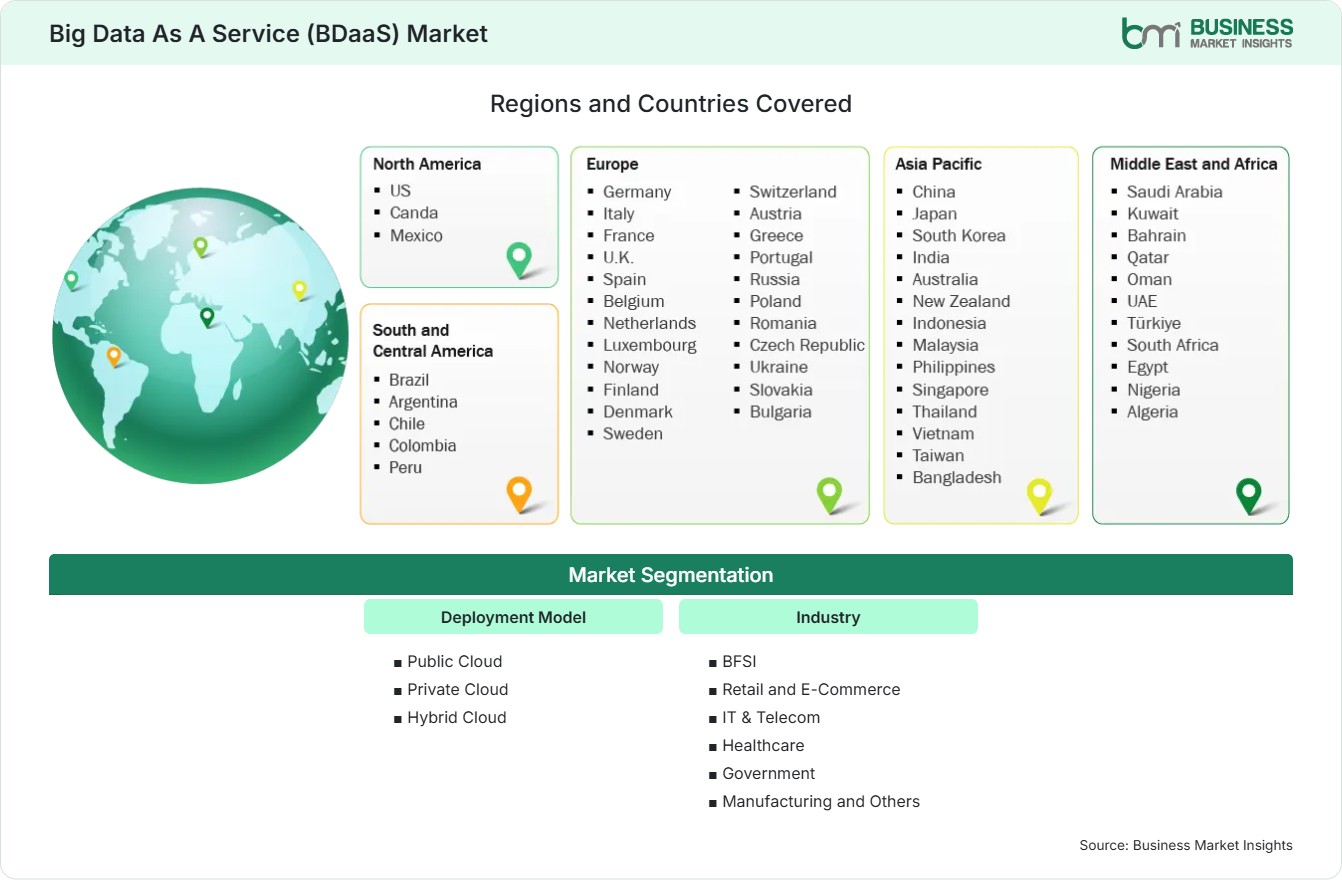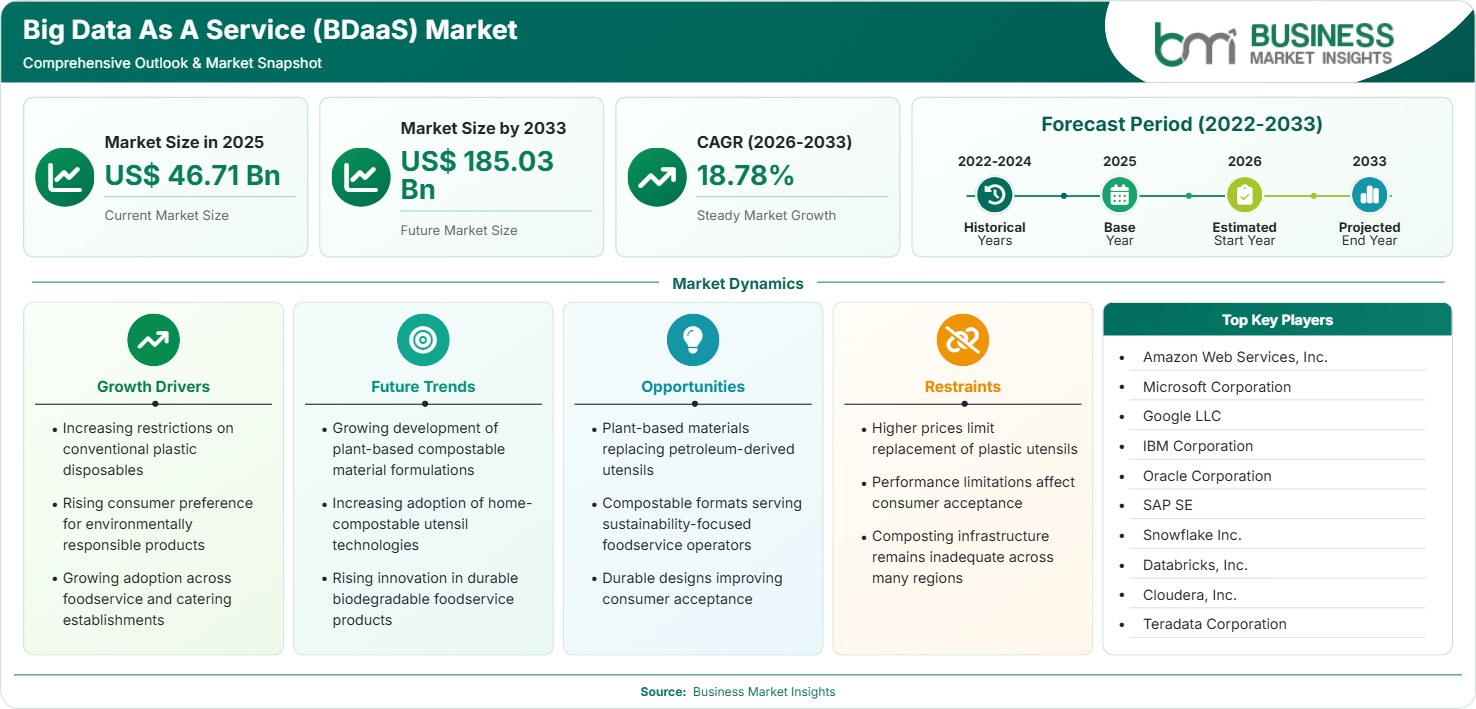
Big Data As A Service (BDaaS) Market Regional Highlights
North America Big Data As A Service Market
North America accounts for approximately 36%–39% of global revenue in 2025 and advances at a CAGR of 17.5%–18.5% through 2033. The region benefits from its existing cloud infrastructure, large investments in AI, and extensive use of analytics in the finance, health care, retail, and governmental industries. The Big Data As A Service market share is highest in the US owing to the hyperscale cloud environment and high digitization in enterprises. The focus of demand shifts to real-time analytics and governance.
- Enterprise cloud migrations are being sped up by AI-driven analytics modernization programs, at the same time as the demand for scalable data engineering capabilities within regulated sectors rises.
- Banks and other financial institutions are putting more money into fraud detection and risk intelligence. They want to make their operations stronger and connect better with customers.
- Healthcare organizations are now using analytics platforms for the purpose of population health management, for precision medicine research, and for administrative optimization.
- Retail companies invest in customer intelligence platforms to make use of predictive insights for the purpose of improving both their inventory planning and their omnichannel experiences.
- Federal and state digital modernization programs still encourage using cloud-based data management and analytics.
US Big Data As A Service Market
The United States represents 78%–82% of the North American BDaaS Market revenue and records a CAGR of 17.8%–18.8% through 2033. Cloud adoption by enterprises, AI integration, and large investments in digital infrastructure are factors that help facilitate the growth of the market. Advanced analytics environments are being deployed more frequently by companies to handle the growing amount of data while improving decision-making, operational effectiveness, and regulatory compliance performance.
- Technology providers are constantly extending their managed analytics portfolios to support workloads involving generative AI and high-performance computing.
- BFSI organizations place a priority on using scalable platforms for customer intelligence, anti-money laundering analytics, and for carrying out risk assessment activities.
- Manufacturers make use of advanced analytics environments to improve both predictive maintenance and supply-chain visibility.
- Venture capital activity remains strong and is continuing to support innovation in the areas of data management and intelligence software.
Europe Big Data As A Service Market
Europe captures 24%–27% of Big Data As A Service Market revenue in 2025 and grows at a CAGR of 17.0%–18.0% through 2033. Germany leads regional adoption, while Eastern European markets exhibit stronger growth profiles. Continued emphasis on data sovereignty, privacy compliance, and industrial digitalization sustains demand. Organizations increasingly embrace cloud analytics platforms capable of aligning with evolving governance requirements while supporting cross-border operations and operational intelligence initiatives.
- Germany is still the leading contributor, a position it holds due to its implementation of Industry 4.0 and its enterprise cloud modernization projects.
- Strong adoption is shown in the United Kingdom in the finance, retail, and digital services sectors.
- France is making heavy investments in sovereign cloud projects, which are intended to meet regulatory compliance and strategic autonomy requirements.
- Poland and other emerging economies are achieving higher adoption rates as a result of their ongoing digital transformation programs.
- Sustainability reporting rules push more companies to use enterprise analytics platforms.
Asia Pacific Big Data As A Service Market
Asia Pacific holds 26%–29% Big Data As A Service Market share in 2025 and records the fastest growth at 20.5%–21.5% CAGR through 2033. China is seen as the most significant source of revenue, while India has the highest capacity for growth. Large-scale efforts for the digital economy, increased usage of e-commerce and cloud computing services, as well as increasing sophistication of enterprise analytics, are the key factors fueling the growth in this region.
- China benefits from extensive digital platform ecosystems that generate massive volumes of data, requiring sophisticated analytics capabilities.
- There is rapid growth in demand for financial technology, telecommunications, healthcare, and public digital infrastructure projects in India.
- Japan is promoting adoption by implementing programs aimed at the modernization of smart manufacturing and at optimizing enterprise productivity.
- The business models of economies in Southeast Asia are increasingly adopting cloud-native approaches and operational strategies based on analytics.
- The expansion of internet connectivity and the development of 5G infrastructure are leading to an increase in the amount of data that enterprises generate in various industries.
Rest of World Big Data As A Service Market
The Rest of World region represents 10%–13% of Big Data As A Service Market revenue in 2025 and progresses at a CAGR of 18.5%–19.5% through 2033. South and Central America benefit from fintech innovation and enterprise digitalization. Meanwhile, Middle East and Africa markets gain momentum through smart city investments, cloud infrastructure development, and e-government transformation programs. These factors collectively contribute to sustained regional adoption of scalable analytics services.
- Brazil is leading demand in South America through its ongoing initiatives to expand digital banking and modernize enterprises.
- Adoption in Mexico is increasing due to the digitization of manufacturing and the need for integrated supply chain analytics.
- Saudi Arabia benefits from its national digital transformation and large-scale investments in smart cities.
- The United Arab Emirates is supporting the growth of cloud analytics byadopting dthe adoption of advanced technologies, carrying out government modernization programs.
- There is increasing demand in South Africa from institutions in the telecommunications, financial services, and public sectors.