
Infrastructure As A Service (IaaS) Market Outlook: Size, Share, Trends, Growth Analysis, Competitive Landscape & Forecast, 2026-2033

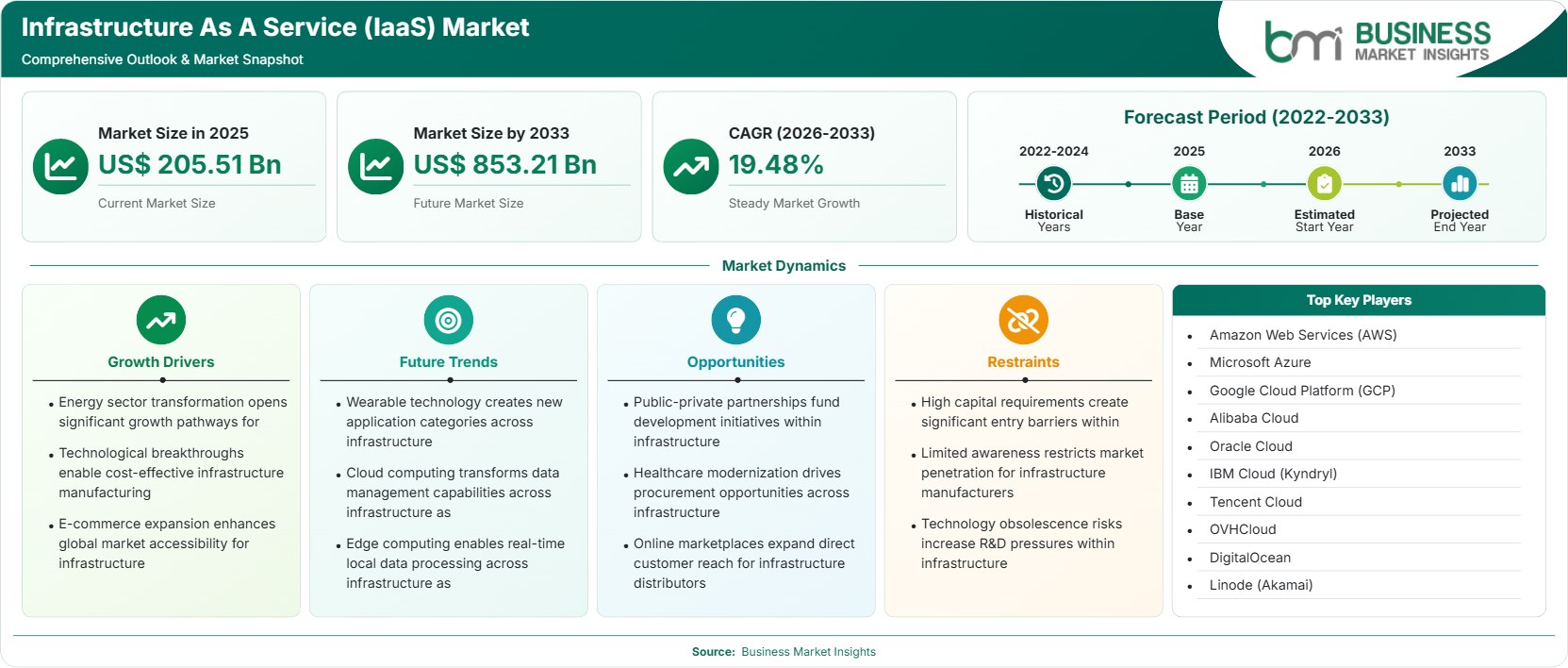
The Infrastructure as a Service IaaS Market size was valued at US$ 205.51 Billion in 2025 and is projected to reach US$ 853.21 Billion by 2033, growing at a CAGR of 19.48% during 2026–2033, driven by cloud migration, digital transformation, scalable computing demand, AI workloads, and opportunities in hybrid infrastructure modernization.

Report Coverage
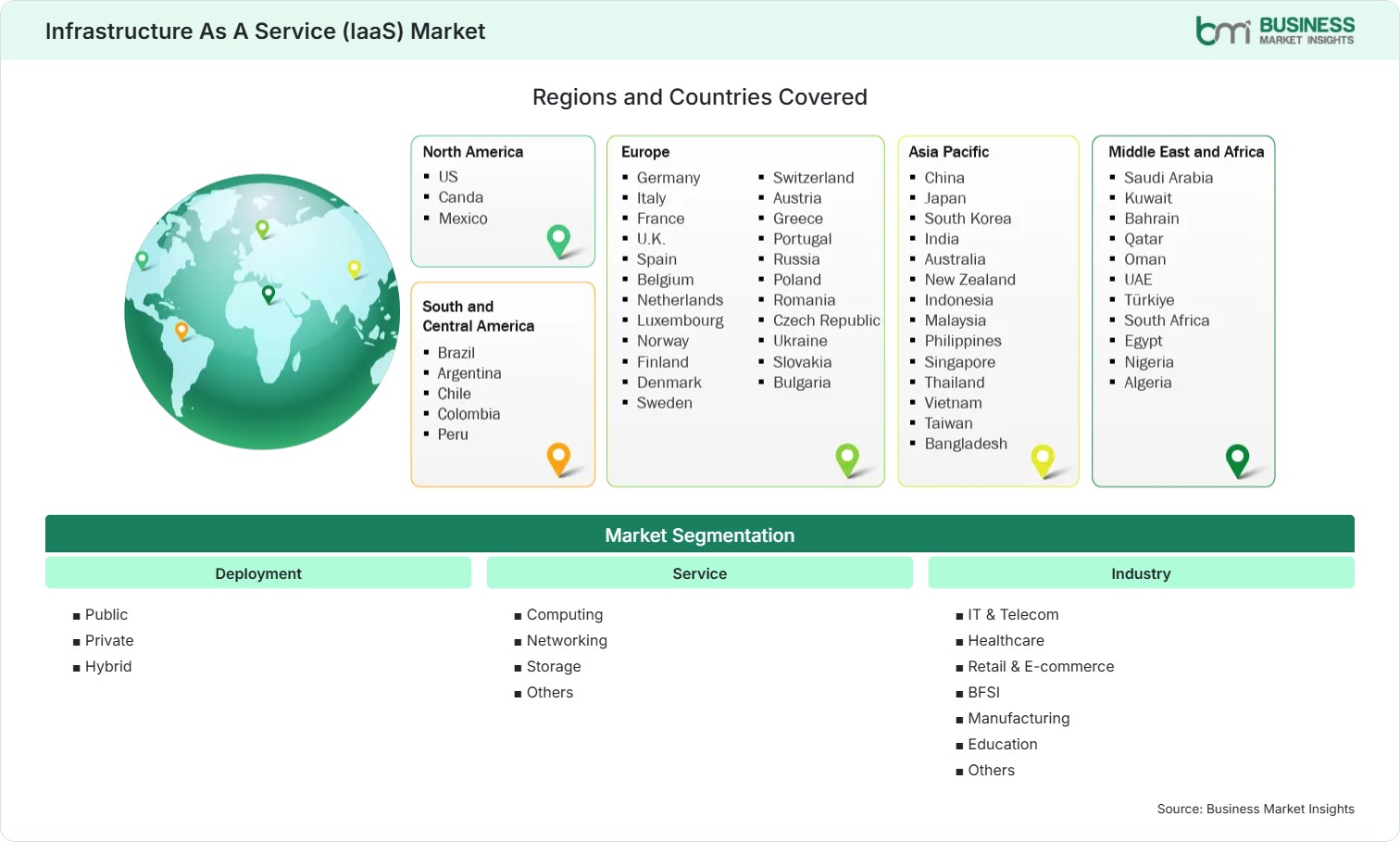
  • Deployment: Public, Private, Hybrid
  • Service: Computing, Networking, Storage, Others
  • Industry: IT & Telecom, Healthcare, Retail & E-commerce, BFSI, Manufacturing, Education, Others
US$ 205.51 Bn Market size in 2025
US$ 853.21 Bn Market Size by 2033
19.48% CAGR, 2026 - 2033
2026-2033 Forecast Period

01 AI Overview

Infrastructure As A Service (IaaS) Market Summary

  • North America Region: North America holds 38%–42% share in 2025, growing with a CAGR of 18%–20% due to enterprise cloud adoption, AI infrastructure investments, cybersecurity modernization, and hybrid cloud expansion opportunities. The U.S. market demonstrates strong adoption with a CAGR of 19%–21% during 2026–2033, supported by hyperscale cloud providers, enterprise digitization, and government cloud initiatives.
  • Fastest Growing Region: Asia Pacific represents 28%–32% share in 2025, expanding at a CAGR of 21%–23% due to increasing cloud penetration, digital economies, data center investments, AI adoption, and expanding enterprise technology spending across emerging economies.
  • Leading Segment: Public deployment holds 55%–60% share in 2025, growing at a CAGR of 20%–22% due to cost efficiency, scalability, rapid provisioning capabilities, and increasing adoption among enterprises seeking flexible cloud infrastructure solutions.
  • High Growth Segment: Hybrid deployment is estimated at 25%–30% share in 2025, expanding with a CAGR of 22%–24% due to enterprise requirements for workload flexibility, regulatory compliance, data sovereignty, and integration between private and public cloud environments.
  • Key Market Opportunity: Increasing AI workloads, edge computing expansion, industry-specific cloud platforms, and demand for scalable infrastructure create opportunities for providers offering secure, automated, and cost-optimized cloud solutions across global markets.
  • Major Market Players: Amazon Web Services (AWS), Microsoft Azure, Google Cloud Platform (GCP), Alibaba Cloud, Oracle Corporation, IBM Cloud, Tencent Cloud, OVHcloud, DigitalOcean Holdings, Inc., and Akamai Technologies.
02 Strategic Insights

Infrastructure As A Service (IaaS) Market: Strategic Insights

Infrastructure As A Service (IaaS) Market Strategic Framework
FREE PDF
Request your free sample
Request free sample
03 Stakeholder View

Key Takeaways

  • The market ecosystem is evolving from traditional infrastructure ownership toward service-based models involving hyperscale providers, managed service companies, data center operators, and technology integrators. Cloud infrastructure value chains increasingly depend on automation, cybersecurity capabilities, and global connectivity networks.
  • Enterprises are prioritizing hybrid cloud environments, AI-ready infrastructure, and industry-specific platforms as high-value growth areas. Healthcare, BFSI, manufacturing, and retail organizations are adopting scalable infrastructure solutions to support advanced analytics, digital applications, and operational modernization.
  • Innovation is shifting toward AI-optimized computing environments, advanced virtualization technologies, serverless architectures, and sustainable cloud infrastructure. Providers are investing in energy-efficient data centers, specialized processors, and automated cloud management tools to improve performance.
  • Asia Pacific presents a strong investment opportunity due to expanding digital economies, rising cloud adoption among enterprises, and increasing government-backed technology initiatives. India, China, Japan, and Southeast Asian countries are becoming important destinations for cloud infrastructure expansion.
  • The competitive environment is experiencing consolidation through strategic partnerships, infrastructure expansion, and technology investments. Major cloud providers are strengthening capabilities through acquisitions, regional data center development, and collaborations focused on AI, cybersecurity, and enterprise solutions.
  • Enterprise demand is increasingly shifting toward flexible consumption models, creating opportunities for providers offering transparent pricing, workload optimization, compliance support, and managed infrastructure services tailored to specific industry requirements.
04 Geographic Outlook

Infrastructure As A Service (IaaS) Market Regional Highlights

North America Infrastructure as a Service IaaS Market

North America accounts for 38%–42% share in 2025 and is projected to grow at a CAGR of 18%–20% during 2026–2033, supported by hyperscale cloud infrastructure expansion, enterprise digital transformation, and AI-driven computing demand. The region remains the largest adoption center due to mature cloud ecosystems, advanced cybersecurity requirements, and strong technology investments. The Infrastructure as a Service IaaS Market share in North America is strengthened by extensive enterprise migration, government cloud programs, and increasing adoption of hybrid infrastructure models.

  • Cloud providers are expanding regional data center networks to support AI workloads, enterprise applications, and low-latency computing requirements across multiple industries.
  • The United States dominates regional demand through strong enterprise cloud adoption, advanced technology ecosystems, and increasing investments in artificial intelligence infrastructure platforms.
  • Organizations are prioritizing hybrid and multi-cloud architectures to improve operational flexibility, security compliance, and workload management efficiency across business environments.
  • Increasing demand from BFSI, healthcare, and technology sectors is accelerating infrastructure modernization initiatives and creating new opportunities for cloud service providers.

US Infrastructure as a Service IaaS Market

The U.S. represents 32%–36% share of the global market in 2025 and is expected to expand at a CAGR of 19%–21% during 2026–2033. Strong presence of leading cloud providers, enterprise technology adoption, and AI infrastructure investments continue supporting domestic growth. The Infrastructure as a Service IaaS Market in the U.S. benefits from widespread cloud migration across industries, increasing cybersecurity investments, and government initiatives encouraging secure digital infrastructure development.

  • Large enterprises are increasing cloud spending to support advanced analytics, machine learning applications, and scalable enterprise software deployment.
  • Federal and state organizations are adopting cloud platforms to improve operational efficiency, data management, and public service modernization.
  • Technology companies are investing in specialized computing infrastructure to support generative AI, high-performance computing, and next-generation applications.
  • Rising demand for secure cloud environments is encouraging providers to expand compliance-focused infrastructure offerings.

Europe Infrastructure as a Service IaaS Market

Europe holds 22%–26% share in 2025 and is estimated to grow at a CAGR of 17%–19% during 2026–2033. The region is driven by cloud adoption among enterprises, strict data protection regulations, and increasing demand for sovereign cloud solutions. Germany, the United Kingdom, France, and the Netherlands represent major markets, while countries including Spain and Italy are witnessing accelerated adoption due to digital transformation programs. The Infrastructure as a Service IaaS Market share in Europe is influenced by regulatory compliance, sustainability initiatives, and enterprise modernization.

  • Germany is strengthening cloud infrastructure adoption through industrial digitalization, manufacturing automation, and enterprise technology transformation initiatives.
  • The United Kingdom demonstrates strong demand due to financial services modernization, AI adoption, and cloud-based business applications.
  • European organizations increasingly prioritize data sovereignty and compliant infrastructure solutions aligned with regional regulations.
  • Sustainability-focused data center strategies are influencing provider investments in energy-efficient cloud infrastructure.
  • Public sector modernization programs are supporting cloud adoption across government and educational institutions.

Asia Pacific Infrastructure as a Service IaaS Market

Asia Pacific represents 28%–32% share in 2025 and is projected to expand at a CAGR of 21%–23% during 2026–2033, making it the fastest-growing regional market. Growth is supported by rapid digitalization, expanding internet penetration, enterprise cloud migration, and government technology initiatives. China, India, Japan, South Korea, and Southeast Asian countries are key contributors. The Infrastructure as a Service IaaS Market growth in Asia Pacific is driven by increasing data center investments, AI adoption, and cloud-native application development.

  • China remains a major regional contributor through extensive cloud infrastructure investments and strong enterprise technology adoption.
  • India is experiencing accelerated cloud demand due to digital transformation programs, startup ecosystems, and increasing enterprise application modernization.
  • Japan and South Korea are adopting advanced cloud platforms for manufacturing automation, AI development, and smart technology initiatives.
  • Southeast Asian economies are attracting cloud investments through expanding digital economies and improving technology infrastructure.
  • Regional data localization requirements are encouraging providers to establish domestic infrastructure facilities.

Rest of World Infrastructure as a Service IaaS Market

Rest of World includes South and Central America, Middle East, and Africa regions, representing 8%–12% share in 2025 with a CAGR of 20%–22% during 2026–2033. These regions are witnessing increasing cloud adoption through digital transformation, financial inclusion initiatives, and enterprise modernization. Brazil, Mexico, UAE, Saudi Arabia, and South Africa are emerging markets due to government technology programs and infrastructure investments. The Infrastructure as a Service IaaS Market analysis indicates rising demand for localized cloud services, cybersecurity solutions, and scalable infrastructure platforms.

  • Brazil and Mexico are expanding cloud adoption through enterprise digitization and increasing demand for scalable business applications.
  • Middle Eastern countries are investing in cloud infrastructure as part of economic diversification and smart city development programs.
  • UAE and Saudi Arabia are attracting hyperscale cloud investments through technology-focused national strategies.
  • South Africa is developing cloud ecosystems to support financial services, government applications, and enterprise modernization.
  • Growing connectivity improvements across developing economies are enabling wider adoption of cloud-based infrastructure services.
Global Market Geography
FREE PDF
Request your free sample
Request free sample
05 Segment Analysis

Infrastructure As A Service (IaaS) Market Segmentation

Deployment

Deployment segmentation represents a critical factor influencing cloud infrastructure adoption, with organizations selecting models based on scalability, security, and compliance requirements. The public deployment segment holds 55%–60% share in 2025 and is expected to grow at a CAGR of 20%–22% during 2026–2033. Enterprises increasingly combine multiple deployment approaches to balance flexibility, performance, and regulatory requirements.

  • Public: Public deployment enables cost-effective infrastructure access through shared cloud environments, supporting startups, enterprises, and organizations requiring scalable computing resources without major capital investments.
  • Private: Private deployment provides dedicated infrastructure environments for organizations requiring enhanced security, customization, compliance management, and control over sensitive workloads.
  • Hybrid: Hybrid deployment combines public and private infrastructure capabilities, enabling enterprises to optimize workloads, improve flexibility, and maintain regulatory compliance across complex technology environments.

Service

Service segmentation highlights diverse infrastructure capabilities required by enterprises, including computing, networking, and storage resources. Computing services represent the leading category with 45%–50% share in 2025 and a CAGR of 21%–23% during 2026–2033, driven by AI workloads, enterprise applications, and high-performance computing requirements. Increasing demand for scalable infrastructure strengthens service diversification across industries.

  • Computing: Computing services provide virtual machines, processing power, and scalable resources supporting enterprise applications, artificial intelligence workloads, analytics platforms, and digital transformation initiatives.
  • Networking: Networking services enable secure connectivity, workload optimization, and distributed application performance through virtual networks, cloud routing, and advanced communication infrastructure solutions.
  • Storage: Storage services support growing enterprise data volumes through scalable cloud storage, backup solutions, disaster recovery capabilities, and efficient data management platforms.

Industry

Industry segmentation reflects increasing cloud adoption across sectors requiring scalable infrastructure, secure data management, and application modernization. IT and Telecom represents the leading industry segment with 30%–35% share in 2025 and is expected to grow at a CAGR of 20%–22% during 2026–2033 due to expanding digital platforms, network modernization, and cloud-native application development. The Infrastructure as a Service IaaS Market scope continues expanding as industries adopt flexible infrastructure models for operational efficiency.

  • IT & Telecom: IT and Telecom organizations utilize cloud infrastructure for network transformation, software development, application hosting, edge computing, and advanced digital service delivery.
  • Healthcare: Healthcare institutions adopt cloud infrastructure for electronic health records, medical analytics, telehealth platforms, and secure healthcare data management requirements.
  • Retail & E-commerce: Retail and e-commerce companies leverage scalable infrastructure for online platforms, customer analytics, inventory management, and personalized digital shopping experiences.
  • BFSI: Banking, financial services, and insurance organizations deploy cloud infrastructure for secure transactions, fraud detection, regulatory compliance, and digital banking applications.
  • Manufacturing: Manufacturing companies use cloud infrastructure for industrial automation, Internet of Things applications, predictive analytics, and connected production environments.
  • Education: Educational institutions adopt cloud platforms for digital learning systems, virtual classrooms, research computing, and scalable academic technology solutions.
06 Market Forces

Infrastructure As A Service (IaaS) Market Dynamics

Key Market Drivers

Increasing Enterprise Cloud Migration

Enterprise migration from traditional data centers toward cloud-based infrastructure is a primary driver accelerating adoption across industries. Organizations are shifting workloads to scalable platforms to reduce infrastructure costs, improve operational flexibility, and enhance application performance. The market growth is supported by increasing demand for remote accessibility, automated resource management, and digital business transformation. Cloud adoption enables enterprises to deploy applications faster while improving infrastructure utilization. The Infrastructure as a Service IaaS Market trends indicate growing preference for flexible consumption models, particularly among businesses seeking optimized technology investments. Enterprises are increasingly adopting hybrid environments to balance performance, security, and compliance requirements.

Rising Artificial Intelligence and High-Performance Computing Demand

Artificial intelligence, machine learning, and advanced analytics workloads are increasing demand for scalable computing infrastructure. Businesses require high-performance cloud environments capable of processing large datasets, training AI models, and supporting real-time applications. Cloud providers are investing in specialized computing resources, including accelerated processors and AI-optimized infrastructure, to address evolving enterprise requirements. The Infrastructure as a Service IaaS Market is benefiting from expanding AI adoption across healthcare, finance, manufacturing, and technology sectors. Growing computational requirements are encouraging organizations to move from fixed infrastructure models toward dynamic cloud platforms capable of supporting complex workloads.

Expansion of Hybrid and Multi-Cloud Strategies

Enterprises are increasingly adopting hybrid and multi-cloud approaches to improve resilience, optimize workload placement, and address regulatory requirements. These strategies allow organizations to combine public cloud scalability with private infrastructure control. Cloud management platforms, automation tools, and improved interoperability solutions are enabling seamless workload movement across different environments. The Infrastructure as a Service IaaS Market growth is supported by organizations seeking greater flexibility while maintaining security standards. Increasing complexity of enterprise technology ecosystems is encouraging demand for infrastructure providers offering integrated management, monitoring, and cybersecurity capabilities.

Key Market Opportunities

Growth of Industry-Specific Cloud Infrastructure

Industry-focused cloud solutions represent a major opportunity as organizations demand infrastructure customized for specific operational requirements. Healthcare, BFSI, manufacturing, and government sectors require platforms supporting compliance, security, and specialized applications. Providers who create infrastructure services that are customized to meet the demands of specific verticals will be able to benefit from new opportunities created by the increased performance, service, and regulation. As per the Infrastructure as a Service (IaaS) Market Forecasts, there are rising opportunities due to the need for dedicated clouds from businesses.

Expansion of Edge Computing Infrastructure

Edge computing adoption is creating opportunities for infrastructure providers to deliver localized processing capabilities closer to end users and connected devices. Increasing demand for low-latency applications, autonomous systems, IoT platforms, and real-time analytics is encouraging investment in distributed cloud infrastructure. Enterprises require computing resources positioned closer to operational environments to improve responsiveness and efficiency. Cloud providers are expanding edge capabilities through regional infrastructure deployment and partnerships. This opportunity is particularly relevant for manufacturing, telecommunications, transportation, and smart city applications requiring immediate data processing.

Cloud Infrastructure Development in Emerging Economies

Emerging markets present significant opportunities due to increasing internet adoption, digital transformation programs, and enterprise technology modernization. Countries within the Asia-Pacific, Latin American, and Middle Eastern regions are adopting cloud ecosystems in order to develop their economies through technological advancement. Providers of infrastructure have started creating local data centers and other local services due to high demand. Governments in the region are encouraging the use of technology through programs that create a favorable environment for the growth of the cloud infrastructure.

Market Restraints and Challenges

Data Security and Privacy Concerns

Factor: Increasing cybersecurity threats and concerns regarding sensitive data management create challenges for enterprise cloud adoption. Impact: Institutions that deal with finance, health care, and government-related data need rigorous security measures before moving their workloads to the cloud. Despite the ongoing effort by cloud vendors to develop better cybersecurity technology, enterprises may still delay implementing such measures due to the fear of any risk associated with data access and compliance issues. The Infrastructure as a Service IaaS Market faces pressure to provide transparent security solutions, encryption capabilities, and compliance support across different geographic regions. Maintaining customer trust remains essential as cloud environments become more complex.

Infrastructure Cost Management Complexity

Factor: Increasing cloud service complexity and unpredictable consumption patterns create challenges in controlling infrastructure spending.

Impact: Enterprises may experience higher operational costs without effective monitoring, optimization, and governance strategies. The use of cloud services needs professional people to ensure efficient use of resources and avoid any wastage of money. Companies that implement different cloud systems experience extra difficulties regarding cost awareness, workload optimization, and resource allocation. The response from providers is to provide automatic management services, cost transparency, and optimization services. Cost control is one of the necessary conditions for successful cloud implementation.

07 Company Analysis

Competitive Landscape

The Infrastructure as a Service IaaS Market analysis highlights a highly competitive ecosystem dominated by global hyperscale providers and specialized cloud infrastructure companies. Leading players are competing through regional expansion, AI-ready infrastructure, cybersecurity capabilities, pricing strategies, and industry-focused solutions.

Company Name

Overview

Products and Services relevant to this market

Amazon Web Services (AWS)

Amazon Web Services provides global cloud infrastructure services with extensive enterprise adoption and worldwide availability zones.

Offers Amazon EC2 computing, Amazon S3 storage, networking services, databases, AI infrastructure, and enterprise cloud solutions.

Microsoft Azure

Microsoft Azure delivers enterprise-focused cloud infrastructure with strong integration across business applications and software ecosystems.

Provides virtual machines, Azure storage, networking, hybrid cloud solutions, AI services, and enterprise infrastructure platforms.

Google Cloud Platform (GCP)

Google Cloud Platform specializes in cloud infrastructure with strong capabilities in analytics, AI, and data management services.

Offers Compute Engine, Cloud Storage, networking solutions, AI infrastructure, Kubernetes platforms, and cloud-native services.

Alibaba Cloud

Alibaba Cloud provides cloud infrastructure services supporting enterprises, e-commerce platforms, and digital businesses globally.

Delivers elastic computing, storage, networking, database services, security solutions, and AI-powered cloud platforms.

Oracle Corporation

Oracle provides enterprise cloud infrastructure focused on database workloads, business applications, and enterprise computing requirements.

Offers Oracle Cloud Infrastructure, computing services, storage solutions, networking capabilities, and enterprise application infrastructure.

IBM Cloud

IBM Cloud delivers infrastructure solutions emphasizing hybrid cloud environments, enterprise workloads, and regulated industries.

Provides cloud computing, storage, networking, hybrid cloud platforms, and infrastructure management services.

Tencent Cloud

Tencent Cloud offers infrastructure services supporting digital platforms, gaming, entertainment, and enterprise applications.

Provides computing resources, cloud storage, networking, cybersecurity, and AI infrastructure solutions.

OVHcloud

OVHcloud provides European cloud infrastructure services focused on performance, data sovereignty, and enterprise applications.

Offers dedicated servers, public cloud services, private cloud infrastructure, storage, networking, and data center solutions.

DigitalOcean Holdings, Inc.

DigitalOcean provides developer-focused cloud infrastructure designed for startups, developers, and small businesses.

Offers virtual servers, managed databases, storage services, Kubernetes solutions, and developer cloud platforms.

Akamai Technologies, Inc.

Akamai delivers distributed cloud infrastructure through edge computing and digital experience technologies.

Provides cloud computing, edge infrastructure, security services, storage, and distributed application delivery solutions.

10 Trust & Transparency

Research Methodology

The market analysis combines proprietary research with secondary data from government agencies, company disclosures, regulatory filings, industry databases and expert interviews. Market estimates are validated through data triangulation, cross-market benchmarking and analyst review.

View Full Research Methodology

11 Questions Answered

Frequently Asked Questions

What should investors consider when evaluating the Infrastructure as a Service IaaS Market Report?

Investors should evaluate cloud adoption rates, regional infrastructure expansion, AI-driven demand, competitive positioning, and long-term enterprise digitalization trends. The Infrastructure as a Service IaaS Market Report provides insights into growth opportunities, segment performance, and industry dynamics.

Which industries are creating new opportunities for cloud infrastructure providers?

Healthcare, BFSI, manufacturing, retail, and telecommunications industries are creating new opportunities through digital transformation initiatives. These sectors require secure, scalable infrastructure to support analytics, automation, customer platforms, and connected technologies.

How are enterprises selecting between public and hybrid cloud models?

Enterprises evaluate cloud models based on security requirements, workload characteristics, compliance obligations, and operational flexibility. Public cloud supports scalability and cost efficiency, while hybrid cloud enables organizations to combine private infrastructure control with public cloud capabilities.

What role does artificial intelligence play in cloud infrastructure demand?

Artificial intelligence is increasing demand for high-performance computing, specialized processors, and scalable data processing environments. Cloud providers are developing AI-ready infrastructure solutions to support machine learning models, generative AI applications, and enterprise analytics workloads.

What factors are driving adoption of Infrastructure As A Service IaaS solutions across industries?

Cloud migration, artificial intelligence workloads, hybrid infrastructure adoption, and demand for scalable computing resources are major factors accelerating adoption. Enterprises are using Infrastructure As A Service IaaS platforms to improve flexibility, reduce infrastructure ownership costs, and support digital transformation initiatives.

Access the Full Infrastructure As A Service (IaaS) Market Report

Get segment-level forecasts, regional estimates, competitive benchmarking, company profiles and downloadable Excel datasets.

Access the full Infrastructure As A Service (IaaS) Market Report
350 pages PDF & Excel | 2026-08-17