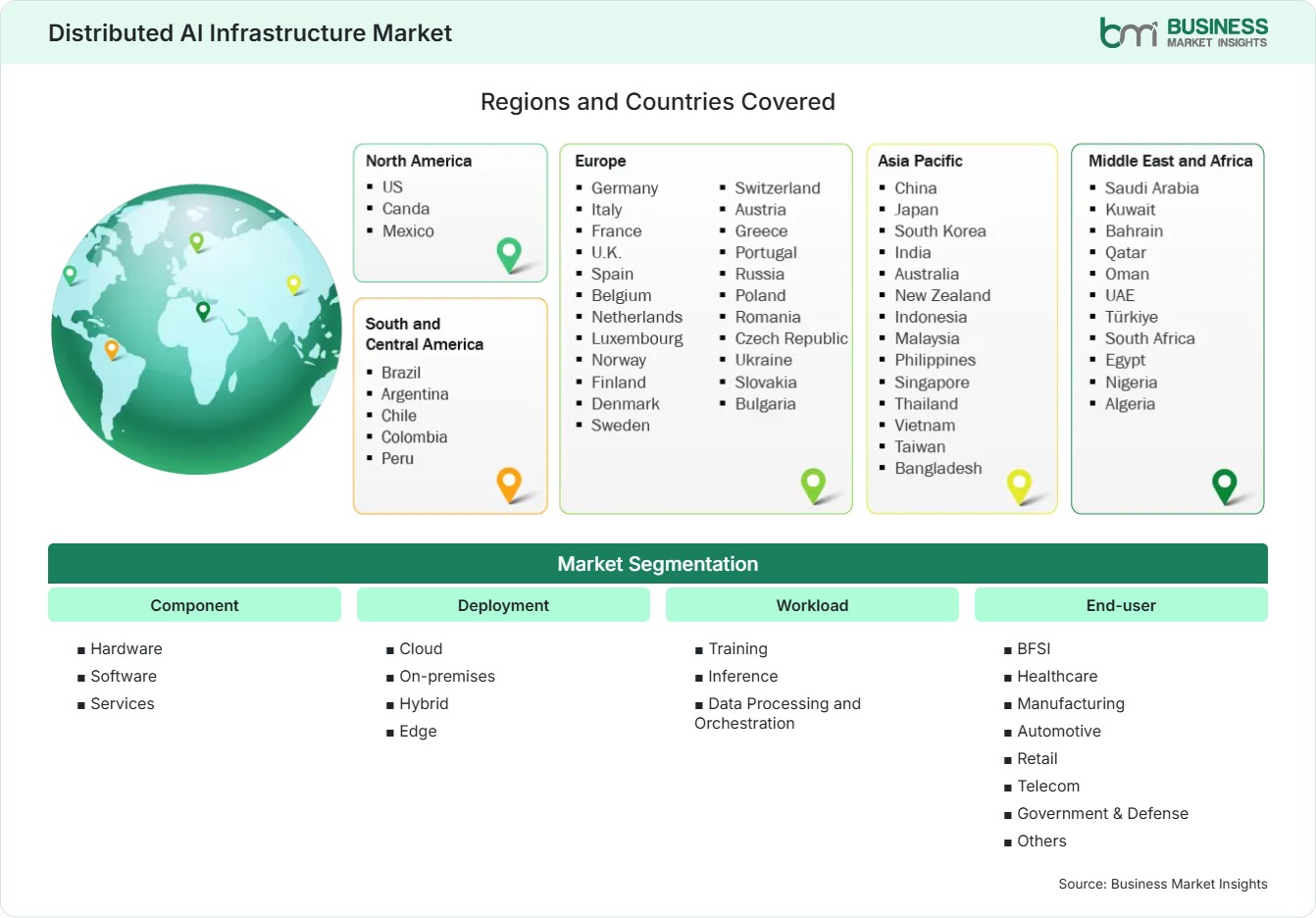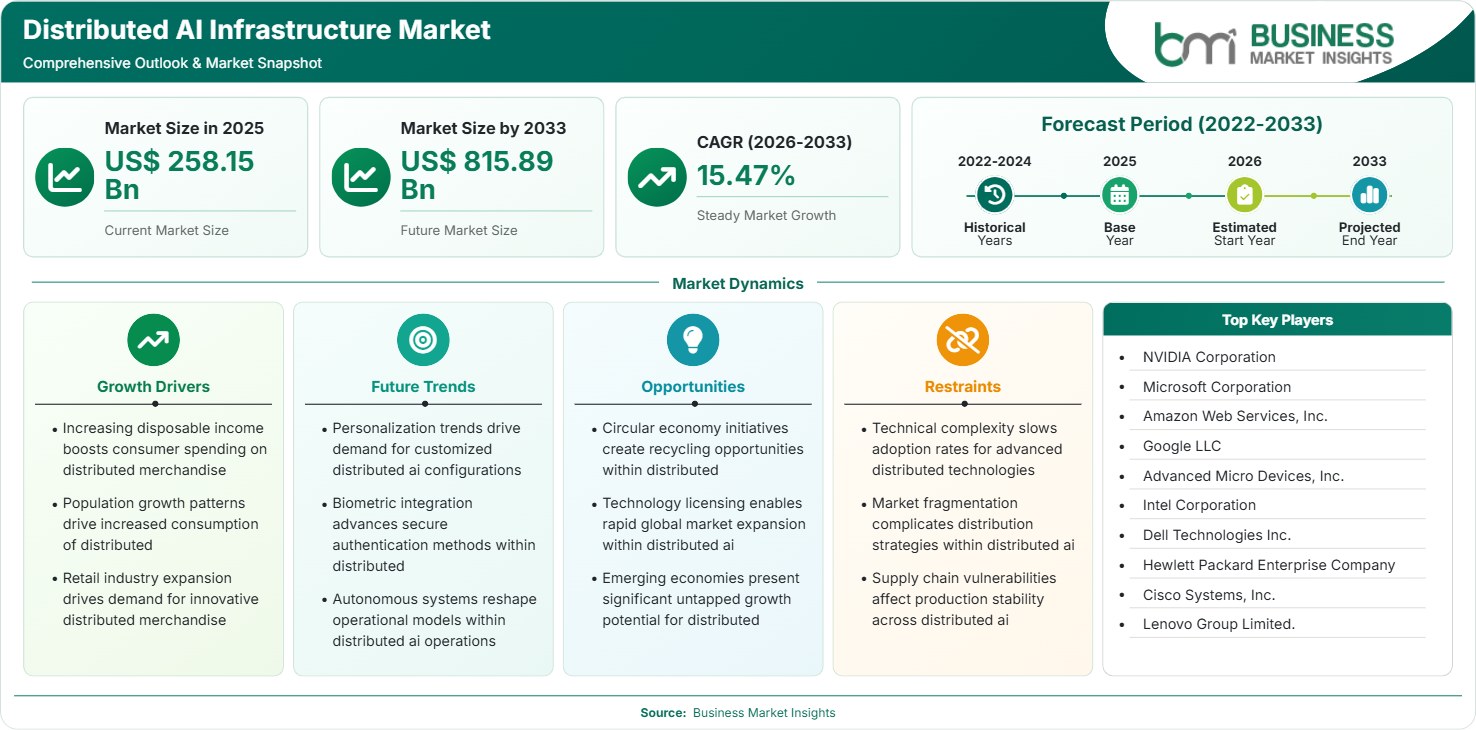
Distributed AI Infrastructure Market Regional Highlights
North America Distributed AI Infrastructure Market
North America held a 38%–40% share in 2025 and is modeled to grow at a 15.0%–15.6% CAGR during 2026–2033. The region benefits from hyperscale cloud providers, advanced semiconductor ecosystems, enterprise AI adoption, and substantial data-center investment. The United States dominates regional demand, while Canada provides additional opportunities through cloud infrastructure and AI research. The Distributed AI Infrastructure Market share remains strongest because leading technology companies continue expanding accelerated compute, networking, storage, and AI services across centralized and distributed environments.
- Hyperscalers continue deploying accelerator-rich infrastructure, increasing demand for AI servers, high-speed interconnects, liquid cooling, storage systems, and integrated orchestration platforms across major data-center clusters.
- Enterprise AI adoption is expanding infrastructure requirements beyond centralized training, creating demand for private AI environments, regional inference, hybrid deployments, and workload-specific computing architectures.
- Networking investment is becoming increasingly important as distributed AI workloads require high-bandwidth, low-latency communication between accelerators, data centers, edge locations, and cloud platforms.
- Power and cooling availability increasingly influence data-center expansion, encouraging infrastructure providers to develop higher-density systems, direct liquid cooling, energy optimization, and workload-aware capacity management.
US Distributed AI Infrastructure Market
The U.S. represented approximately 84%–86% of North American Distributed AI Infrastructure Market demand in 2025 and is modeled at a 15.1%–15.7% CAGR during 2026–2033. Demand is supported by hyperscale cloud expansion, enterprise AI deployment, federal technology initiatives, semiconductor investment, and rapid growth in AI-enabled software services. Microsoft reported substantial capital expenditure focused on GPUs, CPUs, data centers, and cloud capacity, illustrating the infrastructure intensity associated with continued AI adoption.
- Major cloud platforms continue expanding compute capacity, strengthening demand for accelerators, AI servers, networking, storage, and infrastructure management software across regional facilities.
- Sovereign and private AI deployments are increasing as enterprises seek greater control over sensitive data, compliance requirements, model operations, and workload placement.
- Edge infrastructure is expanding across telecommunications, manufacturing, healthcare, retail, and industrial environments where real-time inference requires lower latency and localized processing.
Europe Distributed AI Infrastructure Market
Europe accounted for approximately 22%–24% Distributed AI Infrastructure Market share in 2025 and is modeled at a 14.0%–14.6% CAGR during 2026–2033. Germany, the U.K., France, and the Netherlands remain important infrastructure markets, while France and Germany provide strong opportunities through sovereign computing and industrial AI. European demand is increasingly shaped by data sovereignty, cybersecurity, energy efficiency, and regulatory requirements, creating demand for private, hybrid, and geographically controlled AI infrastructure deployments.
- Germany benefits from industrial automation, automotive AI, manufacturing digitization, research computing, and enterprise demand for localized AI processing and secure infrastructure.
- France is strengthening sovereign AI capabilities through public and private infrastructure initiatives, supporting demand for high-performance computing, cloud platforms, and localized AI services.
- The U.K. provides opportunities through financial services, healthcare, research, cloud adoption, and enterprise AI, requiring secure and scalable compute environments.
- European infrastructure buyers increasingly evaluate energy efficiency, data residency, cybersecurity, and operational sovereignty alongside accelerator performance and infrastructure cost.
Asia Pacific Distributed AI Infrastructure Market
Asia Pacific held approximately 28%–30% Distributed AI Infrastructure Market share in 2025 and is modeled to expand at 16.3%–17.0% CAGR during 2026–2033, making it the fastest-growing region. China, Japan, South Korea, India, Singapore, and Australia are major demand centers. Rapid digitalization, sovereign AI programs, semiconductor investments, hyperscale data centers, telecommunications modernization, and enterprise adoption are strengthening the regional infrastructure pipeline and accelerating distributed deployment models.
- China supports large-scale AI infrastructure demand through domestic computing initiatives, cloud expansion, AI model development, advanced networking, and growing enterprise adoption.
- Japan combines advanced manufacturing, robotics, telecommunications, research, and enterprise technology spending, creating demand for reliable high-performance AI infrastructure.
- India provides significant upside through cloud expansion, digital services, government-backed AI initiatives, enterprise adoption, and growing investment in domestic data-center capacity.
- South Korea and Singapore benefit from semiconductor ecosystems, advanced connectivity, cloud infrastructure, and strategic investment in high-performance computing and AI services.
Rest of World Distributed AI Infrastructure Market
Rest of World represented approximately 7%–9% Distributed AI Infrastructure Market share in 2025 and is modeled at 13.8%–14.6% CAGR during 2026–2033. Latin America is developing through cloud modernization, financial technology, telecommunications, and industrial digitization. Brazil and Mexico provide the strongest opportunities, while the Middle East is investing heavily in sovereign AI, hyperscale data centers, and digital infrastructure. Saudi Arabia and the UAE are emerging as important regional AI infrastructure hubs.
Latin American adoption is supported by financial services, retail, telecommunications, manufacturing, and government digitalization. Middle Eastern investment is increasingly focused on sovereign computing, smart cities, energy optimization, and enterprise AI deployment.
- Brazil provides opportunities through financial technology, industrial AI, cloud services, agriculture technology, and expanding enterprise demand for localized computing infrastructure.
- Mexico benefits from manufacturing digitization, nearshoring, telecommunications modernization, cloud adoption, and AI-enabled industrial applications requiring distributed processing capabilities.
- Saudi Arabia is investing in sovereign AI infrastructure, data centers, digital government, smart-city systems, and large-scale computing ecosystems to support national technology strategies.
- The UAE provides strong potential through cloud services, financial technology, smart infrastructure, government applications, and advanced data-center development supporting regional AI workloads.