
Cloud Infrastructure Services Market Outlook: Size, Share, Trends, Growth Analysis, Competitive Landscape & Forecast, 2026-2033

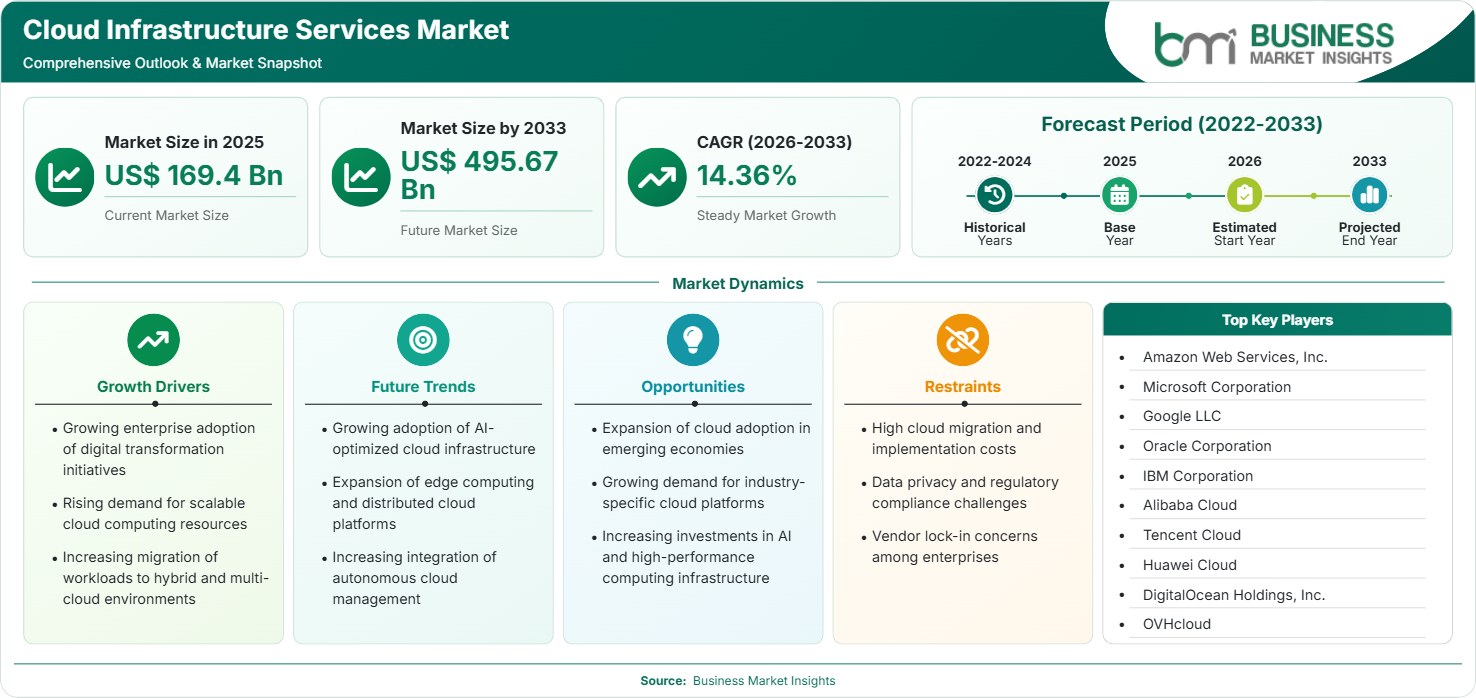
The Cloud Infrastructure Services Market size was valued at US$ 169.4 Billion in 2025 and is projected to reach US$ 495.67 Billion by 2033, growing at a CAGR of 14.36% from 2026 to 2033. Market growth is driven by growing enterprise adoption of digital transformation initiatives, rising demand for scalable cloud computing resources, and increasing migration of workloads to hybrid and multi-cloud environments.

Report Coverage
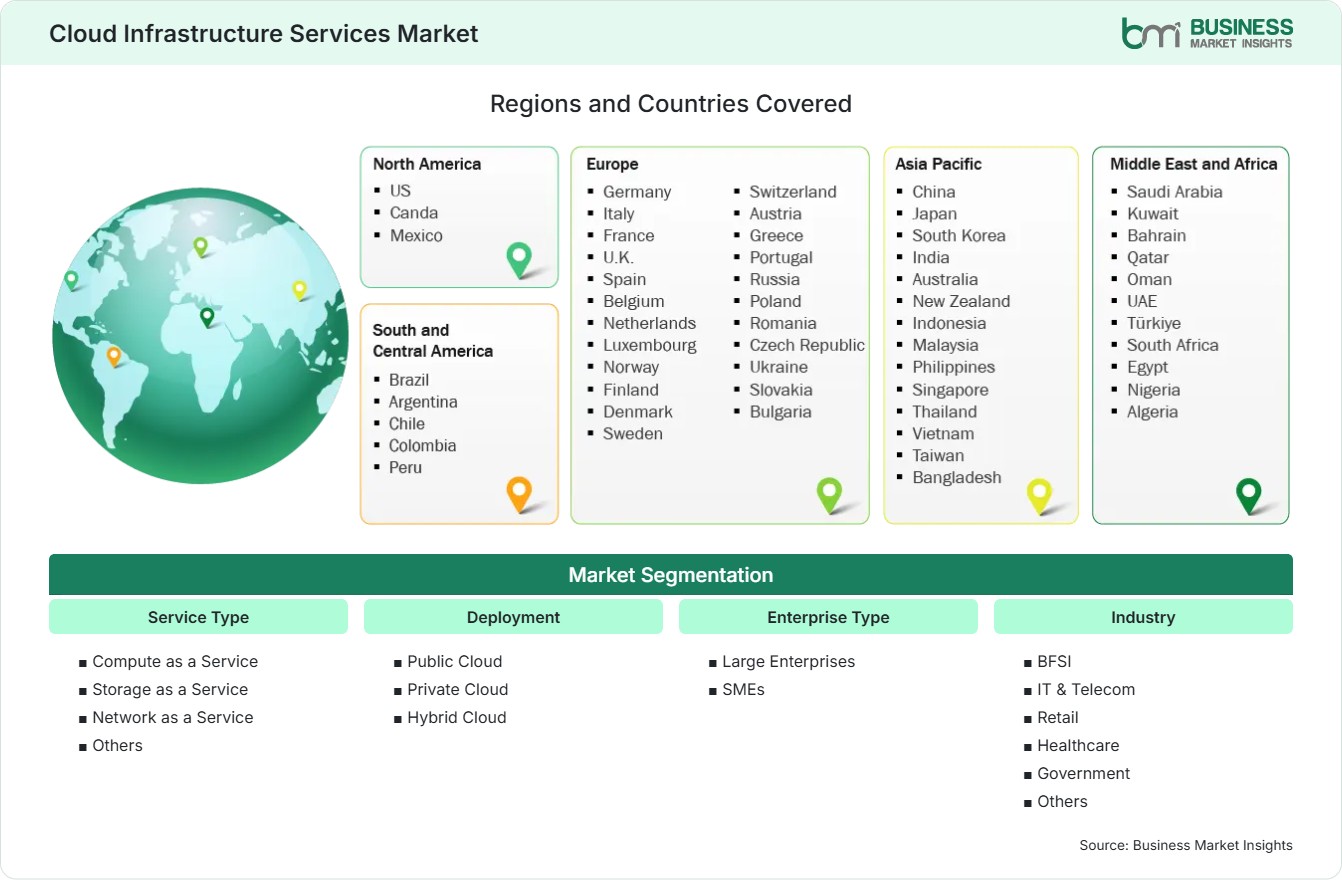
  • Service Type: Compute as a Service, Storage as a Service, Network as a Service, Others
  • Deployment: Public Cloud, Private Cloud, Hybrid Cloud
  • Enterprise Type: Large Enterprises, SMEs
  • Industry: BFSI, IT & Telecom, Retail, Healthcare, Government, Others
US$ 169.4 Bn Market size in 2025
US$ 495.67 Bn Market Size by 2033
14.36% CAGR, 2026 - 2033
2026-2033 Forecast Period

01 AI Overview

Cloud Infrastructure Services Market Summary

  • North America Region: North America held a significant position in the market in 2025 due to strong enterprise cloud adoption, advanced digital infrastructure, and the presence of leading cloud service providers. The region continues to witness increasing investments in cloud security, artificial intelligence infrastructure, and hybrid cloud solutions.
  • Fastest Growing Region: Asia Pacific is expected to witness strong growth during the forecast period due to rapid digitalization, increasing adoption among SMEs, expanding internet connectivity, and rising investments in cloud infrastructure across emerging economies.
  • Leading Segment: Public Cloud represents a major deployment segment due to its scalability, flexibility, and cost advantages for enterprises seeking efficient IT infrastructure solutions.
  • High Growth Segment: Hybrid Cloud is expected to experience strong adoption as organizations increasingly combine public and private cloud environments to improve flexibility, security, and workload optimization.
  • Key Market Opportunity: Expansion of cloud adoption in emerging economies, growing demand for industry-specific cloud platforms, and increasing investments in artificial intelligence and high-performance computing infrastructure are creating new opportunities for cloud service providers.
  • Major Market Players: Amazon Web Services, Inc., Microsoft Corporation, Google LLC, Oracle Corporation, IBM Corporation, Alibaba Cloud, Tencent Cloud, Huawei Cloud, DigitalOcean Holdings, Inc., and OVHcloud.
02 Strategic Insights

Cloud Infrastructure Services Market: Strategic Insights

Cloud Infrastructure Services Market Strategic Framework
FREE PDF
Request your free sample
Request free sample
03 Stakeholder View

Key Takeaways

  • The market ecosystem includes cloud service providers, enterprises, technology vendors, system integrators, and industry-specific solution providers.
  • Increasing digital transformation initiatives are encouraging organizations to migrate workloads from traditional infrastructure to cloud environments.
  • Hybrid and multi-cloud adoption is increasing as enterprises seek improved flexibility, security, and operational efficiency.
  • Large enterprises remain major adopters due to their extensive computing requirements and complex IT environments.
  • Emerging economies provide significant growth opportunities due to increasing digital infrastructure investments.
  • Artificial intelligence, machine learning, and high-performance computing applications are creating additional demand for advanced cloud infrastructure.
04 Geographic Outlook

Cloud Infrastructure Services Market Regional Highlights

North America Cloud Infrastructure Services Market

North America accounted for 35%–38% share in 2025 and is projected to grow at a CAGR of 13.80%–14.50% from 2026 to 2033. The region represents one of the largest markets due to strong enterprise cloud adoption, advanced digital infrastructure, and the presence of leading cloud service providers.

  • The United States remains the primary contributor due to widespread adoption of cloud services among enterprises and technology companies.
  • Organizations are increasingly investing in hybrid cloud models to balance scalability, security, and compliance requirements.
  • Growing artificial intelligence adoption is increasing demand for advanced cloud computing infrastructure.
  • Enterprises are focusing on cloud security solutions to protect sensitive business data and applications.

US Cloud Infrastructure Services Market

The US Cloud Infrastructure Services Market accounted for 32%–35% share of North America in 2025 and is expected to grow at a CAGR of 14.00%–14.70% during 2026–2033. The United States maintains a leading position due to strong digital transformation initiatives, high enterprise technology spending, and the presence of major cloud infrastructure providers.

  • Large enterprises are adopting cloud platforms for enterprise applications, analytics, and digital transformation initiatives.
  • Financial institutions are using cloud infrastructure to improve data processing, security, and customer service capabilities.
  • Healthcare organizations are adopting cloud solutions for data management, analytics, and digital healthcare services.
  • Government agencies are increasing adoption of secure cloud platforms to modernize public services.

Europe Cloud Infrastructure Services Market

Europe accounted for 24%–27% share in 2025 and is projected to grow at a CAGR of 13.20%–13.90% from 2026 to 2033. Market growth is supported by increasing enterprise digitalization, rising adoption of cloud-based applications, and growing demand for secure and compliant cloud infrastructure. Organizations across the region are focusing on improving operational efficiency while meeting strict data protection and regulatory requirements.

  • Financial institutions are adopting cloud services to support digital banking and advanced analytics.
  • Healthcare providers are increasing cloud usage for healthcare data management and digital solutions.
  • Enterprises are investing in secure and compliant cloud infrastructure to meet regional regulations.
  • Cloud providers are expanding regional data center presence to support growing demand.

Asia Pacific Cloud Infrastructure Services Market

Asia Pacific accounted for 27%–30% share in 2025 and is expected to grow at a CAGR of 15.20%–15.90% during 2026–2033. The region is expected to witness strong growth due to rapid digitalization, increasing internet penetration, growing SME adoption, and rising investments in cloud infrastructure in Cloud Infrastructure Services Market.

  • China represents a major contributor due to large-scale enterprise adoption, technology investments, and expansion of domestic cloud infrastructure.
  • India is witnessing increasing cloud adoption among SMEs, startups, financial institutions, and government organizations due to digital transformation initiatives.
  • Southeast Asian countries are investing in cloud infrastructure to support growing digital economies and online services.
  • Enterprises are increasingly adopting hybrid and multi-cloud strategies to improve flexibility and manage complex workloads.
  • Rising demand for artificial intelligence, analytics, and automation solutions is increasing the requirement for advanced cloud computing capabilities.

Rest of World Cloud Infrastructure Services Market

Rest of World accounted for 8%–11% share in 2025 and is projected to grow at a CAGR of 12.80%–13.50% from 2026 to 2033. The Cloud Infrastructure Services Market growth is supported by increasing digital transformation initiatives, improving connectivity infrastructure, and rising enterprise adoption of cloud-based solutions across Latin America, the Middle East, and Africa.

  • Middle Eastern countries are investing in cloud infrastructure as part of digital economy development initiatives.
  • Latin American businesses are adopting cloud services to improve operational efficiency and support online business models.
  • African markets are witnessing increasing demand due to improving internet access and enterprise technology adoption.
  • Cloud providers are expanding regional infrastructure to address growing demand from emerging markets.
Global Market Geography
FREE PDF
Request your free sample
Request free sample
05 Segment Analysis

Cloud Infrastructure Services Market Segmentation

Service Type

The Cloud Infrastructure Services Market by Service Type was dominated by Compute as a Service, which accounted for approximately 40%–45% market share in 2025 and is expected to grow at a CAGR of 14.50%–15.20% from 2026 to 2033. The segment growth is supported by increasing demand for scalable computing resources, enterprise application hosting, artificial intelligence workloads, and high-performance computing solutions.

  • Compute as a Service: Compute services are widely adopted by enterprises seeking flexible access to processing resources without investing heavily in physical infrastructure.
  • Storage as a Service: Storage services are gaining importance due to rising enterprise data volumes and the growing need for secure, scalable, and accessible data management solutions.
  • Network as a Service: Network services are expanding as enterprises require flexible connectivity solutions to support distributed teams, cloud applications, and digital operations.

Deployment

The Cloud Infrastructure Services Market by Deployment was led by Public Cloud, which held approximately 45%–48% market share in 2025 and is projected to grow at a CAGR of 14.00%–14.60% during 2026–2033. The segment growth is driven by scalability, lower infrastructure costs, and increasing adoption among enterprises of all sizes.

  • Public Cloud: Public cloud platforms are widely adopted by enterprises due to their ability to provide computing, storage, and networking resources through flexible consumption models.
  • Private Cloud: Private cloud solutions are preferred by organizations requiring enhanced security, customization, and regulatory compliance.
  • Hybrid Cloud: Hybrid cloud is becoming one of the fastest-growing deployment models as enterprises combine public and private cloud environments to optimize workload management

Enterprise Type

The Cloud Infrastructure Services Market by Enterprise Type was primarily driven by Large Enterprises, which accounted for approximately 65%–70% market share in 2025 due to extensive IT requirements and higher cloud investment capacity. The segment continues to expand as organizations modernize legacy infrastructure and adopt digital transformation strategies.

  • Large Enterprises: Large organizations are adopting cloud infrastructure to modernize legacy systems, improve operational efficiency, and support global business operations.
  • SMEs: Small and medium enterprises are increasingly adopting cloud infrastructure due to lower implementation costs, reduced dependence on physical infrastructure, and improved business flexibility.

Industry

The segment Industry was led by IT & Telecom, which accounted for approximately 25%–30% Cloud Infrastructure Services Market share in 2025 due to extensive use of cloud platforms for digital services, networking, and application management. The segment continues to benefit from increasing demand for scalable infrastructure and advanced technology solutions.

  • BFSI: Financial institutions are adopting cloud infrastructure for digital banking services, financial analytics, fraud detection, and customer experience improvement.
  • IT & Telecom: IT and telecom companies are major users of cloud infrastructure due to increasing demand for digital services, network management, application development, and data processing.
  • Retail: Retail companies are adopting cloud infrastructure to support e-commerce platforms, customer analytics, inventory management, and personalized shopping experiences
  • Healthcare: Healthcare organizations are increasing cloud adoption for electronic health records, medical data management, telemedicine services, and healthcare analytics
  • Government: Government organizations are adopting cloud infrastructure to improve public services, enhance data management, and support digital transformation initiatives.
06 Market Forces

Cloud Infrastructure Services Market Dynamics

Key Market Drivers

Growing enterprise adoption of digital transformation initiatives

The increasing focus on digital transformation across industries is one of the primary factors driving the growth of the Cloud Infrastructure Services Market trends. Organizations are modernizing their IT environments by replacing traditional infrastructure with cloud-based solutions to improve operational efficiency, scalability, and business agility. Cloud infrastructure enables enterprises to deploy applications faster, optimize resource utilization, and access advanced technologies without significant investments in physical infrastructure. Industries such as BFSI, healthcare, retail, manufacturing, and government are increasingly adopting cloud platforms to support digital services, automation, analytics, and customer-focused applications. Enterprises are also using cloud infrastructure to improve collaboration, enable remote operations, and enhance decision-making through real-time data processing. As businesses continue prioritizing technology modernization, demand for reliable and scalable cloud infrastructure services is expected to increase.

Rising demand for scalable cloud computing resources

The growing requirement for flexible and scalable computing resources is significantly contributing to market expansion. Enterprises are generating increasing amounts of data through digital applications, connected devices, online platforms, and business operations, creating demand for advanced computing and storage capabilities. Cloud infrastructure allows organizations to scale resources according to workload requirements without purchasing additional physical hardware. The adoption of artificial intelligence, machine learning, big data analytics, and high-performance computing is further increasing the need for powerful cloud environments. Businesses are relying on cloud service providers to access advanced computing capabilities, improve application performance, and manage complex workloads efficiently. The ability to quickly adjust computing capacity based on demand is becoming a key advantage for organizations adopting cloud infrastructure solutions.

Increasing migration of workloads to hybrid and multi-cloud environments

The growing migration of enterprise workloads to hybrid and multi-cloud environments is accelerating demand for cloud infrastructure services. Organizations are increasingly adopting multiple cloud models to achieve greater flexibility, improve security, optimize costs, and enhance business continuity. Hybrid cloud solutions allow enterprises to combine private infrastructure for sensitive workloads with public cloud resources for scalability and efficiency. Multi-cloud adoption is also increasing as businesses seek to reduce dependency on a single cloud provider and select specialized services from different platforms. Enterprises across financial services, healthcare, and government sectors are using hybrid and multi-cloud strategies to meet regulatory requirements while maintaining operational flexibility. The increasing complexity of enterprise IT environments is expected to support continued adoption of advanced cloud infrastructure solutions.

Key Market Opportunities

Expansion of cloud adoption in emerging economies

The expansion of cloud adoption across emerging economies represents a significant opportunity for cloud infrastructure providers. Developing markets are experiencing rapid digitalization due to increasing internet penetration, smartphone usage, government technology initiatives, and growing investments in digital infrastructure. Businesses in these regions are adopting cloud platforms to reduce IT infrastructure costs, improve operational efficiency, and access advanced technology capabilities. Small and medium-sized enterprises in emerging economies are increasingly using cloud services because they provide affordable access to enterprise-level computing, storage, and networking solutions. Cloud providers are expanding data center facilities and developing localized offerings to address regional requirements. The increasing adoption of digital services in countries across Asia Pacific, Latin America, and the Middle East is expected to create substantial growth opportunities.

Growing demand for industry-specific cloud platforms

The rising demand for industry-specific cloud platforms is creating opportunities for providers to develop customized solutions designed for sector-specific requirements. Different industries require specialized cloud environments with specific security standards, compliance capabilities, and application functionalities. Cloud providers are increasingly developing solutions tailored for BFSI, healthcare, retail, government, and other industries. Healthcare organizations require secure cloud platforms for managing patient information and healthcare applications, while financial institutions need highly secure and compliant environments for digital banking and financial services. Industry-focused cloud solutions allow providers to differentiate their offerings and address unique business challenges. Increasing demand for customized cloud platforms is expected to create new revenue opportunities for market participants.

Increasing investments in AI and high-performance computing infrastructure

Growing investments in artificial intelligence and high-performance computing infrastructure are creating significant opportunities within the Cloud Infrastructure Services Market growth. AI applications require advanced computing power, large-scale data processing capabilities, and specialized infrastructure, increasing dependence on cloud platforms. Enterprises are increasingly using cloud-based AI services for automation, predictive analytics, customer personalization, and operational optimization. Cloud providers are expanding AI-ready infrastructure by investing in advanced processors, accelerated computing systems, and machine learning platforms. The increasing adoption of generative AI, analytics, and automation across industries is expected to further increase demand for cloud infrastructure capable of supporting complex workloads.

Market Restraints and Challenges

High cloud migration and implementation costs

Factor: High migration and implementation costs remain a major challenge for organizations adopting cloud infrastructure services. Moving existing applications, databases, and workloads from traditional IT environments to cloud platforms requires investments in migration tools, consulting services, cybersecurity solutions, employee training, and system integration.

Impact: High upfront costs can delay cloud adoption, particularly among SMEs with limited technology budgets. Organizations may also face challenges related to workload optimization, cloud cost management, and achieving expected returns on investment after migration. Cloud providers are addressing this challenge through flexible pricing models, managed cloud services, migration assistance, and automated tools that simplify cloud adoption.

Data privacy and regulatory compliance challenges

Factor: Data privacy and regulatory compliance concerns represent significant challenges as organizations increasingly store sensitive business and customer information on cloud platforms. Industries such as BFSI, healthcare, and government operate under strict regulations related to data security, storage location, and information access.

Impact: Compliance requirements can influence cloud adoption decisions and increase operational complexity for enterprises. Organizations need robust encryption, identity management, monitoring systems, and security policies to protect cloud-based data. Cloud providers are investing in compliance certifications, security technologies, and region-specific infrastructure to improve customer trust and address regulatory challenges.

Cybersecurity risks associated with cloud environments

Factor: Increasing dependence on cloud platforms is creating concerns regarding cybersecurity threats such as data breaches, unauthorized access, malware attacks, and cloud misconfiguration. As enterprises migrate critical workloads to cloud environments, protecting digital assets and maintaining secure access controls become essential requirements.

Impact: Security concerns may slow adoption among organizations managing sensitive information and increase demand for advanced cloud security solutions. Enterprises are investing in threat monitoring, identity management, and security automation technologies to strengthen cloud protection. Cloud providers are enhancing built-in security capabilities and developing integrated cybersecurity solutions to address evolving threats.

07 Company Analysis

Competitive Landscape

The Cloud Infrastructure Services Market analysis is highly competitive, with global technology companies focusing on expanding cloud capabilities, improving infrastructure availability, enhancing cybersecurity, and developing solutions for industry-specific requirements. Leading cloud providers are investing in artificial intelligence infrastructure, hybrid cloud platforms, automation technologies, and advanced data management solutions to support increasing enterprise demand.

Company Name

Overview

Products and Services relevant to this market

Amazon Web Services, Inc.

A leading global cloud computing provider offering infrastructure solutions for enterprises, governments, and developers.

Provides computing, storage, networking, database, analytics, artificial intelligence, security, and hybrid cloud infrastructure services.

Microsoft Corporation

A global technology company providing cloud computing, enterprise software, and digital transformation solutions.

Offers Azure cloud infrastructure, computing resources, storage, networking, AI services, cybersecurity solutions, and enterprise cloud platforms.

Google LLC

A technology company focused on cloud computing, artificial intelligence, and data-driven solutions.

Provides Google Cloud services including infrastructure, data analytics, machine learning, storage, networking, and cloud-native application solutions.

Oracle Corporation

A technology provider specializing in enterprise applications, databases, and cloud infrastructure.

Offers Oracle Cloud Infrastructure with computing, storage, database, networking, and enterprise application solutions.

IBM Corporation

A global technology company focused on hybrid cloud, artificial intelligence, automation, and enterprise solutions.

Provides hybrid cloud platforms, cloud consulting, infrastructure management, automation, and AI-enabled cloud services.

Alibaba Cloud

A major cloud service provider offering digital infrastructure and cloud solutions across global markets.

Provides elastic computing, storage, networking, database services, AI solutions, and enterprise cloud platforms.

Tencent Cloud

A cloud computing provider offering infrastructure and digital solutions for enterprises and technology businesses.

Provides cloud computing, storage, networking, database management, AI capabilities, and industry-focused cloud services.

Huawei Cloud

A cloud service provider delivering digital infrastructure and enterprise cloud solutions.

Offers cloud computing, storage, networking, artificial intelligence services, and digital transformation solutions.

DigitalOcean Holdings, Inc.

A cloud platform provider focused on developers, startups, and growing businesses.

Provides cloud computing services, managed databases, storage solutions, application deployment tools, and developer-focused platforms.

OVHcloud

A European cloud provider offering infrastructure and hosting services.

Provides cloud servers, dedicated infrastructure, storage services, private cloud solutions, and data center services.

10 Trust & Transparency

Research Methodology

The market analysis combines proprietary research with secondary data from government agencies, company disclosures, regulatory filings, industry databases and expert interviews. Market estimates are validated through data triangulation, cross-market benchmarking and analyst review.

View Full Research Methodology

11 Questions Answered

Frequently Asked Questions

6. How can stakeholders use the Cloud Infrastructure Services Market Report?

The report helps cloud providers, technology companies, investors, enterprises, and industry stakeholders understand market trends, competitive strategies, regional opportunities, technology adoption patterns, and future growth potential.

What opportunities exist for cloud infrastructure providers?

Significant opportunities exist through cloud adoption in emerging economies, development of industry-specific cloud platforms, expansion of hybrid cloud solutions, and increasing investments in AI and high-performance computing infrastructure.

How is artificial intelligence impacting demand for cloud infrastructure services?

Artificial intelligence is increasing demand for cloud infrastructure by requiring advanced computing power, large-scale data storage, and high-performance processing capabilities.

Which deployment model is gaining strong adoption in the Market?

Hybrid Cloud is gaining strong adoption as organizations seek flexibility, security, and improved workload management. Hybrid environments allow enterprises to combine private and public cloud resources based on application requirements, compliance needs, and operational objectives.

Why are enterprises migrating workloads to cloud infrastructure?

Enterprises are migrating workloads to cloud infrastructure to improve scalability, reduce hardware investments, enhance operational efficiency, and access advanced computing capabilities.

What factors are driving growth in the Cloud Infrastructure Services Market forecasts?

The market growth is driven by increasing enterprise digital transformation initiatives, rising demand for scalable computing resources, growing migration of workloads to hybrid and multi-cloud environments, and increasing investments in artificial intelligence and high-performance computing infrastructure.

Access the Full Cloud Infrastructure Services Market Report

Get segment-level forecasts, regional estimates, competitive benchmarking, company profiles and downloadable Excel datasets.

Access the full Cloud Infrastructure Services Market Report
350 pages PDF & Excel | 2026-08-12