Big Data Technology Market Regional Highlights
North America Big Data Technology Market
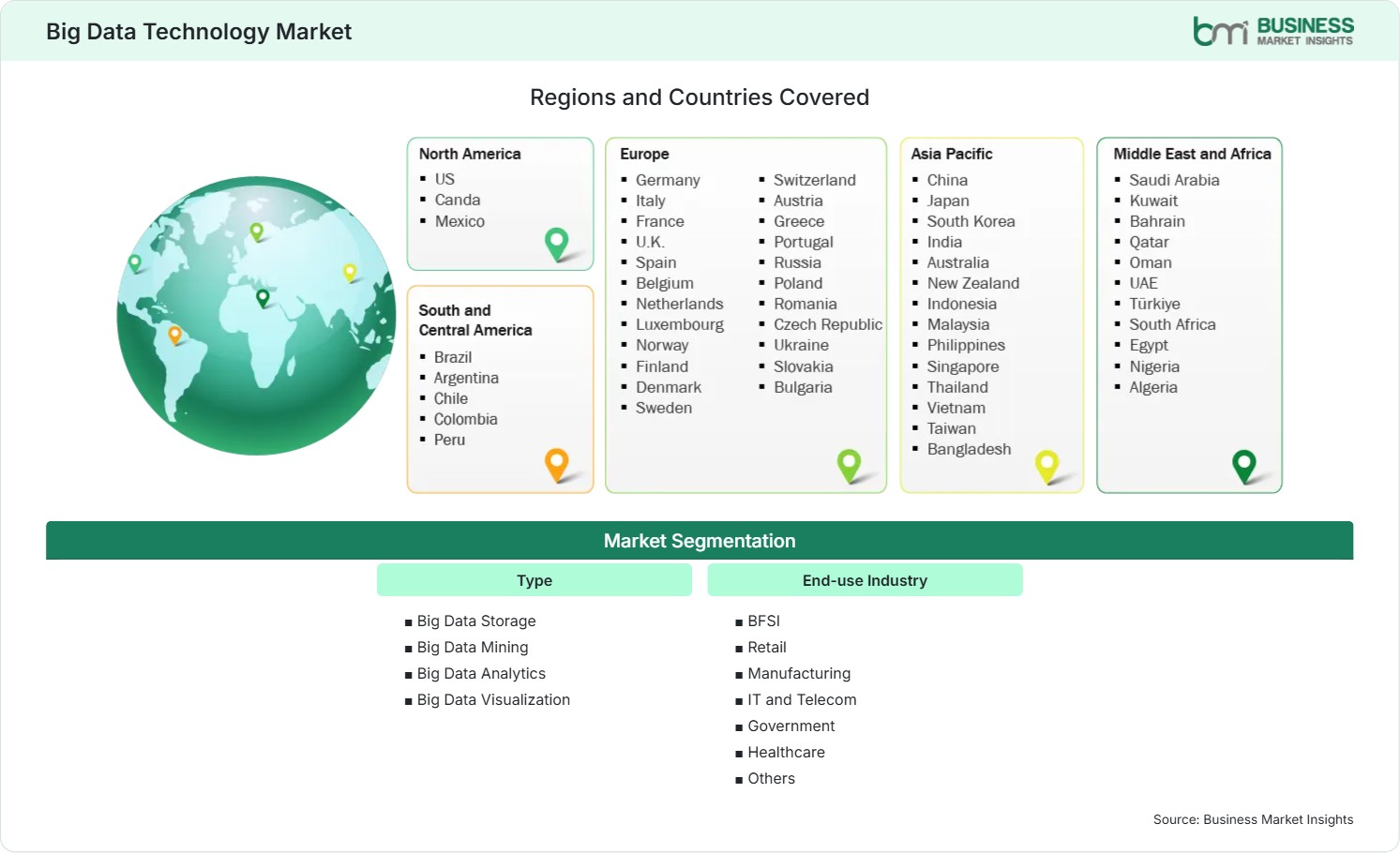
North America holds a 35%–38% share in 2025 and is projected to grow at a 13%–15% CAGR during 2026–2033. The region benefits from mature cloud infrastructure, high enterprise software penetration, AI investment, and strong demand for governed analytics. The market share remains supported by financial services, technology, healthcare, and government adoption. The Big Data Technology Market growth outlook is reinforced by increasing use of AI-ready databases and lakehouse architectures.
- The modernisation of enterprise systems is focusing on unified data estates, which enables organisations to combine their fragmented data warehouses, data lakes, operational databases, and analytics environments while cutting down on duplication and enhancing governance within their ever-more complex technology stacks.
- The demand for vector searches, retrieval pipelines, semantic modeling, and governed data access is rising owing to increased adoption of AI, which creates additional spending areas apart from those related to legacy storage and reporting systems.
- Financial institutions are still investing in real-time fraud detection, customer intelligence, risk analytics, and regulatory reporting, which means that sophisticated data processing has become a key element of their digital operating models.
- Healthcare organisations are extending their use of analytics to include population management, operational efficiency, research, and personalised care while still keeping the strict requirements relating to privacy, security, and data governance.
US Big Data Technology Market
In 2025 the United States accounts for 29% to 32% of global demand for Big Data Technology market and is expected to grow at a 13% to 15% compound annual growth rate until 2033. This leading position is due to extensive use of cloud services, ongoing software innovation, the presence of hyperscale infrastructure, substantial venture investment, and the quick adoption of artificial intelligence by enterprises. Large technology companies are combining analytics with AI agents, databases, and application development. The fact that there is a high concentration of platform vendors and specialized developers also speeds up the pace of competitive product cycles and enables more enterprise experimentation.
- Financial services are still a major centre of demand since organisations make use of distributed data processing for the purposes of fraud prevention, risk management, customer segmentation, algorithmic decision support, and compliance automation.
- Increasingly, technology companies are viewing governed enterprise data as an asset for AI production, which in turn leads to a greater need for cataloging, lineage, vector retrieval, observability, and secure model access.
- Healthcare analytics is being extended via interoperability, population health management, clinical research, and administrative automation, while the need to protect privacy is promoting the use of hybrid and controlled data architectures.
Europe Big Data Technology Market
Europe represents a 24%–27% Big Data Technology Market share in 2025 and is projected to expand at a 12%–14% CAGR during 2026–2033. Germany, UK, and France continue to be dominant markets due to industrial digitalization, finance, and enterprise IT maturity. Spain and Italy offer new growth opportunities. Data strategies for Europe focus on sovereignty, transparency, privacy, and responsible AI, thus driving the need for governed platforms. Germany’s market should grow at around 13%–15% CAGR, whereas the French one should be close to 13%–15%.
- Industrial analytics represents a major opportunity in Europe since manufacturers are increasingly combining machine data, supply-chain information, quality records, and signals from predictive maintenance within single analytical environments.
- Financial institutions are giving priority to explainable analytics and the controlled use of AI, which in turn is increasing the demand for metadata management, lineage, access controls, and auditable analytical workflows.
- The need to regard data sovereignty has led European companies to assess private-cloud, sovereign-cloud, and hybrid architectures, which advantages those providers who are able to maintain consistent governance across various deployment locations.
- The need for interoperable data platforms is growing because of the expansion of digitization within the public sector, these platforms having to combine administrative data sets while at the same time keeping strict access, privacy, and retention controls.
Asia Pacific Big Data Technology Market
Asia Pacific accounts for a 27%–30% Big Data Technology Market share in 2025 and is projected to record a 16%–18% CAGR through 2033, making it the fastest-growing major region. China, Japan, India, South Korea, and Singapore are leading adoption, while India and Southeast Asia provide strong incremental opportunities. India is positioned around 18%–20% CAGR, supported by digital services and enterprise modernization, while China remains a major infrastructure and AI deployment center.
- The pace at which manufacturing is being modernised is increasing the demand for predictive maintenance, computer-vision analytics, industrial IoT processing, and supply-chain intelligence in the automotive, electronics, machinery, and process industries.
- The growing digital economy in India is leading to an increased demand for analytics that can be scaled to support activities in the banking, telecommunications, retail, government services, healthcare, and technology-enabled small and medium enterprises sectors.
- Both Japan and South Korea place great importance on intelligent manufacturing, robotics, semiconductor ecosystems, and the automation of businesses, and they are enhancing the value of real-time processing as well as that of high-performance analytical infrastructure.
- The economies of the Southeast Asian region are expanding their abilities in cloud computing and digital commerce, which in turn is leading to a greater demand for customer analytics, fraud monitoring, recommendation systems, and operational intelligence.
Rest of World Big Data Technology Market
Rest of World represents approximately 10%–13% of global Big Data Technology Market demand in 2025 and is projected to grow at a 11%–14% CAGR during 2026–2033. South and Central America benefit from financial inclusion, digital commerce, telecom modernization, and government digitization. Brazil and Mexico are leading markets, while Colombia and Chile provide additional opportunities. Brazil is positioned near 13%–15% CAGR, supported by financial technology and enterprise modernization.
The Middle East and Africa are developing through smart-city programs, digital government, telecommunications investment, banking modernization, and cloud infrastructure expansion. The UAE and Saudi Arabia lead regional Big Data Technology Market adoption, while South Africa remains an important African market. Saudi Arabia is projected around 14%–16% CAGR, reflecting public-sector digital investment and diversification initiatives.
- The modernisation of the banking industry is leading to a demand for real-time customer analytics, fraud detection, credit scoring, and automated regulatory procedures in emerging financial systems.
- Telecommunications companies are using analytics in order to enhance network performance, customer retention, capacity planning, and monetization since the amount of data across mobile and broadband networks is increasing.
- Smart city initiatives are generating new types of work involving transportation, utilities, public safety, environmental monitoring, and citizen services, which is leading to greater demand for data infrastructure that is both scalable and interoperable.
- The fact that the cloud is expanding is lowering the barriers to adoption for organizations which had previously lacked the kind of capital-intensive infrastructure, and this is allowing them to access analytics and distributed processing on a subscription basis.