
Augmented Analytics Market Outlook: Size, Share, Trends, Growth Analysis, Competitive Landscape & Forecast, 2026-2033

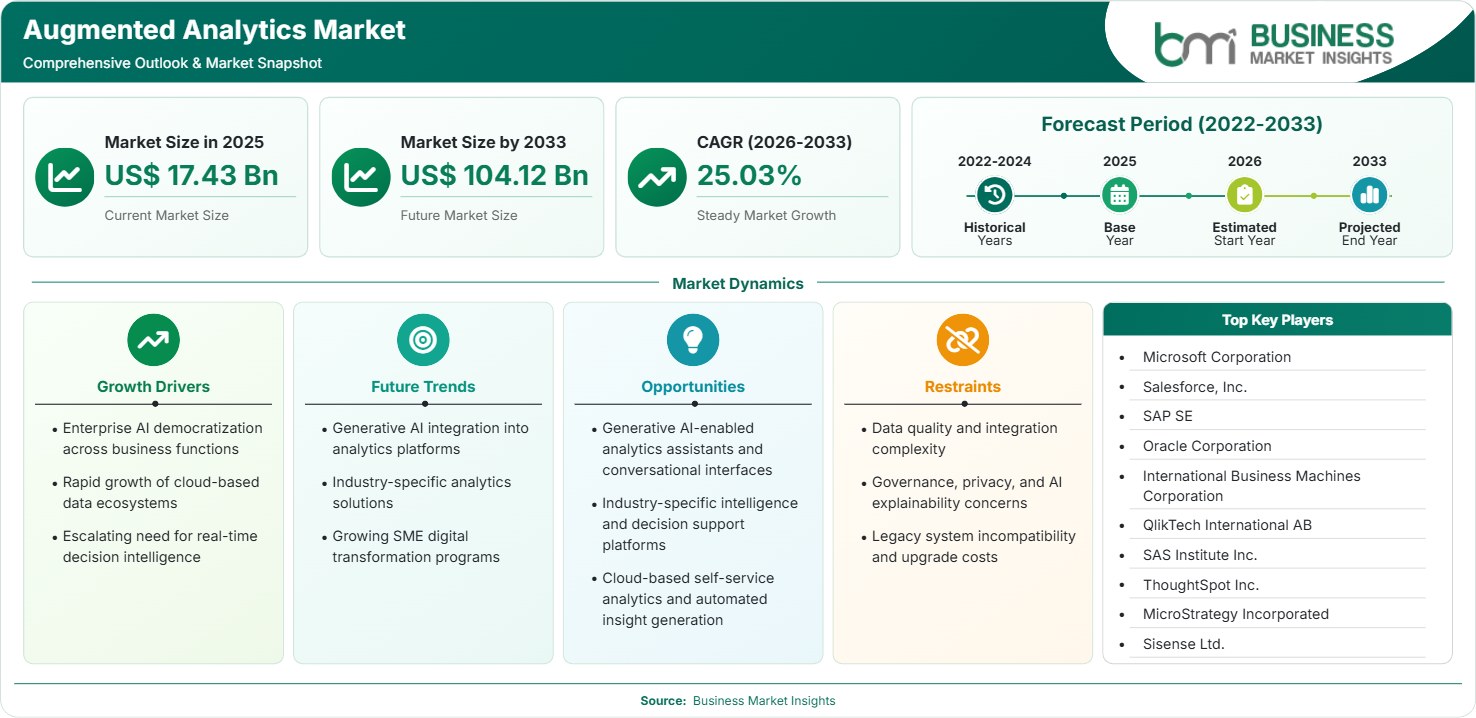
The Augmented Analytics Market size was valued at US$ 17.43 Billion in 2025 and is projected to reach US$ 104.12 Billion by 2033, growing at a CAGR of 25.03% during 2026–2033. Key drivers include enterprise AI adoption, self-service business intelligence, natural language querying, cloud migration, and automated insight generation, while opportunities stem from generative AI integration, industry-specific analytics platforms, and expanding SME digital transformation initiatives.

Report Coverage
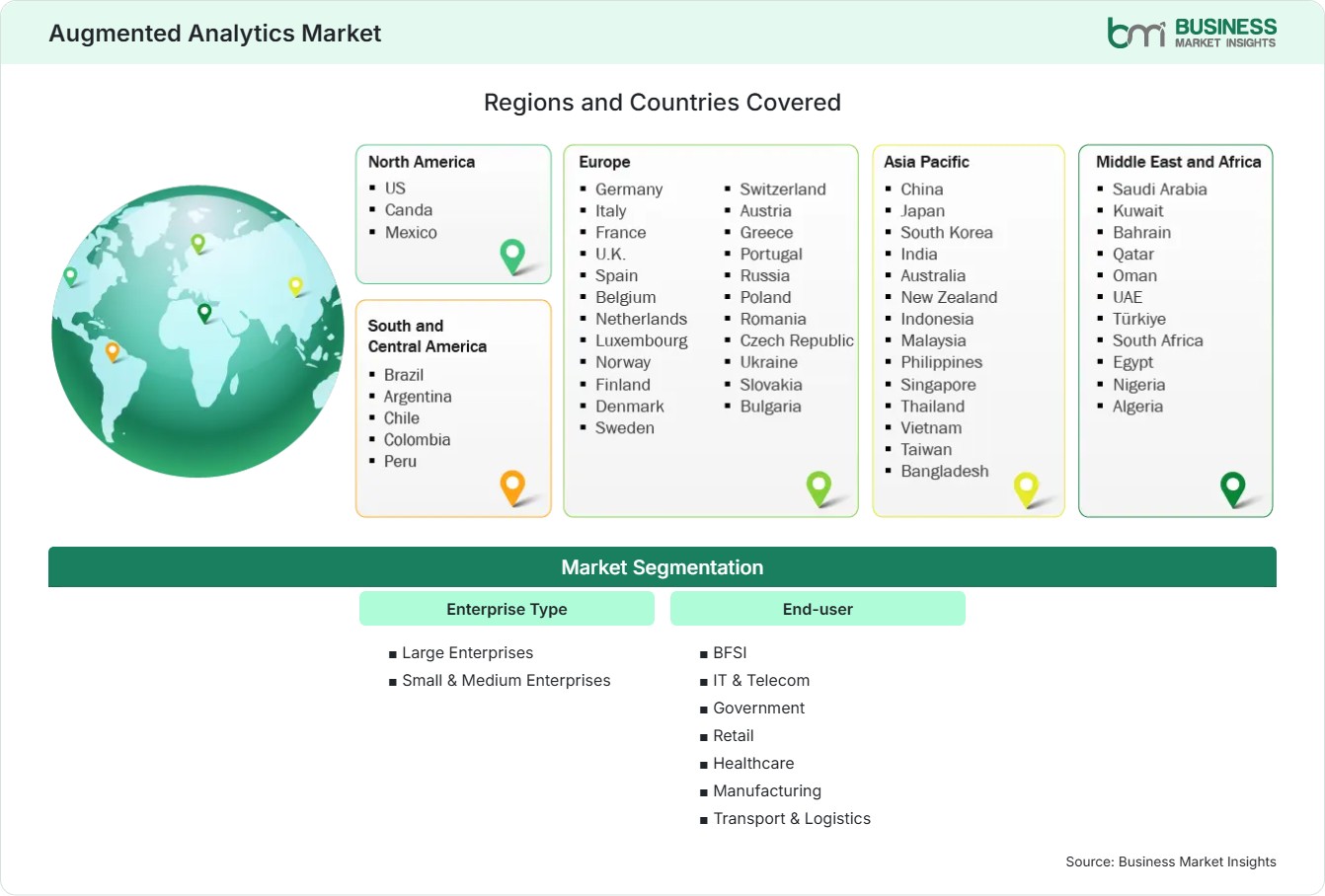
  • Enterprise Type: Large Enterprises, Small & Medium Enterprises
  • End-user: BFSI, IT & Telecom, Government, Retail, Healthcare, Manufacturing, Transport & Logistics
US$ 17.43 Bn Market size in 2025
US$ 104.12 Bn Market Size by 2033
25.03% CAGR, 2026 - 2033
2026-2033 Forecast Period

AI Overview

Augmented Analytics Market Summary

  • North America Region: North America holds a market share of 38%–41% in 2025, growing at a CAGR of 23%–25% during 2026–2033. Strong AI investments, mature cloud ecosystems, enterprise analytics modernization, and generative AI deployment support adoption across industries while creating opportunities for embedded intelligence and operational automation. The U.S. benefits from large-scale enterprise software spending and AI innovation, advancing at 24%–26% CAGR.
  • Fastest Growing Region: Asia Pacific holds 24%–27% share in 2025 and is expected to expand at 28%–30% CAGR. Accelerating digitalization, rising cloud penetration, government-backed AI programs, growing enterprise data volumes, and analytics democratization initiatives create substantial opportunities for vendors and platform providers.
  • Leading Segment: Large Enterprises account for 68%–71% share in 2025 and are projected to grow at 24%–26% CAGR. Adoption is supported by large data infrastructures, enterprise-wide AI strategies, governance requirements, and demand for predictive decision-making capabilities across multiple business functions.
  • High Growth Segment: Healthcare represents 10%–13% share in 2025 and is forecast to grow at 29%–31% CAGR. Increased clinical data generation, predictive care initiatives, operational efficiency requirements, population health management, and AI-assisted diagnostics continue expanding implementation opportunities.
  • Key Market Opportunity: Organizations increasingly seek analytics platforms integrating generative AI, conversational interfaces, and automated recommendations, enabling broader workforce participation, reducing specialist dependency, improving decisions, accelerating insights, and enhancing enterprise productivity.
  • Major Market Players: Microsoft Corporation, Salesforce, Inc., SAP SE, Oracle Corporation, International Business Machines Corporation, QlikTech International AB, SAS Institute Inc., ThoughtSpot Inc., MicroStrategy Incorporated, Sisense Ltd.
Strategic Insights

Augmented Analytics Market: Strategic Insights

Augmented Analytics Market Strategic Framework
FREE PDF
Request your free sample
Request free sample
Stakeholder View

Key Takeaways

  • The value chain is increasingly centered on cloud infrastructure providers, AI model developers, business intelligence vendors, and data integration specialists delivering unified analytics experiences.
  • Healthcare and SME deployments present compelling upside as organizations seek automated insights without expanding large data science teams.
  • Generative AI-enabled analytics assistants are accelerating the transition from dashboard interpretation toward conversational decision support and automated recommendations.
  • Asia Pacific offers the strongest geographic investment opportunity due to enterprise digitalization initiatives in India, China, and Southeast Asia.
  • Strategic acquisitions increasingly focus on AI automation, data governance, and analytics integration capabilities as vendors pursue platform consolidation.
  • Industry-specific analytics solutions are emerging as a key differentiator, particularly in regulated sectors requiring explainability, compliance, and auditability.
Geographic Outlook

Augmented Analytics Market Regional Highlights

North America Augmented Analytics Market

North America accounted for approximately 38%–41% of global revenue in 2025 and is expected to expand at a 23%–25% CAGR through 2033. The region benefits from advanced cloud infrastructure, strong enterprise technology spending, and widespread deployment of AI-powered business intelligence solutions. Large organizations continue prioritizing automation of analytics workflows and governance frameworks. The Augmented Analytics Market share leadership of North America reflects extensive adoption across banking, healthcare, retail, and technology sectors, supported by a mature ecosystem of software vendors and AI innovators.

  • Enterprises increasingly integrate generative AI assistants within analytics environments, reducing manual reporting time and improving accessibility for non-technical business users.
  • BFSI organizations accelerate predictive risk analytics investments as regulatory requirements and fraud detection demands become increasingly complex.
  • Cloud-native deployments continue replacing legacy reporting tools, supporting scalability, interoperability, and faster insight delivery.
  • Strong venture funding activity and technology partnerships foster commercialization of innovative analytics capabilities.

US Augmented Analytics Market

The United States represents 78%–82% of North American revenue and is projected to grow at 24%–26% CAGR. Demand is supported by rapid AI adoption, high enterprise software spending, and significant investments in digital transformation. Major technology vendors, cloud service providers, and analytics innovators maintain a strong presence, accelerating commercialization and deployment. Advanced adoption within healthcare, finance, and telecommunications continues driving innovation while organizations prioritize decision automation, operational intelligence, and productivity enhancement.

  • Enterprises increasingly deploy analytics copilots capable of conversational querying and automated insight recommendations for business users.
  • Financial institutions leverage predictive analytics to improve compliance, customer segmentation, and risk scoring performance.
  • Healthcare providers utilize automated analytics for population health management, clinical planning, and resource optimization.
  • Investments in hybrid-cloud environments encourage broader analytics integration across enterprise functions.

Europe Augmented Analytics Market

Europe captured 27%–30% of global revenue in 2025 and is forecast to advance at 22%–24% CAGR. Regulatory focus on trustworthy AI and digital transformation programs continue shaping adoption priorities. Germany remains the largest regional market, while Spain and several Central European countries register higher growth rates. Organizations increasingly invest in analytics automation to improve productivity and decision-making efficiency while maintaining robust data governance requirements. Growth remains supported by manufacturing, financial services, and public-sector modernization initiatives.

  • Germany leads regional adoption with extensive industrial analytics deployment supporting smart manufacturing strategies.
  • Spain exhibits among the highest regional growth rates through expanding cloud and AI investment programs.
  • GDPR-aligned governance requirements encourage investment in transparent and explainable analytics platforms.
  • Manufacturing organizations increasingly utilize predictive analytics to optimize production and maintenance operations.

Asia Pacific Augmented Analytics Market

Asia Pacific held 24%–27% of revenue in 2025 and is anticipated to register the fastest expansion at 28%–30% CAGR. Accelerating cloud adoption, rising data volumes, and government-backed AI initiatives are driving market momentum. China remains the largest regional contributor, while India demonstrates exceptional growth prospects supported by enterprise digital transformation investments. Organizations across banking, telecommunications, healthcare, and retail sectors are increasingly adopting automated analytics tools to improve competitiveness and decision speed.

  • India records some of the strongest growth rates due to expanding analytics adoption among digital enterprises.
  • China benefits from large-scale AI investment and widespread enterprise technology modernization initiatives.
  • SMEs increasingly adopt cloud-based analytics solutions because implementation costs continue declining.
  • Telecom providers leverage AI-driven analytics to improve customer experience and network optimization.
  • Regional startup ecosystems support innovation across predictive analytics and business intelligence technologies.

Rest of World Augmented Analytics Market

Rest of World represented approximately 8%–11% of market revenue in 2025 and is projected to grow at 24%–27% CAGR. South and Central America benefit from expanding cloud infrastructure investments and growing digital transformation initiatives among enterprises. In the Middle East and Africa, smart-city projects, public-sector digitalization, and increasing AI investments strengthen analytics demand. Brazil leads Latin America, while Saudi Arabia and the United Arab Emirates remain influential growth centers across MEA.

  • Brazil drives regional adoption through banking modernization and enterprise digital transformation programs.
  • GCC countries continue investing in AI-driven government and smart-city initiatives.
  • Cloud deployment models improve accessibility for mid-sized organizations with limited analytical resources.
  • Retail and logistics sectors increasingly utilize predictive forecasting and customer intelligence solutions.
  • Growing technology partnerships accelerate local ecosystem development and analytics capability expansion.
Global Market Geography
FREE PDF
Request your free sample
Request free sample
Segment Analysis

Augmented Analytics Market Segmentation

Enterprise Type

Enterprise Type accounted for the majority of spending, with large organizations maintaining 68%–71% share in 2025 and growing at 24%–26% CAGR. Adoption is driven by expanding data volumes, AI integration priorities, and governance requirements. The Augmented Analytics Market scope continues broadening as cloud-native platforms reduce adoption barriers and improve accessibility among organizations of different sizes.

  • Large Enterprises: Extensive data environments, AI transformation programs, and enterprise governance requirements support strong implementation of automated analytics across finance, operations, marketing, and strategic planning functions.
  • Small & Medium Enterprises: Cloud delivery models and subscription pricing improve affordability, enabling businesses to access advanced analytics capabilities without maintaining large internal data science teams.

End-user

End-user demand remains diversified, with BFSI representing the largest share at 18%–21% in 2025, while Healthcare demonstrates the strongest projected growth at 29%–31% CAGR. The Augmented Analytics Market trends increasingly reflect demand for industry-specific intelligence platforms capable of delivering contextual insights, predictive recommendations, and workflow automation.

  • BFSI: Institutions utilize automated analytics for fraud detection, risk management, customer segmentation, compliance monitoring, and operational optimization.
  • IT & Telecom: Organizations deploy analytics to improve network management, customer experience, service quality measurement, and predictive maintenance activities.
  • Government: Public agencies adopt data-driven decision systems supporting resource allocation, citizen service improvement, and performance management initiatives.
  • Retail: Retailers leverage customer analytics, demand forecasting, pricing optimization, and inventory intelligence to enhance profitability.
  • Healthcare: Providers use analytics platforms for clinical decision support, patient outcomes management, operational efficiency, and resource utilization.
  • Manufacturing: Predictive maintenance, quality monitoring, production optimization, and supply-chain visibility remain important adoption areas.
  • Transport & Logistics: Analytics adoption supports route optimization, demand forecasting, fleet utilization monitoring, and operational efficiency improvements.
Market Forces

Augmented Analytics Market Dynamics

Key Market Drivers

Enterprise AI Democratization Across Business Functions

Organizations increasingly require analytics capabilities accessible to non-technical employees. With respect to data discovery, natural language search queries, and automated visualization processes, the reliance on expert analysts is being minimized. As per the OECD digital adoption indicators, companies have continued to make investments in data-driven and AI-enabled systems. These changes lead to the greater use of analytics technologies. In addition, the increased data complexity in industries such as finance, healthcare, telecoms, and manufacturing drives this demand.

Rapid Growth of Cloud-Based Data Ecosystems

Cloud migration has transformed how organizations store, process, and analyze information. Increasingly, enterprises find themselves operating hybrid/multi-cloud infrastructures that necessitate the need for scalable analytics infrastructure. The augmented platforms provide means for unifying structured/unstructured data and enabling automatic insights. The increasing investment in cloud provides a conducive environment for the adoption of advanced analytics, as implementation is easier and infrastructure constraints are reduced. The vendors continue to embed AI/machine learning in cloud products, making their adoption easier.

Escalating Need for Real-Time Decision Intelligence

In highly competitive industries, organizations increasingly depend on near-real-time decision intelligence to optimize operations, improve customer experiences, and maintain a competitive advantage. The ability of technologies like anomaly detection, forecasting, and recommendations allows companies to spot new trends and act in a proactive manner. The fast pace of development of data through digital channels, internet-connected devices, and enterprise applications exceeds the capacities for manual processing of data. In this way, firms are deploying intelligent automation technologies that improve precision, speed, and responsiveness without reporting lags and decision-making risks.

Key Market Opportunities

Generative AI Integration into Analytics Platforms

Generative AI is changing the face of analytics applications as it enhances their functionality to offer much more than just reporting and visualizing data. Some of the functionalities offered include automated insights, narrative analysis, and context-based recommendations. This way, generative AI makes it easier for technical and non-technical people to make use of data. As enterprises increase investments in AI-driven solutions, vendors integrating large language models can gain a competitive advantage, accelerate self-service analytics adoption, enhance user engagement, and create new revenue opportunities aligned with long-term Augmented Analytics Market forecasts.

Industry-Specific Analytics Solutions

Demand for industry-specific analytics solutions is growing as organizations seek platforms tailored to unique operational workflows, compliance standards, and business objectives. Healthcare professionals need intelligent solutions to provide high-quality care, better manage their resources, and comply with regulations. Banking and financial organizations use platforms for managing risks, identifying fraudulent behavior, and ensuring compliance. Specialized platforms allow for more rapid deployment and easier implementation. Companies that concentrate on acquiring knowledge in verticals can achieve higher customer satisfaction and loyalty and grow market share by delivering clear benefits and ROI.

Growing SME Digital Transformation Programs

Small and medium enterprises (SMEs) increasingly view analytics as a strategic necessity rather than a competitive advantage. Cloud-based and subscription-based solutions reduce initial capital expenditure and streamline implementation. Data preparation automation, artificial intelligence-based analytics, and reporting automation can be helpful in overcoming the talent gap and making the decision-making process faster and better informed. With increasing digitalization in developing countries, there are a lot of growth prospects for vendors that offer affordable analytics solutions.

Market Restraints and Challenges

Data Quality and Integration Complexity

Factor: Many organizations operate in fragmented data environments that include inconsistent data formats, legacy systems, and disconnected repositories.

Impact: These challenges create significant barriers to effective analytics and digital transformation initiatives. Bad data quality can result in incorrect analysis, erroneous prediction, and low confidence in the advice that comes from the automation process. No matter how advanced the analytics platform or the AI solution might be, their effectiveness will be compromised by the bad quality of the input data. Besides, implementing any integration solution can be costly in terms of both money and time.

Governance, Privacy, and AI Explainability Concerns

Factor: Rigorous monitoring of issues related to data privacy, ethical AI application, and algorithmic transparency has led to the emergence of challenges in analytics implementations. Companies usually tend to delay the implementation of any technology until all governance mechanisms, auditability, data security, and explainability requirements are satisfied.

Impact: Industries like banks, hospitals, and insurance companies are at greater risk due to regulation and consequences of using automated decision making. This implies that the analytics and artificial intelligence firms will have to dedicate a lot of resources towards security and other aspects, making the entire process more difficult and costly.

Company Analysis

Competitive Landscape

The competitive environment remains dynamic, with platform providers competing through AI innovation, cloud integration, and industry specialization. Ongoing Augmented Analytics Market analysis highlights growing emphasis on generative AI, self-service intelligence, and governance capabilities.

Company Name

Overview

Products and Services relevant to this market

Microsoft Corporation

Global cloud and software leader integrating AI across data and analytics ecosystems.

Power BI, Fabric analytics, AI-assisted reporting, cloud data services and business intelligence tools.

Salesforce, Inc.

Enterprise software provider focused on customer intelligence and data-driven decision platforms.

Tableau, CRM analytics, AI insights, visualization and automated reporting solutions.

SAP SE

Major enterprise applications company serving multinational organizations worldwide.

SAP Analytics Cloud, planning, predictive analytics and enterprise intelligence services.

Oracle Corporation

Technology provider with extensive database and analytics capabilities.

Oracle Analytics Cloud, AI-assisted insights, data management and reporting platforms.

International Business Machines Corporation

Enterprise AI and analytics specialist supporting complex digital transformation initiatives.

Cognos Analytics, watsonx capabilities, automation and data intelligence solutions.

QlikTech International AB

Recognized analytics vendor emphasizing data integration and active intelligence.

Qlik Sense, augmented analytics, data integration and visualization tools.

SAS Institute Inc.

Analytics-focused company with strong presence in advanced modeling and AI.

Statistical analytics, machine learning, forecasting and decision intelligence software.

ThoughtSpot Inc.

Specialist provider known for search-driven analytics experiences.

AI-powered analytics, natural language querying and self-service intelligence tools.

MicroStrategy Incorporated

Enterprise analytics and business intelligence software company.

Dashboards, distributed analytics, reporting and cloud intelligence solutions.

Sisense Ltd.

Embedded analytics provider focused on scalable data experiences.

Embedded BI, analytics APIs, AI-driven insights and data visualization services.

Trust & Transparency

Research Methodology

The market analysis combines proprietary research with secondary data from government agencies, company disclosures, regulatory filings, industry databases and expert interviews. Market estimates are validated through data triangulation, cross-market benchmarking and analyst review.

View Full Research Methodology

Questions Answered

Frequently Asked Questions

Why are SMEs becoming important customers?

Cloud delivery models, subscription pricing, and automation features lower entry barriers, allowing smaller organizations to gain advanced analytical capabilities without large specialist teams.

What does an Augmented Analytics Market Report typically evaluate?

It generally assesses industry dynamics, competitive positioning, technology adoption trends, segmentation performance, regional demand patterns, and long-term growth opportunities.

How does generative AI influence analytics platforms?

Generative AI enables conversational data access, automated narratives, contextual recommendations, and simplified analysis workflows, improving accessibility for non-technical users.

Which industries are adopting these solutions most rapidly?

Healthcare, BFSI, retail, manufacturing, and telecommunications are among the fastest adopters because they generate large data volumes requiring continuous operational decision-making.

What differentiates augmented analytics from traditional business intelligence?

Augmented analytics automates data preparation, insight discovery, and recommendation generation through AI and machine learning, reducing manual analysis requirements and enabling broader business-user participation.

Access the Full Augmented Analytics Market Report

Get segment-level forecasts, regional estimates, competitive benchmarking, company profiles and downloadable Excel datasets.

Access the full Augmented Analytics Market Report
350 pages PDF & Excel | 2026-08-31