Advanced Analytics Market Regional Highlights
North America Advanced Analytics Market
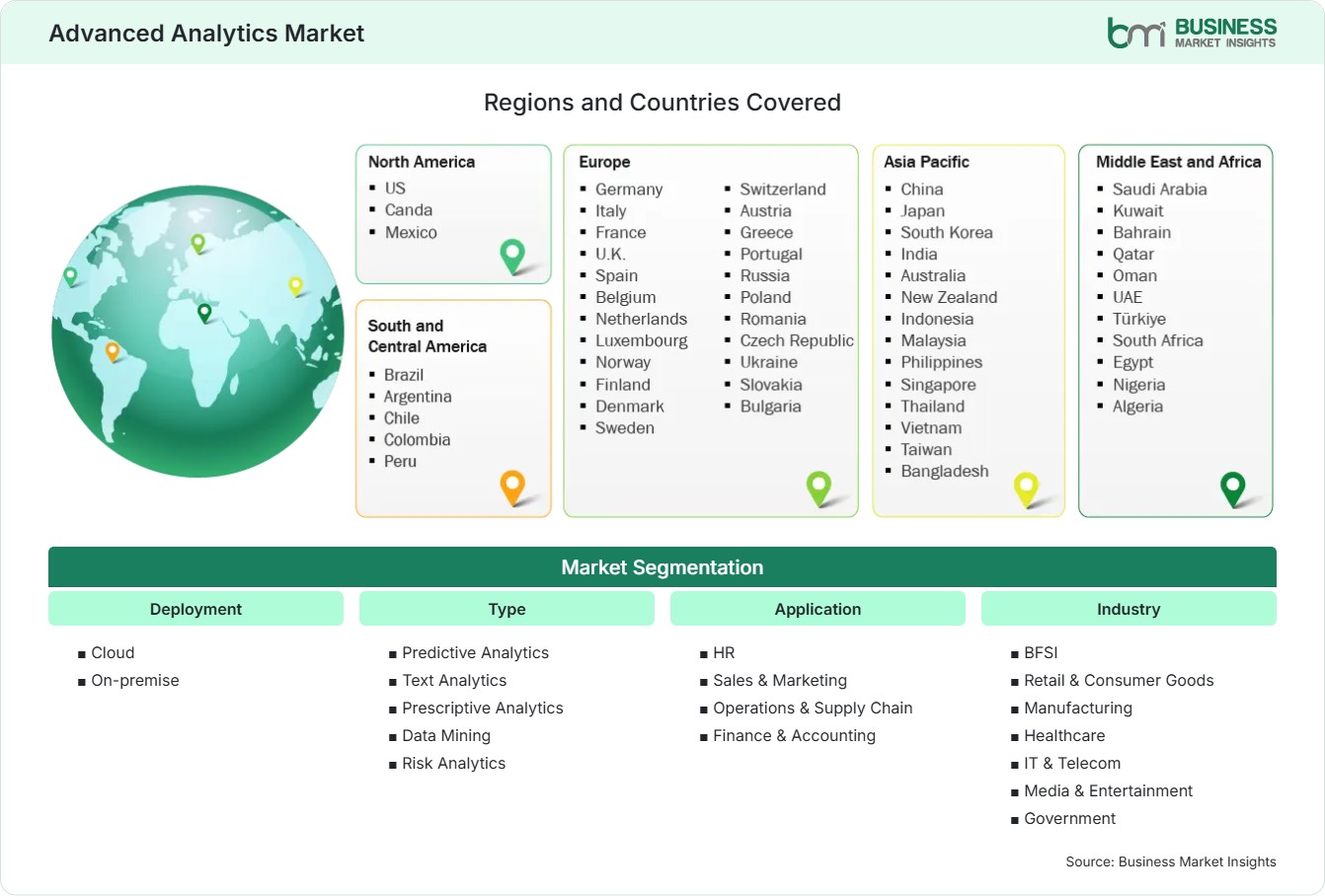
North America holds 36%–39% share in 2025 and is projected to register 19%–21% CAGR during 2026–2033. Advantages for the region include having established cloud infrastructure, enterprise software presence, AI research, digitization in the financial services sector, and a high need for operational intelligence. The United States is the leading country for the national market, while Canada offers contributions through financial analysis, health technology, and resource optimization. Enterprise customers now have an increasing focus on governance of analytics and monitoring models.
- AI infrastructure investment supports complex predictive workloads, while enterprises increasingly connect analytics with operational systems to move insights closer to real-time decisions.
- Financial institutions deploy advanced models for fraud, credit, customer segmentation, compliance, and risk monitoring, strengthening recurring demand for governed analytical applications in advanced analytics market.
- Healthcare organizations are expanding analytics across population management, resource planning, operational optimization, and evidence-informed decision support, consistent with WHO’s focus on responsible health AI.
- Canada provides additional opportunity through cloud adoption, financial-services modernization, resource analytics, and government digitization, supporting regional diversification beyond the US.
US Advanced Analytics Market
The US accounts for 78%–82% of North American share in 2025 and is projected to grow at 19.5%–21.5% CAGR during 2026–2033. Technology providers, cloud infrastructures, data scientists, banks, health organizations, retail companies, and manufacturers drive wide-ranging demands. Implementation is becoming more focused around AI-friendly data, model management, natural language processing, automation, and analytics embedded into business software.
- Enterprise buyers increasingly combine cloud data warehouses, lakehouses, machine learning, and AI assistants to shorten analytical cycles while preserving governance and auditability.
- Financial services remain a major application environment, using advanced models for fraud detection, underwriting, customer intelligence, portfolio analysis, and regulatory monitoring in advanced analytics market.
- AI infrastructure expansion is broadening analytical workloads across data centers and edge environments, increasing demand for efficient inference, high-performance computing, and optimized data movement.
Europe Advanced Analytics Market
Europe represents 27%–30% share in 2025 and is projected to record 20%–22% CAGR during 2026–2033. Germany, the UK, and France are leading markets, while Ireland, the Netherlands, and the Nordic countries provide high-growth opportunities. Regulatory requirements increasingly influence product design, governance, transparency, and auditability.
- Germany benefits from industrial analytics demand spanning predictive maintenance, process optimization, engineering, automotive production, and energy efficiency.
- The UK combines financial-services analytics expertise with strong technology ecosystems, creating opportunities in fraud, customer intelligence, risk, and operational forecasting in advanced analytics market.
- France is expanding AI and analytics adoption across industrial, financial, public-sector, and customer-service environments, supporting broader enterprise transformation.
- Nordic markets offer high-growth opportunities through digital public services, sustainability analytics, cloud adoption, and data-driven industrial modernization.
Asia Pacific Advanced Analytics Market
Asia Pacific accounts for 22%–25% share in 2025 and is projected to register 23%–25% CAGR during 2026–2033, making it the fastest-growing region. China, Japan, India, South Korea, Australia, and Singapore drive adoption, while Southeast Asian countries offer growing prospects. Digitization of manufacturing, fintech developments, cloud technology, government AI initiatives, and enhanced data science skills are driving adoption by enterprises in various sectors.
- China provides large-scale opportunities across manufacturing, e-commerce, financial services, logistics, telecommunications, and industrial automation, where analytics supports high-volume operational decisions.
- India combines digital public infrastructure, fintech expansion, enterprise modernization, and a large technology-services workforce, creating strong demand for scalable analytics implementation in advanced analytics market.
- Japan and South Korea emphasize predictive maintenance, robotics, semiconductor operations, automotive intelligence, and smart manufacturing, supporting sophisticated industrial analytics deployments.
- Southeast Asia is emerging as a high-growth deployment zone as banks, retailers, manufacturers, and telecommunications providers modernize cloud and data infrastructure.
Rest of World Advanced Analytics Market
Rest of World represents 12%–15% share in 2025 and is projected to grow at 21%–23% CAGR during 2026–2033. The leaders in South and Central America are Brazil and Mexico, where the demand drivers include financial inclusion, retail digitization, telecoms and logistics modernization. The use of analytics is becoming increasingly focused on fraud management, customer intelligence, demand forecasting and efficiency as businesses grow their digital footprint. The Middle East and Africa present high-growth prospects through government digitization, smart cities, fintech, energy efficiency, and health care innovation. The UAE and Saudi Arabia lead implementation efforts in the region, while South Africa provides a developed analytics ecosystem.
- Brazil is a prominent regional market driven by banking analytics, retail analytics, agricultural analytics, telecoms optimization, and fraud management.
- Mexico has advantages with digital manufacturing, nearshoring, logistics upgrades, and predictive supply chain and production analytics demand.
- The UAE and Saudi Arabia offer growth-driven environments via smart government, fintech, energy analytics, and national AI programs.
- South Africa maintains its regional tech hub position in banking, telecoms, retail, mining, health care, and business process analytics.