
Cloud Analytics Market Outlook: Size, Share, Trends, Growth Analysis, Competitive Landscape & Forecast, 2026-2033

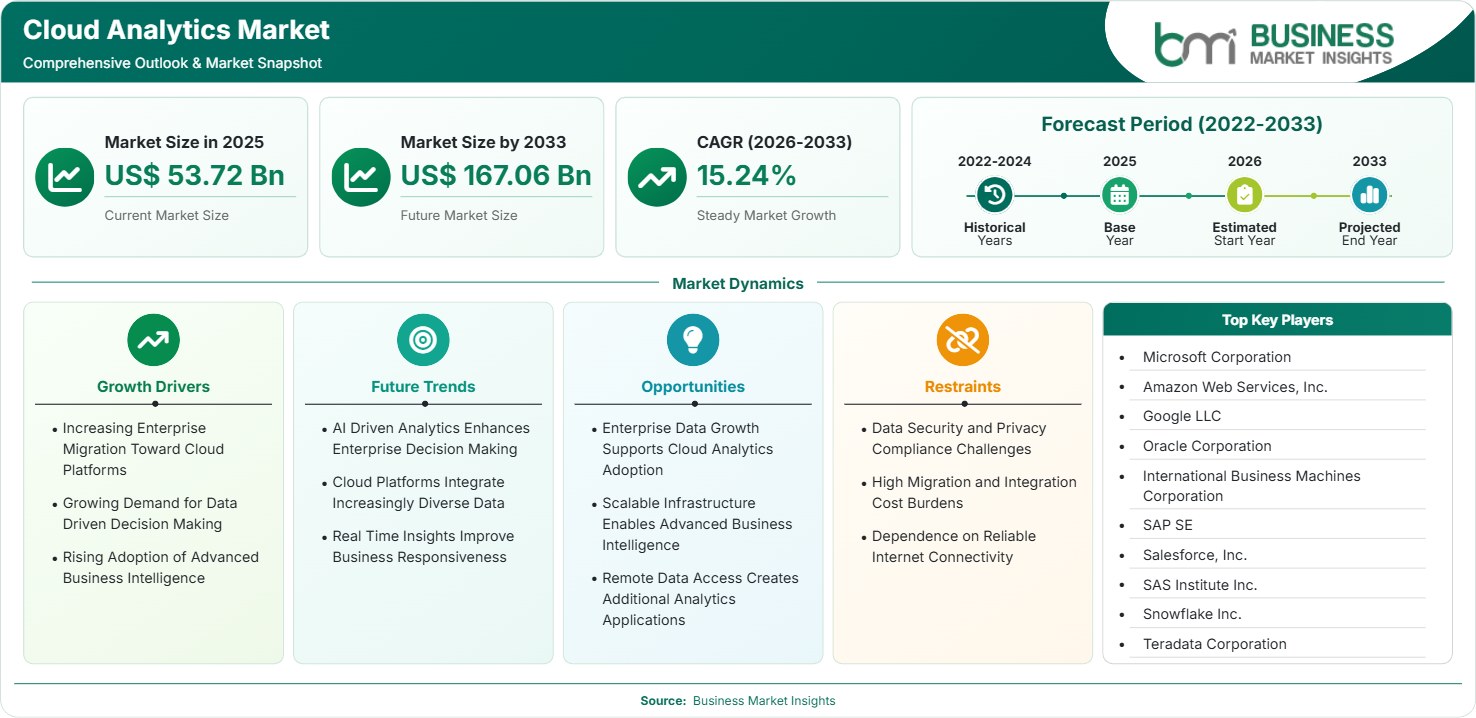
The Cloud Analytics Market size was valued at US$ 53.72 Billion in 2025 and is projected to reach US$ 167.06 Billion by 2033, growing at a CAGR of 15.24% during 2026–2033. Key growth drivers include AI-powered analytics adoption, expanding enterprise cloud migration, real-time decision intelligence requirements, and industry digitization, while opportunities emerge from generative AI integration, data fabric architectures, and hybrid-cloud analytics deployments.

Report Coverage
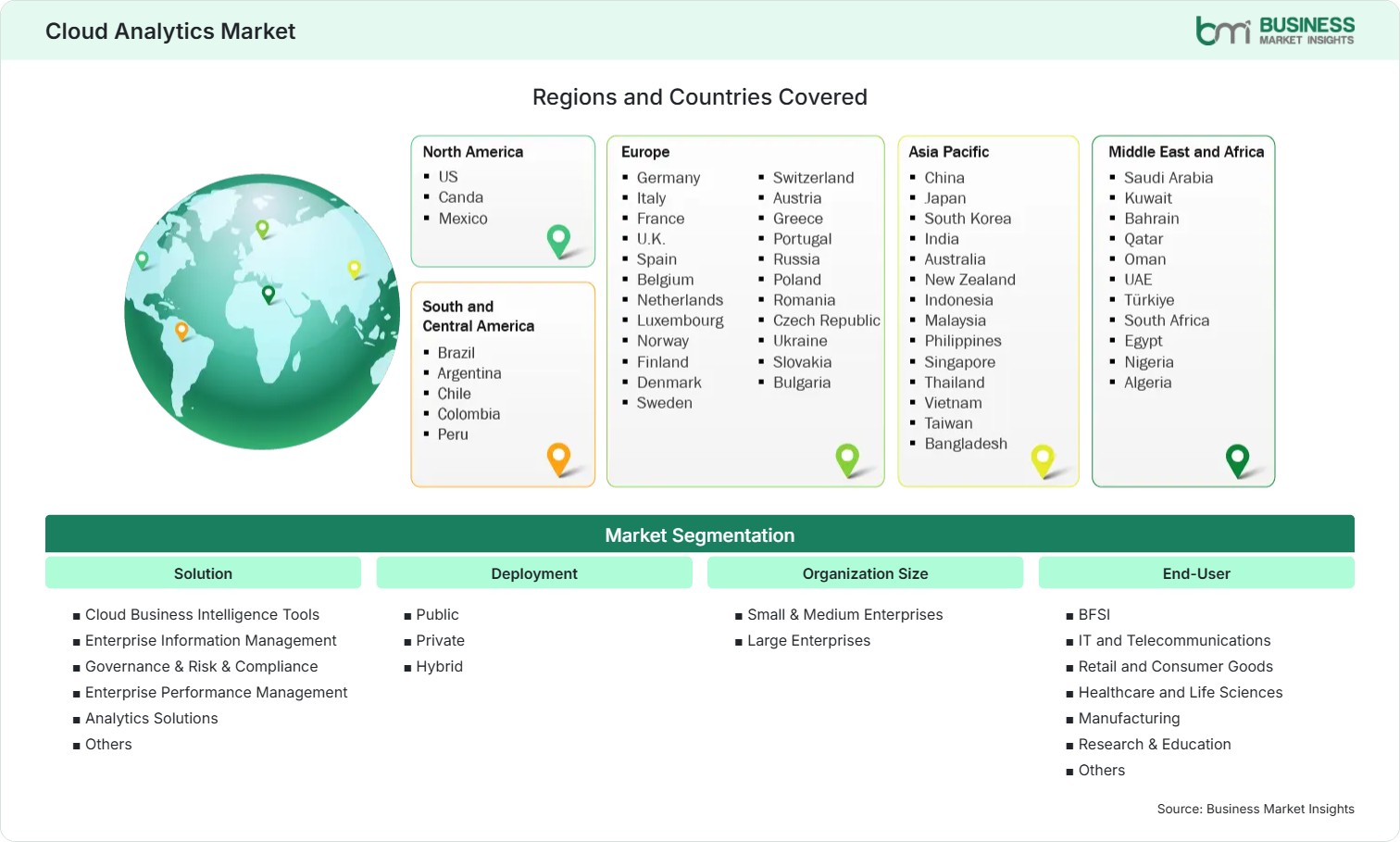
  • Solution: Cloud Business Intelligence Tools, Enterprise Information Management, Governance & Risk & Compliance, Enterprise Performance Management, Analytics Solutions, Others
  • Deployment: Public, Private, Hybrid
  • Organization Size: Small & Medium Enterprises, Large Enterprises
  • End-User: BFSI, IT and Telecommunications, Retail and Consumer Goods, Healthcare and Life Sciences, Manufacturing, Research & Education, Others
US$ 53.72 Bn Market size in 2025
US$ 167.06 Bn Market Size by 2033
15.24% CAGR, 2026 - 2033
2026-2033 Forecast Period

AI Overview

Cloud Analytics Market Summary

  • North America Region: North America holds a Cloud Analytics Market share of 36%–39% in 2025, growing at a 13.5%–15.0% CAGR during 2026–2033. Growth is driven by hyperscale cloud investments, strong enterprise analytics spending, widespread AI deployment, industry digitalization programs, regulatory compliance requirements, advanced data governance practices, real-time intelligence demand, innovation ecosystems, cloud-native modernization strategies, and workforce analytics adoption. US market benefits from mature cloud ecosystems and analytics investments, expanding at approximately 13.8%–15.3% CAGR.
  • Fastest Growing Region: Asia Pacific holds a market share of 25%–28% in 2025, growing at a 17.5%–19.5% CAGR during 2026–2033. Expansion is supported by enterprise cloud adoption, digital economy initiatives, smart manufacturing programs, telecom transformation, rising data creation, local cloud infrastructure investments, growing startup ecosystems, modernization funding, analytics democratization efforts, and increasing AI implementation.
  • Leading Segment: Solution holds a market share of 44%–48% in 2025, growing at a 14.5%–16.0% CAGR during 2026–2033. Demand is supported by cloud business intelligence modernization, enterprise data integration, regulatory reporting requirements, predictive analytics adoption, governance priorities, scalable architectures, automation capabilities, visualization enhancements, operational intelligence applications, and decision-support investments.
  • High Growth Segment: Hybrid deployment holds a Cloud Analytics Market share of 26%–30% in 2025, growing at a 18.0%–20.0% CAGR during 2026–2033. Adoption increases through data residency requirements, workload flexibility needs, multicloud strategies, security considerations, regulatory obligations, infrastructure optimization goals, legacy integration requirements, distributed analytics environments, operational resilience initiatives, and cost management efforts.
  • Key Market Opportunity: Organizations increasingly seek unified platforms connecting structured and unstructured data, creating opportunities for AI-driven cloud analytics offerings delivering governance, automation, predictive insights, operational visibility, and industry-specific intelligence capabilities.
  • Major Market Players: Microsoft Corporation, Amazon Web Services, Inc., Google LLC, Oracle Corporation, International Business Machines Corporation, SAP SE, Salesforce, Inc., SAS Institute Inc., Snowflake Inc., Teradata Corporation.
Strategic Insights

Cloud Analytics Market: Strategic Insights

Cloud Analytics Market Strategic Framework
FREE PDF
Request your free sample
Request free sample
Stakeholder View

Key Takeaways

  • The value chain increasingly combines hyperscale cloud providers, analytics software developers, consulting firms, cybersecurity specialists, and industry-specific solution providers into integrated digital ecosystems.
  • BFSI, healthcare, telecommunications, and manufacturing applications offer substantial upside due to growing demand for predictive intelligence, fraud detection, operational monitoring, and customer analytics.
  • Innovation is shifting toward generative AI-driven analytics assistants, natural-language querying, automated data preparation, and unified lakehouse architectures that simplify enterprise analytics workflows.
  • Asia Pacific presents a compelling investment case due to rapid digitization, expanding cloud infrastructure, supportive government programs, and large-scale enterprise modernization initiatives.
  • Strategic partnerships, platform integrations, and acquisitions remain common as vendors seek stronger positions in AI-enabled analytics, governance, and multicloud environments.
  • Data sovereignty requirements continue influencing deployment decisions, creating opportunities for industry-focused and region-specific analytics solutions.
Geographic Outlook

Cloud Analytics Market Regional Highlights

North America Cloud Analytics Market

North America accounted for 36%–39% Cloud Analytics Market share in 2025 and is projected to expand at a 13.5%–15.0% CAGR through 2033. The region benefits from mature cloud ecosystems, strong enterprise software spending, sophisticated regulatory frameworks, and significant AI investments. Large organizations continue modernizing analytics environments through unified data platforms and cloud-native architectures. Strong adoption across BFSI, healthcare, retail, and telecommunications supports sustained revenue expansion and technology innovation.

  • Major enterprises are investing in real-time intelligence platforms integrating AI, automation, governance, and predictive analytics to improve decision quality across distributed operations.
  • Financial institutions continue deploying advanced analytics for risk management, fraud detection, compliance monitoring, and customer engagement optimization.
  • Healthcare providers leverage scalable analytics to support clinical insights, operational efficiency, population health programs, and research initiatives.
  • Hyperscale cloud providers maintain continuous investments in infrastructure, enabling expanded analytics workloads and enterprise adoption.

US Cloud Analytics Market

The United States accounted for roughly 78%-82% of North American revenues in 2025 and is projected to register a 13.8%-15.3% CAGR through 2033. The US has significant cloud investments, leading AI innovation, numerous digital transformation projects, and a sophisticated, data-centric business culture, all of which have been driving market growth. Enterprise modernization strategies continue to accelerate the adoption of analytics platforms.

  • Technology companies increasingly integrate generative AI capabilities into enterprise analytics workflows, improving accessibility and productivity.
  • Retail organizations expand analytics use for personalized engagement, demand forecasting, inventory management, and pricing optimization.
  • Government modernization initiatives continue supporting secure cloud analytics implementation across critical public services.

Europe Cloud Analytics Market

The Europe region was estimated to have a market share of 28% to 31% in 2025 and is expected to grow at a CAGR of 14.0% to 15.8% for the Cloud Analytics Market. The market dynamics in the region include regulatory compliance, digital sovereignty, and corporate migrations to the cloud. Germany remains the leading country in Europe, but the fastest growth is seen in Central and Eastern European countries. Advanced manufacturing, financial services, and healthcare applications contribute significantly to regional revenues.

  • Germany leads regional adoption through industrial analytics, Industry 4.0 programs, and enterprise digitalization investments.
  • France and the United Kingdom maintain strong demand for governance-focused and AI-enabled analytics solutions.
  • Regional regulators continue emphasizing responsible data management, encouraging adoption of compliant analytics frameworks.
  • Manufacturing enterprises use analytics to optimize supply chains, production planning, and asset performance.

Asia Pacific Cloud Analytics Market

Asia Pacific region held a 25% to 28% share in 2025 and reports the fastest growth rate at 17.5% to 19.5% CAGR. Digitization trends, cloud infrastructure deployment, the growth of the internet economy, and technology upgrades in enterprises are revolutionizing demand patterns. China is the largest market, whereas India shows the highest growth in digital projects and cloud deployments.

  • Telecommunications providers deploy analytics to enhance network performance, customer experience, and operational efficiency.
  • India benefits from accelerating cloud adoption across government, banking, retail, and technology sectors.
  • Manufacturing transformation programs across Asia support analytics investments for productivity and automation.
  • Local cloud infrastructure expansion improves accessibility and scalability for enterprise analytics workloads.

Rest of World Cloud Analytics Market

Rest of World represented a 9%–12% share in 2025 and is forecast to register a 15.0%–17.0% CAGR of the Cloud Analytics Market through 2033. South & Central American markets benefit from digital banking expansion and enterprise modernization initiatives. Middle East and Africa economies increasingly invest in smart-city programs, digital government transformation, and cloud infrastructure development.

  • Brazil leads Latin American demand through financial services innovation and enterprise cloud adoption.
  • GCC countries expand analytics investments to support economic diversification, digital government, and smart infrastructure.
  • Growing cloud availability zones strengthen regional access to scalable analytics environments.
  • Enterprise modernization projects continue driving adoption across energy, public sector, and telecommunications industries.
Global Market Geography
FREE PDF
Request your free sample
Request free sample
Segment Analysis

Cloud Analytics Market Segmentation

Solution

The Solution category contributed 44%-48% share of the market in 2025 and is expected to grow at a CAGR of 14.5%-16.0% over the forecast period. Factors contributing to growth include enterprise-level digital transformation, increased adoption of predictive intelligence, AI-powered decision-making, and rising demand for scalable analytics platforms. The widening scope of the Cloud Analytics Market across various verticals is further reinforcing the adoption of cloud-native analytical applications.

  • Cloud Business Intelligence (BI) Tools: Widely adopted for dashboarding, data visualization, and self-service analytics. Organizations leverage these solutions to democratize access to insights, improve reporting accuracy, and accelerate business decision-making processes.
  • Enterprise Information Management: Supports data integration, master data management, and information governance initiatives. Increasing volumes of enterprise data and compliance requirements continue to drive deployment across large organizations.
  • Governance, Risk, and Compliance: Growing regulatory complexity encourages investment in platforms that monitor compliance, mitigate operational risks, and provide auditable analytics processes across industries.
  • Enterprise Performance Management: Enables financial planning, forecasting, budgeting, and performance tracking. Enterprises increasingly utilize cloud-based performance management tools to improve agility and strategic planning capabilities.
  • Analytics Solutions: Includes predictive, prescriptive, and machine-learning-driven analytics applications. Growing demand for real-time insights and automation continues to enhance adoption across multiple sectors.

Deployment

Deployment preferences are determined by security concerns, workload factors, and regulatory requirements. In this section, the market accounted for a considerable share of revenue in 2025, driven by the growing adoption of agile architectures. The hybrid deployment emerged as the fastest-growing deployment type, growing at a CAGR of 18.0%–20.0%, while the public cloud continued dominating owing to the scalable nature of these systems. Evolving data sovereignty requirements continue influencing deployment strategies.

  • Public: Preferred for scalability, rapid implementation, and cost efficiency. Enterprises utilize public cloud analytics platforms to process large datasets and support distributed business operations effectively.
  • Private: Selected by organizations with stringent data privacy, compliance, and security requirements. Adoption remains strong in regulated industries such as BFSI, healthcare, and government sectors.
  • Hybrid: Combines public cloud flexibility with private infrastructure control. Enterprises increasingly adopt hybrid environments to balance regulatory requirements, operational resilience, and performance optimization objectives.

Organization Size

Large companies continue to generate the bulk of their revenue, holding approximately 58% to 62% in 2025, while the SME segment has been seeing rapid growth due to reduced barriers to entry and subscription pricing models. It will have a CAGR of 14.8% to 16.8% through 2033, as firms increasingly rely on cloud analytics for efficiency, engagement, and decision-making.

  • Small & Medium Enterprises: Adoption is accelerating because cloud platforms reduce infrastructure investments, simplify analytics deployment, and provide access to advanced business intelligence capabilities.
  • Large Enterprises: Large organizations utilize sophisticated analytics ecosystems that integrate multiple data sources, support governance requirements, and enable enterprise-wide insight generation at scale.

End-User

The demand for end users will be determined by industry-specific data intensity, compliance requirements, and digital transformation focus. This category is expected to see widespread adoption in 2025 and register a CAGR of 15.0%-17.0% during 2025-2033. Emerging Cloud Analytics Market trends include the increasing use of AI-driven analytics, real-time monitoring, and predictive intelligence.

  • BFSI: Financial institutions rely on analytics for fraud detection, credit risk assessment, compliance monitoring, portfolio optimization, and personalized customer engagement initiatives.
  • IT and Telecommunications: Service providers deploy analytics for network optimization, customer experience management, capacity planning, and operational performance improvement programs.
  • Retail and Consumer Goods: Organizations use analytics to strengthen demand forecasting, inventory optimization, marketing effectiveness, and omnichannel customer engagement strategies.
  • Healthcare and Life Sciences: Analytics platforms support clinical decision-making, operational efficiency, patient outcomes improvement, pharmaceutical research, and healthcare resource optimization.
  • Manufacturing: Smart manufacturing initiatives encourage adoption of predictive maintenance, supply chain visibility, production optimization, and quality management analytics solutions.
  • Research & Education: Universities and research organizations utilize analytics to improve institutional planning, research performance tracking, and student engagement analysis.
Market Forces

Cloud Analytics Market Dynamics

Key Market Drivers

Enterprise Migration Toward Cloud-Native Data Architectures

Organizations are quickly phasing out traditional on-premises analytics setups and adopting new cloud-based analytics systems that can handle large, distributed workloads. The increased focus on digitization has been a major driver of growth in the Cloud Analytics Market, especially for businesses dealing with increasing volumes of data generated by enterprise software, IoT networks, e-commerce websites, and customer interactions. Cloud-based platforms offer advantages in elasticity, rapid deployment, lower costs, and greater accessibility. Organizations today are looking to build comprehensive data ecosystems that include analytics, artificial intelligence, governance, and automation, all under one umbrella. The above-mentioned trend is prevalent across the BFSI, retail, manufacturing, and healthcare verticals, where data-driven business decisions directly impact operational success and outcomes.

Expansion of Artificial Intelligence and Machine Learning Adoption

Incorporating AI and machine learning into analytics platforms has changed how companies create value from their data. Predictive modeling, automatic insight generation, anomaly detection, and natural language query capabilities are among the features being increasingly used. Analytics tools have reduced the need for data scientists, as business analysts can leverage these tools' capabilities. AI-based analytics have boosted the effectiveness of forecasting, consumer behavior, operational efficiency, and risk management processes. The increased adoption of generative AI systems has necessitated improved analytics tools capable of analyzing both structured and unstructured data. With the rise in intelligent automation, AI-based analytics will continue to be a key driver of market growth.

Rising Demand for Real-Time Business Intelligence

The growing need for insights produced almost instantaneously is becoming an important requirement for businesses to deal efficiently with changing conditions. Real-time analytics enables organizations to continuously monitor their activities, identify risks, refine customer engagement, and allocate resources more effectively. The telecommunications, financial, manufacturing, and retail industries rely heavily on up-to-date information to ensure operational efficiency and competitiveness. Due to the increasing use of digital, connected, and cloud-based solutions, vast amounts of data have to be processed immediately. The constant requirement for visibility and speed in decision-making reinforces the need for a cloud analytics infrastructure that delivers performance-oriented analytics.

Key Market Opportunities

Generative AI-Powered Analytics Platforms

Generative AI has created opportunities to simplify interactions between analytics vendors and enterprise data. Companies are searching for technologies that help users ask difficult questions in natural language and automatically gain insights, without requiring high-level skills. Spending on conversational analytics, smart reporting, and AI-powered analytics visualization will continue to grow. Greater attention to productivity improvements and democratization of analytics usage within the enterprise makes the need for such technologies even stronger. According to Cloud Analytics Market Forecasts, enterprises are increasing their AI-powered analytics investments from digital transformation budgets. Vendors that can integrate trustworthy AI, governance, and explainability into the analytics process will have the opportunity to generate significant value.

Industry-Specific Cloud Analytics Solutions

It is now evident that organizations seek industry-centric analytics tools that cater to the needs of specific industries. Health-care providers need analytics for patients and clinical intelligence; banks look for analytics for fraud detection and risk management; manufacturing businesses need analytics for predictive maintenance and optimization of manufacturing operations. Such a scenario offers vendors the opportunity to develop industry-centric solutions with faster time-to-market and measurable business benefits. These platforms help reduce customization costs while providing high-value benefits. There is a huge demand for insights, compliance management, and operational intelligence, which is inspiring platform providers to expand their analytics portfolios.

Expansion Across Emerging Digital Economies

Rapid investment in cloud infrastructure across APAC, MEA, Africa, and Latin America is making market conditions favorable for analytics vendors. Various strategies for digital economy, smart cities, and government sector modernization rely heavily on data. The increase in internet access, the digital transformation of enterprises, and the growth of start-up ecosystems contribute to rising demand. Analytics is being used by more and more companies in these regions to improve their competitive position, their customer relationships, and their efficiency. Providers of analytics solutions that build cloud infrastructure locally, have partners in the region, and offer solutions compliant with local regulations can capitalize on high demand in these virgin markets.

Market Restraints and Challenges

Data Security and Regulatory Compliance Complexity

Factor: Businesses that handle sensitive data on finance, health care, customers, and their operations must comply with more complex regulations governing the storage, processing, and transfer of data. Impact: Compliance requirements typically affect time to deploy, implementation costs, and governance requirements. Companies operating in different jurisdictions may face issues related to data location, privacy laws, and auditing requirements. Also, security-related issues, such as access issues, cyberattacks, and data breaches, may delay cloud analytics implementation in certain industries. The vendors have to keep investing in technologies such as encryption and identity management to solve their clients' problems and maintain trust within highly regulated business environments.

Integration Challenges Across Legacy and Modern Systems

Factor: Several businesses continue to run their information technology systems, which consist of legacy databases, on-premises software applications, and disparate data repositories. Impact: It may require significant expertise to integrate such an information technology architecture with the new cloud-based analytics tools, which will take considerable time and cost significant money. Data inconsistencies, poor data quality, and interoperability challenges often slow the process of deriving value. There may be disruptions to business operations due to data set transfers and the need to adjust processes. Successful adoption, therefore, requires robust integration frameworks, skilled implementation partners, and long-term modernization strategies.

Company Analysis

Competitive Landscape

The Cloud Analytics Market analysis reflects a competitive environment dominated by cloud platform providers, enterprise software companies, and specialized analytics vendors.

Company Name

Overview

Products and Services relevant to this market

Microsoft Corporation

Global technology leader with extensive cloud and analytics ecosystem serving enterprises worldwide.

Microsoft Fabric, Power BI, Azure Synapse Analytics, AI-powered analytics services.

Amazon Web Services, Inc.

Leading cloud infrastructure provider with broad analytics and data management portfolio.

Amazon Redshift, QuickSight, Athena, data lake and analytics services.

Google LLC

Major cloud provider emphasizing AI-driven analytics and data intelligence capabilities.

BigQuery, Looker, Vertex AI analytics integration, cloud data platforms.

Oracle Corporation

Enterprise software vendor with strong database and cloud analytics offerings.

Oracle Analytics Cloud, Oracle Cloud Infrastructure analytics services.

International Business Machines Corporation

Long-established enterprise technology company focused on hybrid cloud and AI.

IBM Cognos Analytics, watsonx-related analytics platforms and services.

SAP SE

Enterprise application leader serving global industries with integrated analytics solutions.

SAP Analytics Cloud, data management and business intelligence tools.

Salesforce, Inc.

Customer-focused cloud software company with embedded analytics capabilities.

Tableau, CRM analytics, customer intelligence and reporting solutions.

SAS Institute Inc.

Advanced analytics specialist recognized for statistical and predictive analytics expertise.

SAS Viya, AI analytics, risk management and forecasting solutions.

Snowflake Inc.

Cloud-native data platform provider supporting enterprise analytics and AI workloads.

Data Cloud platform, collaborative analytics and governed data sharing.

Teradata Corporation

Enterprise analytics and data platform provider focused on large-scale environments.

VantageCloud, data warehousing, advanced analytics and optimization tools.

Trust & Transparency

Research Methodology

The market analysis combines proprietary research with secondary data from government agencies, company disclosures, regulatory filings, industry databases and expert interviews. Market estimates are validated through data triangulation, cross-market benchmarking and analyst review.

View Full Research Methodology

Questions Answered

Frequently Asked Questions

What does a Cloud Analytics Market Report typically evaluate?

It generally assesses market size, competitive positioning, deployment trends, technology developments, regional dynamics, investment patterns, customer adoption behavior, and future growth opportunities.

Which region offers the strongest long-term expansion potential?

Asia Pacific presents the strongest growth outlook due to rapid enterprise digitization, expanding cloud infrastructure, supportive policies, and increasing AI adoption across industries.

How does hybrid deployment benefit enterprises?

Hybrid environments allow organizations to maintain sensitive workloads in private infrastructure while using public cloud scalability for advanced analytics and high-volume processing.

What industries generate the strongest revenue opportunities?

BFSI, healthcare, manufacturing, retail, telecommunications, and education sectors represent major opportunities because they rely heavily on data-driven decision-making and operational intelligence.

What is the primary factor accelerating demand for cloud analytics solutions?

Organizations increasingly require real-time insights from growing data volumes while avoiding large on-premises infrastructure investments, making cloud-based analytics platforms more attractive.

Access the Full Cloud Analytics Market Report

Get segment-level forecasts, regional estimates, competitive benchmarking, company profiles and downloadable Excel datasets.

Access the full Cloud Analytics Market Report
350 pages PDF & Excel | 2026-09-16
Similar Research

Related Market Reports