
Digital Twin In Shipbuilding Market Outlook: Size, Share, Trends, Growth Analysis, Competitive Landscape & Forecast, 2026–2033

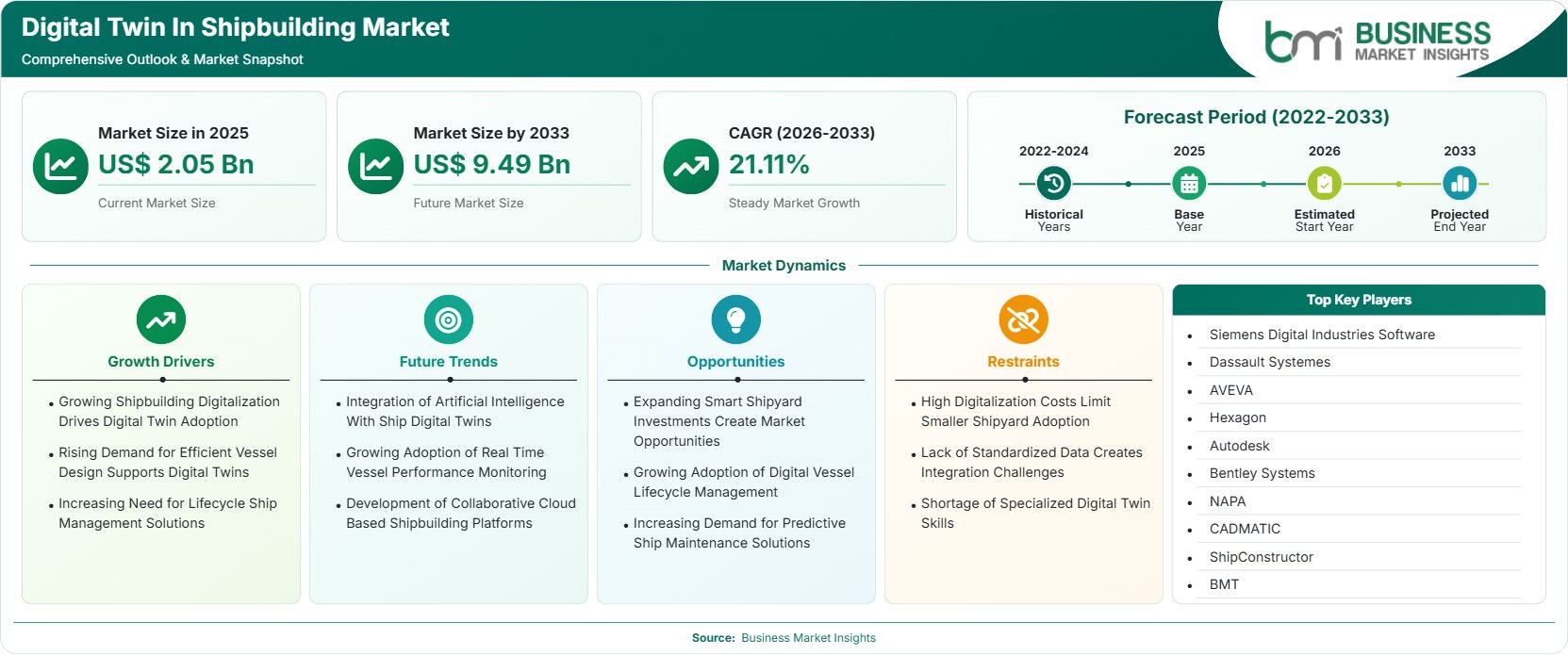
The Digital Twin In Shipbuilding Market size was valued at US$ 2.05 billion in 2025 and is projected to reach US$ 9.49 billion by 2033, growing at a CAGR of 21.11% during 2026–2033, supported by shipyard digitalization, connected engineering, lifecycle optimization, predictive maintenance, and smart production planning.

Report Coverage
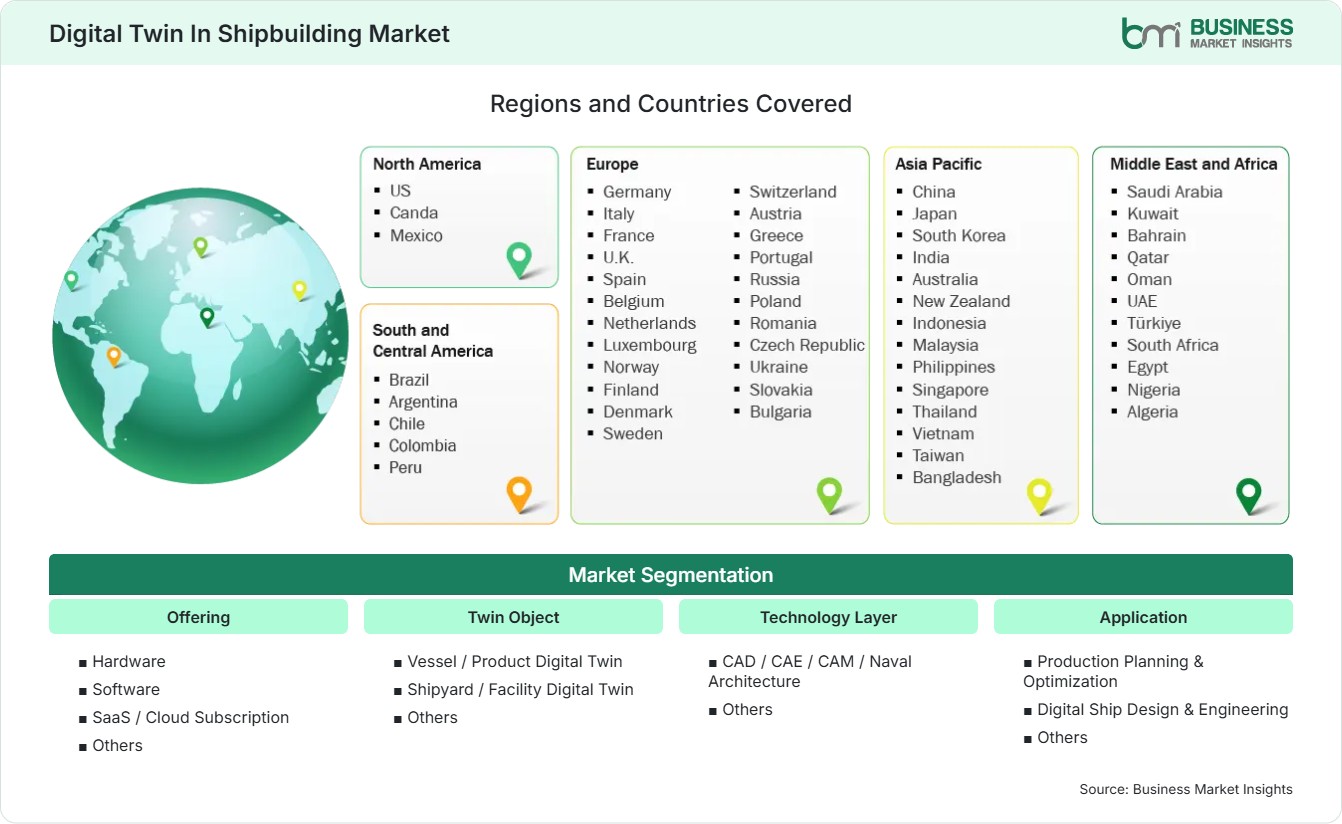
  • Offering: Hardware, Software, SaaS / Cloud Subscription, Others
  • Twin Object: Vessel / Product Digital Twin, Shipyard / Facility Digital Twin, Others
  • Technology Layer: CAD / CAE / CAM / Naval Architecture, Others
  • Application: Production Planning & Optimization, Digital Ship Design & Engineering, Others
  • Ship System: Hull & Structure, Hydrodynamics, Propulsion, Others
US$ 2.05 Bn Market size in 2025
US$ 9.49 Bn Market Size by 2033
21.11% CAGR, 2026 - 2033
2026-2033 Forecast Period

AI Overview

Digital Twin In Shipbuilding Market Summary

  • North America Region: North America holds a 25%–29% share in 2025 and is projected to grow at a 19%–22% CAGR through 2033, supported by naval modernization, connected shipyards, digital engineering, lifecycle management, cybersecurity, and advanced simulation adoption. The U.S. market is projected to grow at a 20%–23% CAGR through 2033, driven by digital shipbuilding programs, naval engineering modernization, and demand for integrated design-to-production workflows.
  • Fastest Growing Region: Asia Pacific holds a 34%–38% share in 2025 and is projected to grow at a 22%–25% CAGR through 2033, supported by expanding smart shipyard investments, digital engineering adoption, vessel production modernization, cloud platforms, connected manufacturing, and growing lifecycle optimization requirements.
  • Leading Segment: Software holds a 48%–52% share in 2025 and is projected to grow at a 20%–23% CAGR through 2033, supported by simulation, design integration, production planning, lifecycle data management, interoperability, and increasingly sophisticated shipyard digital workflows.
  • High Growth Segment: SaaS / Cloud Subscription holds a 24%–28% Digital Twin In Shipbuilding Market share in 2025 and is projected to grow at a 24%–27% CAGR through 2033, supported by scalable deployment, remote collaboration, lower infrastructure requirements, subscription economics, and wider accessibility for digitally transforming shipyards.
  • Key Market Opportunity: Connected shipyard environments, lifecycle simulation, predictive maintenance, autonomous vessel development, and cloud-based engineering create opportunities for integrated digital twin platforms across design, production, operations, and maintenance.
  • Major Market Players: Siemens Digital Industries Software, Dassault Systèmes SE, AVEVA Group Limited, Hexagon AB, Autodesk, Inc., Bentley Systems, Incorporated, NAPA Ltd., CADMATIC Oy, ShipConstructor Software Inc., and BMT Group Ltd.
Strategic Insights

Digital Twin In Shipbuilding Market: Strategic Insights

Digital Twin In Shipbuilding Market Strategic Framework
FREE PDF
Request your free sample
Request free sample
Stakeholder View

Key Takeaways

  • The value chain is moving toward integrated digital continuity, requiring alignment between engineering, production, procurement, commissioning, and vessel-service data.
  • Lifecycle applications offer strong upside because shipyards and vessel operators can extend digital models beyond design into maintenance, performance monitoring, and operational decision support.
  • Technology development is shifting toward AI-enabled simulation, cloud collaboration, real-time data integration, interoperable models, and automated scenario evaluation.
  • Asia Pacific presents a compelling expansion opportunity as shipbuilding ecosystems increasingly combine manufacturing scale with smart-factory and connected-engineering initiatives.
  • Investment priorities are moving toward platforms capable of supporting multiple ship classes, distributed engineering teams, supplier collaboration, and long-term asset information management.
  • Successful vendors will increasingly compete on interoperability, implementation speed, cybersecurity, domain-specific functionality, and the ability to demonstrate measurable lifecycle value.
Geographic Outlook

Digital Twin In Shipbuilding Market Regional Highlights

North America Digital Twin In Shipbuilding Market

North America holds a 25%–29% Digital Twin In Shipbuilding Market share in 2025 and is projected to grow at a 19%–22% CAGR through 2033. Demand is supported by advanced naval programs, established engineering capabilities, smart manufacturing adoption, and growing requirements for connected lifecycle management across complex vessels and shipyard facilities.

  • The United States remains the principal regional market, supported by advanced naval engineering, shipyard modernization, defense-oriented digital workflows, and increasing integration between design, production, testing, and maintenance environments.
  • Canada offers opportunities through commercial shipbuilding, naval programs, marine engineering, and modernization of shipyard information systems requiring stronger collaboration between engineering, manufacturing, procurement, and vessel operators.
  • Digital engineering platforms are increasingly valued for managing design changes, multidisciplinary coordination, simulation, and production sequencing while reducing dependence on disconnected technical information across shipbuilding programs.
  • Lifecycle applications are gaining importance as operators seek stronger links between vessel models, maintenance information, operational data, and engineering documentation throughout extended asset-service periods.

US Digital Twin In Shipbuilding Market

The U.S. represents approximately 78%–82% of North American demand in 2025 and is projected to grow at a 20%–23% CAGR through 2033. Defense shipbuilding, engineering modernization, smart manufacturing, and lifecycle asset management create strong demand for integrated digital environments.

  • Naval shipbuilding creates demand for detailed virtual representations supporting design validation, systems integration, production planning, configuration management, and long-term sustainment of complex vessels.
  • Commercial shipyards can benefit from connected production models that improve collaboration between engineering teams, manufacturing operations, suppliers, and project-management functions.
  • Cybersecurity and data governance are becoming important purchasing criteria as digital models increasingly connect engineering information with operational technology and enterprise systems.

Europe Digital Twin In Shipbuilding Market

Europe holds a 24%–28% share in 2025 and is projected to grow at a 18%–21% CAGR through 2033. Germany, France, Italy, the United Kingdom, Norway, and the Netherlands provide important opportunities, while Nordic shipbuilding ecosystems offer strong digital engineering potential.

  • Germany benefits from advanced industrial engineering, specialized shipbuilding capabilities, automation expertise, and strong demand for integrated design and production environments.
  • France and Italy provide opportunities across naval, commercial, cruise, and specialized vessel programs requiring sophisticated simulation, configuration management, and lifecycle engineering.
  • Norway and the Netherlands offer strong growth potential through advanced maritime engineering, offshore vessels, smart production, and digitally enabled lifecycle management applications.
  • The United Kingdom remains attractive for naval and commercial applications where engineering collaboration, asset sustainment, and digital configuration control influence technology adoption.

Asia Pacific Digital Twin In Shipbuilding Market

Asia Pacific holds a 34%–38% share in 2025 and is projected to grow at a 22%–25% CAGR through 2033. China, South Korea, and Japan provide major demand centers, while India and Southeast Asia offer expanding opportunities through shipyard modernization and digital manufacturing.

  • China combines extensive shipbuilding capacity with growing investment in connected manufacturing, engineering automation, production optimization, and digitally coordinated vessel development.
  • South Korea provides strong opportunities through sophisticated shipyard operations, advanced vessel engineering, automation, simulation, and increasing emphasis on smart production environments.
  • Japan offers demand for high-precision engineering, ship design optimization, lifecycle information management, and connected production systems supporting advanced vessel manufacturing.
  • India and Southeast Asia present higher-growth opportunities as shipbuilding infrastructure expands and operators pursue modern engineering, planning, and maintenance capabilities.

Rest of World Digital Twin In Shipbuilding Market

Rest of World holds a 9%–13% share in 2025 and is projected to grow at a 15%–19% CAGR through 2033. South America and the Middle East benefit from offshore and commercial vessel activity, while Africa offers emerging opportunities through maritime infrastructure development.

Brazil and other South American markets can adopt digital twins to improve engineering coordination, offshore vessel development, maintenance planning, and asset utilization. Middle Eastern shipyards increasingly require digital capabilities supporting specialized vessels, offshore projects, and industrial diversification.

  • Brazil offers opportunities across offshore vessels, commercial shipbuilding, engineering services, and lifecycle applications connected with maritime and energy infrastructure.
  • Saudi Arabia and the United Arab Emirates provide attractive opportunities through shipyard development, maritime diversification, offshore activities, and investment in digitally enabled industrial infrastructure.
  • South Africa can benefit from digital engineering adoption across vessel maintenance, naval programs, commercial fleets, and maritime infrastructure modernization.
  • Latin American markets offer longer-term potential as shipyards strengthen engineering capabilities, supplier coordination, asset management, and digital production planning.
Global Market Geography
FREE PDF
Request your free sample
Request free sample
Segment Analysis

Digital Twin In Shipbuilding Market Segmentation

Offering

Software holds a 48%–52% share in 2025 and is projected to grow at a 20%–23% CAGR through 2033. The Digital Twin In Shipbuilding Market scope increasingly includes engineering platforms, simulation, cloud environments, lifecycle tools, and integrated shipyard applications.

  • Hardware: Hardware supports sensors, edge computing, industrial connectivity, visualization, and data acquisition, enabling digital models to receive operational and production information for continuous analysis.
  • Software: Software integrates design, simulation, production planning, lifecycle data, and engineering workflows, supporting connected digital environments across shipyard and vessel applications.
  • SaaS / Cloud Subscription: Cloud subscriptions provide scalable access to engineering and lifecycle tools, enabling distributed collaboration, flexible deployment, centralized data management, and lower infrastructure barriers.
  • Others: Other offerings include implementation, integration, consulting, training, maintenance, and specialized digital services supporting deployment and ongoing optimization.

Twin Object

Vessel / Product Digital Twin holds a 45%–49% share in 2025 and is projected to grow at a 21%–24% CAGR through 2033. Demand centers on design continuity, engineering validation, operational monitoring, and lifecycle optimization for complex vessels.

  • Vessel / Product Digital Twin: Product twins connect vessel design, engineering, performance, and operational information, supporting simulation, configuration management, maintenance planning, and lifecycle decision-making.
  • Shipyard / Facility Digital Twin: Facility twins model shipyard layouts, production flows, equipment, resources, and processes, helping optimize capacity utilization, sequencing, logistics, and manufacturing operations.
  • Others: Other twin objects include systems, equipment, production assets, and specialized maritime infrastructure requiring connected modeling and simulation capabilities.

Technology Layer

CAD / CAE / CAM / Naval Architecture holds a 42%–46% share in 2025 and is projected to grow at a 20%–23% CAGR through 2033. Engineering integration remains fundamental to digital continuity from concept through production.

  • CAD / CAE / CAM / Naval Architecture: Integrated engineering tools connect design, simulation, manufacturing, structural analysis, and naval architecture workflows, improving collaboration and reducing disconnected technical information.
  • Others: Other technology layers include IoT, analytics, AI, cloud computing, data platforms, visualization, and integration technologies that strengthen digital twin functionality.

Application

Production Planning & Optimization holds a 36%–40% share in 2025 and is projected to grow at a 21%–24% CAGR through 2033. Shipyards increasingly use virtual production environments to evaluate workflows, resources, schedules, and capacity constraints.

  • Production Planning & Optimization: Production twins support workflow simulation, resource allocation, sequencing, capacity planning, logistics coordination, and identification of manufacturing bottlenecks.
  • Digital Ship Design & Engineering: Digital design environments improve multidisciplinary collaboration, simulation, design validation, configuration control, and management of complex vessel engineering requirements.
  • Others: Other applications include maintenance, training, operations, procurement, inspection, asset monitoring, and lifecycle performance management across vessel programs.

Ship System

Hull & Structure holds a 34%–38% share in 2025 and is projected to grow at a 19%–22% CAGR through 2033. Structural modeling remains a core application because vessel geometry and integrity influence multiple engineering disciplines.

  • Hull & Structure: Digital models support structural analysis, design validation, configuration management, fabrication planning, inspection, and lifecycle monitoring of vessel structures.
  • Hydrodynamics: Hydrodynamic twins enable virtual assessment of vessel behavior, resistance, propulsion efficiency, maneuverability, and performance under different operating conditions.
  • Propulsion: Propulsion twins support system simulation, performance analysis, condition monitoring, maintenance planning, and optimization of machinery operating parameters.
  • Others: Other systems include electrical, navigation, auxiliary machinery, safety, environmental, and onboard systems requiring integrated lifecycle information.
Market Forces

Digital Twin In Shipbuilding Market Dynamics

Key Market Drivers

Growing Shipbuilding Digitalization Drives Digital Twin Adoption

Shipyards are shifting away from being used in standalone engineering applications to connected digital ecosystems where information regarding design, manufacturing, logistics, and lifecycles is coordinated. Digital twins facilitate this shift through a shared vision of ships, yards, and the manufacturing process. Engineering teams are able to virtually analyze design options without having to physically implement them, while the production teams can leverage connected information for planning purposes. The Digital Twin In Shipbuilding Market trend is becoming more defined through the use of connected digital workflows, which help in minimizing information silos and making decisions consistently throughout the development process of vessels.

Rising Demand for Efficient Vessel Design Supports Digital Twins

There is mounting pressure on shipbuilders to handle complex ship design issues as well as engineering change control, manufacturing risks, and scheduling issues. Digital twin technology allows multi-disciplinary design teams to assess their design decisions in a virtual environment prior to making any investments in physical ship construction. This may lead to better design coordination and avoid penalties arising from last-minute changes in design. The Digital Twin In Shipbuilding Market growth can be attributed to the rising adoption of digital engineering solutions to help improve workflow coordination and visibility.

Increasing Need for Lifecycle Ship Management Solutions

Continuity is becoming increasingly important between engineering information and the vessel operations to the ship owners and builders. A twin based on the lifecycle concept can serve as a framework that can connect design information, equipment information, inspection, maintenance, and operational observations. Such an approach will enhance the value of engineering models post-delivery and facilitate condition-based maintenance, performance improvement, crew training, and asset planning. Lifecycle twin is especially useful for ships with long operating cycles and complicated equipment configurations. With the increased need for asset visibility in the maritime sector, digital twins can become the backbone of information decision-making processes from commissioning through to decommissioning.

Key Market Opportunities

Expanding Smart Shipyard Investments Create Market Opportunities

Well-thought-out investment in smart shipyards will give you a chance to use digital twins together with automation, robotics, manufacturing execution systems, IIoT, and advanced planning. Integrated digital environments may assist shipyards in assessing production options without making any modifications in the factory. They can also facilitate coordination of resources through fabrication, assembly, outfitting, testing, and logistics processes. The most lucrative market opportunity is platforms that can integrate engineering and operations workflows rather than offer modeling capabilities on their own. Vendors with flexible deployment options will be able to cater to various levels of maturity, starting with production or design applications and then moving towards digital continuity.

Growing Adoption of Digital Vessel Lifecycle Management

Lifecycle management allows extending the use of the digital twins investments not only during the construction phase but also during the operations and sustainment of the vessels. Connected asset modeling provides the ability to manage technical data in maintenance, inspection, modification, and performance processes, making such information easily accessible to engineers and service teams. The Digital Twin In Shipbuilding Market Forecast is increasingly associated with a lifecycle approach, as customers will be able to demonstrate investments across several stages rather than in a single construction project. Vendors may distinguish themselves by integration with maintenance processes, data management, interoperability, analytics, and role-based access.

Increasing Demand for Predictive Ship Maintenance Solutions

Predictive maintenance presents an interesting use case since digital twins can link asset models with information about equipment condition, engineering limits, maintenance history, and operation patterns. In this way, the base is formed to detect abnormal operation and prioritize maintenance work to prevent failures from interfering with the vessel’s operability. The potential covers propulsion, auxiliary equipment, electrical equipment, and other critical assets. Advanced analytics may enhance the twin by comparing the current state of equipment with model-based and historical patterns. Vendors can add value by developing maintenance dashboards, automatic notifications, troubleshooting based on simulations, and linking with enterprise asset management systems.

Market Restraints and Challenges

High Digitalization Costs Limit Smaller Shipyard Adoption

Factor: Implementing digital twins entails license costs for software and cloud, integration services, data management, training, security measures, and process reengineering. Impact: Small yards will tend to postpone the implementation where the cost of the effort does not seem commensurate with the immediate gains of the implementation. This is especially true in cases where existing engineering systems need heavy customization to be able to integrate data in a common platform. Vendors can make things easier through a modular approach to implementation, a pay-as-you-go pricing model, and prebuilt templates. It is also important to prove value through specific production, engineering, or maintenance scenarios.

Lack of Standardized Data Creates Integration Challenges

Factor: Shipbuilding projects involve heterogeneous engineering formats, supplier information, classification requirements, operational records, and legacy systems that may not share common structures. Impact: Inconsistent data can reduce model accuracy, increase integration effort, and limit interoperability between digital twin environments. Data governance therefore becomes a central implementation requirement rather than a secondary technical consideration. Industry initiatives increasingly emphasize interoperability, cybersecurity, and data quality, but shipyards still need practical information architectures tailored to their workflows. Successful deployments require controlled data ownership, clear model definitions, standardized interfaces, validation processes, and lifecycle governance.

Company Analysis

Competitive Landscape

Digital Twin In Shipbuilding Market analysis shows competition centered on integrated engineering platforms, virtual modeling, simulation, cloud deployment, lifecycle management, interoperability, and specialized maritime functionality. Vendors increasingly differentiate through the ability to connect design, production, operations, and maintenance rather than offering isolated digital modeling tools.

Company Name

Overview

Products and Services relevant to this market

Siemens Digital Industries Software

Global industrial software provider with extensive capabilities across digital engineering, manufacturing, PLM, simulation, and connected shipbuilding workflows.

Digital twin platforms, CAD, PLM, manufacturing software, simulation, production planning, lifecycle engineering, and smart shipyard solutions.

Dassault Systèmes SE

Diversified engineering software company providing virtual twin and collaborative platforms for complex marine, offshore, and naval projects.

3DEXPERIENCE, CATIA, DELMIA, SIMULIA, virtual twin technology, ship design, simulation, and smart shipyard solutions.

AVEVA Group Limited

Industrial software provider focused on engineering, operations, asset performance, visualization, and connected industrial information environments.

Engineering software, asset lifecycle management, industrial data platforms, visualization, simulation, and digital transformation solutions.

Hexagon AB

Technology group combining digital reality, engineering, manufacturing, geospatial, and asset management capabilities for industrial customers.

Digital reality platforms, engineering software, metrology, manufacturing solutions, visualization, asset lifecycle tools, and data technologies.

Autodesk, Inc.

Design and engineering software provider supporting digital modeling, manufacturing, construction, and multidisciplinary project workflows.

CAD, BIM, manufacturing software, 3D design, simulation-related tools, cloud collaboration, and engineering data management capabilities.

Bentley Systems, Incorporated

Infrastructure engineering software company offering digital modeling and asset lifecycle technologies for complex physical infrastructure.

3D modeling, infrastructure digital twins, asset information management, simulation, visualization, and lifecycle engineering solutions.

NAPA Ltd.

Maritime technology specialist focused on ship design, stability, performance, operations, and vessel lifecycle applications.

Naval architecture software, stability analysis, performance optimization, ship design, operational analytics, and maritime lifecycle solutions.

CADMATIC Oy

Engineering software provider specializing in marine design, electrical engineering, automation, and shipbuilding information management.

3D ship design, electrical design, outfitting, engineering integration, documentation, and production-oriented shipbuilding software.

ShipConstructor Software Inc.

Maritime software specialist providing shipbuilding design and production solutions built around detailed 3D vessel modeling.

3D ship design, production planning, structural modeling, outfitting, documentation, and engineering collaboration tools.

BMT Group Ltd.

Maritime engineering and technology company supporting vessel design, naval architecture, operational analysis, and advanced marine engineering.

Marine engineering, vessel performance analysis, digital engineering, simulation, naval architecture, and lifecycle advisory services.

Trust & Transparency

Research Methodology

The market analysis combines proprietary research with secondary data from government agencies, company disclosures, regulatory filings, industry databases and expert interviews. Market estimates are validated through data triangulation, cross-market benchmarking and analyst review.

View Full Research Methodology

Questions Answered

Frequently Asked Questions

What does the Digital Twin In Shipbuilding Market report indicate about future competition?

Competition will increasingly focus on interoperability, lifecycle integration, simulation capabilities, cloud deployment, cybersecurity, implementation speed, and maritime-specific functionality. Providers that can connect vessel and shipyard models with engineering, production, and operational systems should gain stronger positioning as shipbuilding organizations pursue broader digital transformation.

Why are autonomous and connected vessels creating new opportunities?

Autonomous and connected vessels require stronger integration of engineering models, operational data, onboard systems, simulation, and decision-support technologies. Digital twins can provide a structured environment for testing scenarios, monitoring vessel behavior, evaluating system interactions, and supporting lifecycle decisions as vessel automation increases.

How are cloud technologies influencing digital twin adoption in shipbuilding?

Cloud technologies enable distributed engineering teams to access shared models and information without relying entirely on localized infrastructure. They support collaboration, scalable computing, centralized data management, subscription-based deployment, and easier integration of analytics and simulation capabilities across shipbuilding organizations.

Which applications present the strongest opportunity in the market?

Production planning, digital ship design, lifecycle management, predictive maintenance, and smart shipyard optimization present strong opportunities. These applications address costly engineering changes, production bottlenecks, fragmented information, maintenance planning, and the need for stronger coordination between shipyards and vessel operators.

What factors are improving Digital Twin In Shipbuilding Market return on investment?

Integration of design, engineering, production, maintenance, and operational information can improve return on investment by reducing disconnected workflows and supporting earlier decision-making. Digital twins can also create value through production optimization, lifecycle management, predictive maintenance, and improved collaboration across shipbuilding stakeholders.

Access the Full Digital Twin In Shipbuilding Market Report

Get segment-level forecasts, regional estimates, competitive benchmarking, company profiles and downloadable Excel datasets.

Access the full Digital Twin In Shipbuilding Market Report
350 pages PDF & Excel | 2026-08-19