Market Summary
Executive Summary and Market Analysis
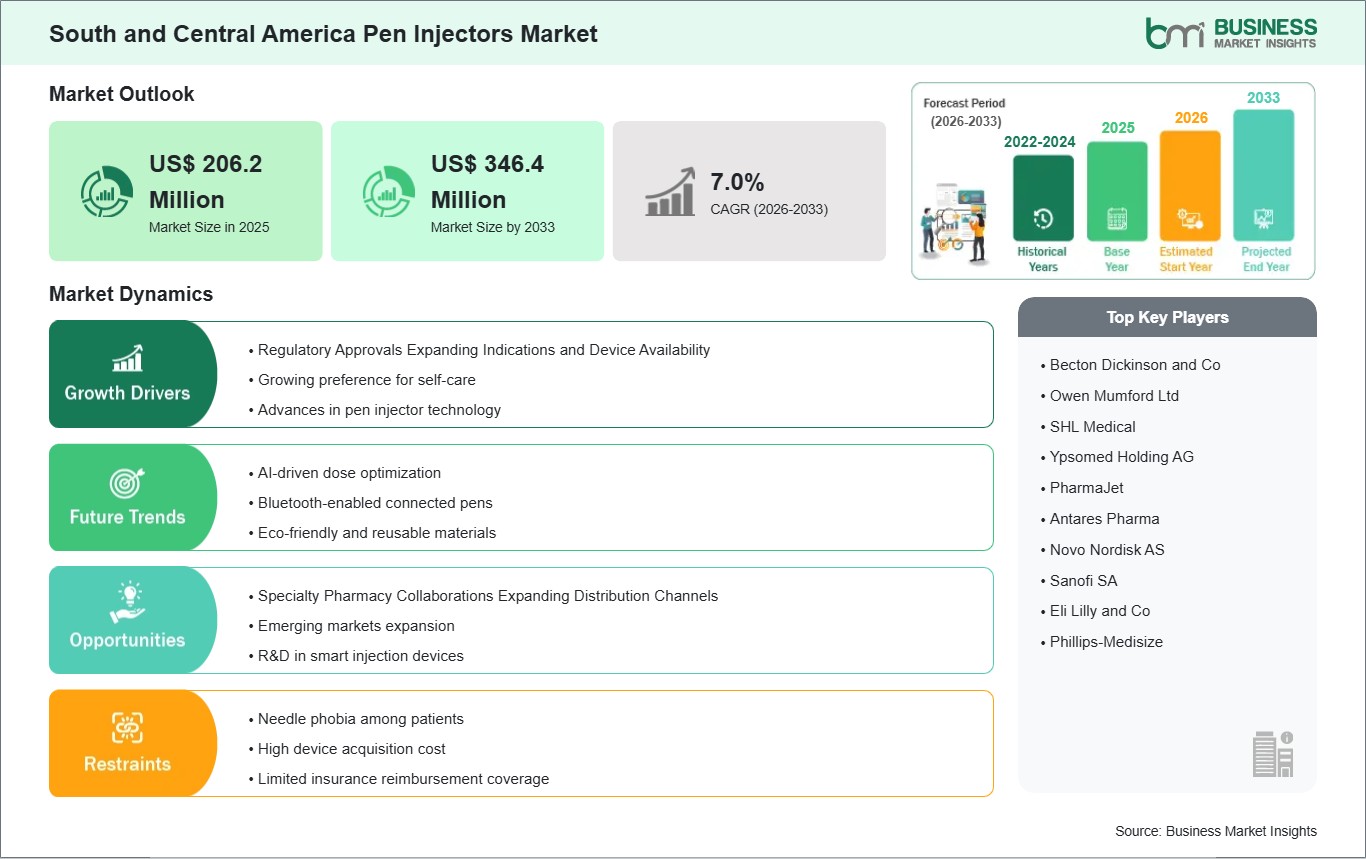
Diabetes, growth hormone deficiencies, and autoimmune disorders are the primary therapeutic areas fueling demand for prefilled, reusable, and ergonomic pen injectors. Countries such as Brazil, Mexico, Argentina, Chile, and Colombia represent key markets due to their population size, healthcare infrastructure, and increasing chronic disease burden. Hospital-based distribution, retail pharmacies, and emerging e-pharmacy platforms improve accessibility across urban and semi-urban areas. Manufacturers are leveraging product innovation to differentiate offerings, focusing on devices with enhanced dosing accuracy, ergonomic design, dose-memory functionality, and compatibility with biologics and biosimilars. Regulatory environments vary across the region, with countries requiring local clinical validation or government approval, influencing product launch timelines. Strategic partnerships between multinational device manufacturers and domestic pharmaceutical distributors facilitate localized production, cost optimization, and compliance with country-specific regulatory requirements. Patient education programs, led by government agencies and diabetes associations, play a pivotal role in promoting proper device use and improving treatment adherence. Sustainability is emerging as a consideration in procurement decisions, with governments and private healthcare providers favoring recyclable components and eco-friendly designs. The South and Central America pen injectors market reflects an innovation-driven environment, where regulatory complexities, patient awareness, and strategic collaborations shape adoption patterns.
Segment Analysis
South and Central America Pen Injectors Market Segmentation
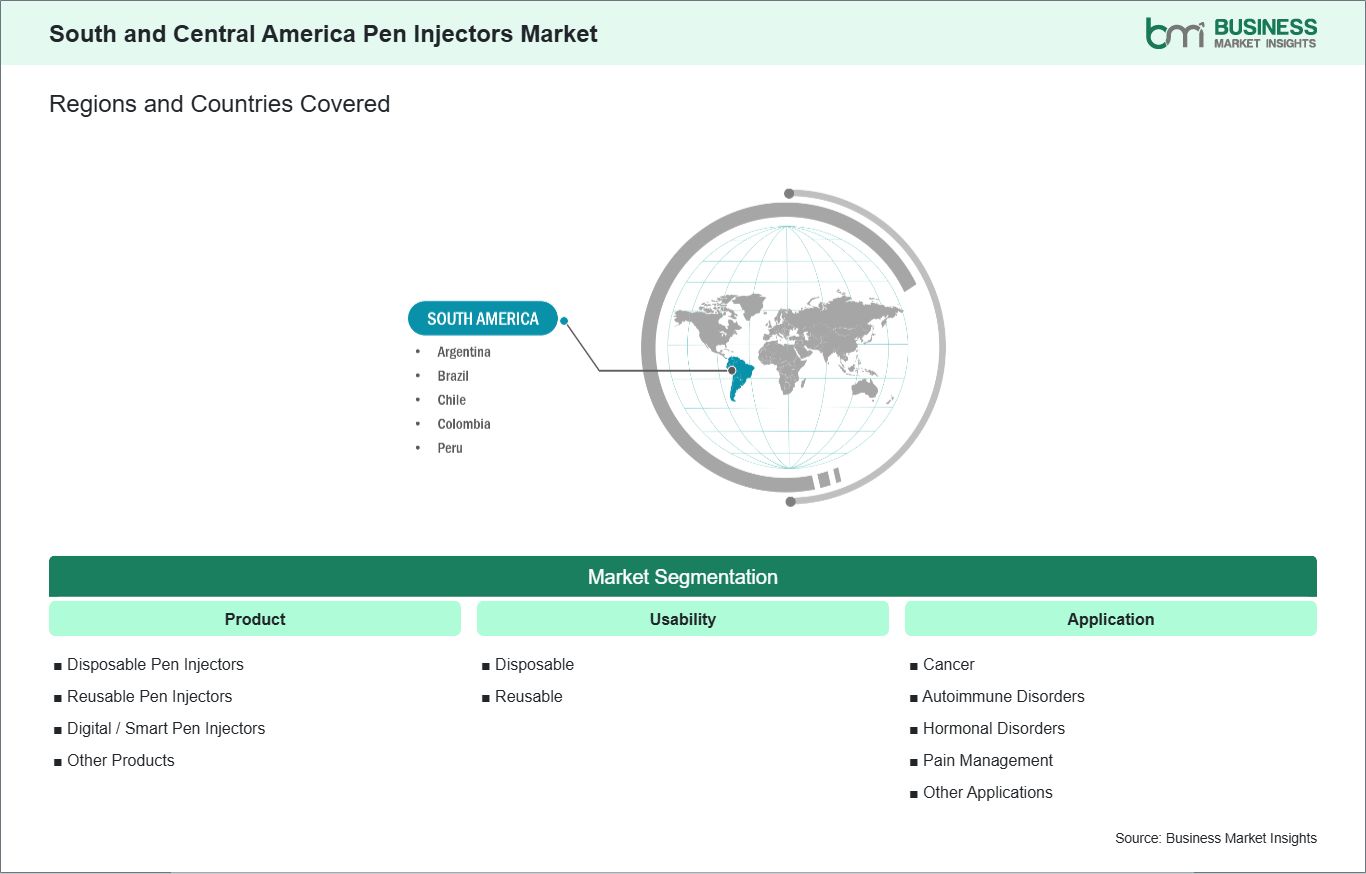
Key segments that contributed to the derivation of the South and Central America Pen Injectors Market analysis are product, usability, and application.
- By product, the pen injectors market is segmented into disposable pen injectors, reusable pen injectors, digital/smart pen injectors, and others. The disposable pen injectors segment dominated the market in 2025.
- Based on usability, the pen injectors market is categorized into disposable and reusable. The disposable segment dominated the market in 2025.
- In terms of application, the market is classified into cancer, autoimmune disorders, hormonal disorders, pain management, and other applications. The autoimmune disorders segment dominated the market in 2025.
Market Forces
South and Central America Pen Injectors Market Drivers and Opportunities
Regulatory Approvals Expanding Indications and Device Availability
Healthcare authorities are streamlining approval pathways for combination products, including pen injectors paired with biologics and other long-acting therapies. This regulatory support is facilitating the introduction of new devices for a range of chronic and specialty treatments, enhancing accessibility for patients who previously had limited options for self-administered therapies. The approval of new indications for pen injectors is impactful for conditions such as diabetes, autoimmune disorders, and hormone therapies, where precise dosing and consistent administration are critical. Regulatory frameworks are being aligned to ensure device safety, quality, and usability, enabling manufacturers to launch products that meet regional standards while providing patients with reliable delivery options. This approach is making advanced devices more widely available across hospitals, clinics, and home-based treatment settings. Regulatory clarity is encouraging innovation in device design and functionality. Manufacturers are introducing pen injectors with enhanced features such as pre-filled cartridges, ergonomic design, and digital dose tracking to comply with safety and performance requirements. These approvals expand the range of treatable conditions and build confidence among healthcare providers and patients, supporting higher adoption rates in South and Central America.
Specialty Pharmacy Collaborations Expanding Distribution Channels
Strategic collaborations with specialty pharmacies enable manufacturers to reach urban and remote healthcare settings, providing patients with convenient access to self-administered therapies. Specialty pharmacies play a critical role in supporting therapy adherence by offering educational resources, device training, and home delivery services, ensuring that pen injectors are used consistently. Manufacturers are leveraging these collaborations to integrate patient support programs that reinforce adherence and proper device use. By working with specialty pharmacies, companies can provide comprehensive care solutions that include device selection guidance, dosing instructions, and monitoring tools. In South and Central America, geography and infrastructure challenges can limit direct access to healthcare facilities, making pharmacy-based distribution an essential element of market growth. Partnerships with specialty pharmacies are driving innovation in supply chain efficiency and patient engagement. Coordinated distribution models reduce delays, optimize stock availability, and facilitate the timely delivery of pen injectors to patients in diverse regions. Combined with educational initiatives and therapy support, these collaborations enhance patient confidence in self-administration and promote sustained use of pen injectors. In South and Central America, specialty pharmacy partnerships are emerging as a critical strategy to expand market reach, improve treatment adherence, and strengthen healthcare delivery for chronic and specialty therapies.
Size and Share Analysis
South and Central America Pen Injectors Market Size and Share Analysis
The South and Central America Pen Injectors Market demonstrates steady growth, with size and share analysis highlighting evolving trends and competitive dynamics among key players. The report examines subsegments categorized within product, usability, and application, offering insights into their contribution to overall market performance.
By product, the disposable pen injectors subsegment dominated the market in 2025, driven by increasing focus on cost‑effective, hygienic single‑use solutions that reduce infection risk.
Based on usability, the disposable subsegment dominated the market in 2025, driven by strong demand for easy‑to‑use, prefilled devices that simplify diabetes and chronic disease management.
In terms of application, the autoimmune disorders subsegment dominated the market in 2025, driven by the growing prevalence of autoimmune conditions and expanding access to advanced biologic therapies in the region.
Report Coverage
South and Central America Pen Injectors Market Report Coverage and Deliverables
The "South and Central America Pen Injectors Market Size and Forecast (2022–2033)" report provides a detailed analysis of the market covering below areas:
- South and Central America Pen Injectors Market size and forecast at regional and country levels for all market segments covered under the scope
- South and Central America Pen Injectors Market trends, as well as drivers, restraints, and opportunities
- South and Central America Pen Injectors Market analysis covering key trends, regional framework, major players, regulations, and recent developments
- Industry landscape and competition analysis covering market concentration, heat map analysis, prominent players, and recent developments for the South and Central America Pen Injectors Market
- Detailed company profiles, including SWOT analysis
Geographic Insights
South and Central America Pen Injectors Market Geographic Insights
The geographical scope of the South and Central America Pen Injectors Market report is divided into Brazil, Argentina, Peru, Chile, and Colombia. Brazil held the largest share in 2025.
Brazil represents the dominant market, driven by its large population, advanced hospital and pharmacy networks, and government programs focused on diabetes and chronic disease management. Brazil has demonstrated early adoption of smart pen injectors and reusable devices, which enhance adherence and patient convenience while integrating with digital health monitoring systems. Argentina shows steady adoption, with urban hospital networks and retail pharmacy distribution serving as the primary channels. However, fragmented reimbursement policies and regional disparities can slow device uptake in certain areas. Chile is emphasizing patient education programs and the adoption of smart pen injectors to facilitate accurate self-administration. Colombia is increasing device penetration, driven by government-sponsored healthcare programs and growing awareness campaigns that promote proper use of pen injectors. Across countries in the region, partnerships with local distributors, compliance with regulatory frameworks, and investment in patient education initiatives are critical for market entry. Brazil’s scale, rapid adoption, and integration of digital and reusable technologies set the benchmark for regional procurement strategies, device feature expectations, and commercialization approaches. While healthcare infrastructure, reimbursement models, and patient awareness vary across South and Central America, Brazil’s dominant position positions it as the central driver of innovation in the pen injector segment.
Industry Activity
Recent Developments
The South and Central America Pen Injectors Market is evaluated by gathering qualitative and quantitative data post primary and secondary research, which includes important corporate publications, association data, and databases. A few of the key developments in the South and Central America Pen Injectors Market are:
- In August 2025, Brazilian‑based EMS began selling its Olire injector pens for obesity and Lirux injector pens for type 2 diabetes management at select pharmacies across Brazil. Both pens use liraglutide as the active ingredient, expanding locally produced pen options for chronic care.
- In January 2025, Mexican COFEPRIS granted market authorization for Novo Nordisk’s GLP‑1 pen formulations (semaglutide variants) in multiple dose strengths, aligning regulatory clearance with rising regional demand.
Trust & Transparency
Research Methodology
The market analysis combines proprietary research with secondary data from government agencies, company disclosures, regulatory filings, industry databases and expert interviews. Market estimates are validated through data triangulation, cross-market benchmarking and analyst
review.
View Full Research Methodology
Key Sources Referred:
World Health Organization (WHO) Organisation for Economic Cooperation and Development (OECD) The World Bank Group Worldometer The Lancet International Bar Association International Trade Administration