Market Summary
Executive Summary and Market Analysis
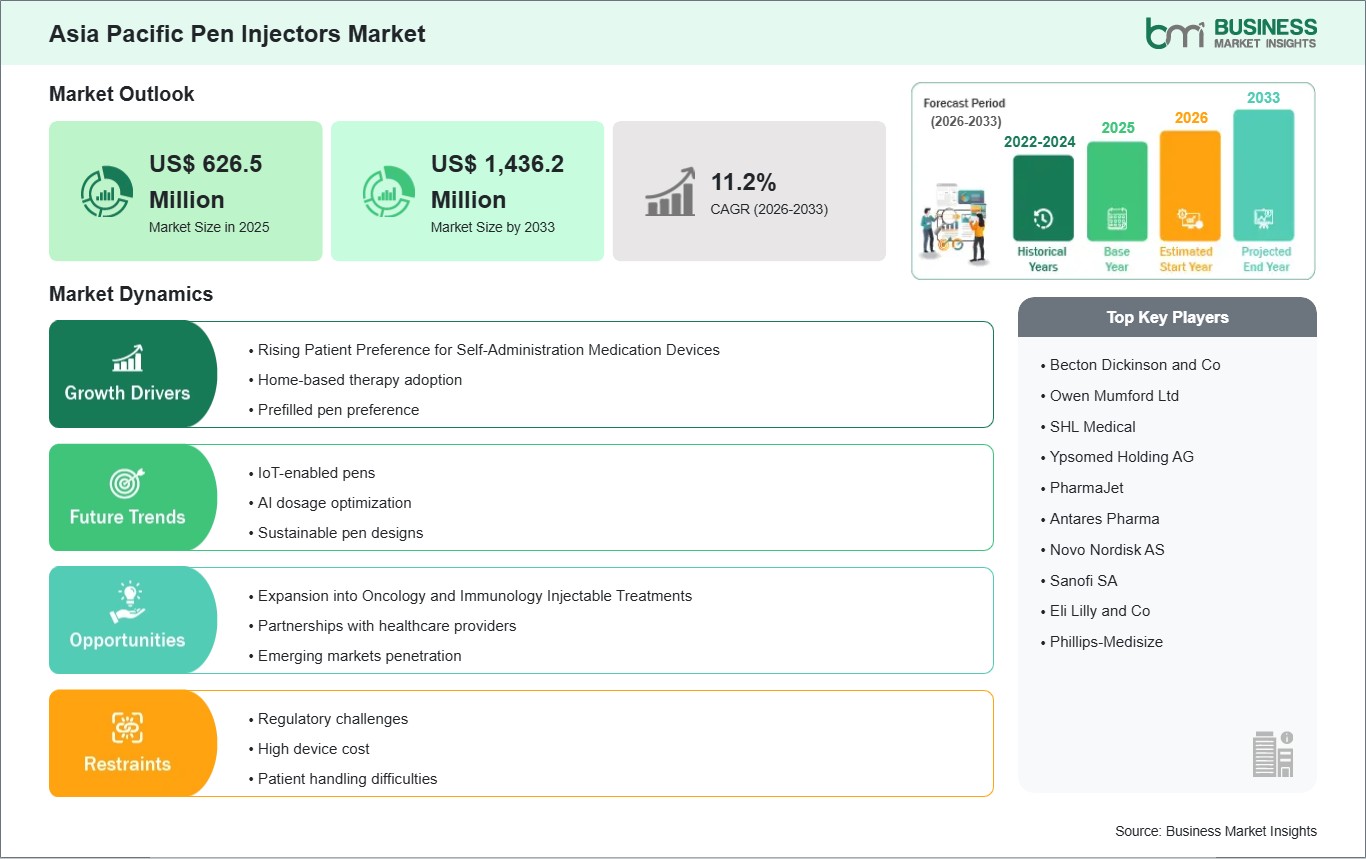
Manufacturers are focusing on user-centric designs, including ergonomic pens, prefilled cartridges, and smart connectivity features to enhance patient adherence and reduce medication errors. Regulatory frameworks emphasize safety, sterility, and environmental considerations for disposable injectors. Market players are leveraging partnerships with local pharmaceutical companies to optimize distribution networks and streamline product launches across tiered healthcare systems. Competitive intensity remains high, with multinational medical device firms and emerging regional manufacturers vying to capture market share through technological differentiation and cost optimization strategies. Digital health integration such as Bluetooth-enabled pens and mobile tracking apps is becoming a critical value proposition, enabling real-time monitoring for clinicians and personalized care plans for patients. A balance between innovation-driven growth and regulatory compliance positions APAC as a rapidly evolving region for injectable therapies.
Segment Analysis
Asia Pacific Pen Injectors Market Segmentation
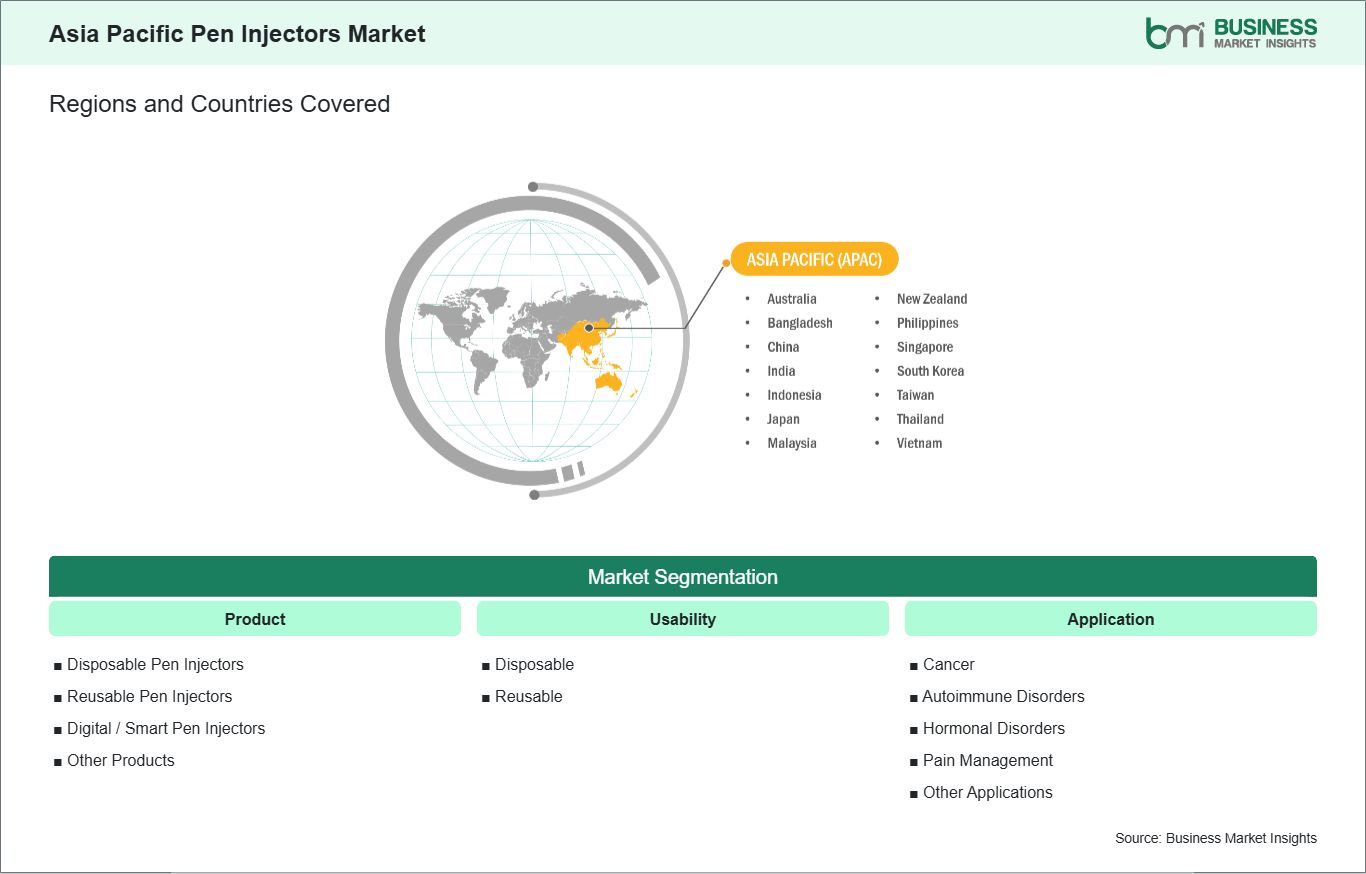
Key segments that contributed to the derivation of the Asia Pacific Pen Injectors Market analysis are product, usability, and application.
- By product, the Pen Injectors Market is segmented into disposable pen injectors, reusable pen injectors, digital/smart pen injectors, and others. The disposable pen injectors segment dominated the market in 2025.
- Based on usability, the pen injectors market is categorized into disposable and reusable. The disposable segment dominated the market in 2025.
- In terms of application, the market is classified into cancer, autoimmune disorders, hormonal disorders, pain management, and other applications. The autoimmune disorders segment dominated the market in 2025.
Market Forces
Asia Pacific Pen Injectors Market Drivers and Opportunities
Rising Patient Preference for Self-Administration Medication Devices
Patients prefer self‑administration for their treatments due to convenience, privacy, and control over medication schedules. They are seeking solutions that allow them to manage chronic conditions from home rather than relying on frequent clinic visits, leading to broader acceptance of user‑friendly pen injector devices. Healthcare providers are integrating patient education programs to facilitate proper use of pen injectors. This trend has helped reduce apprehension associated with self-administration and encouraged patients to adopt these devices confidently. The ease of handling, safety features, and ergonomic design of modern pen injectors appeal to younger and older patient populations, making these devices popular across diverse demographics. Governments and healthcare organizations recognize the benefits of self-care in reducing clinical burdens. Encouraging home-based treatments improves patient adherence and optimizes resource allocation within healthcare facilities. The cumulative effect is a rising preference for pen injectors across urban and semi-urban areas, establishing them as a staple in patient-centric healthcare solutions.
Expansion into Oncology and Immunology Injectable Treatments
As therapies in oncology and immunology become more patient-friendly, there is increasing adoption of devices that allow subcutaneous administration at home. This shift supports better patient convenience, minimizes hospital dependency, and aligns with evolving treatment models. Pharmaceutical and medical device companies are innovating to meet the unique requirements of oncology and immunology patients. Devices are being designed with enhanced safety, precision dosing, and comfort, catering to sensitive populations who require regular injections. The adoption of these devices reflects a trend toward decentralization of complex therapies, allowing patients to manage care outside traditional clinical environments while maintaining treatment efficacy. Healthcare systems are emphasizing self-administration in specialty treatments. Training programs, patient guidance materials, and support services are integrated to ensure safe and effective use of pen injectors. These initiatives strengthen patient confidence and promote wider acceptance of injectable therapies for conditions traditionally managed in clinical settings, marking a strategic growth avenue for the market.
Size and Share Analysis
Asia Pacific Pen Injectors Market Size and Share Analysis
The Asia Pacific Pen Injectors Market demonstrates steady growth, with size and share analysis highlighting evolving trends and competitive dynamics among key players. The report examines subsegments categorized within product, usability, and application, offering insights into their contribution to overall market performance.
By product, the disposable pen injectors subsegment dominated the market in 2025, driven by their ease of use, cost-effectiveness, and reduced risk of contamination.
Based on usability, the disposable subsegment dominated the market in 2025, driven by patient preference for simple, ready-to-use devices that require minimal training.
In terms of application, the autoimmune disorders subsegment dominated the market in 2025, driven by the increasing adoption of self-administered biologics and chronic treatment regimens.
Report Coverage
Asia Pacific Pen Injectors Market Report Coverage and Deliverables
The "Asia Pacific Pen Injectors Market Size and Forecast (2022–2033)" report provides a detailed analysis of the market covering below areas:
- Asia Pacific Pen Injectors Market size and forecast at regional and country levels for all market segments covered under the scope
- Asia Pacific Pen Injectors Market trends, as well as drivers, restraints, and opportunities
- Asia Pacific Pen Injectors Market analysis covering key trends, regional framework, major players, regulations, and recent developments
- Industry landscape and competition analysis covering market concentration, heat map analysis, prominent players, and recent developments for the Asia Pacific Pen Injectors Market
- Detailed company profiles, including SWOT analysis
Geographic Insights
Asia Pacific Pen Injectors Market Geographic Insights
The geographical scope of the Asia Pacific Pen Injectors Market report is divided into China, India, Japan, Australia, Bangladesh, Indonesia, Malaysia, New Zealand, Philippines, Singapore, South Korea, Taiwan, Thailand, and Vietnam. China held the largest share in 2025.
China stands out with its high healthcare infrastructure maturity, advanced hospital networks, and rising digital health ecosystem that enables faster adoption of smart and connected pen injectors. Emerging markets such as India, Indonesia, and the Philippines face cost sensitivity and fragmented distribution channels, which can limit access to premium devices. Local reimbursement policies play a pivotal role, with countries offering comprehensive insurance coverage or government-supported chronic disease management programs experiencing quicker uptake of sophisticated injectors. Market players are customizing product portfolios to meet regional preferences, including needle gauge variations, pen sizes, and reusable versus disposable options. Educational campaigns promoting home-based therapies are gaining traction across China and Southeast Asia, boosting demand for user-friendly, self-administration devices. Strategic investments in localized manufacturing, partnerships with domestic pharmaceutical firms, and patient-centric initiatives are critical for companies to navigate diverse regulatory frameworks while capitalizing on differences in urbanization rates, chronic disease prevalence, and healthcare access.
Industry Activity
Recent Developments
The Asia Pacific Pen Injectors Market is evaluated by gathering qualitative and quantitative data post primary and secondary research, which includes important corporate publications, association data, and databases. A few of the key developments in the Asia Pacific Pen Injectors Market are:
- In June 2025, Eli Lilly launched the Mounjaro KwikPen in India, introducing a once‑weekly prefilled injector pen format for its diabetes and obesity therapy to improve patient convenience and compete more directly with similar products in the region. This launch expanded access to multiple dosage strengths and supported broader patient adoption of self‑administration devices in chronic care.
- In June 2025, Novo Nordisk introduced Wegovy in India in an easy‑to‑use pen format, delivering its weight‑management therapy through a weekly injection designed for self‑administration. This product launch marked an expansion of injectable pen‑based treatments for metabolic and chronic conditions in the Asia Pacific market.
Trust & Transparency
Research Methodology
The market analysis combines proprietary research with secondary data from government agencies, company disclosures, regulatory filings, industry databases and expert interviews. Market estimates are validated through data triangulation, cross-market benchmarking and analyst
review.
View Full Research Methodology
Key Sources Referred:
World Health Organization (WHO)Organisation for Economic Cooperation and Development (OECD)The World Bank GroupWorldometerThe LancetInternational Bar AssociationInternational Trade Administration