Market Summary
Executive Summary and Market Analysis
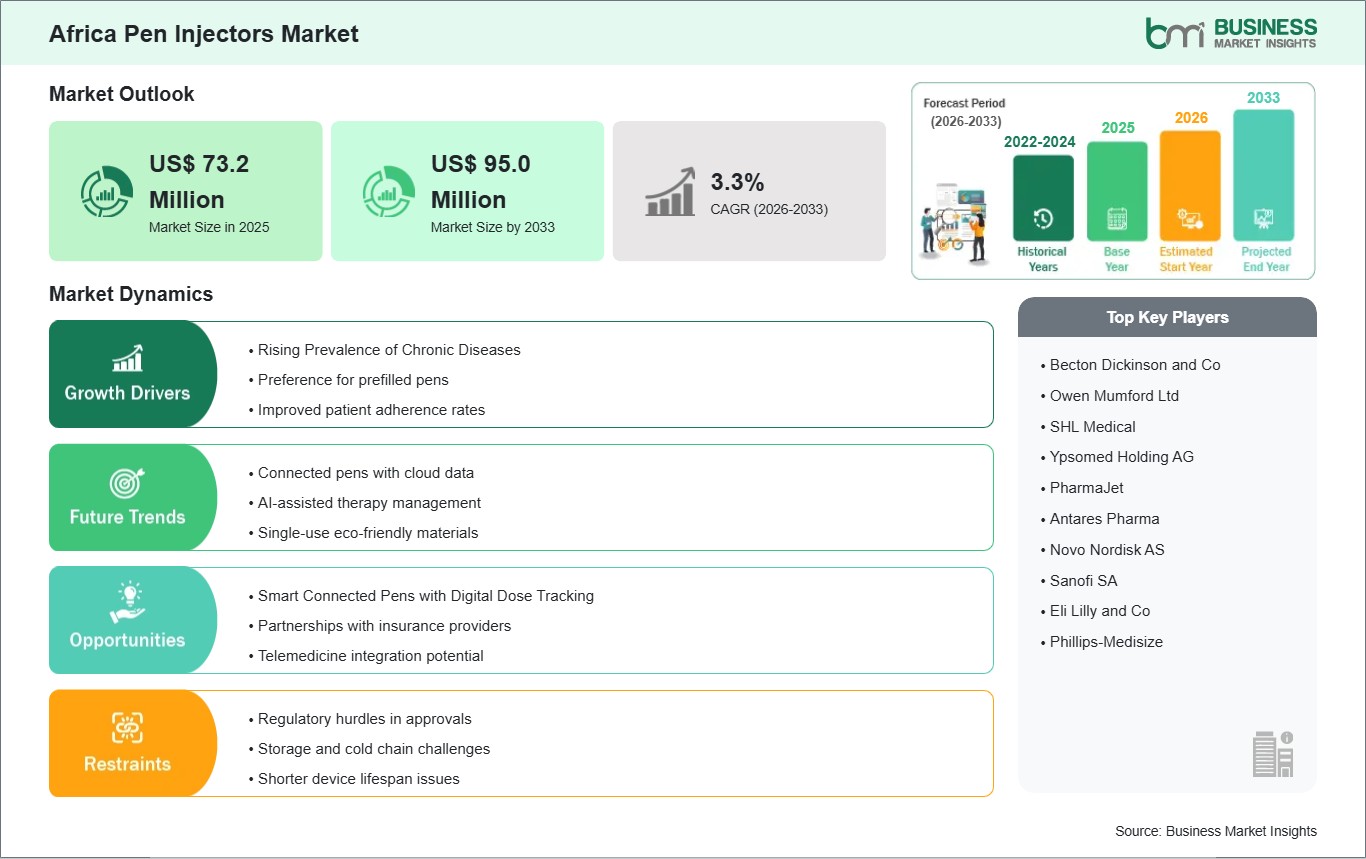
Pen injectors are viewed as essential tools to enhance patient adherence, simplify dosing, and reduce reliance on healthcare facilities, particularly in regions with limited access to specialized care. Multinational pharmaceutical manufacturers are introducing advanced devices, and local distributors are offering cost-effective alternatives tailored to resource-constrained settings. Regulatory frameworks across the continent are evolving, with agencies such as the South African Health Products Regulatory Authority strengthening oversight on quality and safety standards for combination drug-device products. Supply chain efficiency remains a challenge due to infrastructural disparities and dependency on imports for high-quality pen injectors. Strategic partnerships between global manufacturers and regional healthcare providers are fostering training programs for patients and medical professionals, emphasizing correct usage and safety compliance. Awareness campaigns targeting urban and rural populations are driving adoption, as familiarity with injection devices often influences patient acceptance. Manufacturers are prioritizing ergonomic designs, reusable pen options, and temperature-stable formulations to address local climatic and logistical challenges. Competitive differentiation is achieved through innovation in device usability, patient-centric designs, and strategic distribution networks. The market is evolving toward modernized, patient-friendly injectable solutions while navigating infrastructural and regulatory complexities, positioning pen injectors as a crucial component of Africa’s expanding chronic disease management framework.
Segment Analysis
Africa Pen Injectors Market Segmentation
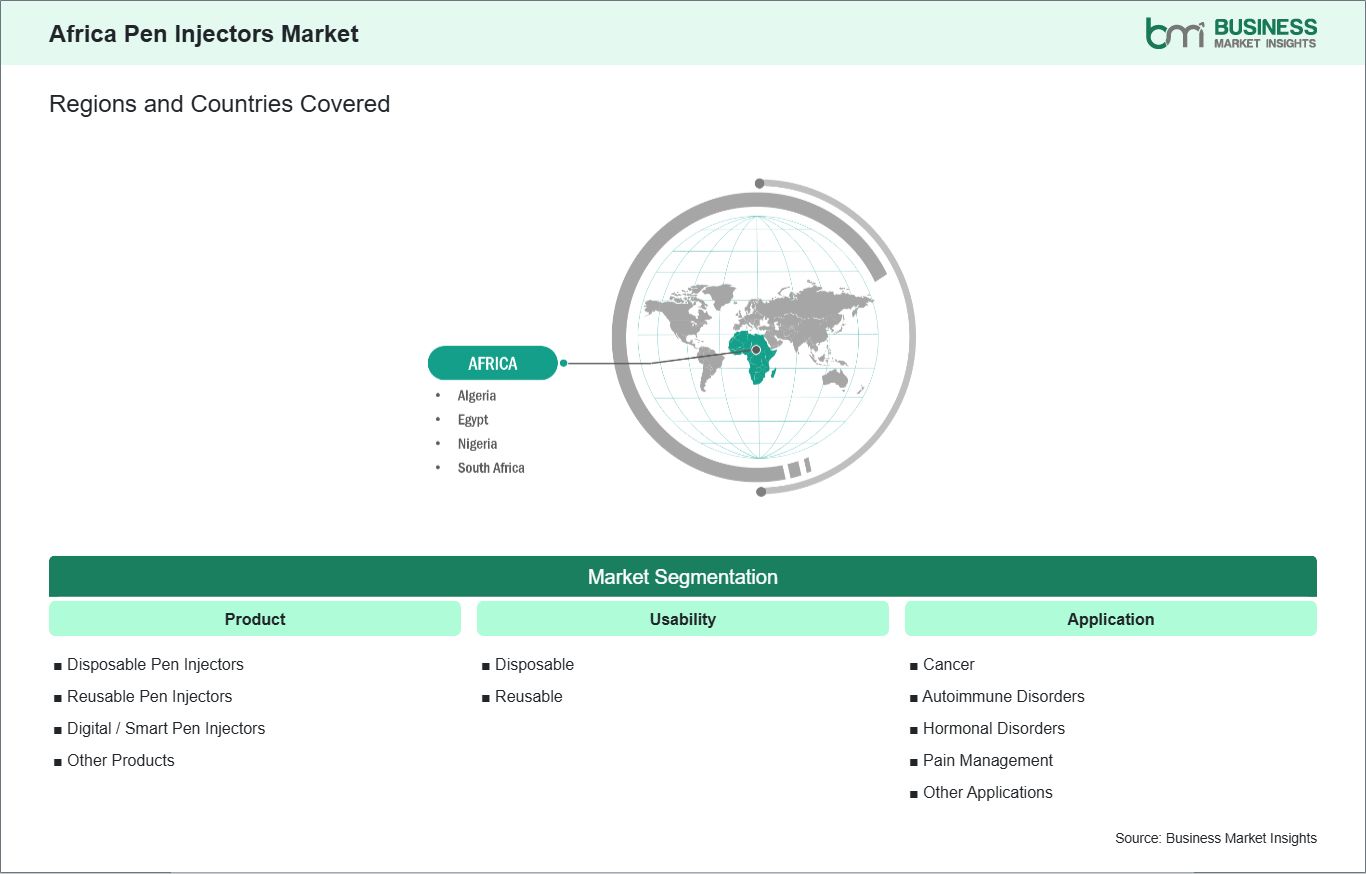
Key segments that contributed to the derivation of the Africa Pen Injectors Market analysis are product, usability, and application.
- By product, the pen injectors market is segmented into disposable pen injectors, reusable pen injectors, digital/smart pen injectors, and others. The disposable pen injectors segment dominated the market in 2025.
- Based on usability, the pen injectors market is categorized into disposable and reusable. The disposable segment dominated the market in 2025.
- In terms of application, the market is classified into cancer, autoimmune disorders, hormonal disorders, pain management, and other applications. The autoimmune disorders segment dominated the market in 2025.
Market Forces
Africa Pen Injectors Market Drivers and Opportunities
Rising Prevalence of Chronic Diseases
Rising incidences of diabetes, cardiovascular disorders, and other long-term conditions have created a demand for user-friendly injection devices. Healthcare systems are shifting focus toward long-term disease management, encouraging the adoption of pen injectors over traditional syringes due to their ease of use and precision in dosing. Patients are seeking treatment options that allow them to manage their conditions more independently. The convenience and safety of pen injectors align with this need, supporting self-administration and reducing reliance on frequent clinical visits. This shift is relevant in regions where access to healthcare facilities is limited, making home-based management solutions an essential part of chronic disease care. Healthcare providers and pharmaceutical companies are recognizing the importance of expanding pen injector availability across Africa. Investments in training programs, awareness campaigns, and distribution networks are facilitating adoption. As awareness of chronic disease management grows, pen injectors are emerging as a critical tool for improving treatment adherence, enhancing patient comfort, and supporting healthcare outcomes in the region.
Smart Connected Pens with Digital Dose Tracking
Smart connected pen injectors enable digital dose tracking, allowing patients to monitor their medication usage and share information with healthcare providers remotely. This integration supports more effective disease management, ensuring that patients receive accurate dosing while enabling clinicians to provide timely guidance. Digital health adoption is increasing across Africa, creating a favorable environment for connected pen technologies. Patients are becoming more comfortable with mobile-based health tools, which can complement smart injectors to track therapy adherence and generate actionable health insights. These innovations are helping bridge gaps in healthcare access and monitoring, particularly in areas with limited clinical resources. Manufacturers and healthcare stakeholders are exploring strategies to integrate connected pen injectors into disease management programs. By combining technology with education and support services, these devices can improve patient engagement, streamline treatment monitoring, and foster better long-term health outcomes. The region stands to benefit from these solutions, which align with the growing need for accessible and patient-centered healthcare delivery.
Size and Share Analysis
Africa Pen Injectors Market Size and Share Analysis
The Africa Pen Injectors Market demonstrates steady growth, with size and share analysis highlighting evolving trends and competitive dynamics among key players. The report examines subsegments categorized within product, usability, and application, offering insights into their contribution to overall market performance.
By product, the disposable pen injectors subsegment dominated the market in 2025, driven by a broad preference for convenient, ready‑to‑use single‑use devices that simplify self‑injection and reduce the risk of contamination in emerging healthcare settings across Africa.
Based on usability, the disposable subsegment dominated the market in 2025, driven by the ease of use, minimal training required, and enhanced hygiene of disposable formats that make them more accessible for chronic therapy management in resource‑limited environments.
In terms of application, the autoimmune disorders subsegment dominated the market in 2025, driven by the rising adoption of biologic therapies for autoimmune and inflammatory conditions, which rely on patient‑friendly pen injectors for accurate dosing and improved adherence.
Report Coverage
Africa Pen Injectors Market Report Coverage and Deliverables
The "Africa Pen Injectors Market Size and Forecast (2022–2033)" report provides a detailed analysis of the market covering below areas:
- Africa Pen Injectors Market size and forecast at regional and country levels for all market segments covered under the scope
- Africa Pen Injectors Market trends, as well as drivers, restraints, and opportunities
- Africa Pen Injectors Market analysis covering key trends, regional framework, major players, regulations, and recent developments
- Industry landscape and competition analysis covering market concentration, heat map analysis, prominent players, and recent developments for the Africa Pen Injectors Market
- Detailed company profiles, including SWOT analysis
Geographic Insights
Africa Pen Injectors Market Geographic Insights
The geographical scope of the Africa Pen Injectors Market report is divided into Egypt, South Africa, Nigeria, and Algeria. Nigeria held the largest share in 2025.
Nigeria’s established healthcare facilities, comprehensive regulatory guidance, and significant patient awareness make it a key entry point for advanced pen injector devices. South Africa, the continent’s most populous country, presents high potential driven by increasing diabetes prevalence and urbanization. However, fragmented healthcare systems and import reliance necessitate strategic distribution partnerships. Kenya and Egypt show growing adoption within private clinics and specialty pharmacies, bolstered by public health initiatives targeting chronic disease management. Regulatory oversight varies widely, with the National Agency for Food and Drug Administration and Control and the Egyptian Drug Authority harmonizing standards for combination products. In West and Central Africa, adoption is limited by infrastructural challenges, limited healthcare professional training, and affordability constraints. However, international donor programs and NGO-led initiatives are slowly increasing access. Climate considerations and transportation infrastructure influence the demand for temperature-stable and robust pen injector designs. The diverse economic and healthcare environments across African countries necessitate flexible market strategies, emphasizing tailored pricing, patient education, and localized supply solutions to optimize penetration.
Industry Activity
Recent Developments
The Africa Pen Injectors Market is evaluated by gathering qualitative and quantitative data post primary and secondary research, which includes important corporate publications, association data, and databases. A few of the key developments in the Africa Pen Injectors Market are:
- In August 2025, Novo Nordisk launched its weight‑loss injection product Wegovy in South Africa via an easy‑to‑use pen injector device. This launch marks the first availability of Wegovy on the continent, expanding patient access to GLP‑1 therapies that address weight management and diabetes‑related treatment needs. The pen format helps patients self‑administer the medication more conveniently and supports broader adoption across healthcare settings. The launch intensifies competition with other injector‑delivered therapies entering the region.
- In September 2025, Aspen Pharmacare secured regulatory approval for the Mounjaro pen injector device in South Africa, enabling distribution of Eli Lilly’s tirzepatide prefilled pen for Type 2 diabetes treatment. This approval supports the transition from vial‑based administration to user‑friendly pen injectors, helping ease self‑administration for patients. It also strengthens competition in the diabetes device segment, especially against rival pens such as Novo Nordisk’s offerings. This regulatory milestone improves device availability in one of Africa’s largest healthcare markets.
Trust & Transparency
Research Methodology
The market analysis combines proprietary research with secondary data from government agencies, company disclosures, regulatory filings, industry databases and expert interviews. Market estimates are validated through data triangulation, cross-market benchmarking and analyst
review.
View Full Research Methodology
Key Sources Referred:
World Health Organization (WHO)Organisation for Economic Cooperation and Development (OECD)The World Bank GroupWorldometerThe LancetInternational Bar AssociationInternational Trade Administration