Market Summary
Executive Summary and Market Analysis
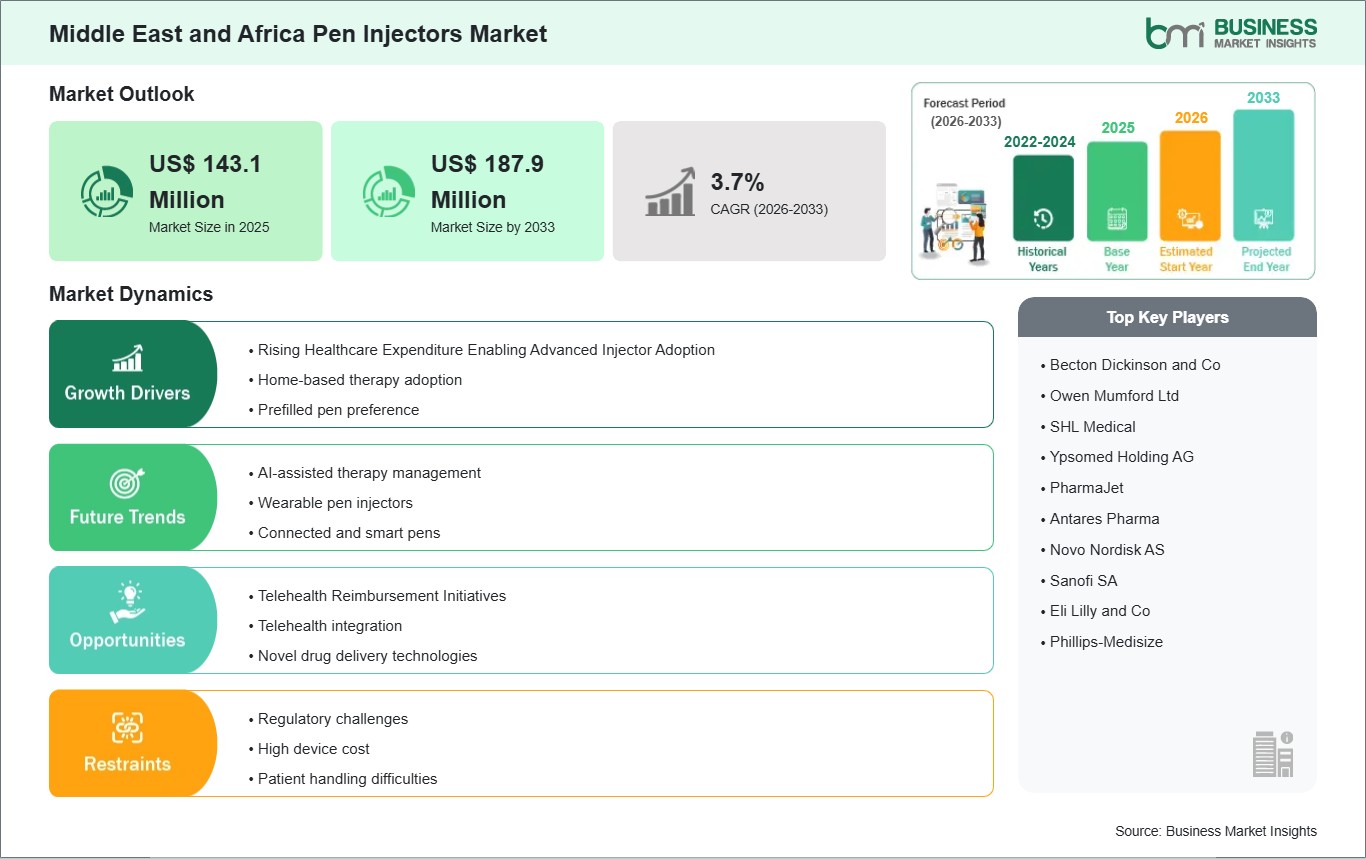
Diabetes, growth hormone deficiencies, and autoimmune disorders are key therapeutic segments driving demand, particularly in countries such as Saudi Arabia, the UAE, South Africa, Egypt, and Nigeria. Manufacturers are focusing on ergonomic designs, prefilled and reusable injectors, and devices with dose-memory features to improve adherence and patient convenience. Regulatory frameworks are evolving across the region, aligning with international standards while emphasizing local clinical requirements and safety validations, influencing product launch strategies. Distribution channels include hospitals, retail pharmacies, and emerging e-pharmacy networks in urban centers, while rural regions rely heavily on public healthcare facilities. Strategic partnerships between multinational medical device companies and local pharmaceutical distributors facilitate market penetration, ensure supply chain efficiency, and address regional compliance requirements. Patient education campaigns, led by governmental programs and diabetes associations, are enhancing device adoption, particularly in countries with lower health literacy. Environmental sustainability considerations, such as recyclable components and reduced packaging, influence procurement decisions, particularly in more developed markets. The MEA pen injectors market reflects a technologically progressive yet heterogeneous landscape, shaped by evolving healthcare policies, patient-centric initiatives, and collaborative distribution strategies.
Segment Analysis
Middle East and Africa Pen Injectors Market Segmentation
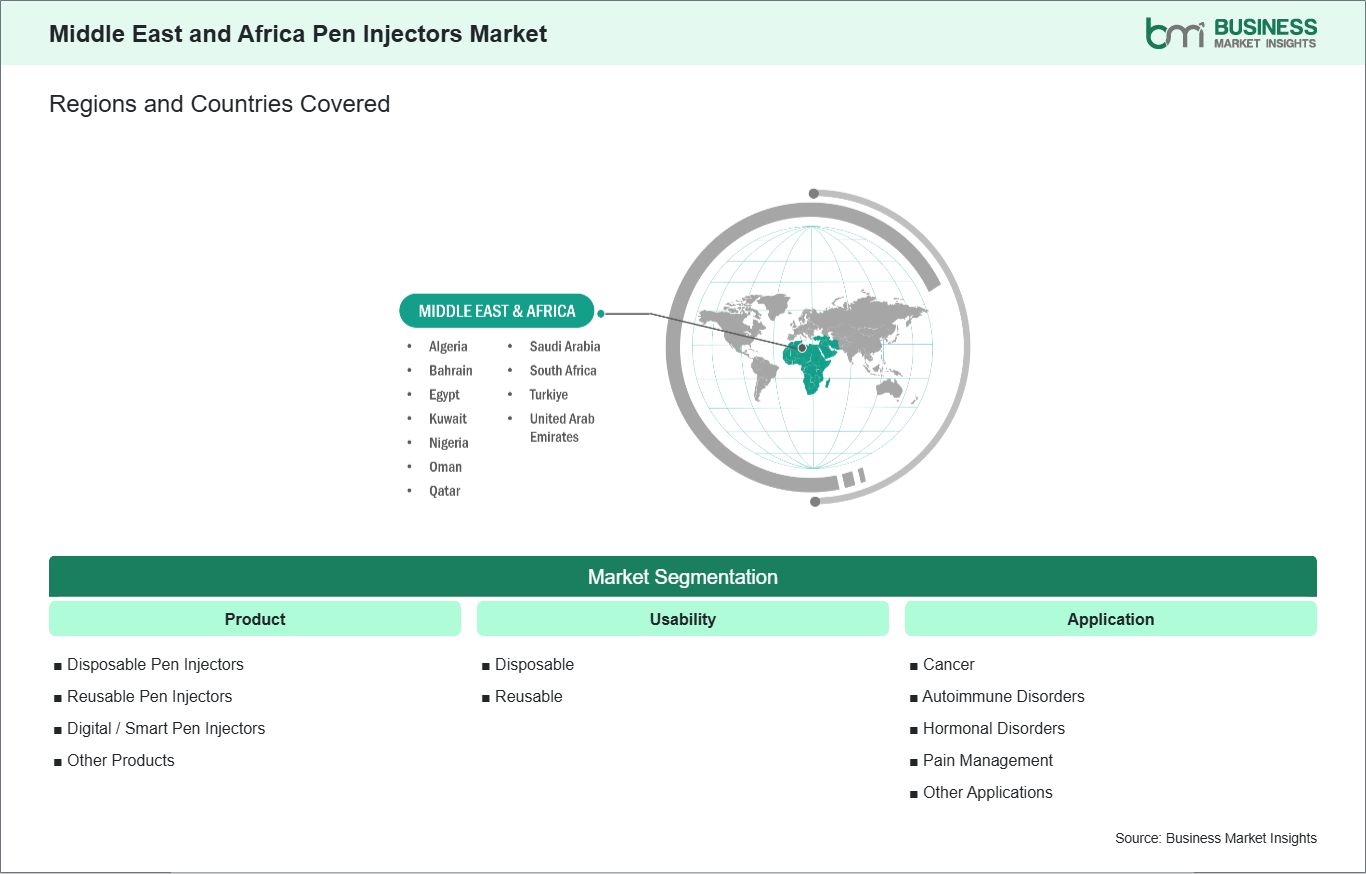
Key segments that contributed to the derivation of the Middle East and Africa Pen Injectors Market analysis are product, usability, and application.
- By product, the pen injectors market is segmented into disposable pen injectors, reusable pen injectors, digital/smart pen injectors, and others. The disposable pen injectors segment dominated the market in 2025.
- Based on usability, the pen injectors market is categorized into disposable and reusable. The disposable segment dominated the market in 2025.
- In terms of application, the market is classified into cancer, autoimmune disorders, hormonal disorders, pain management, and other applications. The autoimmune disorders segment dominated the market in 2025.
Market Forces
Middle East and Africa Pen Injectors Market Drivers and Opportunities
Rising Healthcare Expenditure Enabling Advanced Injector Adoption
Governments and private healthcare systems are allocating resources toward modernizing medical infrastructure and improving access to self-administered therapies. This investment is creating opportunities for manufacturers to introduce pen injectors with enhanced features, including ergonomic designs, safety mechanisms, and compatibility with complex therapies, making advanced treatments accessible to patients. Healthcare providers are integrating advanced pen injectors into hospital and home care settings to improve patient outcomes and streamline chronic disease management. Rising expenditure allows institutions to procure devices that ensure precise dosing and enhance usability, particularly for patients managing long-term therapies outside of clinical supervision. Manufacturers are offering pens with intuitive interfaces, reliable dose control, and patient-centered design, aligning with regional priorities for safe, effective, and accessible healthcare solutions. Increased healthcare funding is stimulating innovation in device technology and market penetration strategies. Advanced pen injectors are positioned as part of initiatives to modernize treatment delivery, reduce dependency on hospital visits, and promote patient self-management. The rising healthcare budgets and growing patient demand are creating a favorable environment for adopting pen injectors that balance safety, usability, and therapeutic precision, driving growth in this evolving market.
Telehealth Reimbursement Initiatives
Healthcare systems in the region are supporting digital health platforms and home-based care, including coverage for connected medical devices that allow clinicians to monitor therapy adherence and patient outcomes remotely. Pen injectors integrated with telehealth solutions provide actionable data for healthcare providers while giving patients greater independence and confidence in managing their treatments at home. The integration of telehealth reimbursement policies encourages manufacturers to develop pen injectors with connectivity features, such as dose tracking, mobile app synchronization, and adherence reporting. These devices align with regional healthcare objectives by improving monitoring efficiency, reducing the need for frequent hospital visits, and supporting proactive intervention when adherence issues arise. This approach ensures that patients receive timely support, enhancing treatment efficacy and promoting consistent use of self-administered therapies across diverse populations. Telehealth-driven device adoption is influencing regional strategies for patient education and engagement. Healthcare providers and payers are emphasizing the use of connected pen injectors as tools for remote training, dose verification, and adherence reinforcement. These initiatives are fostering greater acceptance of self-administered therapies and accelerating the adoption of smart pen injector technologies. By linking reimbursement policies with telehealth-enabled devices, the region is expanding access to advanced injectable therapies and promoting more effective home-based care.
Size and Share Analysis
Middle East and Africa Pen Injectors Market Size and Share Analysis
The Middle East and Africa Pen Injectors Market demonstrates steady growth, with size and share analysis highlighting evolving trends and competitive dynamics among key players. The report examines subsegments categorized within product, usability, and application, offering insights into their contribution to overall market performance.
By product, the disposable pen injectors subsegment dominated the market in 2025, driven by increasing adoption of affordable, ready‑to‑use devices that enhance safety and convenience in diverse healthcare settings.
Based on usability, the disposable subsegment dominated the market in 2025, driven by strong demand for user‑friendly, low‑maintenance injection solutions that support self‑administration and reduce clinical burden.
In terms of application, the autoimmune disorders subsegment dominated the market in 2025, driven by the rising incidence of autoimmune diseases and greater access to biologic treatments across the region’s evolving healthcare systems.
Report Coverage
Middle East and Africa Pen Injectors Market Report Coverage and Deliverables
The "Middle East and Africa Pen Injectors Market Size and Forecast (2022–2033)" report provides a detailed analysis of the market covering below areas:
- Middle East and Africa Pen Injectors Market size and forecast at regional and country levels for all market segments covered under the scope
- Middle East and Africa Pen Injectors Market trends, as well as drivers, restraints, and opportunities
- Middle East and Africa Pen Injectors Market analysis covering key trends, regional framework, major players, regulations, and recent developments
- Industry landscape and competition analysis covering market concentration, heat map analysis, prominent players, and recent developments for the Middle East and Africa Pen Injectors Market
- Detailed company profiles, including SWOT analysis
Geographic Insights
Middle East and Africa Pen Injectors Market Geographic Insights
The geographical scope of the Middle East and Africa Pen Injectors Market report is divided into Turkiye, the UAE, Saudi Arabia, Bahrain, Oman, Egypt, South Africa and Africa, Algeria, Nigeria, Kuwait, and Qatar. Turkiye held the largest share in 2025.
Turkiye’s advanced pharmaceutical manufacturing capabilities, expanding hospital networks, and government-backed chronic disease programs, particularly for diabetes and endocrine disorders, have positioned it as a regional leader in pen injector adoption. Prefilled and reusable pens, including emerging smart devices with dose-tracking features, are integrated into outpatient care and home administration programs. Saudi Arabia and the UAE remain significant markets, with high adoption driven by well-developed healthcare infrastructure, telemedicine initiatives, and digital health integration. Turkiye’s combination of population scale, domestic production, and growing biosimilar adoption is rapidly positioning it at the forefront of the region. South Africa continues to see strong private sector uptake of advanced pen injectors, although public healthcare procurement remains cost-sensitive. Egypt and Nigeria are expanding adoption, supported by increasing patient awareness and broader hospital and pharmacy networks, but constrained by fragmented distribution and limited reimbursement coverage. Across the region, partnerships with local distributors, alignment with regulatory frameworks, and patient education initiatives are essential for successful market penetration. Türkiye’s emergence as a dominant market is influencing regional trends, guiding device feature expectations, pricing strategies, and manufacturer prioritization. While infrastructure, regulatory maturity, and patient awareness vary across countries, Türkiye is becoming the benchmark for adoption, innovation, and strategic engagement, highlighting its central role in shaping the future trajectory of pen injectors in the region.
Industry Activity
Recent Developments
The Middle East and Africa Pen Injectors Market is evaluated by gathering qualitative and quantitative data post primary and secondary research, which includes important corporate publications, association data, and databases. A few of the key developments in the Middle East and Africa Pen Injectors Market are:
- In September 2025, Aspen Pharmacare prepared to launch Eli Lilly’s Mounjaro KwikPen for Type 2 diabetes in South Africa following regulatory approval for pen use. The product, a once‑weekly GLP‑1/GIP agonist, transitions from vial dosing to an easy‑to‑use injector pen format, helping alleviate supply issues and improve patient convenience. This roll‑out represents one of the first major weight‑loss/diabetes pen introductions in sub‑Saharan Africa.
- In August 2025, Novo Nordisk introduced its Wegovy weight‑loss pen injector in South Africa. This rollout expands access to a once‑weekly injectable therapy in a region with high obesity prevalence and unmet metabolic care needs. Wegovy complements the company’s existing diabetes portfolio, including Ozempic pens already available locally. The launch positions Novo Nordisk to compete more intensely with Eli Lilly products.
Trust & Transparency
Research Methodology
The market analysis combines proprietary research with secondary data from government agencies, company disclosures, regulatory filings, industry databases and expert interviews. Market estimates are validated through data triangulation, cross-market benchmarking and analyst
review.
View Full Research Methodology
Key Sources Referred:
World Health Organization (WHO)Organisation for Economic Cooperation and Development (OECD)The World Bank GroupWorldometerThe LancetInternational Bar AssociationInternational Trade Administration