Market Summary
Executive Summary and Market Analysis
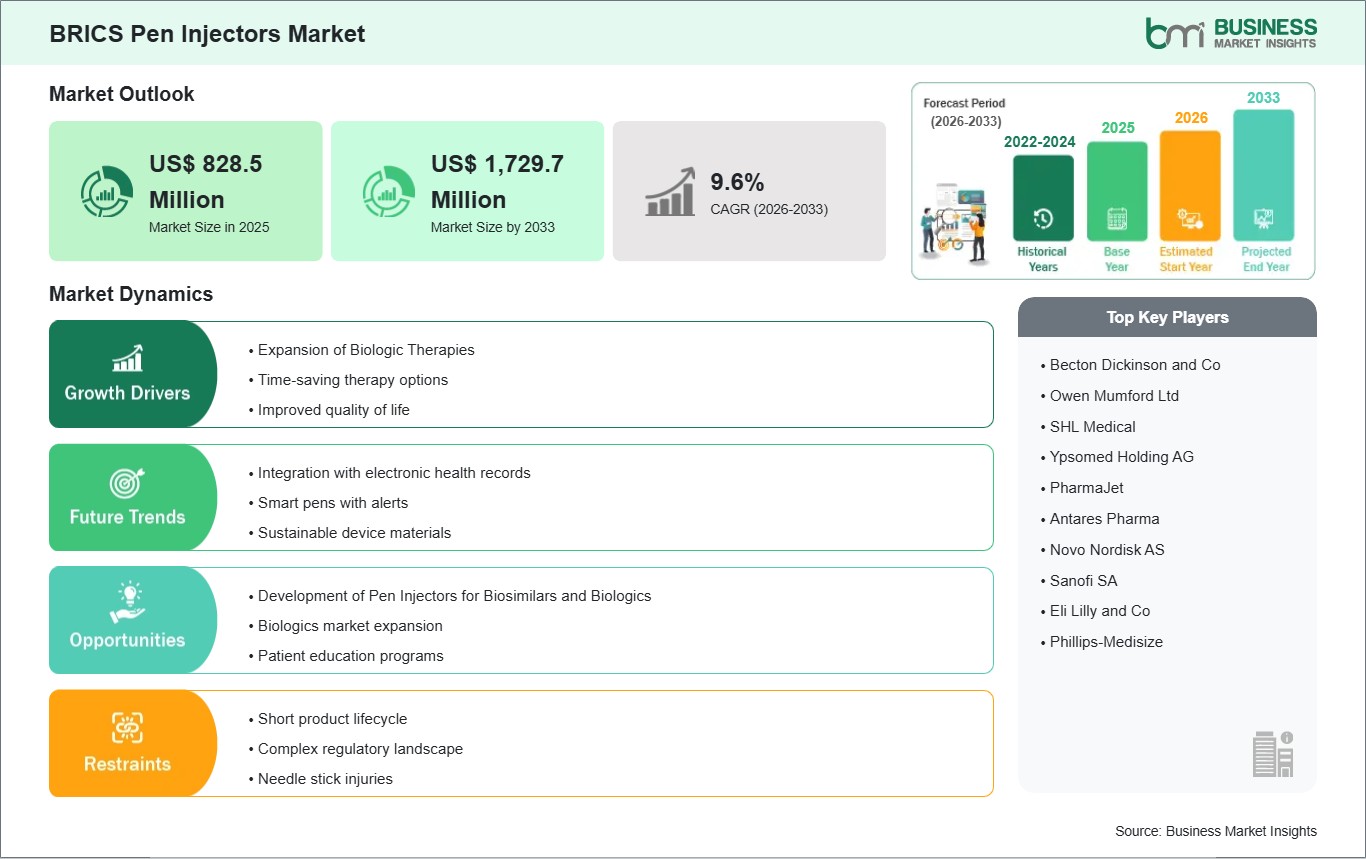
Countries such as Brazil, Russia, India, China, and South Africa are witnessing growth in diabetes, growth hormone deficiency, and autoimmune disease populations, creating demand for easy-to-use, accurate, and patient-friendly drug delivery systems. Market dynamics are influenced by the rising penetration of biologics and biosimilars, coupled with government initiatives to improve access to healthcare in urban and semi-urban areas. Manufacturers are focusing on product differentiation, offering features such as prefilled pens, reusable injectors, and dose memory functionality to enhance adherence. Regulatory environments across BRICS countries vary significantly, affecting market entry strategies and timelines, with some nations emphasizing local clinical trial data or price control mechanisms. Partnerships between domestic pharmaceutical companies and global medical device manufacturers are prevalent, enabling technology transfer and local assembly of pen injectors. Distribution channels are evolving to include retail pharmacies, hospital networks, and emerging e-pharmacy platforms, reflecting shifts toward decentralized healthcare delivery. Strategic collaborations, lifecycle management, and patient education campaigns play a pivotal role in influencing adoption rates. Environmental considerations, such as reducing disposable plastic components, are emerging as differentiators in select markets. Overall, the BRICS pen injectors market demonstrates a rapid growth potential driven by increasing patient demand, juxtaposed against regulatory complexity and price sensitivity, necessitating a market-specific commercialization strategy.
Segment Analysis
BRICS Pen Injectors Market Segmentation
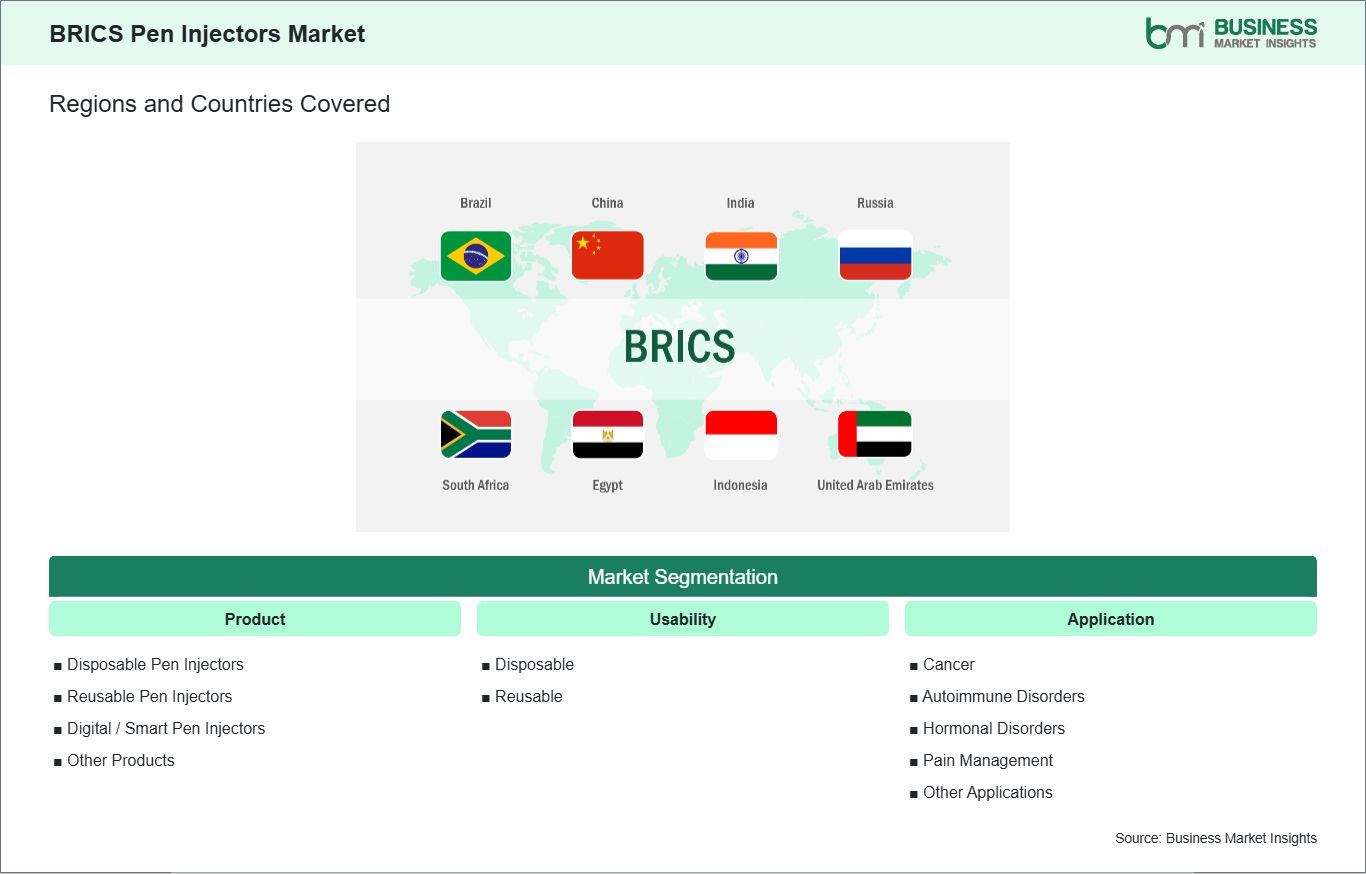
Key segments that contributed to the derivation of the BRICS Pen Injectors Market analysis are product, usability, and application.
- By product, the pen injectors market is segmented into disposable pen injectors, reusable pen injectors, digital/smart pen injectors, and others. The disposable pen injectors segment dominated the market in 2025.
- Based on usability, the pen injectors market is categorized into disposable and reusable. The disposable segment dominated the market in 2025.
- In terms of application, the market is classified into cancer, autoimmune disorders, hormonal disorders, pain management, and other applications. The autoimmune disorders segment dominated the market in 2025.
Market Forces
BRICS Pen Injectors Market Drivers and Opportunities
Expansion of Biologic Therapies
With increasing emphasis on patient self-administration, healthcare providers and manufacturers are prioritizing devices that offer precision, reliability, and consistent dosing. The need for accurate subcutaneous delivery has become critical, as biologics require strict control over injection volumes and rates. Pen injectors are being redesigned to reduce variability and enhance safety, reflecting the region’s growing focus on treatment efficacy and patient outcomes. Healthcare systems are supporting outpatient and home-based treatment models, which drives demand for user-friendly pen injectors capable of handling complex therapies. Device developers are concentrating on ergonomic designs, simplified dosing mechanisms, and feedback features that reassure patients of accurate administration. This focus on usability ensures that patients can manage their treatments confidently while maintaining adherence to prescribed therapy protocols, a factor that has become central in regional healthcare strategies. The market is evolving to address the challenges associated with high-viscosity biologic drugs and large-molecule therapies. The pen injector landscape in BRICS is moving toward solutions that balance clinical precision with patient comfort, enabling broader adoption of advanced biologic therapies. Manufacturers are considering the unique requirements of the region’s healthcare delivery environments, ensuring that devices perform across diverse patient populations and care settings. The expansion of biologic therapies in the region is driving innovation in pen injector design, positioning the market for sustained growth.
Development of Pen Injectors for Biosimilars and Biologics
The region is prioritizing devices that provide consistent performance across a range of therapeutic molecules. Manufacturers are designing pen injectors that are compatible with high-complexity biologics and cost-effective biosimilar alternatives, ensuring that patients have access to reliable delivery methods for diverse therapies. Device features such as dose accuracy, safety locks, and intuitive operation are becoming key differentiators in this competitive landscape. Regional healthcare strategies are encouraging the adoption of biosimilars, which is creating demand for pen injectors capable of supporting these treatments safely and efficiently. The focus is on integrating ease of use with clinical reliability, allowing patients to manage their therapy at home without compromising efficacy. Pen injectors are being tailored to meet the region’s requirements for repeatable and precise dosing, reflecting the trend of expanding access to advanced therapies while maintaining high standards of patient care. Innovation in pen injector technology is helping to address the logistical and operational challenges of distributing biosimilars and biologics throughout the region. Manufacturers are considering the need for robust, adaptable devices that can function reliably in diverse healthcare settings. Pen injectors are emerging as a critical enabler for broader adoption of biologic and biosimilar therapies, offering solutions that combine patient convenience with clinical performance. The region’s growing emphasis on self-administration and treatment accessibility is driving continuous evolution in device design and functionality.
Size and Share Analysis
BRICS Pen Injectors Market Size and Share Analysis
The BRICS Pen Injectors Market demonstrates steady growth, with size and share analysis highlighting evolving trends and competitive dynamics among key players. The report examines subsegments categorized within product, usability, and application, offering insights into their contribution to overall market performance.
By product, the disposable pen injectors subsegment dominated the market in 2025, driven by growing preference for cost‑effective, convenient single‑use devices in emerging healthcare markets.
Based on usability, the disposable subsegment dominated the market in 2025, driven by high demand for easy‑to‑use, low‑training injection solutions among expanding patient populations.
In terms of application, the autoimmune disorders subsegment dominated the market in 2025, driven by the rising incidence of chronic autoimmune diseases and increasing access to biologic therapies across BRICS countries.
Report Coverage
BRICS Pen Injectors Market Report Coverage and Deliverables
The "BRICS Pen Injectors Market Size and Forecast (2022–2033)" report provides a detailed analysis of the market covering below areas:
- BRICS Pen Injectors Market size and forecast at regional and country levels for all market segments covered under the scope
- BRICS Pen Injectors Market trends, as well as drivers, restraints, and opportunities
- BRICS Pen Injectors Market analysis covering key trends, regional framework, major players, regulations, and recent developments
- Industry landscape and competition analysis covering market concentration, heat map analysis, prominent players, and recent developments for the BRICS Pen Injectors Market
- Detailed company profiles, including SWOT analysis
Geographic Insights
BRICS Pen Injectors Market Geographic Insights
The geographical scope of the BRICS Pen Injectors Market report is divided into Russia, Brazil, South Africa, India, the UAE, and China. China held the largest share in 2025.
China emerges as the dominant market driver, reflecting its expansive healthcare infrastructure, high prevalence of chronic diseases, and progressive adoption of digital health solutions. The country’s robust investment in homecare and connected health technologies has positioned it as the largest adopter of smart pen injectors, particularly in urban centers where e-pharmacy and telemedicine platforms facilitate widespread patient access. Regulatory reforms, including expedited approvals for combination devices and biosimilars, have accelerated market entry for international manufacturers. Localized production partnerships reduce costs and enhance supply chain efficiency. India represents a rapidly growing secondary market, driven by urbanization, rising diabetes incidence, and increasing patient preference for prefilled and reusable pens. However, price sensitivity remains a major constraint. Brazil’s centralized public procurement emphasizes cost-effective, reusable devices, and Russia’s hospital-centric model requires stringent local clinical validation. South Africa reflects a bifurcated market: a well-resourced private sector with high adoption of premium pen injectors, contrasted with a public sector constrained by tender-based procurement and cost controls. China’s scale and technological adoption influence regional trends, shaping manufacturer strategies, pricing frameworks, and innovation priorities. Strategic partnerships, patient education initiatives, and digital integration efforts are guided by Chinese market dynamics, positioning the country as a revenue leader and as a benchmark for device features, connectivity standards, and patient engagement approaches. Consequently, market players seeking regional success must prioritize China-focused commercialization while tailoring strategies for other BRICS nations to account for unique regulatory, economic, and healthcare delivery landscapes.
Industry Activity
Recent Developments
The BRICS Pen Injectors Market is evaluated by gathering qualitative and quantitative data post primary and secondary research, which includes important corporate publications, association data, and databases. A few of the key developments in the BRICS Pen Injectors Market are:
- In August 2025, Eli Lilly introduced the Mounjaro KwikPen (a once‑weekly pre‑filled injector pen for diabetes and obesity treatment) in India, bringing enhanced patient convenience and adherence with multiple dose options immediately after regulatory approval. This launch marked the commercial entry of a high‑profile GLP‑1 pen therapy across one of the largest BRICS diabetes markets. It challenged rival products such as Novo Nordisk’s Wegovy.
- In April 2025, Shaily Engineering Plastics unveiled plans to launch its “NEO” and “HARMONY” pen injector platforms for semaglutide and other peptide drugs in India and Brazil, aiming to localize advanced delivery devices in BRICS markets. These pen platforms are intended to improve injectables accessibility with simplified designs adaptable to chronic disease treatments. This launch underscores rising regional manufacturing strength in pen injector technology.
Trust & Transparency
Research Methodology
The market analysis combines proprietary research with secondary data from government agencies, company disclosures, regulatory filings, industry databases and expert interviews. Market estimates are validated through data triangulation, cross-market benchmarking and analyst
review.
View Full Research Methodology
Key Sources Referred:
World Health Organization (WHO)Organisation for Economic Cooperation and Development (OECD)The World Bank GroupWorldometerThe LancetInternational Bar AssociationInternational Trade Administration