Market Summary
Executive Summary and Market Analysis
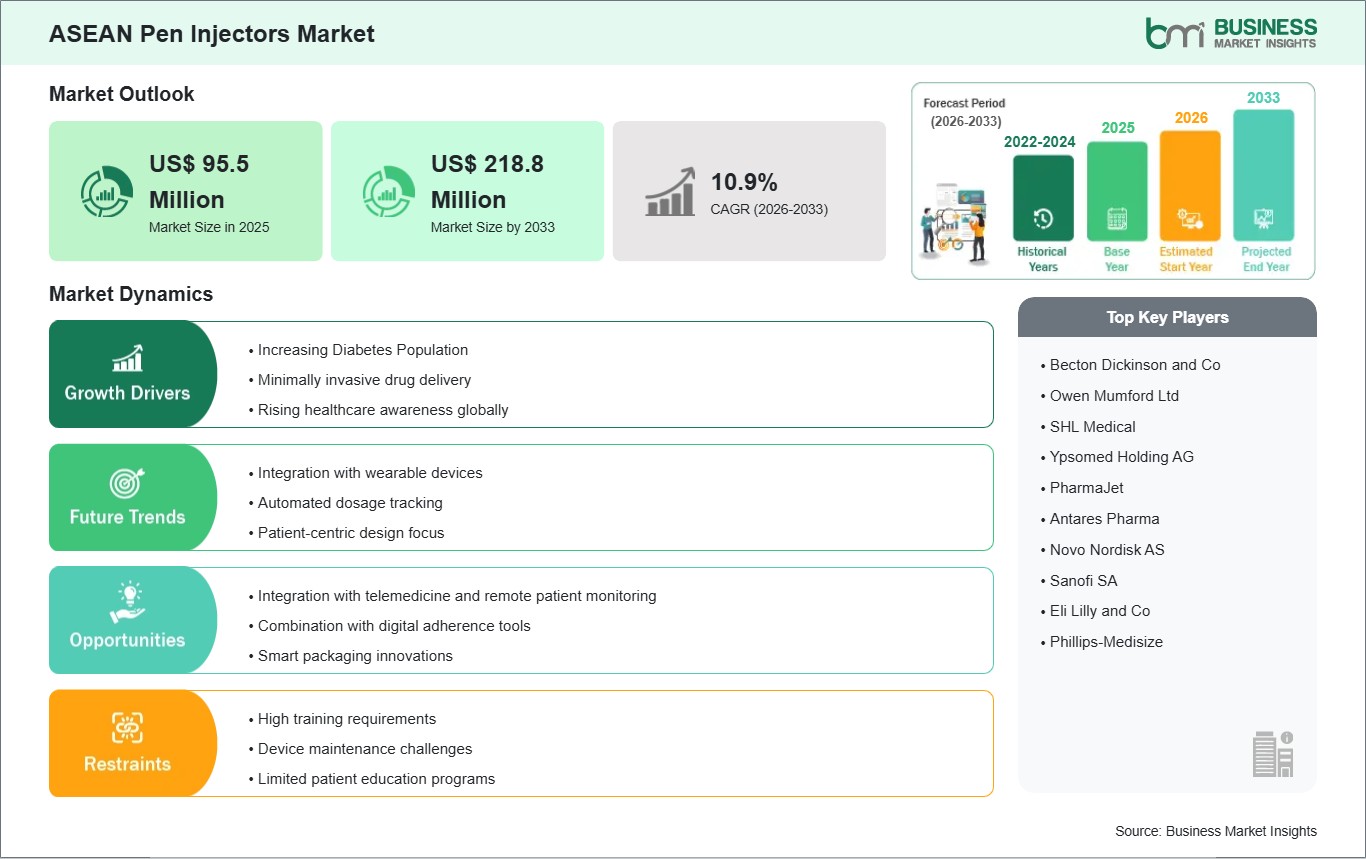
Healthcare modernization initiatives and broader access to essential medicines are accelerating the transition from conventional vial-and-syringe methods to user-friendly pen injector systems. Governments across ASEAN member states are strengthening regulatory pathways to ensure safety and quality compliance for drug-device combination products, improving confidence among healthcare providers and patients. Multinational pharmaceutical companies are introducing branded prefilled and reusable pen injectors. Regional manufacturers are offering competitively priced alternatives to address cost-sensitive segments. Distribution channels are evolving, with hospital pharmacies and private specialty clinics acting as primary adoption hubs, particularly in urban centers. Increasing physician preference for precise dosing and simplified titration mechanisms is reinforcing the clinical appeal of pen injectors. Patient awareness campaigns led by diabetes associations and healthcare institutions are improving familiarity with self-injection techniques. Supply chain optimization, including regional warehousing and localized packaging, is emerging as a strategic priority to reduce lead times and manage temperature-sensitive inventory. Competitive positioning in the market is defined by device reliability, ergonomic design, affordability, and after-sales training support. The market reflects innovation adoption and pragmatic pricing strategies, shaped by diverse healthcare systems and economic conditions across Southeast Asia.
Segment Analysis
ASEAN Pen Injectors Market Segmentation
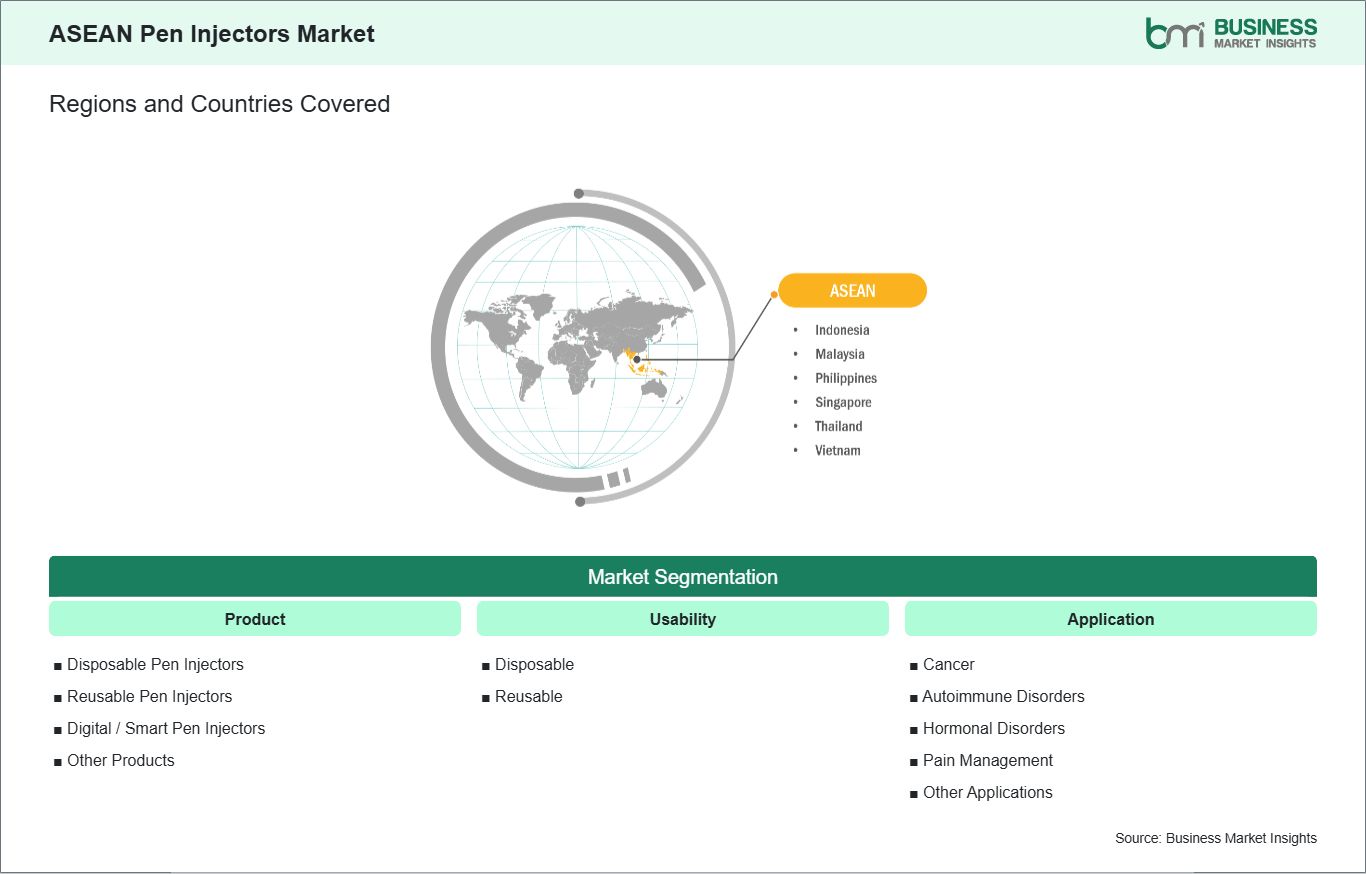
Key segments that contributed to the derivation of the ASEAN Pen Injectors Market analysis are product, usability, and application.
- By product, the pen injectors market is segmented into disposable pen injectors, reusable pen injectors, digital/smart pen injectors, and others. The disposable pen injectors segment dominated the market in 2025.
- Based on usability, the pen injectors market is categorized into disposable and reusable. The disposable segment dominated the market in 2025.
- In terms of application, the market is classified into cancer, autoimmune disorders, hormonal disorders, pain management, and other applications. The autoimmune disorders segment dominated the market in 2025.
Market Forces
ASEAN Pen Injectors Market Drivers and Opportunities
Increasing Diabetes Population
As diabetes becomes prevalent in Southeast Asian nations, demand for convenient treatment solutions continues to grow. Health systems are experiencing rising pressure to support long-term disease management, creating an important role for pen injectors that enable regular injectable therapy outside of traditional clinical settings. This dynamic is driving manufacturers and healthcare providers to prioritize insulin delivery devices that meet patient preferences for ease of use and accurate dosing. In markets such as Indonesia, Malaysia, Thailand, the Philippines, and Vietnam, diabetes care is becoming a central focus of public and private healthcare strategies. Patients and clinicians recognize the limitations of conventional vial and syringe methods, especially for those requiring daily injections. Pen injectors offer improved handling, portability, and dosing precision, which are valued in urban environments where lifestyles are becoming busier and chronic disease management must adapt accordingly. Pen injectors are viewed as a standard option for insulin delivery and other injectable therapies. The regional increase in diabetes prevalence is prompting investment in related support services, including training programs for patients and healthcare professionals. As awareness of chronic disease management improves, more individuals are seeking solutions that facilitate self-administration in home settings. This trend bolsters the appeal of pen injectors over traditional methods, especially in areas where access to frequent clinical care may be limited. The rising diabetes population in driving demand for pen injector adoption, shaping product strategies, distribution networks, and healthcare engagement around modern injectable therapies.
Integration with telemedicine and remote patient monitoring
Across Southeast Asia, digital health adoption is evolving as healthcare payors and providers seek more efficient ways to manage chronic conditions. Telemedicine platforms that facilitate virtual consultations and remote monitoring are becoming mainstream, especially in urban and semi-urban markets where digital infrastructure and smartphone penetration support these services. By connecting pen injectors with remote care solutions, patients can share dosing data and treatment feedback with clinicians without in-person visits, enhancing the continuity of care. Remote patient monitoring is gaining traction as a complement to telehealth consultations. Healthcare providers are interested in solutions that offer real-time insights into treatment adherence and patient behavior between clinical appointments. Connected pen injectors, when paired with mobile or cloud-based systems, can provide such data, enabling clinicians to tailor treatment regimens and intervene proactively. This integration supports better clinical outcomes and aligns with wider regional goals of leveraging digital tools to improve chronic disease management and patient engagement. ASEAN markets exhibit diverse digital readiness, creating challenges and opportunities for integrated solutions. Nations with advanced digital infrastructure are piloting telemedicine frameworks that incorporate device connectivity and remote data sharing, expanding the utility of smart injectors in routine care. Health systems with limited digital capabilities are adopting hybrid models that combine basic remote follow-ups and messaging with traditional care. These varied approaches reflect the regional shift toward incorporating digital touchpoints in healthcare delivery, positioning connected pen injectors as key enablers of chronic disease management across ASEAN.
Size and Share Analysis
ASEAN Pen Injectors Market Size and Share Analysis
The ASEAN Pen Injectors Market demonstrates steady growth, with size and share analysis highlighting evolving trends and competitive dynamics among key players. The report examines subsegments categorized within product, usability, and application, offering insights into their contribution to overall market performance.
By product, the disposable pen injectors subsegment dominated the market in 2025, driven by strong demand for convenient, ready-to-use pre-filled devices that simplify self-administration and improve adherence in chronic care settings where ease of use is a priority.
Based on usability, the disposable subsegment dominated the market in 2025, driven by widespread preference for single-use pens that minimize maintenance and cross-contamination risk, making them suitable for patients and caregivers in emerging healthcare systems.
In terms of application, the autoimmune disorders subsegment dominated the market in 2025, driven by the growing prevalence of autoimmune and inflammatory diseases in the region and the increasing use of biologic therapies requiring precise, patient-friendly delivery via pen injectors.
Report Coverage
ASEAN Pen Injectors Market Report Coverage and Deliverables
The "ASEAN Pen Injectors Market Size and Forecast (2022–2033)" report provides a detailed analysis of the market covering below areas:
- ASEAN Pen Injectors Market size and forecast at regional and country levels for all market segments covered under the scope
- ASEAN Pen Injectors Market trends, as well as drivers, restraints, and opportunities
- ASEAN Pen Injectors Market analysis covering key trends, regional framework, major players, regulations, and recent developments
- Industry landscape and competition analysis covering market concentration, heat map analysis, prominent players, and recent developments for the ASEAN Pen Injectors Market
- Detailed company profiles, including SWOT analysis
Geographic Insights
ASEAN Pen Injectors Market Geographic Insights
The geographical scope of the ASEAN Pen Injectors Market report is divided into Indonesia, Malaysia, the Philippines, Singapore, Thailand, and Vietnam. Indonesia held the largest share in 2025.
Indonesia represents a high-potential market due to its large diabetic population and ongoing healthcare reforms aimed at expanding universal coverage. Thailand demonstrates advanced hospital infrastructure and strong government-led chronic disease programs, fostering consistent demand for pen injectors. Malaysia benefits from a well-structured dual public-private healthcare system, supporting access to innovative drug delivery devices. Vietnam is experiencing rapid healthcare investment and increasing private sector participation, though pricing considerations remain central to procurement decisions. The Philippines shows growing demand in metropolitan areas, supported by expanding pharmacy chains and private insurance coverage. Regulatory authorities are enhancing evaluation standards for medical devices and combination therapies, contributing to improved market transparency. Urban-rural disparities, healthcare funding mechanisms, and physician training levels influence penetration rates. These country-specific characteristics require tailored market entry strategies, localized partnerships, and adaptive pricing frameworks to ensure sustainable expansion across the ASEAN pen injectors landscape.
Industry Activity
Recent Developments
The ASEAN Pen Injectors Market is evaluated by gathering qualitative and quantitative data post primary and secondary research, which includes important corporate publications, association data, and databases. A few of the key developments in the ASEAN Pen Injectors Market are:
- In August 2025, Eli Lilly launched the once-weekly Mounjaro KwikPen prefilled injectable for diabetes and weight management in India, offering enhanced patient convenience with its single-use pen format and expanding the GLP-1 pen injector portfolio in the region.
- In February 2025, Insulin glargine pre-filled pen products developed by Gan & Lee Pharmaceuticals, in collaboration with a Malaysian partner, received registration approval from the National Pharmaceutical Regulatory Agency (NPRA) of Malaysia, marking the first entry of these insulin pen products into Malaysia.
Trust & Transparency
Research Methodology
The market analysis combines proprietary research with secondary data from government agencies, company disclosures, regulatory filings, industry databases and expert interviews. Market estimates are validated through data triangulation, cross-market benchmarking and analyst
review.
View Full Research Methodology
Key Sources Referred:
World Health Organization (WHO)Organisation for Economic Cooperation and Development (OECD)The World Bank GroupWorldometerThe LancetInternational Bar AssociationInternational Trade Administration