Market Summary
Executive Summary and Market Analysis
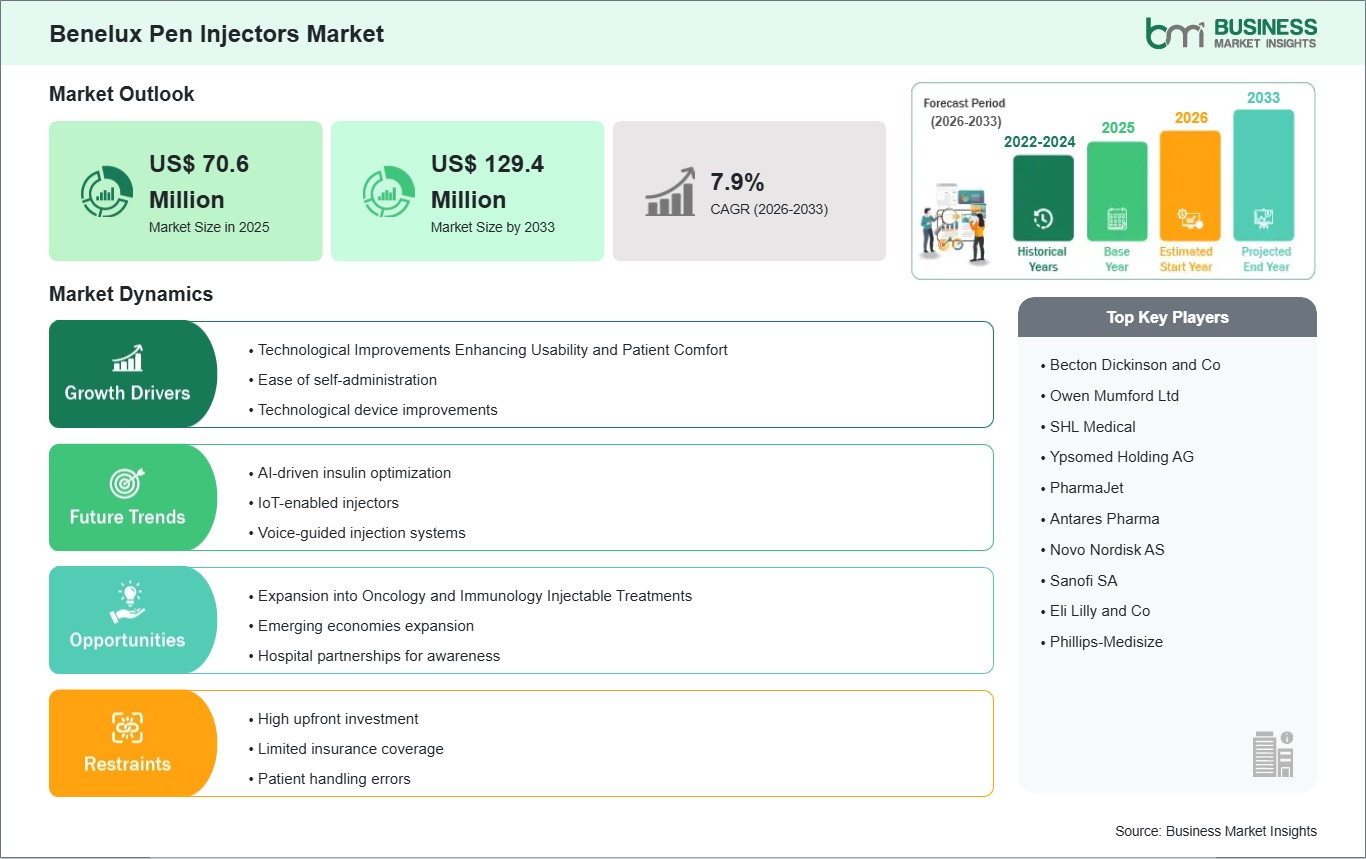
The increasing prevalence of chronic diseases such as diabetes, rheumatoid arthritis, and growth hormone deficiencies has elevated the demand for patient-centric drug delivery systems that enhance adherence and dosing accuracy. Healthcare systems across Belgium, the Netherlands, and Luxembourg are emphasizing value-based care models, accelerating the transition from conventional vial-and-syringe formats to prefilled and reusable pen injectors. The market landscape is characterized by strong participation from multinational pharmaceutical and medical device manufacturers, strategic licensing agreements, and lifecycle management initiatives focused on biologics and biosimilars. Technological differentiation, such as dose-memory functions, ergonomic designs, and dual-chamber systems, has become a critical competitive lever. Regulatory alignment under the European Medicines Agency framework ensures standardized compliance, yet local reimbursement negotiations remain decisive in market penetration. Rising homecare adoption and digital health integration are influencing procurement patterns within hospital and retail pharmacy channels. Competitive intensity is moderate to high, with innovation cycles closely tied to biologic pipeline expansion. Environmental sustainability considerations, including recyclable components and reduced plastic usage, are gradually shaping procurement criteria among institutional buyers. The Benelux pen injectors market reflects an innovation-driven ecosystem supported by strong healthcare infrastructure, high patient awareness, and a favorable policy landscape encouraging advanced drug delivery technologies.
Segment Analysis
Benelux Pen Injectors Market Segmentation
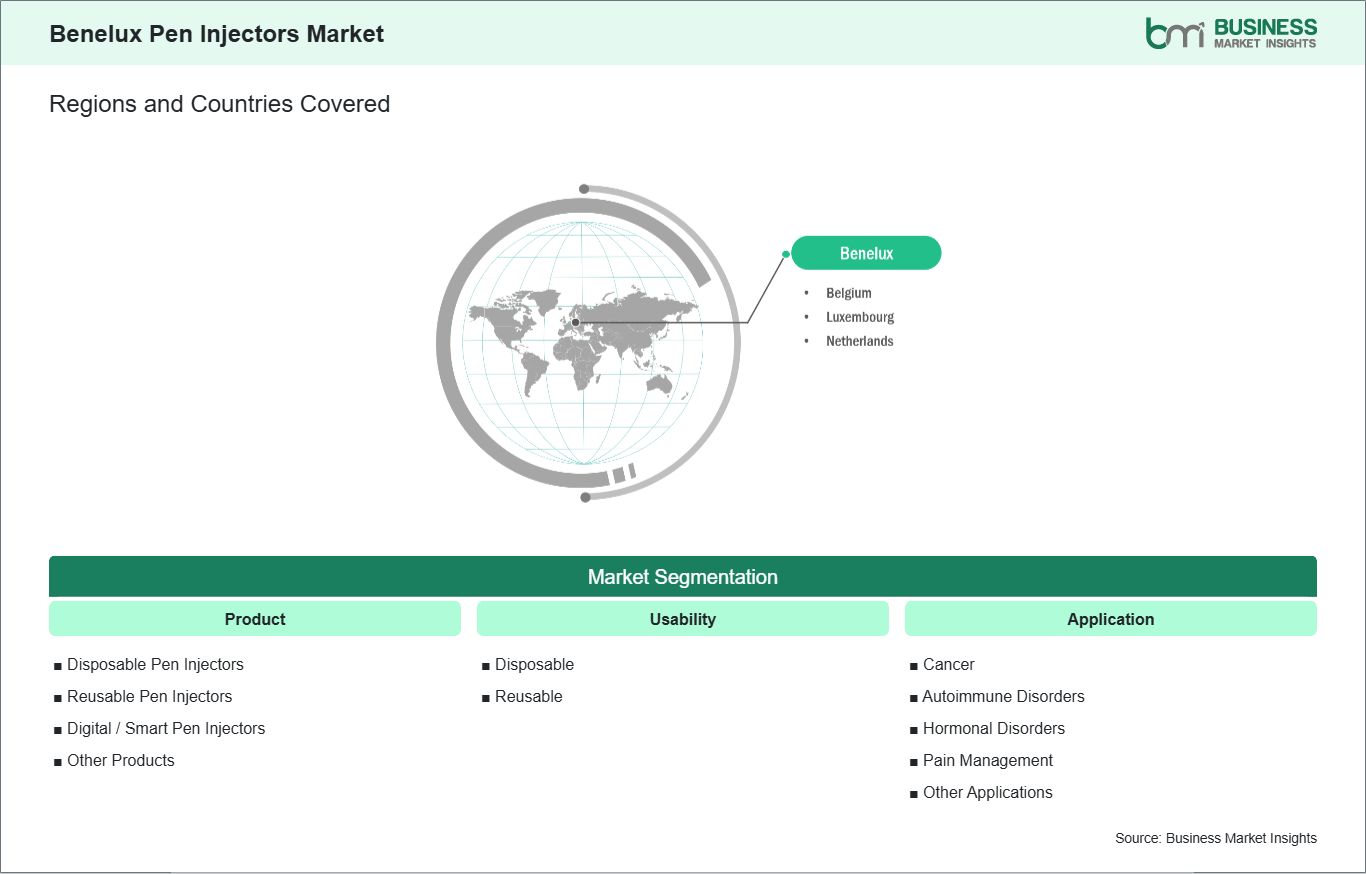
Key segments that contributed to the derivation of the Benelux Pen Injectors Market analysis are product, usability, and application.
- By product, the pen injectors market is segmented into disposable pen injectors, reusable pen injectors, digital/smart pen injectors, and others. The disposable pen injectors segment dominated the market in 2025.
- Based on usability, the pen injectors market is categorized into disposable and reusable. The disposable segment dominated the market in 2025.
- In terms of application, the market is classified into cancer, autoimmune disorders, hormonal disorders, pain management, and other applications. The autoimmune disorders segment dominated the market in 2025.
Market Forces
Benelux Pen Injectors Market Drivers and Opportunities
Technological Improvements Enhancing Usability and Patient Comfort
Manufacturers and healthcare stakeholders in Belgium, the Netherlands, and Luxembourg are placing a strong emphasis on reducing barriers to self-administration. Ergonomic design features, clearer dosing mechanisms, and smoother injection processes are becoming standard expectations rather than optional upgrades. This focus reflects the region’s commitment to patient-centric care and aligns with the priorities of healthcare providers who seek to empower patients to manage their treatment with confidence and minimal discomfort. Belgian healthcare providers, device developers, and patient advocacy groups have shown interest in how pen injector design can improve usability for diverse patient populations. Feedback from users in Belgium has influenced development priorities, leading to devices that are more intuitive and responsive to individual needs. The interplay between digital health solutions and pen injectors is gaining attention across the region. Dutch healthcare systems, known for embracing digital innovations, are supporting enhancements that allow integration with monitoring tools that help patients track their treatment experience, strengthening patient engagement and supporting adherence. In Luxembourg, where the healthcare environment emphasizes personalized treatment approaches, there is a clear preference for injector technologies that deliver comfort without compromising safety. Pen injector makers are focused on ensuring that devices are easy to use and adaptable to various therapeutic contexts, including chronic disease management beyond diabetes. The market is moving toward a future where usability and patient comfort are key differentiators, setting the stage for sustained adoption of advanced pen injector solutions across the region.
Expansion into Oncology and Immunology Injectable Treatments
Healthcare professionals and industry stakeholders in Belgium recognize the value of pen injector solutions for delivering therapies that were previously confined to clinical settings. This shift is driven by a shared objective to make complex injectable treatments more accessible and convenient for patients managing long-term conditions. As a result, device developers are investing in adaptations that ensure pen injectors can support a range of therapeutic molecules while maintaining ease of use and clinical reliability. In the Netherlands, there is an appetite among healthcare institutions to adopt pen injector technologies that extend into immunology and oncology. This interest reflects a growing understanding that patient-friendly delivery options can support treatment continuity, reduce the burden on outpatient facilities, and enhance quality of care for individuals receiving biologic therapies. Dutch healthcare purchasers and clinicians are evaluating how pen injector innovations can be incorporated into treatment pathways in a way that maintains clinical integrity while offering patients more autonomy. The emphasis is on ensuring that delivery devices are compatible with diverse drug profiles and adaptable to evolving treatment needs. Luxembourg’s healthcare market, characterized by a focus on personalized treatment, is receptive to expanded use of pen injectors for oncology and immunology. Decision-makers in the public and private sectors are assessing how these delivery systems can improve patient experiences and streamline therapy administration. Manufacturers targeting the region are positioning their pen injector portfolios to address the demands of advanced therapeutic areas while aligning with regional expectations for safety, reliability, and patient usability. This strategic expansion underscores the evolving role of pen injectors in supporting a wider spectrum of injectable treatments across Benelux healthcare systems.
Size and Share Analysis
Benelux Pen Injectors Market Size and Share Analysis
The Benelux Pen Injectors Market demonstrates steady growth, with size and share analysis highlighting evolving trends and competitive dynamics among key players. The report examines subsegments categorized within product, usability, and application, offering insights into their contribution to overall market performance.
By product, the disposable pen injectors subsegment dominated the market in 2025, driven by a strong preference for single-use, low-maintenance devices that reduce infection risk and simplify self-administration.
Based on usability, the disposable subsegment dominated the market in 2025, driven by high patient demand for ease of use, affordability, and minimal training requirements in at-home treatment settings.
In terms of application, the autoimmune disorders subsegment dominated the market in 2025, driven by the high and growing prevalence of chronic autoimmune conditions in the Benelux region, fueling sustained use of biologics delivered via pen injectors.
Report Coverage
Benelux Pen Injectors Market Report Coverage and Deliverables
The "Benelux Pen Injectors Market Size and Forecast (2022–2033)" report provides a detailed analysis of the market covering below areas:
- Benelux Pen Injectors Market size and forecast at regional and country levels for all market segments covered under the scope
- Benelux Pen Injectors Market trends, as well as drivers, restraints, and opportunities
- Benelux Pen Injectors Market analysis covering key trends, regional framework, major players, regulations, and recent developments
- Industry landscape and competition analysis covering market concentration, heat map analysis, prominent players, and recent developments for the Benelux Pen Injectors Market
- Detailed company profiles, including SWOT analysis
Geographic Insights
Benelux Pen Injectors Market Geographic Insights
The geographical scope of the Benelux Pen Injectors Market report is divided into Belgium, the Netherlands, and Luxembourg. The Netherlands held the largest share in 2025.
In the Netherlands, strong primary care networks and insurer-led procurement frameworks encourage rapid uptake of cost-effective pen injector alternatives, particularly biosimilar-compatible devices. The country’s emphasis on digital health infrastructure supports integration of connected injector technologies, reinforcing adherence monitoring initiatives. Belgium exhibits a hospital-centric distribution structure, where formulary inclusion and physician preference influence brand penetration. Reimbursement negotiations and reference pricing mechanisms shape competitive positioning, prompting manufacturers to adopt value-based evidence strategies. Luxembourg, though comparatively smaller in healthcare volume, benefits from high per capita healthcare expenditure and cross-border treatment access, supporting premium device adoption. Regulatory harmonization across the three countries simplifies market entry. However, language localization and tender processes require tailored commercial strategies. Distribution partnerships with regional wholesalers and pharmacy chains play a pivotal role in last-mile penetration. Patient education campaigns led by diabetes associations and specialist societies contribute to awareness and device familiarity. While the region operates within a unified European regulatory environment, nuanced reimbursement structures, procurement models, and healthcare delivery frameworks necessitate country-specific market engagement strategies to optimize penetration and competitive advantage.
Industry Activity
Recent Developments
The Benelux Pen Injectors Market is evaluated by gathering qualitative and quantitative data post primary and secondary research, which includes important corporate publications, association data, and databases. A few of the key developments in the Benelux Pen Injectors Market are:
- In December 2025, Phillips-Medisize introduced its Envoi disposable pen injector platform, designed to support broad pharmaceutical applications including diabetes, growth hormone, fertility, and osteoporosis, with flexible dosing and compact design. This offering aims to lower cost and risk for pharma companies seeking ready-to-market pen injectors and accelerate product introductions in EU markets, including Belgium, the Netherlands, and Luxembourg. It emphasizes scalable manufacturing and patient-centric design to improve adherence. The launch reflects growing regional demand for affordable, state-of-the-art injection devices in chronic care and specialty therapies.
- In January 2025, Ypsomed’s reusable pen platforms, including YpsoPen and ServoPen, received CE certification and market readiness, enabling manufacturers to launch a range of compatible insulin, GLP-1, and peptide drug pens across the EU (including Benelux) more efficiently. These pens support multiple therapies and allow pharma companies to bring customized self-injector products to Benelux markets via local partners. The CE certification under EU MDR facilitates faster market access for pens used with different medications.
Trust & Transparency
Research Methodology
The market analysis combines proprietary research with secondary data from government agencies, company disclosures, regulatory filings, industry databases and expert interviews. Market estimates are validated through data triangulation, cross-market benchmarking and analyst
review.
View Full Research Methodology
Key Sources Referred:
World Health Organization (WHO)Organisation for Economic Cooperation and Development (OECD)The World Bank GroupWorldometerThe LancetInternational Bar AssociationInternational Trade Administration