Market Summary
Executive Summary and Market Analysis
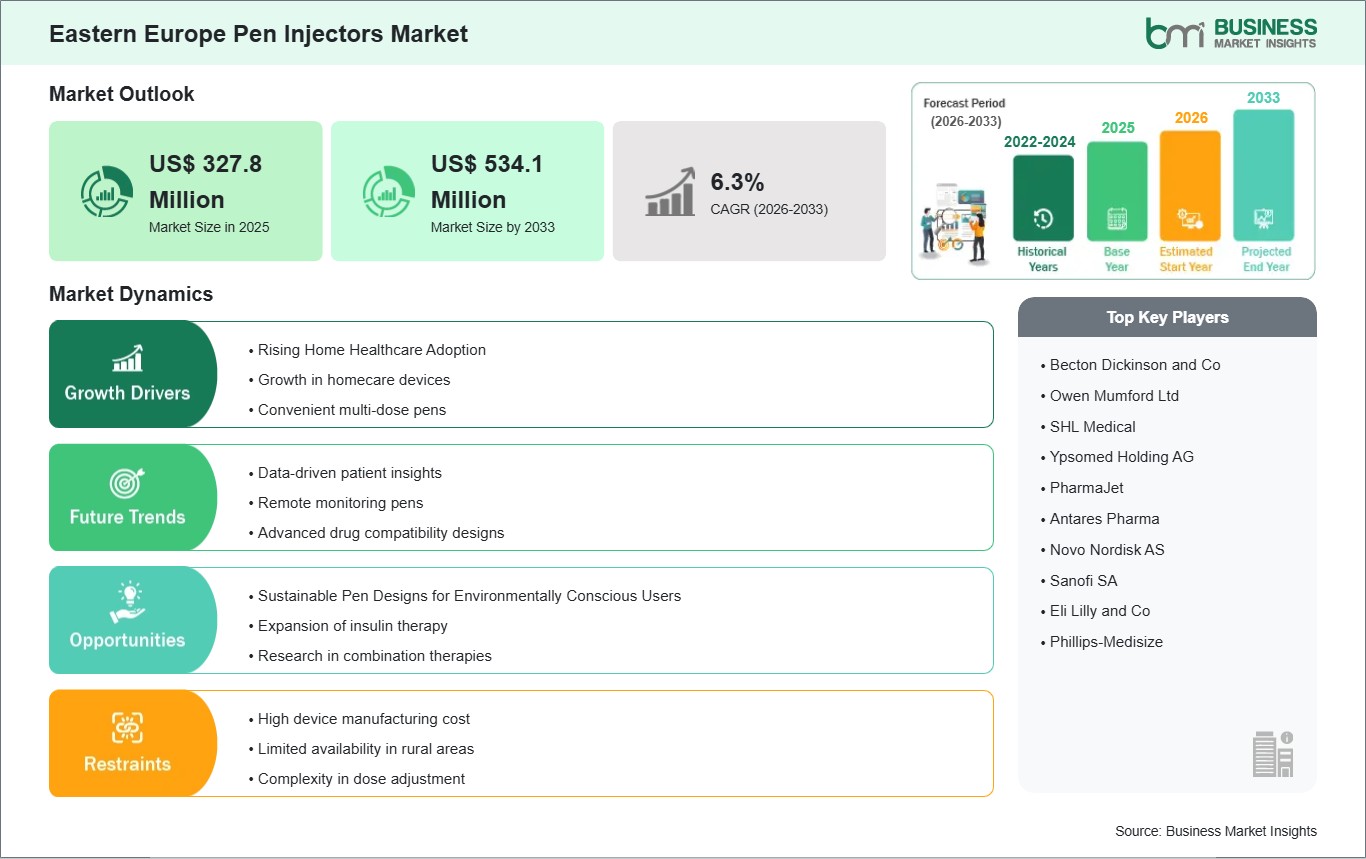
The increasing prevalence of diabetes, growth hormone deficiencies, and autoimmune disorders across countries such as Poland, the Czech Republic, Hungary, and Romania has created demand for pen injectors that improve dosing accuracy and adherence. Market dynamics are influenced by a rising adoption of biologics and biosimilars, coupled with healthcare system initiatives aimed at decentralizing treatment to outpatient and homecare settings. Manufacturers are prioritizing product differentiation through ergonomic designs, prefilled and reusable formats, and integrated safety features. Regulatory frameworks in the region are aligned with European Union standards, though local reimbursement policies and tender-based procurement models create variations in market access. Distribution networks remain fragmented, with hospital pharmacies, retail chains, and emerging online platforms playing complementary roles. Competitive intensity is driven by multinational medical device companies entering through partnerships with local distributors and domestic firms leveraging cost-effective solutions. Awareness campaigns by patient advocacy groups and endocrinology associations have enhanced adoption rates. Environmental sustainability considerations, such as recyclable pens and reduced plastic packaging, are influencing purchasing decisions. In Eastern Europe, innovation, regulatory alignment, and patient-focused product design shape market growth.
Segment Analysis
Eastern Europe Pen Injectors Market Segmentation
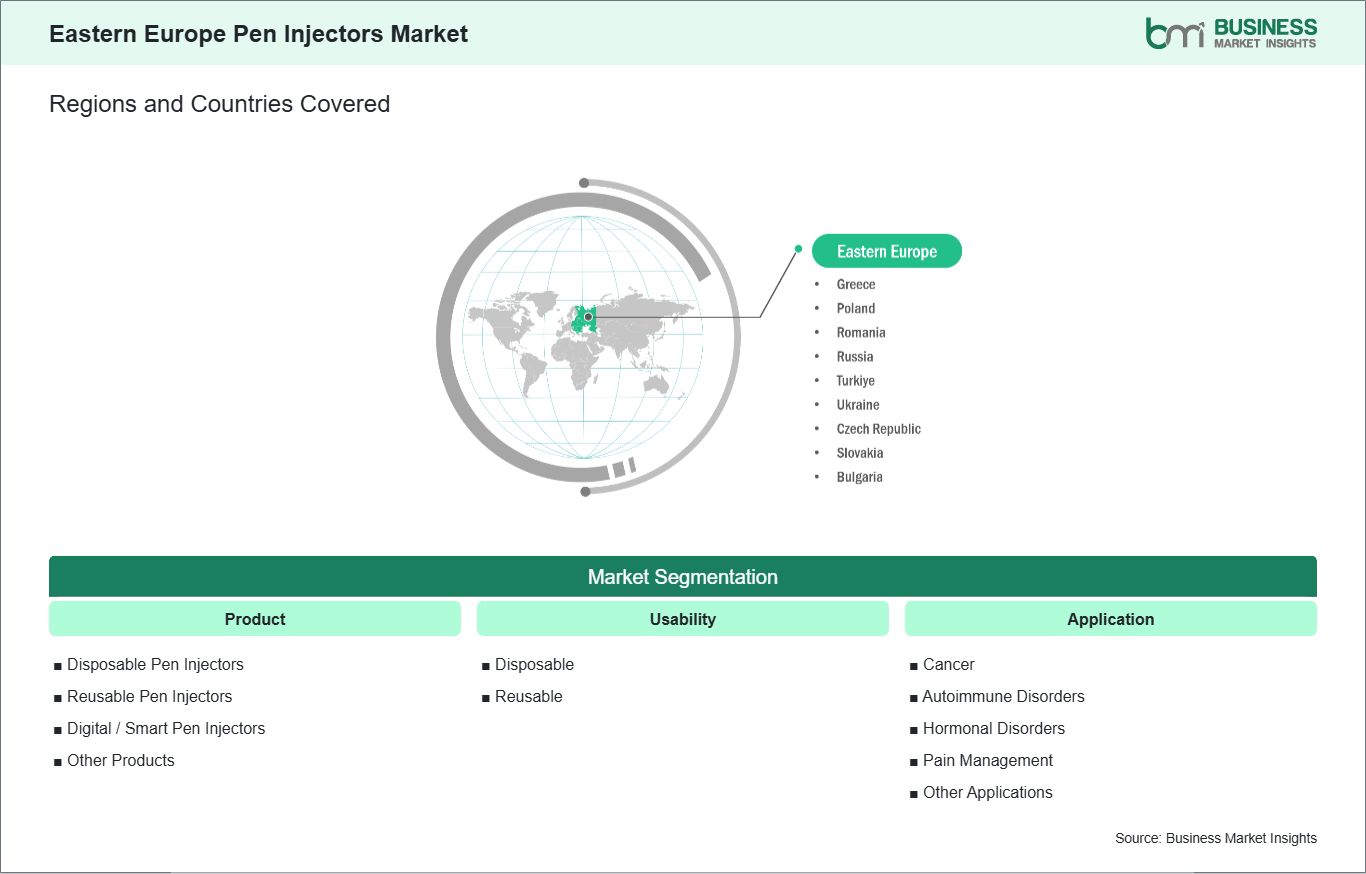
Key segments that contributed to the derivation of the Eastern Europe Pen Injectors Market analysis are product, usability, and application.
- By product, the Pen Injectors Market is segmented into disposable pen injectors, reusable pen injectors, digital/smart pen injectors, and others. The disposable pen injectors segment dominated the market in 2025.
- Based on usability, the Pen Injectors Market is categorized into disposable and reusable. The disposable segment dominated the market in 2025.
- In terms of application, the market is classified into cancer, autoimmune disorders, hormonal disorders, pain management, and other applications. The autoimmune disorders segment dominated the market in 2025.
Market Forces
Eastern Europe Pen Injectors Market Drivers and Opportunities
Rising Home Healthcare Adoption
Healthcare providers and policymakers are emphasizing patient empowerment, enabling individuals to manage chronic conditions from home. This transition is encouraging the adoption of pen injectors that are simple, safe, and reliable, allowing patients to self-administer treatments for conditions that previously required clinical oversight. The focus on home healthcare is creating demand for devices that are user-friendly and designed to minimize errors while maintaining treatment efficacy. Healthcare infrastructure in Eastern Europe is evolving to accommodate outpatient care and remote monitoring solutions. Pen injectors are being integrated into home-based treatment protocols for chronic diseases, reducing hospital congestion and lowering operational costs for healthcare systems. Device manufacturers are incorporating ergonomic designs, easy-to-read dose indicators, and safety features that cater to patients of different age groups and dexterity levels. These enhancements are critical for ensuring adherence to therapy, improving patient satisfaction, and enabling consistent dosing outside of professional healthcare settings. Furthermore, the adoption of home healthcare has spurred innovation in connectivity and smart device features in the Eastern European pen injector market. Devices are designed to interface with digital health platforms, enabling remote monitoring and personalized reminders for patients. This trend aligns with regional healthcare priorities focused on improving outcomes while controlling costs. The growing emphasis on home-based care is driving the demand for advanced pen injector technologies that combine usability, precision, and safety, transforming the delivery of injectable therapies in Eastern Europe.
Sustainable Pen Designs for Environmentally Conscious Users
Healthcare providers and patients are showing interest in delivery devices that minimize environmental impact, prompting manufacturers to explore eco-friendly materials and designs. Reusable pen systems, recyclable components, and reduced packaging are gaining traction as strategies to align product development with the region’s growing emphasis on sustainability. This trend represents a shift from traditional single-use devices to solutions that meet medical and environmental objectives. Manufacturers are focusing on innovations that maintain functionality and safety while reducing waste. Lightweight materials, biodegradable components, and modular designs allow for easier recycling and a lower environmental footprint without compromising device reliability. These developments are relevant in healthcare systems that are implementing sustainability initiatives, reflecting a regional commitment to environmental stewardship. Patients are favoring devices that support eco-conscious treatment practices, which encourages manufacturers to prioritize green design principles. Sustainable pen injectors are being positioned as part of a regional effort to integrate responsible practices into healthcare delivery. By combining environmental considerations with ergonomic usability and clinical precision, these devices are appealing to providers and patients who value eco-conscious innovation. The emphasis on sustainable pen design in Eastern Europe illustrates the intersection of healthcare modernization and environmental responsibility, creating opportunities for manufacturers to develop devices that address patient needs and societal expectations for sustainability.
Size and Share Analysis
Eastern Europe Pen Injectors Market Size and Share Analysis
The Eastern Europe Pen Injectors Market demonstrates steady growth, with size and share analysis highlighting evolving trends and competitive dynamics among key players. The report examines subsegments categorized within product, usability, and application, offering insights into their contribution to overall market performance.
By product, the disposable pen injectors subsegment dominated the market in 2025, driven by increasing adoption of single‑use, low‑cost devices that support safer and more convenient self‑administration.
Based on usability, the disposable subsegment dominated the market in 2025, driven by strong patient preference for easy‑to‑use, maintenance‑free injection solutions in home care settings.
In terms of application, the autoimmune disorders subsegment dominated the market in 2025, driven by a growing prevalence of autoimmune diseases and expanding access to biologic treatments in the region.
Report Coverage
Eastern Europe Pen Injectors Market Report Coverage and Deliverables
The "Eastern Europe Pen Injectors Market Size and Forecast (2022–2033)" report provides a detailed analysis of the market covering below areas:
- Eastern Europe Pen Injectors Market size and forecast at regional and country levels for all market segments covered under the scope
- Eastern Europe Pen Injectors Market trends, as well as drivers, restraints, and opportunities
- Eastern Europe Pen Injectors Market analysis covering key trends, regional framework, major players, regulations, and recent developments
- Industry landscape and competition analysis covering market concentration, heat map analysis, prominent players, and recent developments for the Eastern Europe Pen Injectors Market
- Detailed company profiles, including SWOT analysis
Geographic Insights
Eastern Europe Pen Injectors Market Geographic Insights
The geographical scope of the Eastern Europe Pen Injectors Market report is divided into Russia, Poland, Ukraine, Romania, the Czech Republic, Slovakia, Bulgaria, and Greece. Russia held the largest share in 2025.
Russia emerges as the dominant market driver, reflecting its extensive healthcare infrastructure, high prevalence of chronic diseases, and strong adoption of advanced drug delivery systems. The country’s hospital-centric model, combined with centralized procurement frameworks and public reimbursement schemes, has positioned it as the leading adopter of prefilled and reusable pen injectors, particularly for diabetes and growth hormone therapies. Multinational manufacturers prioritize Russia for early launches due to its sizable patient population and regulatory environment that supports combination devices and biosimilars. The Czech Republic exhibits moderate growth, driven by hospital formulary inclusion and physician preference, with tender-based procurement influencing brand penetration. Hungary benefits from growing patient awareness campaigns and increasing diabetes prevalence, supporting the adoption of ergonomic and reusable pens, though pricing sensitivity remains significant. Romania is constrained by fragmented distribution networks and variable public healthcare funding, but is gradually embracing advanced pen technologies. Russia’s scale and regulatory influence shape regional trends, guiding manufacturer strategies, product features, and pricing frameworks. Partnerships with local distributors, alignment with government procurement policies, and engagement with patient advocacy programs are essential for success. While market conditions vary across countries, Russia’s leadership ensures it remains the benchmark for device adoption, technological innovation, and market growth strategies in the region.
Industry Activity
Recent Developments
The Eastern Europe Pen Injectors Market is evaluated by gathering qualitative and quantitative data post primary and secondary research, which includes important corporate publications, association data, and databases. A few of the key developments in the Eastern Europe Pen Injectors Market are:
- In August 2025, Trividia Health launched its TRUEplus five‑bevel insulin pen needles in the UK and broader European markets, offering enhanced comfort and safety for injectable therapy. While focused on needles, this accessory launch supports pen injector usability across Eastern European countries supplied through EU distributors.
- In May 2025, Sandoz launched Pyzchiva, the first commercially available pre‑filled autoinjector pen for ustekinumab biosimilars in Europe, improving self‑administration comfort for patients with chronic inflammatory diseases; this product is marketed across Europe, including Eastern European markets, with EU CE authorization. The device provides a more intuitive injection experience, automatic dosing, and a convenient design aimed at better patient adherence.
Trust & Transparency
Research Methodology
The market analysis combines proprietary research with secondary data from government agencies, company disclosures, regulatory filings, industry databases and expert interviews. Market estimates are validated through data triangulation, cross-market benchmarking and analyst
review.
View Full Research Methodology
Key Sources Referred:
World Health Organization (WHO)Organisation for Economic Cooperation and Development (OECD)The World Bank GroupWorldometerThe LancetInternational Bar AssociationInternational Trade Administration