Market Summary
Executive Summary and Market Analysis
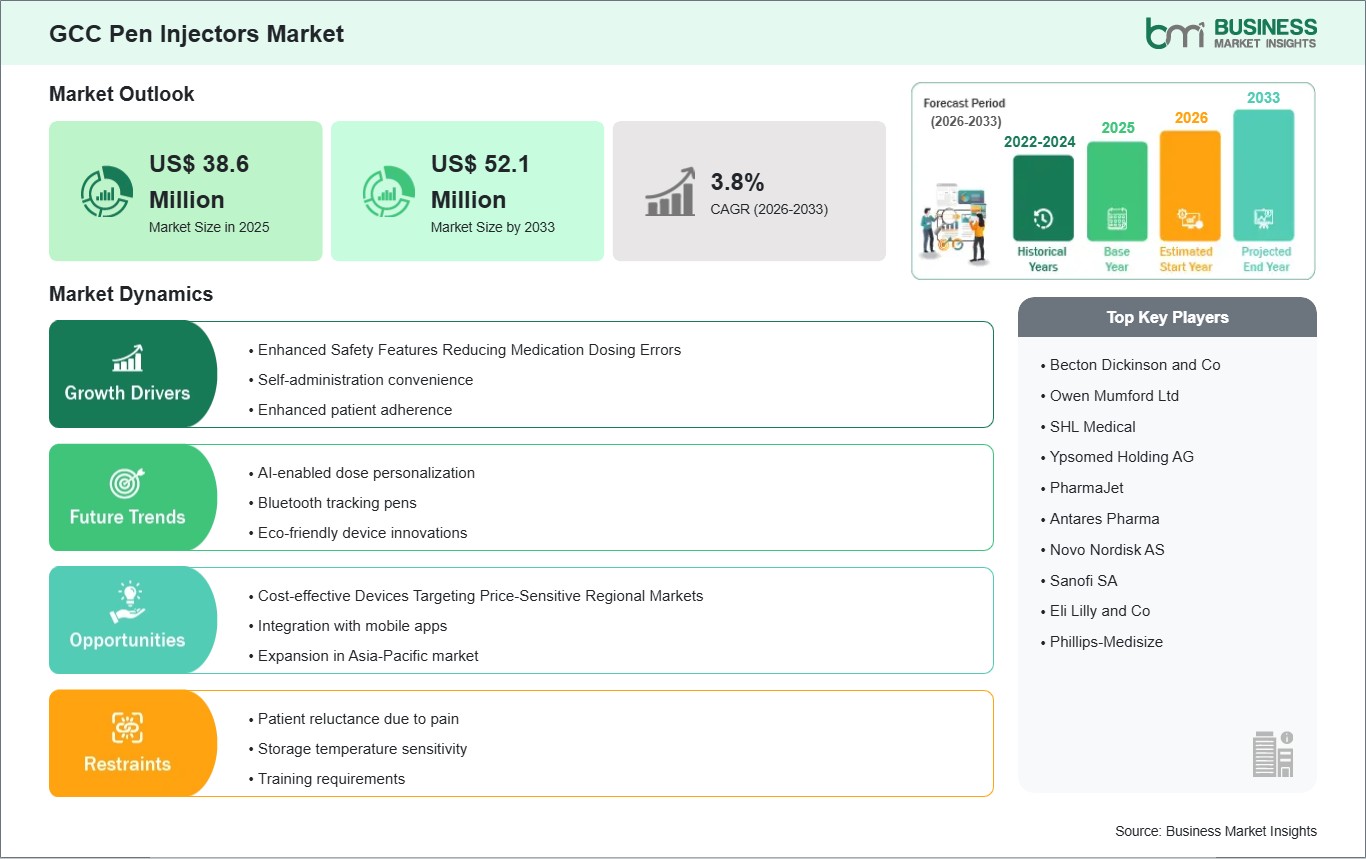
Countries such as Saudi Arabia, the UAE, Qatar, Kuwait, and Bahrain are witnessing higher adoption of advanced pen injector technologies, driven by patient-centric care initiatives and the increasing focus on home-based therapy models. The market is influenced by the proliferation of biologics and biosimilars, with manufacturers emphasizing prefilled and reusable injectors to enhance dosing accuracy and adherence. Regulatory frameworks are evolving rapidly, with authorities promoting alignment with international standards while supporting domestic manufacturing initiatives through economic diversification programs. Distribution channels are becoming more sophisticated, spanning hospitals, retail pharmacies, and digital health platforms, including e-pharmacies that cater to urban populations. Competitive strategies focus on technological differentiation, patient convenience, and lifecycle management, with smart pens integrating connectivity features gaining traction in digitally advanced markets such as the UAE and Saudi Arabia. Sustainability considerations are slowly emerging as procurement criteria, with manufacturers exploring recyclable components and reduced packaging. The GCC pen injectors market reflects a technology-driven environment where modernization of healthcare systems, patient education, and strategic partnerships shape market dynamics.
Segment Analysis
GCC Pen Injectors Market Segmentation
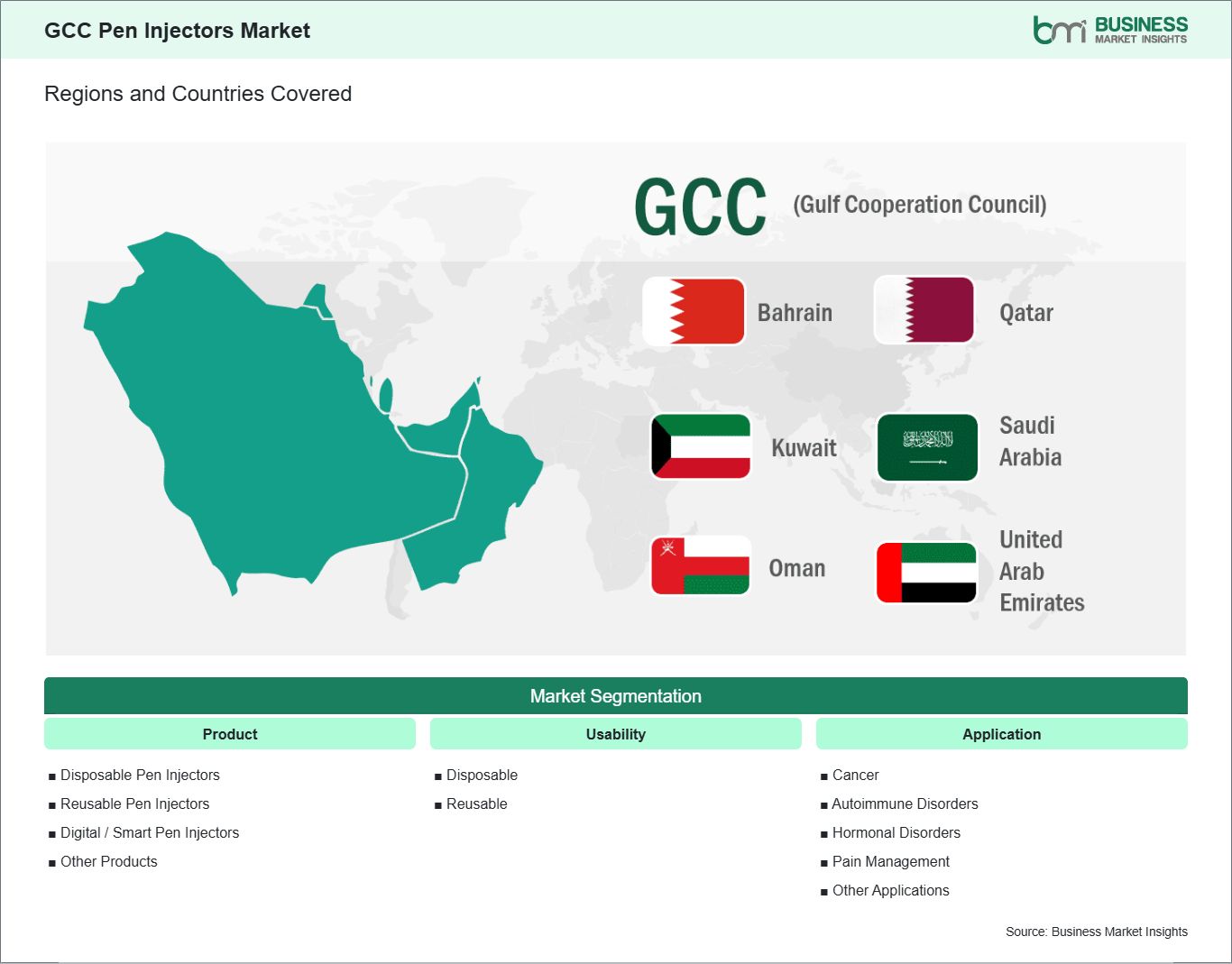
Key segments that contributed to the derivation of the GCC Pen Injectors Market analysis are product, usability, and application.
- By product, the pen injectors market is segmented into disposable pen injectors, reusable pen injectors, digital/smart pen injectors, and others. The disposable pen injectors segment dominated the market in 2025.
- Based on usability, the pen injectors market is categorized into disposable and reusable. The disposable segment dominated the market in 2025.
- In terms of application, the market is classified into cancer, autoimmune disorders, hormonal disorders, pain management, and other applications. The autoimmune disorders segment dominated the market in 2025.
Market Forces
GCC Pen Injectors Market Drivers and Opportunities
Enhanced Safety Features Reducing Medication Dosing Errors
With healthcare systems focusing on patient safety and high-quality care, providers and manufacturers are prioritizing pen injectors with built-in safety mechanisms, such as automatic needle retraction, lockable dose settings, and error-prevention alerts. These features are relevant in the region, where self-administration of chronic therapies is becoming more common and accurate dosing is critical for effective treatment outcomes. Regional healthcare initiatives are encouraging the adoption of devices that enhance safety in hospital and home settings. Pen injectors with intuitive interfaces and clear dose indicators help patients administer complex therapies confidently, reducing the risk of under- or overdosing. Manufacturers are developing devices with tactile or audible feedback, ensuring that users receive confirmation of each dose, which is important for patients with limited experience in self-injection or visual impairments. These innovations support patient adherence and contribute to improved clinical outcomes. Safety-enhanced pen injectors are becoming a key differentiator in the GCC, reflecting the region’s emphasis on advanced healthcare technologies and patient-centered care. Providers and distributors are seeking devices that combine safety with usability, ensuring that patients can manage their therapies without frequent clinical supervision. The adoption of these devices underscores a trend toward reducing medication errors, strengthening patient confidence, and aligning with regional healthcare quality standards.
Cost-effective Devices Targeting Price-Sensitive Regional Markets
Despite the region’s advanced healthcare infrastructure, affordability remains a critical factor for public health programs, private clinics, and patients who manage long-term therapies. Manufacturers are developing pen injectors that offer essential features at competitive price points, enabling broader adoption across diverse patient populations. Affordability does not compromise usability or safety, as device developers are focusing on streamlining designs and optimizing manufacturing processes to lower costs. Reusable pens, simplified dosing mechanisms, and modular components are among the strategies being implemented to balance price and performance. By offering devices that are cost-efficient and clinically reliable, manufacturers can expand market reach, particularly in segments where patients are responsible for a significant portion of treatment costs. Cost-effective pen injectors support regional initiatives to improve access to self-administered therapies. Healthcare providers and payers are recognizing the value of devices that reduce dependency on hospital resources while remaining financially sustainable. Affordability, reliability, and ease of use position pen injectors as essential tools in promoting adherence, improving treatment outcomes, and supporting the expansion of home-based therapy programs throughout the region.
Size and Share Analysis
GCC Pen Injectors Market Size and Share Analysis
The GCC Pen Injectors Market demonstrates steady growth, with size and share analysis highlighting evolving trends and competitive dynamics among key players. The report examines subsegments categorized within product, usability, and application, offering insights into their contribution to overall market performance.
By product, the disposable pen injectors subsegment dominated the market in 2025, driven by growing demand for affordable, ready‑to‑use injection devices that support safe and convenient medication delivery.
Based on usability, the disposable subsegment dominated the market in 2025, driven by a strong preference for easy‑to‑use, low‑maintenance solutions in patient self‑care and outpatient settings.
In terms of application, the autoimmune disorders subsegment dominated the market in 2025, driven by the increasing incidence of autoimmune diseases and greater access to advanced biologic treatments in the GCC healthcare landscape.
Report Coverage
GCC Pen Injectors Market Report Coverage and Deliverables
The "GCC Pen Injectors Market Size and Forecast (2022–2033)" report provides a detailed analysis of the market covering below areas:
- GCC Pen Injectors Market size and forecast at regional and country levels for all market segments covered under the scope
- GCC Pen Injectors Market trends, as well as drivers, restraints, and opportunities
- GCC Pen Injectors Market analysis covering key trends, regional framework, major players, regulations, and recent developments
- Industry landscape and competition analysis covering market concentration, heat map analysis, prominent players, and recent developments for the GCC Pen Injectors Market
- Detailed company profiles, including SWOT analysis
Geographic Insights
GCC Pen Injectors Market Geographic Insights
The geographical scope of the GCC Pen Injectors Market report is divided into UAE, Bahrain, Saudi Arabia, Oman, Qatar, and Kuwait. Saudi Arabia held the largest share in 2025.
Saudi Arabia is the dominant market, driven by its large population base, extensive hospital infrastructure, and government investment in healthcare modernization. The Kingdom has prioritized diabetes and endocrine disease management programs, supporting high adoption of prefilled and reusable pen injectors. The UAE follows closely, leveraging its advanced digital health ecosystem and telemedicine initiatives to integrate smart pen devices into outpatient and homecare programs. Qatar and Kuwait’s smaller populations but high per capita healthcare expenditure facilitate access to premium pen injector devices. In Bahrain, government-led healthcare programs are expanding device penetration and reimbursement coverage. Across GCC countries, distribution partnerships with regional wholesalers, engagement with patient advocacy organizations, and alignment with evolving regulatory standards are critical for successful market entry. Differences in healthcare delivery models, procurement strategies, and technology adoption rates necessitate country-specific approaches. While Saudi Arabia sets the regional benchmark, each GCC market offers distinct opportunities for innovation, patient engagement, and growth in the pen injector segment.
Industry Activity
Recent Developments
The GCC Pen Injectors Market is evaluated by gathering qualitative and quantitative data post primary and secondary research, which includes important corporate publications, association data, and databases. A few of the key developments in the GCC Pen Injectors Market are:
- In February 2026, OneSource Specialty Pharma received Saudi Food and Drug Authority (SFDA) approval to commercialise its generic Ozempic (semaglutide) pre‑filled pen injector in Saudi Arabia, in partnership with Hikma Pharmaceuticals PLC for MENA distribution. This regulatory nod clears the path for the regional launch of a lower‑cost GLP‑1 pen therapy. The approval strengthens generic entry into the Gulf pen market
- In April 2025, Novo Nordisk started introducing Wegovy® (semaglutide) pre‑filled injection pens to the Saudi Arabian market as part of local access initiatives for obesity management and type 2 diabetes care. This pen format supports once‑weekly subcutaneous dosing with multiple strengths designed for patient self‑administration. The product’s availability is aligned with efforts to improve chronic metabolic care in the region. Local production agreements were also signed to support long‑term supply.
Trust & Transparency
Research Methodology
The market analysis combines proprietary research with secondary data from government agencies, company disclosures, regulatory filings, industry databases and expert interviews. Market estimates are validated through data triangulation, cross-market benchmarking and analyst
review.
View Full Research Methodology
Key Sources Referred:
World Health Organization (WHO)Organisation for Economic Cooperation and Development (OECD)The World Bank GroupWorldometerThe LancetInternational Bar AssociationInternational Trade Administration