Market Summary
Executive Summary and Market Analysis
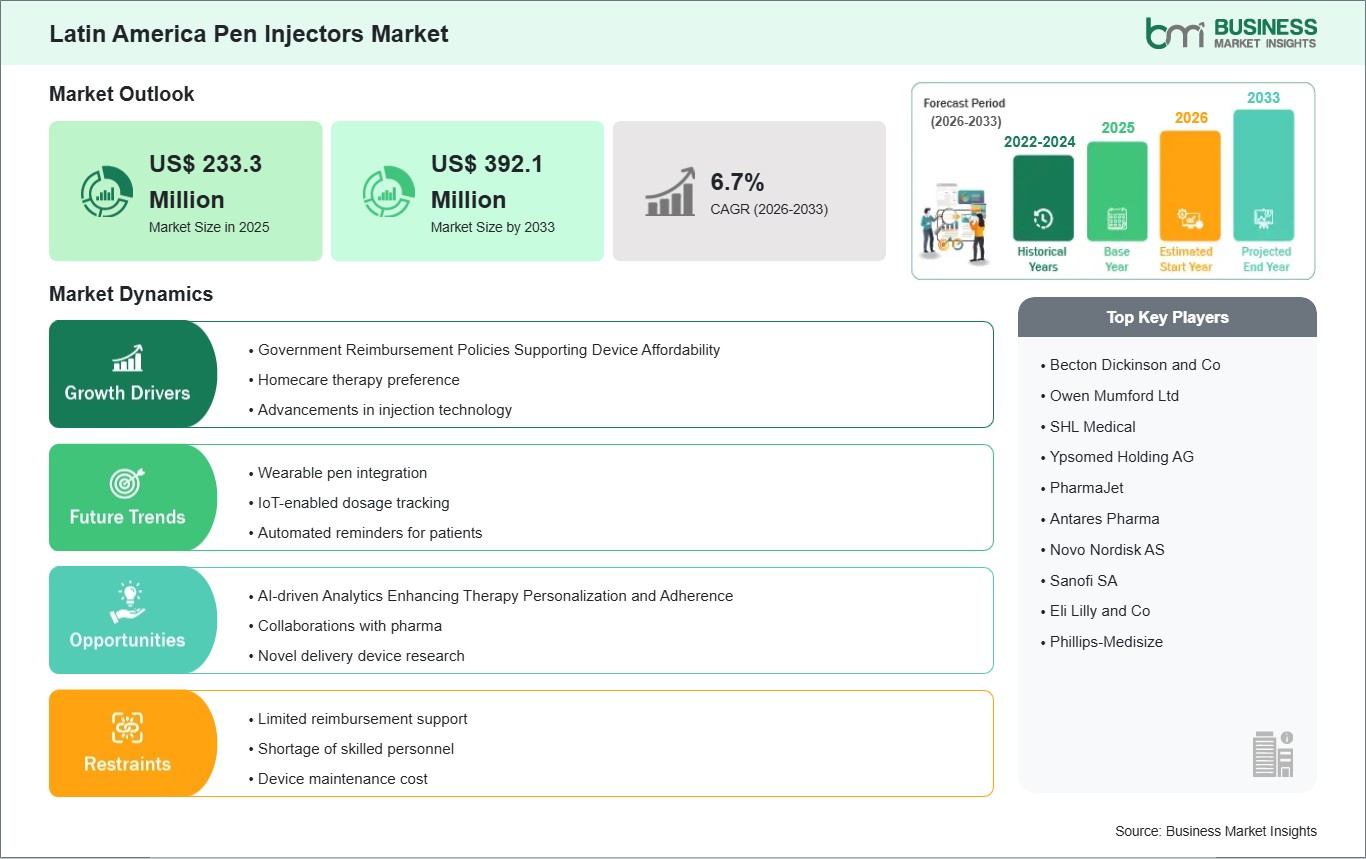
Diabetes, growth hormone deficiencies, and autoimmune disorders are the primary therapeutic segments contributing to device adoption in countries such as Brazil, Mexico, Argentina, Chile, and Colombia. Manufacturers are emphasizing product differentiation through prefilled and reusable pen injectors, ergonomic designs, and enhanced dosing accuracy to improve patient adherence. Regulatory environments vary across the region, with markets requiring localized clinical trial data or government approvals for combination devices, influencing product launch timelines. Distribution networks are evolving, combining hospital and retail pharmacy channels with emerging e-pharmacy platforms to reach urban and semi-urban populations. Strategic collaborations between multinational device manufacturers and domestic pharmaceutical companies are enabling localized production, reducing cost, and improving market penetration. Patient education programs, supported by diabetes associations, are playing a pivotal role in enhancing awareness and promoting self-administration. Sustainability considerations, including recyclable components and minimized packaging, are influencing procurement decisions in progressive markets such as Brazil and Chile. The Latin America pen injectors market reflects a technologically aware ecosystem, where regulatory complexity, patient education, and strategic partnerships shape adoption trends.
Segment Analysis
Latin America Pen Injectors Market Segmentation
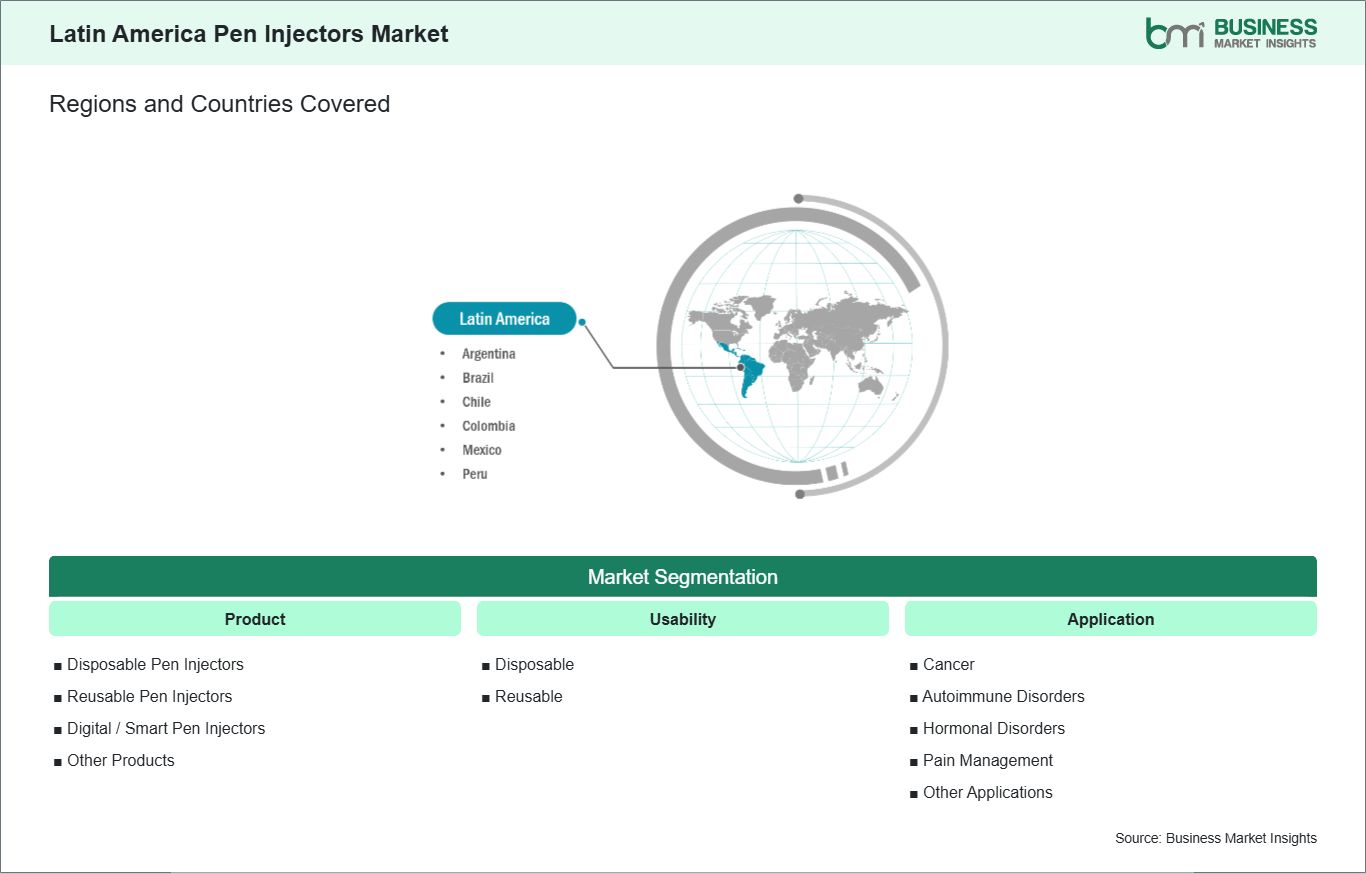
Key segments that contributed to the derivation of the Latin America Pen Injectors Market analysis are product, usability, and application.
- By product, the pen injectors market is segmented into disposable pen injectors, reusable pen injectors, digital/smart pen injectors, and others. The disposable pen injectors segment dominated the market in 2025.
- Based on usability, the pen injectors market is categorized into disposable and reusable. The disposable segment dominated the market in 2025.
- In terms of application, the market is classified into cancer, autoimmune disorders, hormonal disorders, pain management, and other applications. The autoimmune disorders segment dominated the market in 2025.
Market Forces
Latin America Pen Injectors Market Drivers and Opportunities
Government Reimbursement Policies Supporting Device Affordability
Public healthcare systems across the region are integrating coverage for chronic disease management devices, recognizing the potential of pen injectors to reduce hospital visits and improve patient adherence. These reimbursement frameworks help lower out-of-pocket costs for patients, making advanced delivery devices more accessible to a broader population, especially in areas where healthcare affordability has traditionally been a barrier. Healthcare providers are aligning their procurement and treatment strategies with these supportive policies. Pen injectors that qualify for reimbursement are prioritized in public and private healthcare networks, as they enable consistent dosing and improve treatment continuity. Manufacturers are developing devices that meet regulatory standards and demonstrate clinical reliability and cost-effectiveness, ensuring they remain eligible for government programs. This dynamic encourages innovation while addressing affordability challenges, which is a key factor in expanding device adoption. Reimbursement policies are fostering competitive differentiation in the market. Devices that offer usability and affordability are positioned to capture significant market share, as governments incentivize therapies that improve patient outcomes while controlling healthcare expenditure. By reducing financial barriers for patients and institutions, these policies are playing a pivotal role in increasing the adoption of pen injectors and supporting regional growth in self-administered therapies.
AI-driven Analytics Enhancing Therapy Personalization and Adherence
Connected pen injector devices integrated with digital platforms allow for real-time monitoring of dosing patterns, enabling healthcare providers to tailor treatment plans to individual patient needs. These insights help clinicians identify adherence challenges, adjust therapy schedules, and provide timely guidance, improving clinical outcomes and patient confidence in managing long-term therapies at home. Manufacturers are leveraging AI-powered data analytics to enhance device functionality and patient support. Smart pen injectors can track injection frequency, dose consistency, and patient engagement, feeding information into platforms that generate actionable insights. In Latin America, healthcare systems are focused on maximizing the impact of home-based therapy programs and improving adherence in populations managing chronic conditions across varied socio-economic settings. AI-driven analytics support the development of personalized healthcare initiatives that integrate behavioral and clinical data. Pen injector manufacturers and healthcare providers are collaborating to create solutions that combine predictive alerts, dosage reminders, and adherence reporting, offering patients tailored support throughout their treatment journey. The integration of these digital capabilities is establishing pen injectors as more than just delivery devices. They are becoming tools that actively guide therapy, strengthen patient-provider interaction, and reinforce adherence, driving the market toward smarter, patient-centered care solutions.
Size and Share Analysis
Latin America Pen Injectors Market Size and Share Analysis
The Latin America Pen Injectors Market demonstrates steady growth, with size and share analysis highlighting evolving trends and competitive dynamics among key players. The report examines subsegments categorized within product, usability, and application, offering insights into their contribution to overall market performance.
By product, the disposable pen injectors subsegment dominated the market in 2025, driven by growing adoption of cost‑effective, single‑use devices that simplify medication delivery and improve safety.
Based on usability, the disposable subsegment dominated the market in 2025, driven by high patient demand for easy‑to‑use, low‑training injection solutions in home and outpatient care.
In terms of application, the autoimmune disorders subsegment dominated the market in 2025, driven by the rising prevalence of autoimmune diseases and increasing availability of biologic therapies across the region.
Report Coverage
Latin America Pen Injectors Market Report Coverage and Deliverables
The "Latin America Pen Injectors Market Size and Forecast (2022–2033)" report provides a detailed analysis of the market covering below areas:
- Latin America Pen Injectors Market size and forecast at regional and country levels for all market segments covered under the scope
- Latin America Pen Injectors Market trends, as well as drivers, restraints, and opportunities
- Latin America Pen Injectors Market analysis covering key trends, regional framework, major players, regulations, and recent developments
- Industry landscape and competition analysis covering market concentration, heat map analysis, prominent players, and recent developments for the Latin America Pen Injectors Market
- Detailed company profiles, including SWOT analysis
Geographic Insights
Latin America Pen Injectors Market Geographic Insights
The geographical scope of the Latin America Pen Injectors Market report is divided into Mexico, Brazil, Argentina, Peru, Chile, and Colombia. Brazil held the largest share in 2025.
Brazil is the dominant market due to its large population, well-developed hospital infrastructure, and government programs supporting diabetes and endocrine therapies, driving high adoption of prefilled and reusable pen injectors. Mexico represents a high-growth market, bolstered by rising chronic disease prevalence, increasing healthcare coverage, and expanding urban access to digital health tools, which facilitate smart pen adoption. Argentina exhibits steady growth, with hospital and retail pharmacy networks serving as primary distribution channels. Tender-based procurement in the public sector shapes brand penetration. Chile has emerged as a technology-forward market, emphasizing patient education initiatives and digital health integration, supporting the adoption of connected pen injectors. Colombia is expanding device uptake through government-sponsored chronic disease programs and increasing patient awareness. Across the region, manufacturers must navigate variations in reimbursement policies, regulatory approval timelines, and distribution infrastructure. Partnerships with local distributors, educational outreach programs, and alignment with country-specific healthcare strategies are essential for market penetration. While Brazil remains the benchmark for scale and adoption, each market offers unique opportunities for growth driven by patient engagement, regulatory alignment, and technological innovation.
Industry Activity
Recent Developments
The Latin America Pen Injectors Market is evaluated by gathering qualitative and quantitative data post primary and secondary research, which includes important corporate publications, association data, and databases. A few of the key developments in the Latin America Pen Injectors Market are:
- In November 2025, Adium Perú announced the launch of Mounjaro (tirzepatide) agonist dual GIP/GLP‑1 pre‑filled pen for diabetes and obesity under its local representation agreement with Eli Lilly. This launch marks a regional pen injector commercial entry for this dual‑action therapy in Latin America. The product is available in multidose KwikPen format for patient self‑ The launch reflects rising demand for advanced metabolic pens region‑wide.
- In April 2025, Mounjaro (tirzepatide) pen injector obtained regulatory approval in Brazil from ANVISA for use in type 2 diabetes, enabling its availability in pharmacy channels alongside existing branded pen products for metabolic care.
Trust & Transparency
Research Methodology
The market analysis combines proprietary research with secondary data from government agencies, company disclosures, regulatory filings, industry databases and expert interviews. Market estimates are validated through data triangulation, cross-market benchmarking and analyst
review.
View Full Research Methodology
Key Sources Referred:
World Health Organization (WHO)Organisation for Economic Cooperation and Development (OECD)The World Bank GroupWorldometerThe LancetInternational Bar AssociationInternational Trade Administration