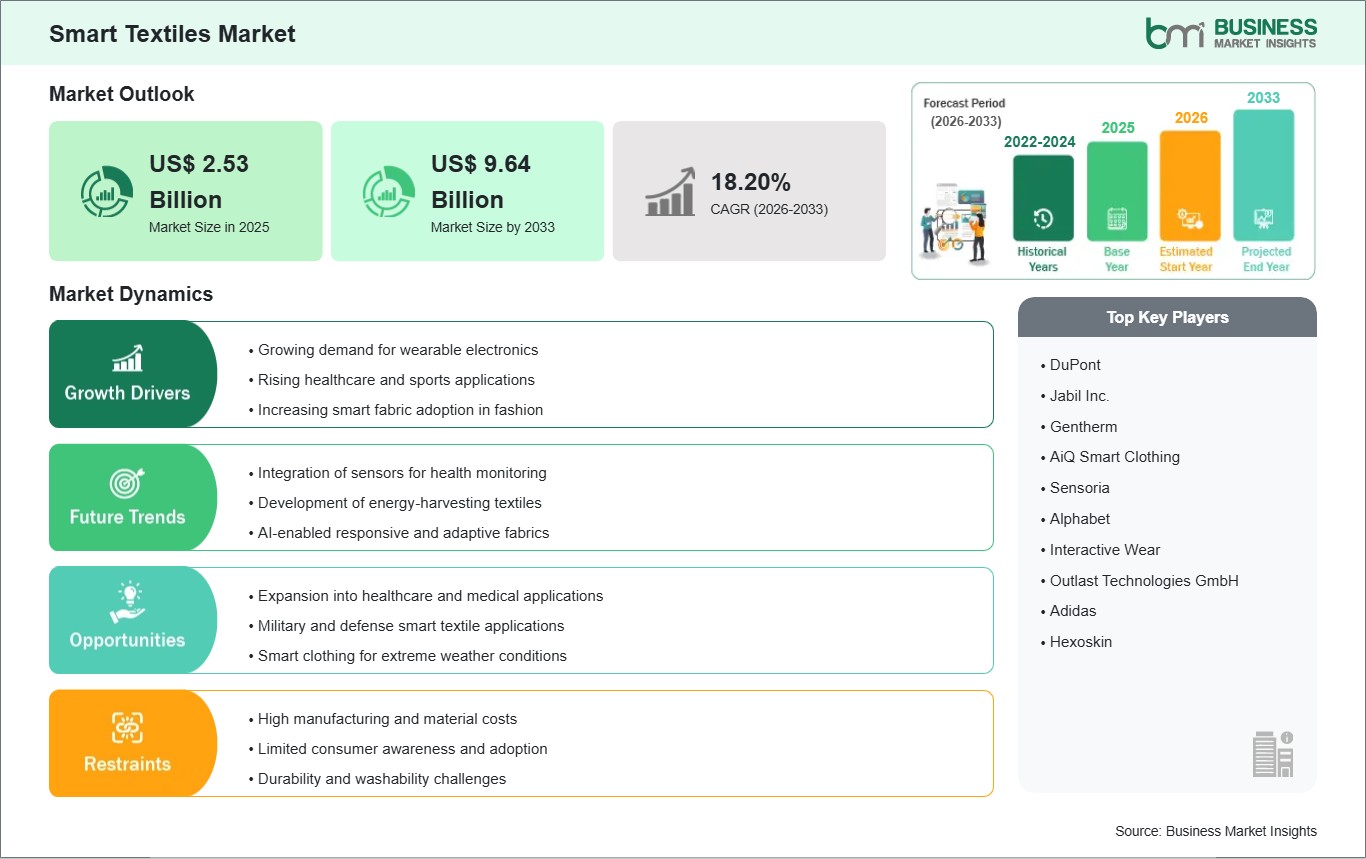
The Smart Textiles Market size is expected to reach US$ 9.64 billion by 2033 from US$ 2.53 billion in 2025. The market is estimated to record a CAGR of 18.20% from 2026 to 2033.
The smart textiles market is changing as technology turns traditional fabrics into multifunctional, connected materials. Smart textiles, or e-textiles, incorporate sensors, conductive fibers, and electronic components into fabrics. This allows for functions like health monitoring, temperature control, motion tracking, and energy collection. Growing interest in wearable technology, fitness tracking, and lifestyle management is driving their use. Industries like healthcare, defense, and sports are adopting these fabrics to improve performance, safety, and operational efficiency. Improvements in materials science and flexible electronics have made them more durable, comfortable, and functional. Now, garments can monitor vital signs, provide haptic feedback, or send data to external devices.
Wireless connectivity and IoT integration expand their uses even further, supporting remote health monitoring, performance analytics, and interactive experiences. In defense and industrial settings, smart textiles enable environmental sensing, fatigue detection, and protective clothing solutions, which enhance safety and productivity. Fashion brands are also looking into responsive and energy-harvesting fabrics that marry style with practical technology. Sustainability, regulatory compliance, and collaboration across industries are important factors in product development. Partnerships among textile manufacturers, electronics companies, and research institutions are speeding up innovation and commercialization. The market features rapid technological growth, a variety of applications, and increasing consumer interest, making smart textiles a vital part of connected, functional material solutions.

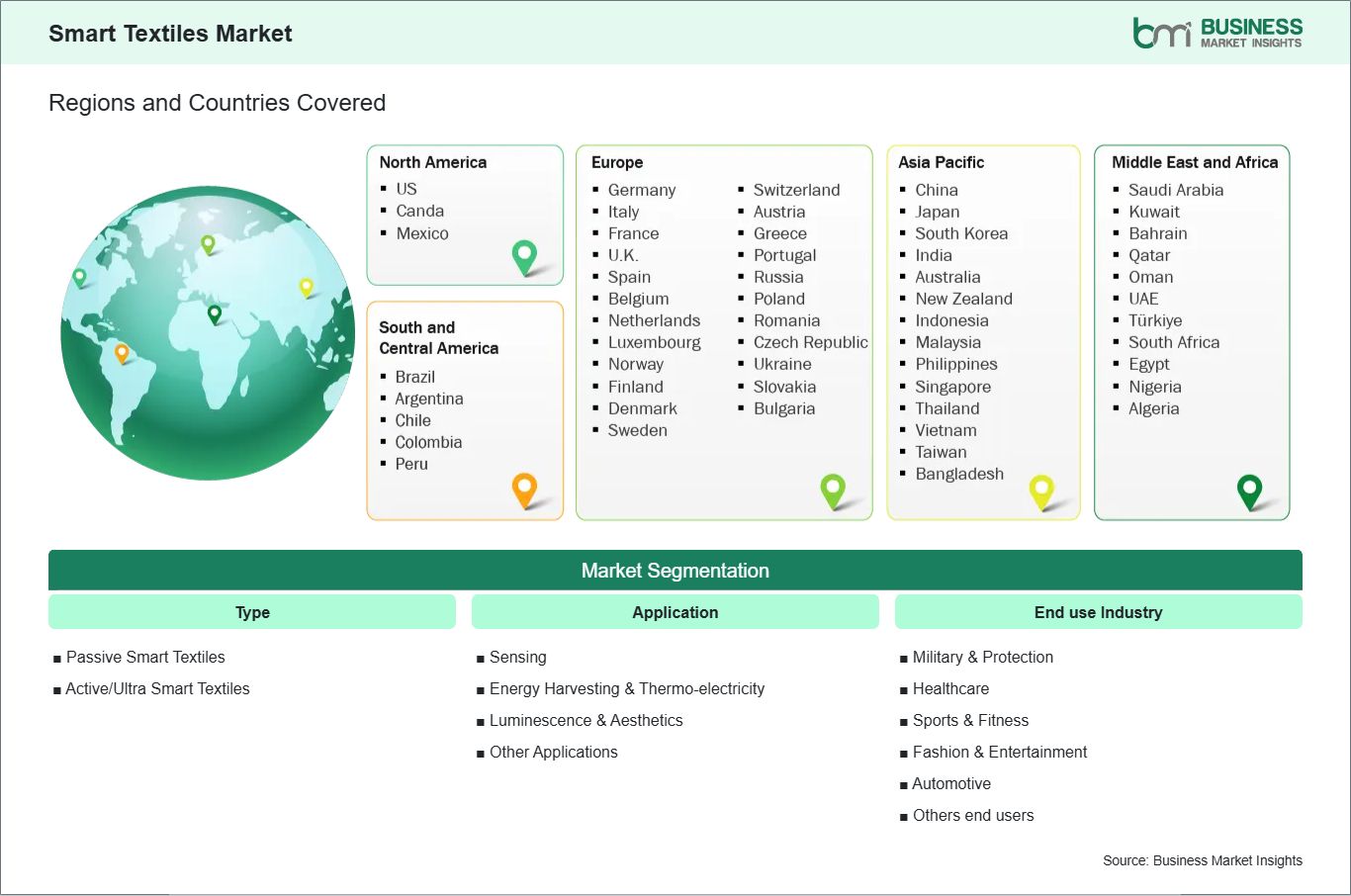
Key segments that contributed to the derivation of the smart textiles market analysis are type, application, end user.
The smart textiles market is growing steadily as wearable technology becomes more common in clothing for consumers, industries, and healthcare. New fabrics with built-in sensors allow for real-time tracking of health data, performance, and environmental factors. Improvements in flexible electronics, conductive fibers, and IoT connectivity are making garments more functional, which makes wearables smarter and more interactive. Increased interest in wellness, fitness, and connected living is boosting adoption. Partnerships between textile makers and technology developers are accelerating up innovation, leading to versatile smart garments. This trend highlights wearable technology as a significant growth factor for the smart textiles market.
Smart textiles are becoming more popular worldwide in healthcare. They support patient monitoring, rehabilitation, and managing chronic diseases. Fabrics with sensors allow for continuous tracking of vital signs, mobility, and recovery. This leads to better patient outcomes and lower operational costs. Connecting with digital health platforms enables remote monitoring and data-driven clinical decisions. The growing use by hospitals, clinics, and medical device companies drives research and product development. The healthcare and medical field offers a significant growth opportunity for smart textiles, making these innovative fabrics an important part of the evolving digital health and connected care landscape.
The Smart Textiles Market demonstrates steady growth, with size and share analysis highlighting evolving trends and competitive dynamics among key players. The report examines subsegments categorized within type, application, end user offering insights into their contribution to overall market performance.
Type, the active/ultra smart textiles sub segment dominated the market in 2025, driven by rising demand for high-performance fabrics with integrated electronics.
Based on application, the sensing sub segment dominated the market in 2025, driven by increased use of wearable sensors for health monitoring and performance tracking.
In terms of end user, the military & protection sub segment dominated the market in 2025, driven by the need for advanced protective gear and tactical wearables for defense applications.
| Report Attribute | Details |
|---|---|
| Market size in 2025 | US$ 2.53 Billion |
| Market Size by 2033 | US$ 9.64 Billion |
| Global CAGR (2026 - 2033) | 18.20% |
| Historical Data | 2022-2024 |
| Forecast period | 2026-2033 |
| Segments Covered | By Type
|
|
Regions and Countries Covered
| |
| North America | US, Canada, Mexico |
| Europe | Belgium, Austria, Finland, Denmark, Greece, Poland, Romania, Russia, Ukraine, Czech Republic, Slovakia, Bulgaria, Italy, Luxembourg, Germany, Switzerland, France, Netherlands, Norway, Portugal, Spain, Sweden, United Kingdom |
| Asia-Pacific | Australia, China, India, Japan, South Korea, Indonesia, Malaysia, Philippines, Singapore, Thailand, Vietnam, Bangladesh, New Zealand, Taiwan |
| South and Central America | Brazil, Argentina, Peru, Chile, Colombia |
| Middle East and Africa | Bahrain, Kuwait, Oman, Qatar, Saudi Arabia, United Arab Emirates, Turkiye, South Africa, Egypt, Algeria, Nigeria |
| Market leaders and key company profiles |
|
The "Smart Textiles Market Size and Forecast (2022 - 2033)" report provides a detailed analysis of the market covering below areas:
The geographical scope of the Smart Textiles Market report is divided into North America, Asia Pacific, Europe, Middle East & Africa, and South & Central America. North America held the largest share in 2025.
Adoption of smart textiles varies across regions, influenced by technological infrastructure, industry focus, and consumer awareness. North America is a leading market, supported by strong research capabilities, wearable technology adoption, and a presence of major players in healthcare, sports, and defense. Collaborations between universities, startups, and technology firms accelerate innovation and commercial deployment of smart fabrics for health monitoring, performance tracking, and protective apparel.
Europe shows steady growth, particularly in Germany, the United Kingdom, and France. Regulatory emphasis on wearable technology, safety, and environmental compliance influences product development. Smart textiles are increasingly applied in healthcare, occupational safety, and sustainable fashion, with luxury brands exploring interactive and energy-harvesting fabrics.
Asia Pacific is expanding rapidly, driven by large-scale textile manufacturing, growing consumer awareness, and government initiatives. China, Japan, South Korea, and India lead adoption in fitness apparel, healthcare garments, and industrial protective clothing.
Middle East and Africa are emerging markets, where smart textiles are deployed in healthcare monitoring, military gear, and niche fashion applications.
South and Central America show gradual adoption, with Brazil and Mexico leading growth in sports, healthcare, and safety-oriented clothing. Regional differences reflect infrastructure, industrial priorities, and consumer readiness, highlighting the need for tailored strategies and localized innovation to drive smart textile adoption.

The Smart Textiles Market is evaluated by gathering qualitative and quantitative data post primary and secondary research, which includes important corporate publications, association data, and databases. A few of the key developments in the smart textiles market are:
The Smart Textiles Market is valued at US$ 2.53 Billion in 2025, it is projected to reach US$ 9.64 Billion by 2033.
As per our report Smart Textiles Market, the market size is valued at US$ 2.53 Billion in 2025, projecting it to reach US$ 9.64 Billion by 2033. This translates to a CAGR of approximately 18.20% during the forecast period.
The Smart Textiles Market report typically cover these key segments-
The historic period, base year, and forecast period can vary slightly depending on the specific market research report. However, for the Smart Textiles Market report:
The Smart Textiles Market is populated by several key players, each contributing to its growth and innovation. Some of the major players include:
The Smart Textiles Market report is valuable for diverse stakeholders, including:
Essentially, anyone involved in or considering involvement in the Smart Textiles Market value chain can benefit from the information contained in a comprehensive market report.
Please tell us your area of interest
(Market Segments/ Regions and Countries/ Companies)