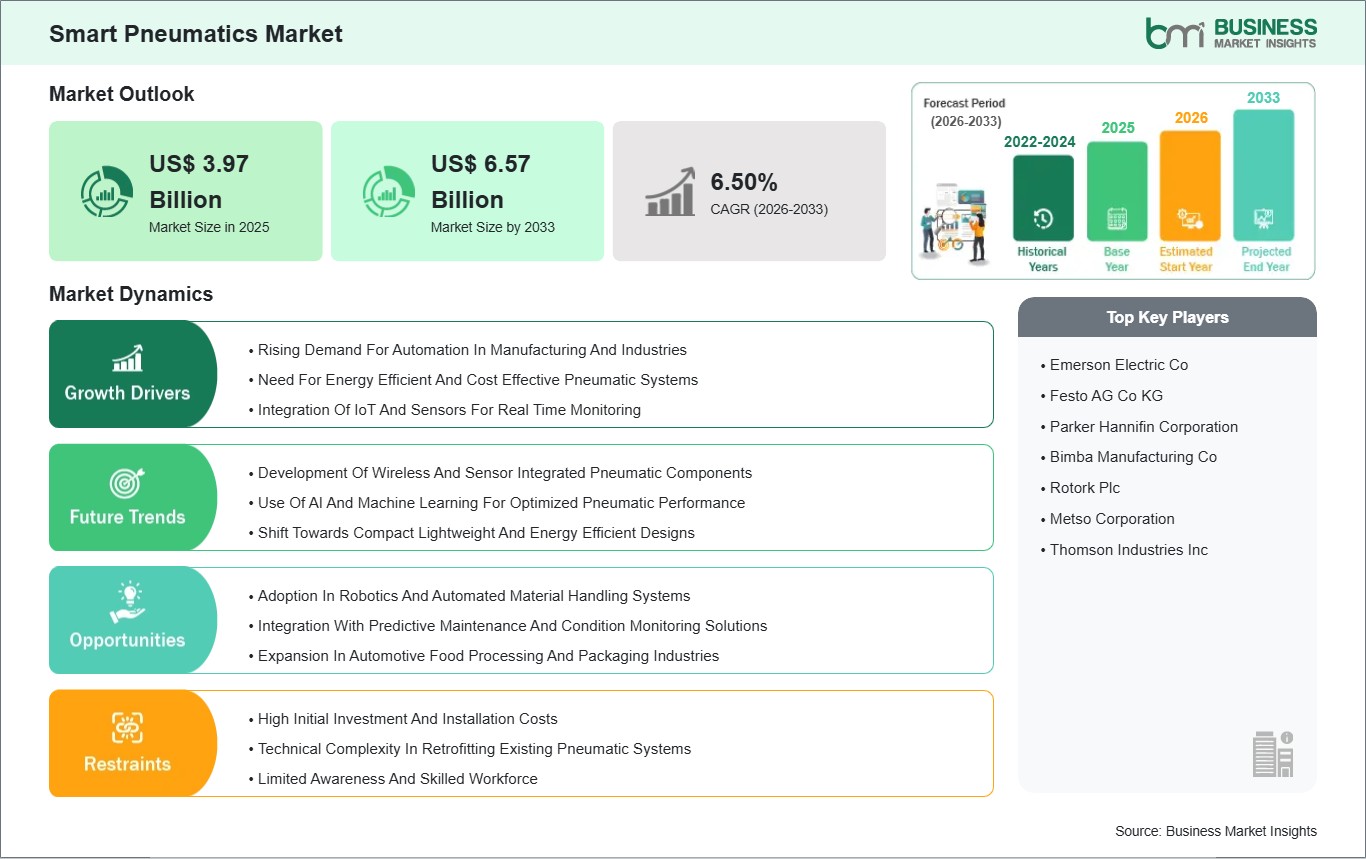
The Smart Pneumatics Market size is expected to reach US$ 6.57 billion by 2033 from US$ 3.97 billion in 2025. The market is estimated to record a CAGR of 6.50% from 2026 to 2033.
The global smart pneumatics market is changing how traditional pneumatics work by adding digital intelligence, connectivity, and advanced sensors to compressed air and pneumatic systems. Smart pneumatics uses sensors, controllers, real-time diagnostics, and communication tools to turn standard actuators and valves into adaptive, data-driven parts. These systems are now common in industrial automation, manufacturing, packaging, automotive assembly, and material handling, where quick response, accuracy, and uptime matter most. The move to smart pneumatics is part of the larger trend toward Industry 4.0 and smart factories, as operators want to see system performance, spot problems, and predict maintenance before breakdowns happen.
Pneumatic systems, which often use a lot of energy and are key to many production lines, benefit from sensors that track airflow, pressure changes, and actuator performance in real time. When this data connects with factory control systems, manufacturers can cut waste, adjust pressure, and find issues that could cause downtime or expensive repairs. Adding smart pneumatics to older equipment can be challenging, since it may require updating infrastructure and retraining staff. There are also concerns about data security and making different manufacturers’ systems work together, which can slow adoption. The shift to connected pneumatic systems is picking up speed, as more companies see the value of real-time data for improving productivity, sustainability, and system reliability.

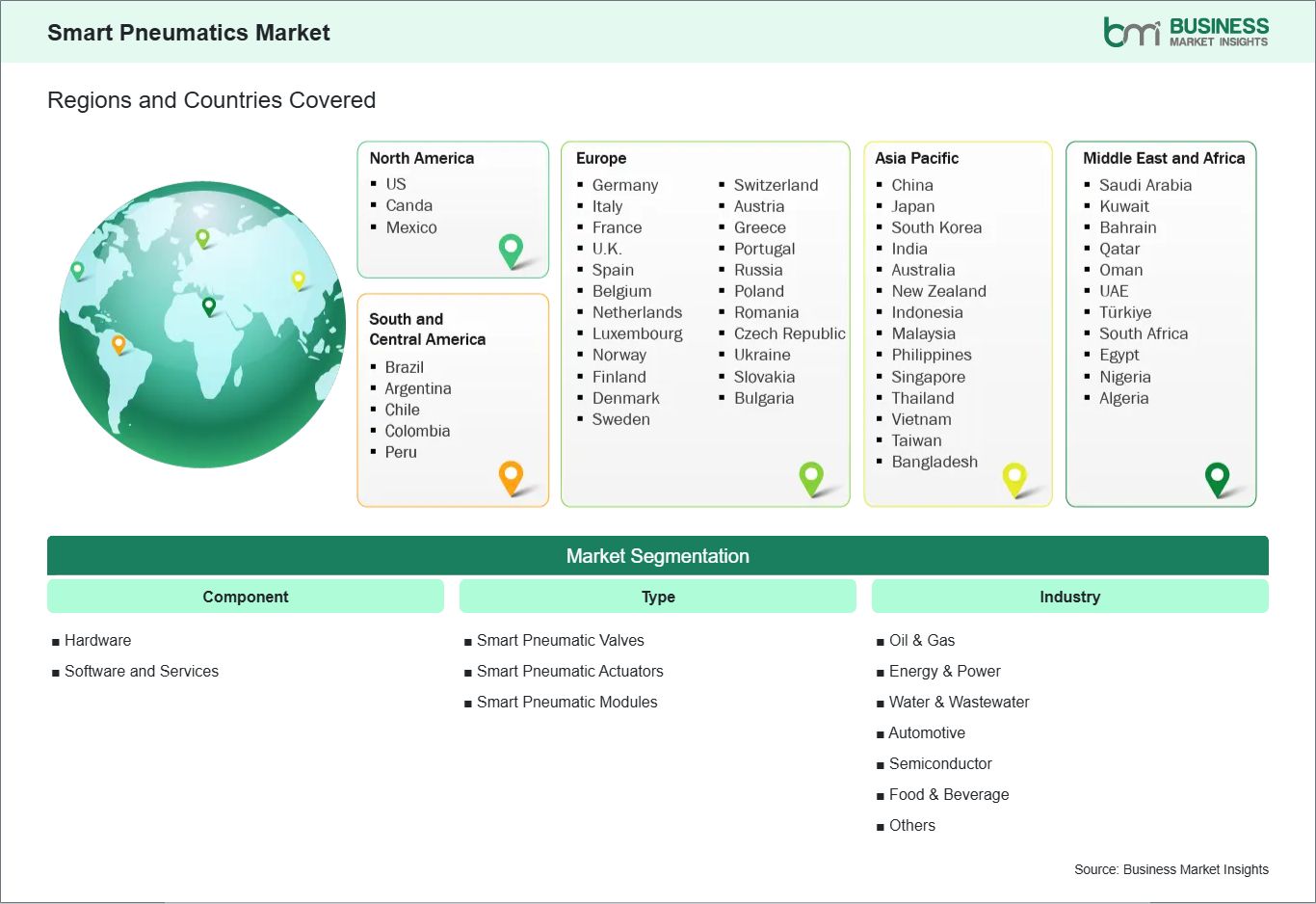
Key segments that contributed to the derivation of the smart pneumatics market analysis are component, type, and industry.
As industries evolve, there is a growing need for automation that can handle complex, repetitive tasks while maintaining consistent quality. Smart pneumatics systems are increasingly adopted because they offer precise motion control and adaptability, which are critical in modern production environments. Factories can now rely on pneumatic systems that respond dynamically to changing operational conditions, ensuring smoother workflow and reducing dependency on manual intervention.
In the context of industrial automation, smart pneumatics can enable conveyors, palletizers, and other packaging robots to respond in real-time to variations in loads or products. For example, in a high-speed beverage bottling plant, smart pneumatics can allow the pneumatic equipment to change speed in real-time in response to variations in bottle shape or fill level. This is especially useful in regions with highly diversified manufacturing operations, where products change frequently and speed is of the essence. Furthermore, smart pneumatics can also provide new opportunities for predictive maintenance when combined with monitoring technology. Real-time feedback from smart pneumatics can provide early warning of potential wear or performance inconsistencies, which can prevent costly maintenance problems. Worldwide, robotics technology combined with smart pneumatics is helping industries boost productivity, flexibility, and smooth, intelligent workflow in a variety of manufacturing and distribution environments.
Smart pneumatics is unlocking new opportunities in robotics and automated material handling by enabling machines to perform smoother and more responsive movements. In modern warehouses, robotic arms powered by intelligent pneumatic actuators can pick, sort, and position items with minimal human oversight. This precision helps streamline logistics operations and reduces the likelihood of product damage during handling.
In industrial automation, smart pneumatics allows conveyors, palletizers, and packaging robots to adapt in real time to changing loads or product sizes. For example, in high-throughput bottling plants, pneumatic systems can adjust movements instantly to accommodate different bottle shapes or fill levels. This flexibility is particularly valuable in regions with highly diversified manufacturing operations, where products change frequently and speed is crucial.
Moreover, integrating smart pneumatics with monitoring systems creates new insights for predictive maintenance. Real-time feedback from sensors can identify potential wear or performance inconsistencies before they escalate into downtime. This not only prolongs equipment life but also reduces maintenance costs and operational interruptions. Globally, combining robotics with smart pneumatic technology is helping industries increase productivity, enhance adaptability, and maintain smooth, intelligent workflows in both manufacturing and distribution environments.

The smart pneumatics market is experiencing steady growth, with market size and share analysis reflecting evolving treatment preferences and competitive dynamics among key players. The report evaluates important subsegments categorized within component, type, and industry, highlighting their respective contributions to overall market performance.
By component, the hardware subsegment dominated the Smart Pneumatics market in 2025. Hardware components, including valves, actuators, and control modules, are essential for precise operation, reliability, and performance in pneumatic systems, driving their high demand.
Based on type, the smart pneumatic valves subsegment dominated the Smart Pneumatics market in 2025. Smart pneumatic valves offer advanced control, automation, and energy efficiency, making them the most widely adopted solution in industrial and automotive applications.
In terms of industry, the automotive subsegment dominated the Smart Pneumatics market in 2025. The automotive sector increasingly relies on smart pneumatics for automation, safety systems, and assembly line efficiency, fueling strong market adoption in this industry.
| Report Attribute | Details |
|---|---|
| Market size in 2025 | US$ 3.97 Billion |
| Market Size by 2033 | US$ 6.57 Billion |
| Global CAGR (2026 - 2033) | 6.50% |
| Historical Data | 2022-2024 |
| Forecast period | 2026-2033 |
| Segments Covered | By Component
|
|
Regions and Countries Covered
| |
| North America | US, Canada, Mexico |
| Europe | Belgium, Austria, Finland, Denmark, Greece, Poland, Romania, Russia, Ukraine, Czech Republic, Slovakia, Bulgaria, Italy, Luxembourg, Germany, Switzerland, France, Netherlands, Norway, Portugal, Spain, Sweden, United Kingdom |
| Asia-Pacific | Australia, China, India, Japan, South Korea, Indonesia, Malaysia, Philippines, Singapore, Thailand, Vietnam, Bangladesh, New Zealand, Taiwan |
| South and Central America | Brazil, Argentina, Peru, Chile, Colombia |
| Middle East and Africa | Bahrain, Kuwait, Oman, Qatar, Saudi Arabia, United Arab Emirates, Turkiye, South Africa, Egypt, Algeria, Nigeria |
| Market leaders and key company profiles |
|
The "Smart Pneumatics Market Size and Forecast (2022 - 2033)" report provides a detailed analysis of the market covering below areas:
The geographical scope of the Smart Pneumatics market report is divided into five regions: North America, Asia Pacific, Europe, Middle East & Africa, and South & Central America. The Smart Pneumatics market in North America is expected to grow during the forecast period.
North America leads the smart pneumatics market, thanks to advanced manufacturing, strong adoption of industrial automation, and a focus on operational intelligence. In the United States and Canada, manufacturers in industries like automotive, electronics, food processing, and aerospace are using smart pneumatic components to boost productivity and accuracy on the factory floor. These systems help companies monitor air pressure, actuator performance, and system health in real time. This enables predictive maintenance and also helps reduce unplanned downtime. The region has a robust industrial ecosystem with the support of digital transformation initiatives by automation experts and technology providers.
Many companies are connecting pneumatic systems with advanced analytics solutions. This creates a feedback loop that notifies technicians of problems and offers suggestions for optimizing energy usage and increasing efficiency. Production environments are becoming smarter and more responsive, supporting lean manufacturing and sustainability. There are still challenges, such as upgrading old systems, addressing cybersecurity risks, and finding skilled workers to handle complex data. Even so, North America’s early adoption of smart manufacturing technologies sets an example for global trends in smart pneumatics. The region shows how data-driven pneumatic systems can improve performance, lower risks, and help shape the future of industrial automation.

The smart pneumatics market is evaluated by gathering qualitative and quantitative data post primary and secondary research, which includes important corporate publications, association data, and databases. A few of the key developments in the smart pneumatics market are:
The Smart Pneumatics Market is valued at US$ 3.97 Billion in 2025, it is projected to reach US$ 6.57 Billion by 2033.
As per our report Smart Pneumatics Market, the market size is valued at US$ 3.97 Billion in 2025, projecting it to reach US$ 6.57 Billion by 2033. This translates to a CAGR of approximately 6.50% during the forecast period.
The Smart Pneumatics Market report typically cover these key segments-
The historic period, base year, and forecast period can vary slightly depending on the specific market research report. However, for the Smart Pneumatics Market report:
The Smart Pneumatics Market is populated by several key players, each contributing to its growth and innovation. Some of the major players include:
The Smart Pneumatics Market report is valuable for diverse stakeholders, including:
Essentially, anyone involved in or considering involvement in the Smart Pneumatics Market value chain can benefit from the information contained in a comprehensive market report.
Please tell us your area of interest
(Market Segments/ Regions and Countries/ Companies)