Market Summary
Executive Summary and Global Market Analysis
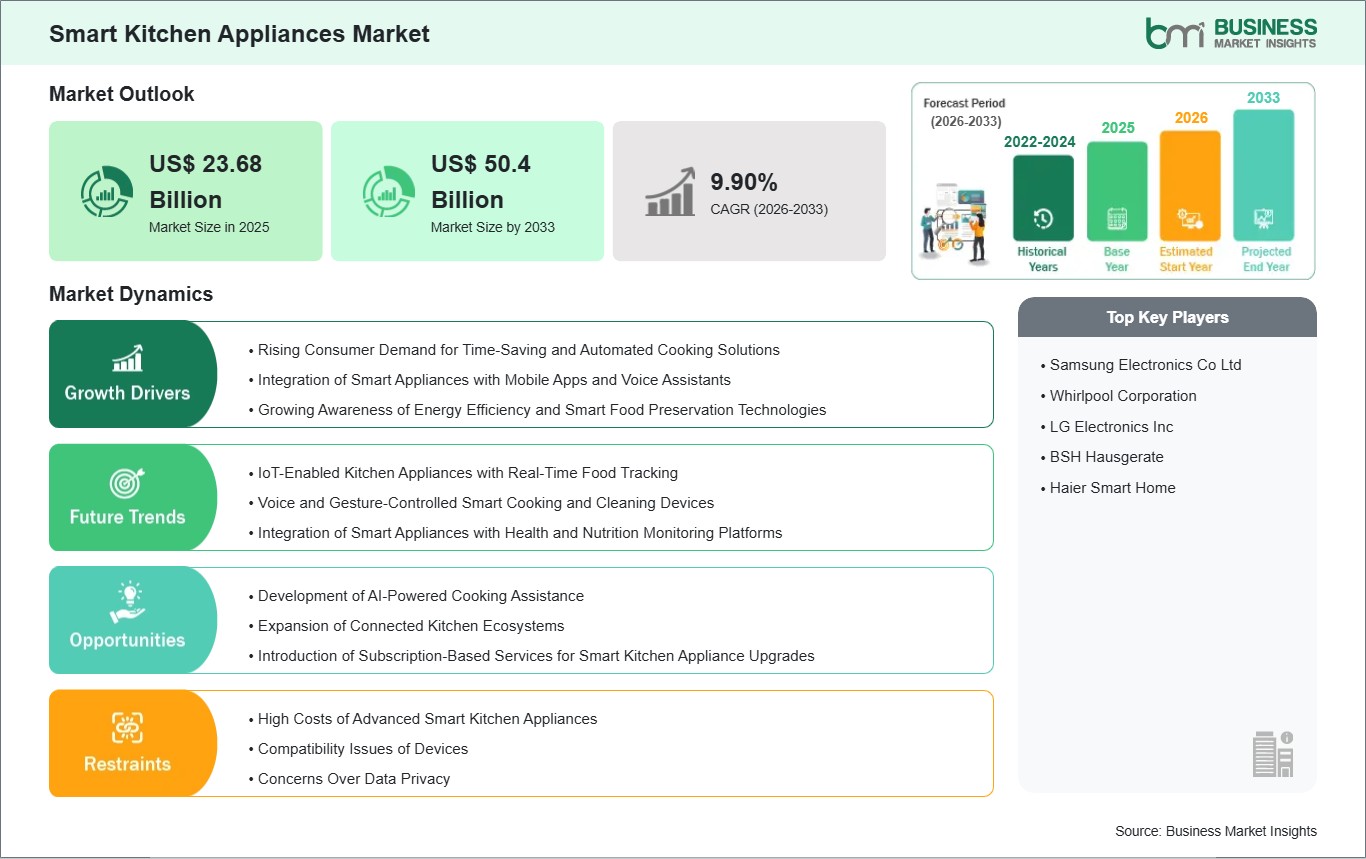
The global smart kitchen appliances market is revolutionizing the way people interact with their kitchens by providing an amalgamation of convenience, connectivity, and efficiency in their culinary experiences. Smart kitchen appliances include refrigerators, ovens, dishwashers, coffee makers, and cooktops that have incorporated features such as Wi-Fi connectivity, AI-powered cooking assistance, touch-screen interfaces, and remote monitoring capabilities to simplify cooking and kitchen management. Some of the key factors fueling the growth of the smart kitchen appliances market include the increasing interest in home automation, the need for time-saving solutions in daily life, and the focus on energy conservation. People are looking for kitchen appliances that can help them with recipe suggestions, food stock monitoring, cooking parameter adjustment, and remote monitoring. Data privacy, device interoperability across devices from different brands, as well as the cost of high-end smart devices, could be potential issues in the adoption of smart home devices, especially in developing countries.
However, innovations in user interface, such as apps, have made smart home devices more user-friendly and convenient for users. Smart appliances have moved beyond being merely convenient in that they are intelligent, adaptive, and have the potential to elevate the home experience while being in line with current living standards that value efficiency, inter-connectivity, and innovation in cooking and food preparation.
Segment Analysis
Smart Kitchen Appliances Market Segmentation
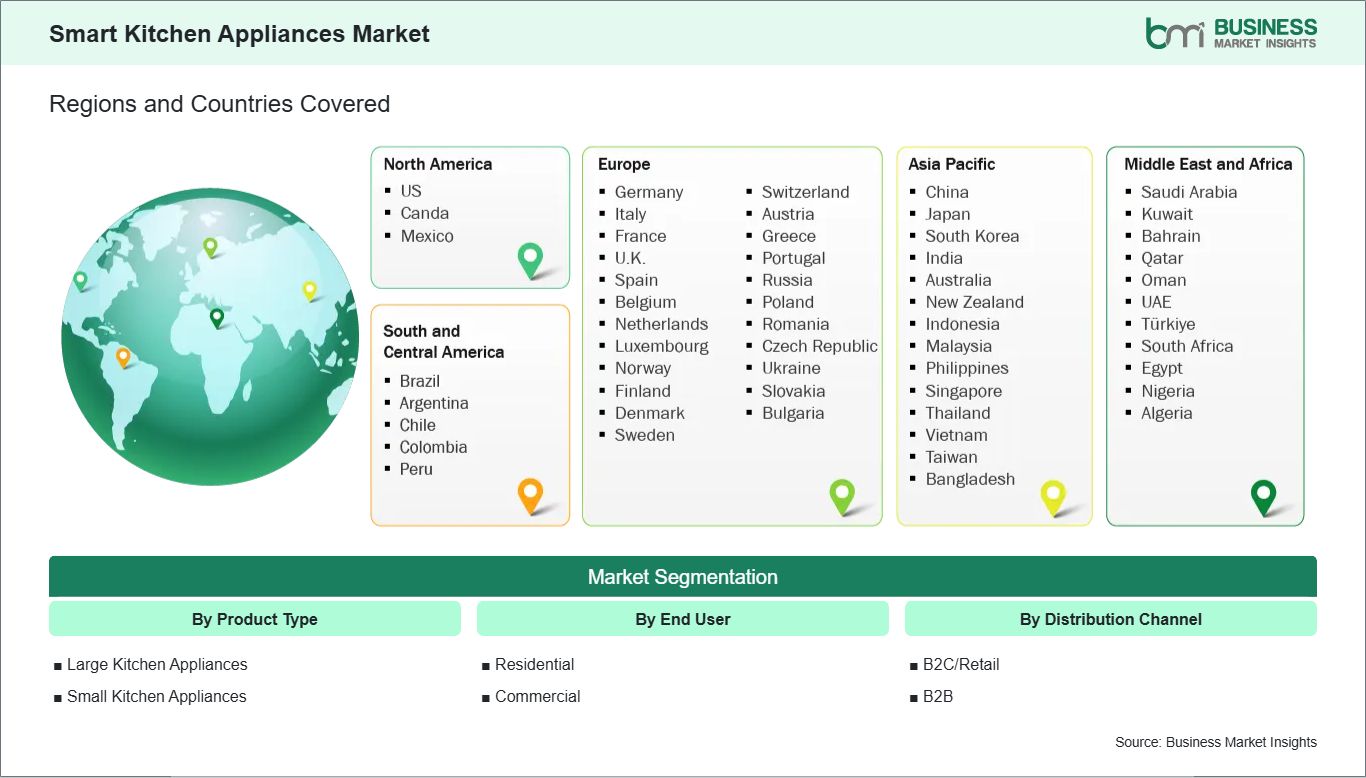
Key segments that contributed to the derivation of the smart kitchen appliances market analysis are product type, end user, and distribution channel.
- By product type, the smart kitchen appliances market is segmented into large kitchen appliances and small kitchen appliances. The large kitchen appliances subsegment dominated the market in 2025.
- Based on end user, the smart kitchen appliances market is classified into residential and commercial. The residential subsegment dominated the market in 2025.
- In terms of distribution channel, the smart kitchen appliances market is segmented into B2C/Retail and B2B. The B2C subsegment dominated the market in 2025.
Market Forces
Smart Kitchen Appliances Market Drivers and Opportunities
Rising Consumer Demand for Time‑Saving and Automated Cooking Solutions
Across the globe, consumers are seeking home appliances that help them save time and reduce the effort required for cooking. For instance, in the North American region, working professionals are seeking smart ovens and connected multicookers that allow consumers to program the cooking time in advance and start the cooking process with the help of a smartphone. This has helped transform the cooking area in the home from a time-consuming zone to a more relaxed area of living. In the European region, consumers are seeking smart home solutions for the kitchen area as they are able to save time by automating the cooking process. Consumers in the European region are seeking smart home solutions as they are able to save time and effort by automating the cooking process. Urban Europeans are seeking smart home solutions as they are able to enjoy healthy home-cooked meals despite the hectic schedule they follow.
Across Asia Pacific, rising urbanization and dual‑income households have contributed to demand for automated kitchen tools that blend technology with everyday cooking. In cities like Tokyo and Seoul, smart rice cookers, steam ovens and app‑linked dishwashers are popular because they reduce manual steps while integrating with digital lifestyle habits. These examples show how kitchen automation isn’t just about novelty it’s a practical response to evolving routines in households worldwide.
Development of AI‑Powered Cooking Assistance
However, artificial intelligence is increasingly playing a revolutionary role in smart kitchens by providing appliances with intelligent cooking advice and adaptive capabilities. For example, in Western Europe, smart kitchen appliances such as ovens use artificial intelligence and identify food types and cooking times accordingly. This intelligent advice from smart kitchen appliances increases user engagement with technology in day-to-day life.
In the Middle East and North Africa regions, which have a high tradition in cooking and cuisine but are increasingly embracing technology and innovation in day-to-day lives, artificial intelligence in smart kitchen appliances provides a unique opportunity to combine cooking traditions with innovation and technology in smart kitchen appliances. In this case, artificial intelligence in smart kitchen appliances will not only be a cooking companion but also a time-saver for users.
Meanwhile, in emerging markets across Latin America and Southeast Asia, AI‑driven kitchen appliances are appealing to younger generations who value connected lifestyles. Smart refrigerators that track inventory and suggest meals based on what’s available are gaining interest among millennials who balance busy schedules and a desire for home‑prepared food. This trend highlights how intelligent cooking assistance isn’t just about automation it’s about making kitchens more responsive, personalized and capable of adapting to diverse cooking habits around the globe.
Size and Share Analysis
Smart Kitchen Appliances Market Size and Share Analysis
The smart kitchen appliances market is experiencing steady growth, with market size and share analysis reflecting evolving treatment preferences and competitive dynamics among key players. The report evaluates important subsegments categorized within product type, end user, and distribution channel, highlighting their respective contributions to overall market performance.
By product type, the large kitchen appliances subsegment dominated the Smart Kitchen Appliances market in 2025. Large appliances such as smart refrigerators, ovens, and dishwashers are widely adopted for their connectivity, automation, and energy-efficiency features, which enhance convenience and kitchen productivity.
Based on end user, the residential subsegment dominated the Smart Kitchen Appliances market in 2025. Homeowners increasingly prefer smart kitchen solutions to simplify daily tasks, improve energy efficiency, and integrate with broader smart home ecosystems, driving strong demand.
In terms of distribution channel, the B2C/Retail subsegment dominated the Smart Kitchen Appliances market in 2025. Direct-to-consumer channels remain preferred as they allow customers to experience products firsthand, access promotions, and benefit from after-sales support, reinforcing their leading position in the market.
Report Coverage
Smart Kitchen Appliances Market Report Coverage and Deliverables
The "Smart Kitchen Appliances Market Size and Forecast (2022 - 2033)" report provides a detailed analysis of the market covering below areas:
- Smart Kitchen Appliances market size and forecast at global, regional, and country levels for all the key market segments covered under the scope
- Smart Kitchen Appliances market trends, as well as drivers, restraints, and opportunities
- Smart Kitchen Appliances market analysis covering key trends, regional framework, major players, regulations, and recent developments
- Industry landscape and competition analysis covering market concentration, heat map analysis, prominent players, and recent developments for the Smart Kitchen Appliances market
- Detailed company profiles, including SWOT analysis
Geographic Insights
Smart Kitchen Appliances Market Geographic Insights
The geographical scope of the Smart Kitchen Appliances market report is divided into five regions: North America, Asia Pacific, Europe, Middle East & Africa, and South & Central America. The Smart Kitchen Appliances market in North America is expected to grow during the forecast period.
North America dominates the smart kitchen appliances market, driven by high consumer awareness, technological infrastructure, and a culture of early adoption for connected home solutions. Households across the United States and Canada increasingly incorporate smart refrigerators that monitor groceries, ovens that adjust cooking times automatically, and coffee makers or dishwashers that can be controlled remotely via apps or voice assistants. Beyond convenience, energy efficiency, sustainability, and predictive maintenance are important motivators for adoption, as consumers look for ways to reduce waste and optimize appliance performance.
Many North American homes connect kitchen appliances with lighting, climate control, and home security systems, creating seamless experiences that combine comfort, safety, and energy management. Manufacturers in the region focus on intuitive user interfaces, AI-enabled recipe recommendations, and remote monitoring, allowing appliances to adapt to family routines and personal preferences.
Despite challenges such as cybersecurity threats, costs, and the need for training in using more sophisticated technologies, North America is leading the way in providing a benchmark for the world. This region is an example of how smart kitchen appliances have the power to revolutionize home living with regard to convenience, innovation, and sustainability.
Industry Activity
Recent Developments
The smart kitchen appliances market is evaluated by gathering qualitative and quantitative data post primary and secondary research, which includes important corporate publications, association data, and databases. A few of the key developments in the smart kitchen appliances market are:
- In January 2026, Bosch announced at CES 2026 that it had unveiled its new “Personal AI Barista” and Bosch Cook AI technologies, enhancing its 800 Series smart espresso machines and integrated kitchen appliance experience with Alexa Plus voice interaction and AI‑guided cooking assistance, aiming to improve natural language control and smart connectivity in the kitchen.
- In December 2025, Samsung announced that it would introduce Gemini AI integration into its Bespoke AI Refrigerator Family Hub at CES 2026, enabling advanced food recognition and organization features as part of its broader push to bring next‑generation AI functionality to smart kitchen appliances worldwide.
Trust & Transparency
Research Methodology
The market analysis combines proprietary research with secondary data from government agencies, company disclosures, regulatory filings, industry databases and expert interviews. Market estimates are validated through data triangulation, cross-market benchmarking and analyst
review.
View Full Research Methodology
Key Sources Referred:
International Electrotechnical Commission Institute of Electrical and Electronics Engineers International Organization for Standardization Bureau of Indian Standards Central Electricity Authority Ministry of Power Indian Electrical and Electronics Manufacturers' Association European Committee for Electrotechnical Standardization VDE Association for Electrical Electronic & Information Technologies Company Websites Company Annual Reports Company Investor Presentations